Thank you for visiting SNEWPapers!
Sign up free
Literary
October 6, 1790
Gazette Of The United States
New York, New York County, New York
What is this article about?
Continuation of historical discourse on French political crisis: King pressures Princes of Bourbon (Navarre, Condé) to attend States assembly at Orleans amid religious disputes and reform demands. They resist but yield to military threats, traveling from Bearn despite fears of subjugation.
Clipping
OCR Quality
95%
Excellent
Full Text
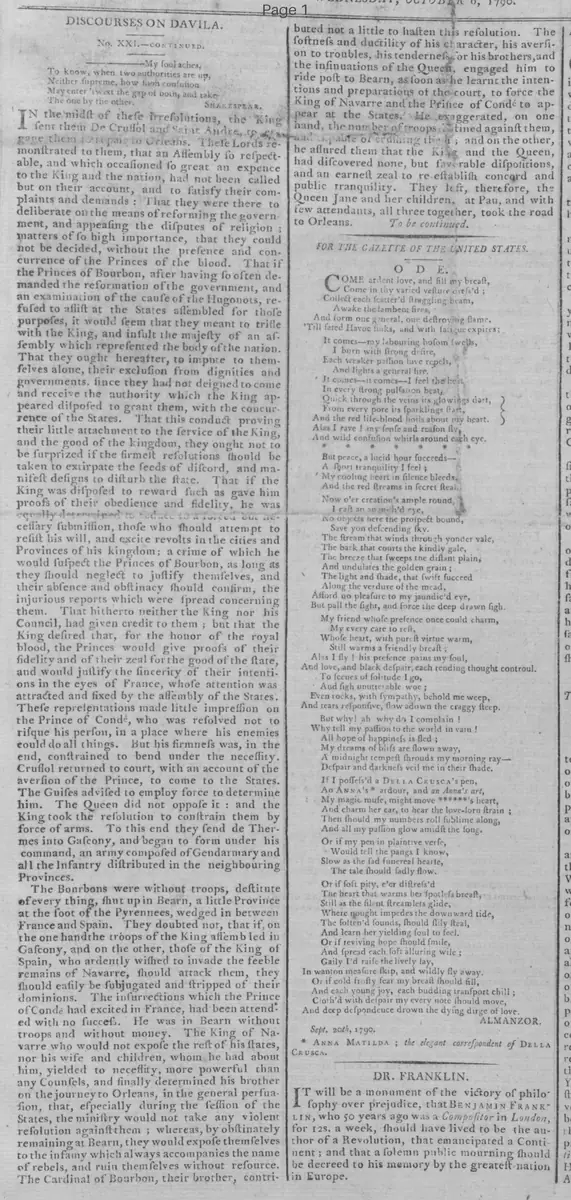
DISCOURSES ON DAVILA.
NO. XXI.-CONTINUED.
"My soul aches,
To know, when two authorities are up,
Neither supreme, how soon confusion
May enter 'twixt the gap of both and take
The one by the other."
SHAKESPEARE.
In the midst of these irresolutions, the King sent them De Crussol and D'Aiandre to gain them to go to Orleans. These Lords remonstrated to them, that an Assembly of respectable, and which occasioned so great an expense to the King and the nation, had not been called but on their account, and to satisfy their complaints and demands: That they were there to deliberate on the means of reforming the government, and appeasing the disputes of religion; matters of so high importance, that they could not be decided, without the presence and concurrence of the Princes of the blood. That if the Princes of Bourbon, after having so often demanded the reformation of the government, and an examination of the cause of the Hugonots, refused to assist at the States assembled for those purposes, it would seem that they meant to trifle with the King, and insult the majesty of an assembly which represented the body of the nation. That they ought hereafter, to impute to themselves alone, their exclusion from dignities and governments, since they had not deigned to come and receive the authority which the King appeared disposed to grant them, with the concurrence of the States. That this conduct proving their little attachment to the service of the King, and the good of the kingdom, they ought not to be surprised if the firmest resolutions should be taken to extirpate the seeds of discord, and manifest designs to disturb the state. That if the King was disposed to reward such as gave him proofs of their obedience and fidelity, he was certainly determined to destroy such necessary submission, those who should attempt to resist his will, and excite revolts in the cities and Provinces of his kingdom; a crime of which he would suspect the Princes of Bourbon, as long as they should neglect to justify themselves, and their absence and obstinacy should confirm, the injurious reports which were spread concerning them. That hitherto neither the King nor his Council, had given credit to them; but that the King desired that, for the honor of the royal blood, the Princes would give proofs of their fidelity and of their zeal for the good of the state, and would justify the sincerity of their intentions in the eyes of France, whose attention was attracted and fixed by the assembly of the States. These representations made little impression on the Prince of Conde, who was resolved not to risk his person, in a place where his enemies could do all things. But his firmness was, in the end, constrained to bend under the necessity. Crussol returned to court, with an account of the aversion of the Prince, to come to the States. The Guises advised to employ force to determine him. The Queen did not oppose it: and the King took the resolution to constrain them by force of arms. To this end they send de Thermes into Gascony, and began to form under his command, an army composed of Gendarmary and all the Infantry distributed in the neighbouring Provinces.
The Bourbons were without troops, destitute of every thing, shut up in Bearn, a little Province at the foot of the Pyrenees, wedged in between France and Spain. They doubted not, that if, on the one hand the troops of the King assembled in Gascony, and on the other, those of the King of Spain, who ardently wished to invade the feeble remains of Navarre, should attack them, they should easily be subjugated and stripped of their dominions. The insurrections which the Prince of Condé had excited in France, had been attended with no success. He was in Bearn without troops and without money. The King of Navarre who would not expose the rest of his states, nor his wife and children, whom he had about him, yielded to necessity, more powerful than any Counsels, and finally determined his brother on the journey to Orleans, in the general persuasion, that, especially during the session of the States, the ministry would not take any violent resolution against them; whereas, by obstinately remaining at Bearn, they would expose themselves to the infamy which always accompanies the name of rebels, and ruin themselves without resource. The Cardinal of Bourbon, their brother, contributed not a little to hasten this resolution.
The softness and ductility of his character, his aversion to troubles, his tenderness for his brothers, and the insinuations of the Queen, engaged him to write post to Bearn, as soon as he learnt the intentions and preparations of the court, to force the King of Navarre and the Prince of Condé to appear at the States. He exaggerated, on one hand, the number of troops raised against them, and the impossibility of resisting them; and on the other, he assured them that the King and the Queen, had discovered none, but favorable dispositions, and an earnest zeal to re-establish concord and public tranquility. They left, therefore, the Queen Jane and her children, at Pau, and with few attendants, all three together, took the road to Orleans.
To be continued.
NO. XXI.-CONTINUED.
"My soul aches,
To know, when two authorities are up,
Neither supreme, how soon confusion
May enter 'twixt the gap of both and take
The one by the other."
SHAKESPEARE.
In the midst of these irresolutions, the King sent them De Crussol and D'Aiandre to gain them to go to Orleans. These Lords remonstrated to them, that an Assembly of respectable, and which occasioned so great an expense to the King and the nation, had not been called but on their account, and to satisfy their complaints and demands: That they were there to deliberate on the means of reforming the government, and appeasing the disputes of religion; matters of so high importance, that they could not be decided, without the presence and concurrence of the Princes of the blood. That if the Princes of Bourbon, after having so often demanded the reformation of the government, and an examination of the cause of the Hugonots, refused to assist at the States assembled for those purposes, it would seem that they meant to trifle with the King, and insult the majesty of an assembly which represented the body of the nation. That they ought hereafter, to impute to themselves alone, their exclusion from dignities and governments, since they had not deigned to come and receive the authority which the King appeared disposed to grant them, with the concurrence of the States. That this conduct proving their little attachment to the service of the King, and the good of the kingdom, they ought not to be surprised if the firmest resolutions should be taken to extirpate the seeds of discord, and manifest designs to disturb the state. That if the King was disposed to reward such as gave him proofs of their obedience and fidelity, he was certainly determined to destroy such necessary submission, those who should attempt to resist his will, and excite revolts in the cities and Provinces of his kingdom; a crime of which he would suspect the Princes of Bourbon, as long as they should neglect to justify themselves, and their absence and obstinacy should confirm, the injurious reports which were spread concerning them. That hitherto neither the King nor his Council, had given credit to them; but that the King desired that, for the honor of the royal blood, the Princes would give proofs of their fidelity and of their zeal for the good of the state, and would justify the sincerity of their intentions in the eyes of France, whose attention was attracted and fixed by the assembly of the States. These representations made little impression on the Prince of Conde, who was resolved not to risk his person, in a place where his enemies could do all things. But his firmness was, in the end, constrained to bend under the necessity. Crussol returned to court, with an account of the aversion of the Prince, to come to the States. The Guises advised to employ force to determine him. The Queen did not oppose it: and the King took the resolution to constrain them by force of arms. To this end they send de Thermes into Gascony, and began to form under his command, an army composed of Gendarmary and all the Infantry distributed in the neighbouring Provinces.
The Bourbons were without troops, destitute of every thing, shut up in Bearn, a little Province at the foot of the Pyrenees, wedged in between France and Spain. They doubted not, that if, on the one hand the troops of the King assembled in Gascony, and on the other, those of the King of Spain, who ardently wished to invade the feeble remains of Navarre, should attack them, they should easily be subjugated and stripped of their dominions. The insurrections which the Prince of Condé had excited in France, had been attended with no success. He was in Bearn without troops and without money. The King of Navarre who would not expose the rest of his states, nor his wife and children, whom he had about him, yielded to necessity, more powerful than any Counsels, and finally determined his brother on the journey to Orleans, in the general persuasion, that, especially during the session of the States, the ministry would not take any violent resolution against them; whereas, by obstinately remaining at Bearn, they would expose themselves to the infamy which always accompanies the name of rebels, and ruin themselves without resource. The Cardinal of Bourbon, their brother, contributed not a little to hasten this resolution.
The softness and ductility of his character, his aversion to troubles, his tenderness for his brothers, and the insinuations of the Queen, engaged him to write post to Bearn, as soon as he learnt the intentions and preparations of the court, to force the King of Navarre and the Prince of Condé to appear at the States. He exaggerated, on one hand, the number of troops raised against them, and the impossibility of resisting them; and on the other, he assured them that the King and the Queen, had discovered none, but favorable dispositions, and an earnest zeal to re-establish concord and public tranquility. They left, therefore, the Queen Jane and her children, at Pau, and with few attendants, all three together, took the road to Orleans.
To be continued.
What sub-type of article is it?
Essay
What themes does it cover?
Political
Religious
Liberty Freedom
What keywords are associated?
French Politics
Princes Of Bourbon
States Assembly
Huguenots
Orleans
Bearn
Guises
Religious Disputes
Literary Details
Title
Discourses On Davila. No. Xxi. Continued.
Key Lines
"My Soul Aches,
To Know, When Two Authorities Are Up,
Neither Supreme, How Soon Confusion
May Enter 'Twixt The Gap Of Both And Take
The One By The Other."
Shakespeare.
That They Were There To Deliberate On The Means Of Reforming The Government, And Appeasing The Disputes Of Religion;
The King Took The Resolution To Constrain Them By Force Of Arms.
They Left, Therefore, The Queen Jane And Her Children, At Pau, And With Few Attendants, All Three Together, Took The Road To Orleans.