Thank you for visiting SNEWPapers!
Sign up free
Mississippi Palladium
Holly Springs, Marshall County, Mississippi
What is this article about?
American citizen John S. Thrasher arrested in Havana, Cuba, on Oct. 16, 1851, for alleged treason linked to island invasions. Denied fair trial and counsel, sentenced by Spanish court martial to 8 years hard labor in chains at Ceuta, Africa, plus costs. Shipped to Cadiz; appeals to US Gov't and Pres. Fillmore for release and justice.
Clipping
OCR Quality
Full Text
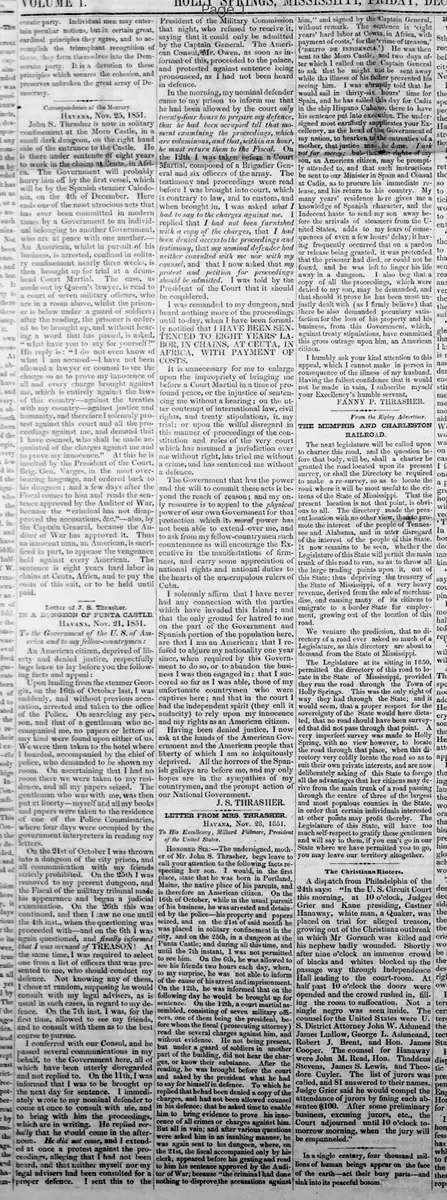
Havana, Nov. 25, 1851.
John S. Thrasher is now in solitary
confinement at the Moro Castle, in a
small dark dungeon, on the right hand
side of the entrance to the Castle. He
is there under sentence of eight years
to work in the chains at Ceuta, in Afri-
ca. The Government will probably
hurry him off by the first vessel, which
will be by the Spanish steamer Caledonia,
on the 4th of December. Here
ends one of the most atrocious acts that
has ever been committed in modern
times by a Government to an individ-
ual belonging to another Government,
who are at peace with one another.—
An American, whilst in pursuit of his
business, is arrested, confined in solita-
ry confinement nearly three weeks, is
then brought up for trial at a drum-
head Court Martial. The case, as
made out by the prisoner's lawyer, is read to
a court of seven military officers, who
are in a room above, whilst the prison-
er is below under a guard of soldiers;
after the reading, the prisoner is ordered
to be brought up, and without hearing
a word that has passed, is asked,
"What have you to say for yourself?"
His reply is: "I do not even know of
what I am accused—I have not been
allowed a lawyer or counsel to see the
charge so as to prove my innocence of
all and every charge brought against
me, which is entirely against the laws
of this country—against the treaties
with my country—against justice and
humanity, and therefore I solemnly pro-
test against this court and all the pro-
ceedings against me, and demand that
I have counsel, who shall be made ac-
quainted of the charges against me and
to prove my innocence." At this he is
insulted by the President of the Court,
Brig. Gen. Vargas, in the most over-
bearing language, and ordered back to
his dungeon: and a few days after the
Fiscal comes to him and reads the sen-
tence approved by the Auditor of War,
because the "criminal has not disap-
proved the accusations. &c."—also by
the Captain General, because the Au-
ditor of War has approved it. Thus
an innocent man, an American, is sacri-
ficed in part, to appease the vengeance
held against every American. The
sentence is eight years hard labor in
chains at Ceuta, Africa, and to pay the
costs of this suit, or to be held until
paid.
Letter of J. S. Thrasher.
IN A DUNGEON OF PUNTA CASTLE
Havana, Nov. 21, 1851.
To the Government of the U. S. of Am-
erica and to my fellow-countrymen:
An American citizen, deprived of lib-
erty and denied justice, respectfully
begs leave to lay before you the follow-
ing facts and appeal:
Upon landing from the steamer Geor-
gia, on the 16th of October last, I was
suddenly, and without previous accu-
sation, arrested and taken to the office
of the Police. On searching my per-
son, and that of a gentleman who ac-
companied me, no papers or letters of
any kind were found upon either of us.
We were then taken to the hotel where
I boarded, accompanied by the chief of
police, who demanded to be shown my
room. On ascertaining that I had no
room there we were taken to my resi-
dence, and all my papers seized. The
gentleman who was with me, was then
put at liberty—myself and all my books
and papers were taken to the residence
of one of the Police Commissaries,
where four days were occupied by the
government interpreters in reading my
letters.
On the 21st of October I was thrown
into a dungeon of the city prison, and
all communication with my friends
strictly prohibited. On the 25th I was
removed to my present dungeon, and
the Fiscal of the military tribunal made
his appearance and began a judicial
examination. On the 26th this was
continued, and then I saw no one until
the 4th inst., when the questioning was
proceeded with—and on the 6th I was
again questioned, and finally informed
that I was accused of TREASON! At
the same time, I was required to select
one from a list of officers that was pre-
sented to me, who should conduct my
defence. Not knowing any of them,
I chose at random, supposing he would
consult with my legal advisers, as is
usual in such cases, in regard to my de-
fence. On the 7th inst. I was, for the
first time, allowed to see my friends,
and to consult with them as to the best
course to pursue.
I conferred with our Consul, and he
passed several communications in my
behalf, to the Government here, all of
which have been utterly disregarded
and not replied to. On the 11th, I was
informed that I was to be brought up
the next day for sentence. I immedi-
ately wrote to my nominal defender to
come at once to consult with me, and
to bring with him the proceedings,
which are in writing. He replied ver-
bally that he would come in the after-
noon. He did not come, and I extend-
ed at once a protest against the pro-
ceedings, alleging that I had not been
heard, and that neither myself nor my
legal advisers had been consulted for a
proper defence. I sent this to the
President of the Military Commission
that night, who refused to receive it,
saying that it could only be admitted
by the Captain General. The Ameri-
can Consul, Mr. Owen, as soon as in-
formed of this, proceeded to the palace,
and protested against sentence being
pronounced, as I had not been heard
in defence.
In the morning, my nominal defender
came to my prison to inform me that
he had been allowed by the court only
twenty-four hours to prepare my defence,
that he had been occupied till that mo-
ment examining the proceedings, which
are voluminous, and that, within an hour,
he must return them to the Fiscal. On
the 12th I was taken before a Court
Martial, composed of a Brigadier Gen-
eral and six officers of the army. The
testimony and proceedings were read
before I was brought into court, which
is contrary to law, and to custom, and
when brought in, I was asked what I
had to say to the charges against me. I
replied that I had not been furnished
with a copy of the charges, that I had
been denied access to the proceedings and
testimony, that my nominal defender had
neither consulted with me nor with my
counsel, and that I now asked that my
protest and petition for proceedings
should be admitted. I was told by the
President of the Court that it should
be considered.
I was remanded to my dungeon, and
heard nothing more of the proceedings
until to-day, when I have been formal-
ly notified that I HAVE BEEN SEN-
TENCED TO EIGHT YEARS' LA-
BOR IN CHAINS AT CEUTA IN
AFRICA, WITH PAYMENT OF
COSTS.
It is unnecessary for me to enlarge
upon the impropriety of bringing me
before a Court Martial in a time of pro-
found peace, or the injustice of senten-
cing me without a hearing; on the ut-
ter contempt of international law, civil
rights, and treaty stipulations, in my
trial: or upon the wilful disregard in
this manner of proceedings of the con-
stitution and rules of the very court
which has assumed a jurisdiction over
me without right, has tried me without
a crime, and has sentenced me without
a defence.
The Government that has the power
and the will to commit these acts is be-
yond the reach of reason: and my only resource is to appeal to the physical
power of our own Government for that
protection which its moral power has
not been able to extend over me, and
to ask from my fellow-countrymen such
countenance as will encourage the Ex-
ecutive in the manifestations of firm-
ness, and carry some appreciation of
national rights and national duties to
the hearts of the unscrupulous rulers of
Cuba.
I solemnly affirm that I have never
had any connection with the parties
which have invaded this Island: and
that the only ground for hatred to me
on the part of the Government and
Spanish portion of the population here,
are that I am an American; that I re-
fused to abjure my nationality one year
since, when required by this Govern-
ment to do so, or to abandon the busi-
ness I was then engaged in; that I suc-
ceeded so far as I was able, those of my
unfortunate countrymen who were
captives here; and that in the court I
had the independent spirit (they call it
audacity) to rely upon my innocence
and my rights as an American citizen.
Having been denied justice, I now
ask at the hands of the American Gov-
errnment and the American people that
liberty of which I am so iniquitously
deprized. All the horrors of the Span-
ish galleys are before me, and my only
hopes are in the sympathies of my
countrymen, and the prompt action of
our National Government.
J. S. THRASHER.
LETTER FROM MRS. THRASHER,
Havana, Nov. 28, 1851.
To His Excellency, Millard Fillmore, President
of the United States.
Honored SIR:—The undersigned, moth-
er of Mr. John S. Thrasher, begs leave to
call your attention to the following facts re-
specting her son. I would, in the first
place, state that he was born in Portland,
Maine, the native place of his parents, and
is therefore an American citizen. On the
16th of October, while in the usual pursuit
of his business, he was arrested and detain-
ed by the police—his property and papers
seized, and on the 21st of said month he
was placed in solitary confinement in the
city, and on the 25th, in a dungeon at the
Punta Castle; and during all this time, and
until the 7th instant, I was not permitted
to see him. On the 6th, he was allowed to
see his friends two hours each day, when,
to my surprise, he was not able to inform
of the cause of his arrest and imprisonment.
On the 12th, he was informed that on the
following day he would be brought up for
sentence. On the 12th, a court martial as-
sembled, consisting of seven military offi-
cers, one of them being the president, be-
fore whom the fiscal (prosecuting attorney)
read the several charges against him, and
without evidence. He not being present,
but under a guard of soldiers in another
part of the building, did not hear the char-
ges, or know their substance. After the
reading, he was brought before the court
and asked by the president what he had
to say for himself in defence. To which he
replied that he had been denied a copy of the
charges, and had not been allowed counsel
in his defence; that he asked time to enable
him to bring evidence to prove his inno-
cence of all crimes or charges against him.
But all in vain; and after various questions
were asked him in an insulting manner, he
was again sent to his dungeon, where, on
the 21st, the fiscal accompanied only by his
clerk, appeared before his grating and read
to him his sentence approved by the Audi-
tor of War; because "the criminal had done
nothing to disprove the accusations against
him," and signed by the Captain General
without remark. The sentence is eight
years' hard labor at Ceuta, in Africa, with
payment of costs, for the crime of treason,
('DELITO DE INFIDENCIA.') He was then
sent to the Moro Castle, and two days af-
ter which I called on the Captain General
to ask that he might not be sent away
while the illness of his father prevented his
seeing him. I was abruptly told that he
would sail in thirty-six hours' time for
Spain, and he has sailed this day for Cadiz
in the ship Hispano Cubano, there to have
his sentence put into execution. The under-
signed most earnestly supplicates your Ex-
cellency, as the head of the Government of
my nation, to hearken to the entreaties of a
mother, that justice may be done. I ask
not for mercy; but that the rights of my
son, an American citizen, may be prompt-
ly attended to, and that such instructions
be sent to our Minister in Spain and Consul
at Cadiz, as to procure his immediate re-
lease, and his return to his country. My
many years' residence here gives me a
knowledge of Spanish character, and the
indecent haste to send my son away be-
fore the arrivals of steamers from the U.
nited States, adds to my fears of conse-
quences of even a few hours' delay; it hav-
ing frequently occurred that on a pardon
or release being granted, it was pretended
that the prisoner had died, or could not be
found, and he was left to linger his life
away in a dungeon. I also beg that a
copy of all the proceedings, which were
denied to my son, may be demanded, and
that should it prove he has been most un-
justly dealt with (as I firmly believe that
there be also demanded pecuniary satis-
faction for the loss of his property and his
business, from this Government, which,
against treaty stipulations, have committed
this gross outrage upon him, an American
citizen.
I humbly ask your kind attention to this
appeal, which I cannot make in person in
consequence of the illness of my husband.
Having the fullest confidence that it would
not be made in vain, I subscribe myself
your Excellency's humble servant.
FANNY P. THRASHER
What sub-type of article is it?
What keywords are associated?
What entities or persons were involved?
Where did it happen?
Foreign News Details
Primary Location
Havana, Cuba
Event Date
October November 1851
Key Persons
Outcome
sentenced to eight years' hard labor in chains at ceuta, africa, and to pay costs of the suit; shipped to cadiz on the hispano cubano.
Event Details
John S. Thrasher, an American citizen, was arrested in Havana on October 16, 1851, without accusation, his papers seized. Confined in solitary in city prison then Punta Castle dungeon. Accused of treason without access to charges or proper counsel. Tried by drumhead court martial of seven officers presided by Brig. Gen. Vargas; proceedings read in his absence, denied defense. Sentence approved by Auditor of War and Captain General. Thrasher and mother appeal to US Government and President Fillmore for intervention, citing treaty violations and injustice.