Thank you for visiting SNEWPapers!
Sign up free
The Virginia Gazette
Richmond, Williamsburg, Richmond County, Virginia
What is this article about?
In colonial Virginia, a 'Country Gentleman' defends proposals for an American Episcopate against a 'Real Layman''s criticisms. He argues for a bishop limited to governing Anglican clergy without civil powers or expense to the colony, advocates securing dissenters' privileges by law, and critiques reliance on the General Court for ecclesiastical authority to prevent future tyranny.
Merged-components note: Continuation of the same letter to the editor across pages.
Clippings
1 of 2
OCR Quality
Full Text
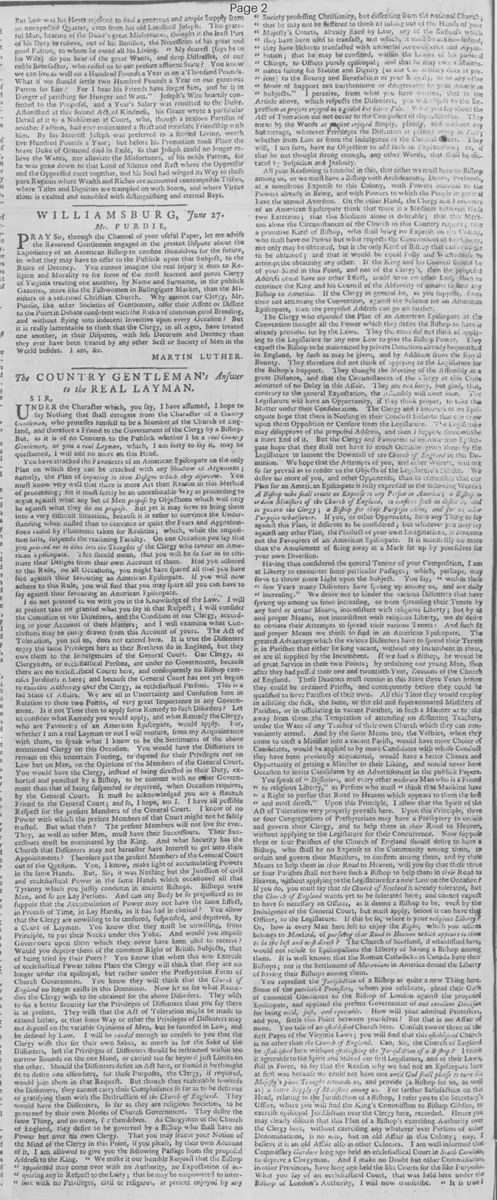
SIR,
UNDER the Character which, you say, I have assumed, I hope to say Nothing that shall derogate from the Character of a Country Gentleman, who professes himself to be a Member of the Church of England, and therefore a Friend to the Government of the Clergy by a Bishop.
But, as it is of no Concern to the Publick whether I be a real Country Gentleman, or you a real Layman, which, I am sorry to say it, may be questioned, I will add no more on this Head.
You have attacked the Favourers of an American Episcopate on the only Plan on which they can be attacked with any Shadow of Argument; namely, the Plan of imputing to them Designs which they disavow. You must know very well that there is more Art than Reason in this Method of proceeding; for it must surely be an unreasonable Way of proceeding to argue against what any Set of Men propose by Objections which will only lie against what they do not propose. But yet it may serve to bring them into a very difficult Situation, because it is easier to convince the Understanding when misled than to convince or quiet the Fears and Apprehensions raised by Phantoms taken for Realities; which, while the Imposition lasts, suspends the reasoning Faculty. On one Occasion you say that you pretend not to dive into the Thoughts of the Clergy who favour an American Episcopate. This should mean, that you will be so fair as to estimate their Designs from their own Account of them. Had you adhered to this Rule, on all Occasions, you might have spared all that you have said against their favouring an American Episcopate. If you will now adhere to this Rule, you will find that you may spare all you can have to say against their favouring an American Episcopate.
I do not pretend to vie with you in the Knowledge of the Law. I will at present take for granted what you say in that Respect; I will consider the Condition of our Dissenters, and the Condition of our Clergy, according to your Account of these Matters; and I will examine what Conclusions may be fairly drawn from this Account of yours. The Act of Toleration, you tell us, does not extend here. It is true the Dissenters enjoy the same Privileges here as their Brethren do in England, but they owe them to the Indulgencies of the General Court. Our Clergy, as Clergymen, or ecclesiastical Persons, are under no Government, because there are no ecclesiastical Courts here, and consequently no Bishop exercises Jurisdiction here; and because the General Court has not yet begun to exercise Authority over the Clergy, as ecclesiastical Persons. This is a sad State of Affairs. We are all in Uncertainty and Confusion here in Relation to these two Points, of very great Importance in any Government. Is it not Time then to apply some Remedy to such Disorders? Let us consider what Remedy you would apply, and what Remedy the Clergy, who are Favourers of an American Episcopate, would apply. For, whether I am a real Layman or not I will venture, from my Acquaintance with them, to speak what I know to be the Sentiments of the above mentioned Clergy on this Occasion. You would have the Dissenters to remain on this uncertain Footing, to depend for their Privileges not on Law but on Men, on the Opinions of the Members of the General Court. You would have the Clergy, instead of being directed in their Duty, exhorted and punished by a Bishop, to be content with no other Government than that of being suspended or deprived, when Occasion requires, by the General Court. It must be acknowledged you are a staunch Friend to the General Court; and so, I hope, am I. I have all possible Respect for the present Members of the General Court. I know of no Power with which the present Members of that Court might not be safely trusted. But what then? The present Members will not live for ever. They, as well as other Men, must have their Successors. Their Successors must be nominated by the King. And what Security has the Church that Dissenters may not hereafter have Interest to get into these Appointments? Therefore put the present Members of the General Court out of the Question. You, I know, make light of accumulating Powers in the same Hands. But, Sir, it was Nothing but the Junction of civil and ecclesiastical Power in the same Hands which occasioned all that Tyranny which you justly condemn in ancient Bishops. Bishops were Men, and so are Lay Persons. And can any Body be so prejudiced as to suppose that the Accumulation of Power may not have the same Effect, in Process of Time, in Lay Hands, as it has had in clerical? You allow that the Clergy are unwilling to be censured, suspended, and deprived, by a Court of Laymen. You know that they must be unwilling, from Principle, to put their Necks under this Yoke. And would you impose Governours upon them which they never have been used to receive? Would you deprive them of the common Right of British Subjects, that of being tried by their Peers? You know that when this new Exercise of ecclesiastical Power takes Place the Clergy will think that they are no longer under the episcopal, but rather under the Presbyterian Form of Church Government. You know they will think that the Church of England no longer exists in this Dominion. Now let us see what Remedies the Clergy wish to see obtained for the above Disorders. They wish to see a better Security for the Privileges of Dissenters than you say there is at present. They wish that the Act of Toleration might be made to extend hither, or that some Way or other the Privileges of Dissenters may not depend on the variable Opinions of Men, but be founded in Law, and be defined by Law. I will be candid enough to confess to you that the Clergy wish this for their own Sakes, as much as for the Sake of the Dissenters, lest the Privileges of Dissenters Should be restrained within too narrow Bounds on the one Hand, or carried too far beyond just Limits on the other. Should the Dissenters desire an Act here, or should it be thought fit to desire one elsewhere, for these Purposes, the Clergy, if required, would join them in that Request. But though thus reasonable towards the Dissenters, they cannot carry their Complaisance so far as to be desirous of gratifying them with the Destruction of the Church of England. They would have the Dissenters, so far as they are religious Societies, to be governed by their own Modes of Church Government. They desire the same Thing, and no more, for themselves. As Clergymen of the Church of England, they desire to be governed by a Bishop who shall have no Power but over his own Clergy. That you may frame your Notion of the Mind of the Clergy in this Point, if you please, by their own Account of it, I am allowed to give you the following Passage from the proposed Address to the King. "We make it our humble Request that the Bishop appointed may come over with no Authority, no Expectation of acquiring any in Respect to the Laity; that he may be empowered to interfere with no Privileges, civil or religious, at present enjoyed by any "Society professing Christianity, but dissenting from the national Church "that he may not be suffered to think of taking out of the Hands of your "Majesty's Courts, already fixed by Law, any of the Business which "they have been used to transact, and which, it must be acknowledged, "they have hitherto transacted with universal acquiescence and Approbation; that he may be confined, within the Limits of his pastoral "Charge, to Offices purely episcopal; and that he may owe his Maintenance suiting his Station and Dignity (as our Commissary does at present) to the Bounty and Benefaction of your Majesty, or to any other "Mode of Support not burthensome or disagreeable to your American "Subjects." I perceive, from what you have written, that in the Article above, which respects the Dissenters, you will object to the Expression at present enjoyed as a gilded but bitter Pill. What you say about the Act of Toleration did not occur to the Composers of the Addresses. They mean by the Words at present enjoyed simply, plainly, and without any Subterfuge, whatever Privileges the Dissenters at present enjoy here; whether from Law or from the Indulgence of the General Court. They will, I am sure, have no Objection to add such an Explanation; or, if that be not thought strong enough, any other Words, that shall be dictated to Suspicion and Jealousy.
All your Reasoning is founded in this, that either we must have no Bishop among us, or we must have a Bishop with Archdeacons, Deans, Prebends, at a monstrous Expence to this Colony, with Powers inimical to the Powers already in Being, and with Powers to which the People in general have the utmost Aversion. On the other Hand, the Clergy and Lay Favourers of an American Episcopate think that there is a Medium between these two Extremes; that this Medium alone is desirable; that this Medium alone the Circumstances of the Church in this Country require; that a primitive Kind of Bishop, who shall bring no Expence on the Colony, who shall have no Power but what respects the Government of the Clergy, not only may be obtained, but is the only Kind of Bishop that can be brought to be obtained; and that it would be equal Folly and Wickedness to attempt the obtaining any other. If the King and his Council would be of your Mind in this Point, and not of the Clergy's, then the proposed Address could have no other Effect, could serve no other End, than to convince the King and his Council of the Absurdity of aiming to send any Bishop to America. If the Clergy in general be, as you suppose, from their not attending the Convention, against the Scheme for an American Episcopate, then the proposed Address can go no farther.
The Clergy who espoused the Plan of an American Episcopate at the Convention thought all the Power which they desire the Bishop to have is already provided for by the Laws. They therefore did not think of applying to the Legislature for any new Law to give the Bishop Power. They expect the Bishop to be maintained by private Donations already bequeathed in England, by such as may be given, and by Addition from the Royal Bounty. They therefore did not think of applying to the Legislature for the Bishop's Support. They thought the Meeting of the Assembly at a great Distance, and that the Circumstances of the Clergy at this Crisis admitted of no Delay in this Affair. They are not sorry, but glad, that, contrary to the general Expectation, the Assembly will meet soon. The Legislature will have an Opportunity, if they think proper, to take this Matter under their Consideration. The Clergy and Favourers of an Episcopate hope that there is Nothing in their Conduct hitherto that can draw upon them Opposition or Censure from the Legislature. The Legislature may disapprove of the proposed Address, and then I suppose there will be a short End of it. But the Clergy and Favourers of an American Episcopate hope that they shall not have so much Occasion given them by the Legislature to lament the Downfall of the Church of England in this Dominion. We hope that the Attempts of you, and other Writers, will not so far prevail as to render us the Objects of the Legislature's Dislike. We desire no more of you, and other Opponents, than to remember that our Plan for an American Episcopate is fully expressed in the following Words: A Bishop who shall create no Expence to any Person in America; a Bishop to ordain Ministers of the Church of England, to confirm such as desire, and to govern the Clergy; a Bishop for these Purposes alone, and for no civil Purposes whatsoever. If you, or other Opponents, have any Thing to say against this Plan, it deserves to be considered; but whatever you may say against any other Plan, the Product of your own Imaginations, it concerns not the Favourers of an American Episcopate. It is manifestly no more than the Amusement of firing away at a Mark set up by yourselves for your own Diversion.
Having thus considered the general Tenour of your Composition, I am at Liberty to encounter some particular Passages; which, perhaps, may serve to throw more Light upon the Subject. You say, "within these few Years many Dissenters have sprung up among us, and are daily increasing." We desire not to hinder the various Dissenters that have sprung up among us from increasing, or from spreading their Tenets by any hard or unfair Means, inconsistent with religious Liberty; but by fit and proper Means, not inconsistent with religious Liberty, we do desire to obviate their Attempts to spread their various Tenets: And such fit and proper Means we think to find in an American Episcopate. The greatest Advantage which the various Dissenters have to spread their Tenets is in Parishes that either lie long vacant, without any Incumbent in them, or are ill supplied by the Incumbent. If we had a Bishop, he would be of great Service in these two Points; by ordaining our young Men, soon after they had passed their one and twentieth Year, Deacons of the Church of England. These Deacons must remain in this State three Years before they could be ordained Priests, and consequently before they could be qualified to serve Parishes of their own. All this Time they would employ in assisting the sick, the lame, or the old and superannuated Ministers of Parishes, or in officiating in vacant Parishes, in such a Manner as to take away from them the Temptation of attending on dissenting Teachers, under the Want of any Teacher of their own Church which they can conveniently attend. And by the same Means too, the Vestries, when they come to elect a Minister into a vacant Parish, would have more Choice of Candidates, would be applied to by more Candidates with whose Conduct they have been previously acquainted, would have a better Chance and Opportunity of getting a Minister to their Liking, and would never have Occasion to invite Candidates by an Advertisement in the publick Papers.
You speak of "Dissenters, and every other moderate Man who is a Friend to religious Liberty," as Persons who must "think that Mankind have a Right to pursue that Road to Heaven which appears to them the best and most direct." Upon this Principle, I allow that the Spirit of the Act of Toleration very properly prevails here. Upon this Principle, three or four Congregations of Presbyterians may have a Presbytery to ordain and govern their Clergy, and to help them in their Road to Heaven, without applying to the Legislature for their Concurrence. Now suppose three or four Parishes of the Church of England should desire to have a Bishop, who shall be no Expence to the Community among them, to ordain and govern their Ministers, to confirm among them, and by these Means to help them in their Road to Heaven, will you say that these three or four Parishes shall not have such a Bishop to help them in their Road to Heaven, without applying to the Legislature for a new Law on the Occasion? If you do, you must say that the Church of Scotland is already tolerated, but the Church of England wants yet to be tolerated here; and cannot expect to have so necessary an Officer, as it deems a Bishop to be, even by the Indulgence of the General Court, but must apply, before it can have that Officer, to the Legislature. If this be so, where is your religious Liberty? Or, how is every Man here left to enjoy the Right, which you affirm belongs to Mankind, of pursuing that Road to Heaven which appears to them to be the best and most direct? The Church of Scotland, if established here, would not refuse to Episcopalians the Liberty of having a Bishop among them. It is well known that the Roman Catholicks in Canada have their Bishops; nor is the Settlement of Moravians in America denied the Liberty of having their Bishops among them.
You represent the Jurisdiction of a Bishop as quite a new Thing here. Some of the patriotic Protesters, whom you celebrate, plead their Oath of canonical Obedience to the Bishop of London against the proposed Episcopate, and applaud the present Government of our excellent Diocesan for being mild, just, and equitable. How will your admired Protesters, and you, settle this Point between yourselves? But that is no Affair of mine. You talk of an established Church here. Consult two or three of the first Pages of the Virginia Laws; you will find that this established Church is no other than the Church of England. Can, Sir, the Church of England be established here without establishing the Jurisdiction of a Bishop? I think it agreeable to the Spirit and Stile of our first Legislators, and of their Laws, still in Force, to say that the Reason why we had not an Episcopate here at first was because we could not have one until God shall please to turn his Majesty's pious Thoughts towards us, and provide (a Bishop for us, as well as) a better Supply of Ministers among us. For farther Satisfaction on this Head, relating to the Jurisdiction of a Bishop, I refer you to the Secretary's Office, where you will find the King's Commission to Bishop Gibson, to exercise episcopal Jurisdiction over the Clergy here, recorded. Hence you may clearly discern that this Plan of a Bishop's exercising Authority over the Clergy here, without exercising any whatever over Persons of other Denominations, is no new, but an old Affair in this Colony; nay, I believe it is an old Affair also in other Colonies. I am well informed that Commissary Gardner long ago held an ecclesiastical Court in South Carolina, to deprive a Clergyman. And I make no Doubt but other Commissaries, in other Provinces, have long ago held the like Courts for the like Purposes.
What you say of an ecclesiastical Court, that was held here under the Bishop of London's Authority, I will now transcribe. "It is true I
Remember some Years ago a Farce was acted in a Corner, by a Company and two Reverend Assessors, as the Gentleman dignifies them, about a Clergyman; but when the Catastrophe was expected, their Reverences discovered they had acted without Authority, and sneaked from their Corner, to the great Diversion of the Auditory. This, it must be allowed, is a very humorous Account of an ecclesiastical Court. But what does the humorous Account amount to, more than this, that an ecclesiastical Court has been held here, of which you were a Witness; that this Court consisted of Clergymen; that these Clergymen met without any of that Pomp and Apparatus which you seem so much to dread from an ecclesiastical Court in other Parts of your Letter; that they were a Subject of Ridicule to the Lay Part of the Auditory; and that they proceeded with so harmless a Lenity as to occasion you from hence to dispute the Existence of the Court? With Respect to the Court's breaking up without proceeding to Sentence, it was caused, I am told, by the Compromise of the Parties, and not by the Court's Consciousness of acting without Authority. Such Courts as these, though of a little more Resolution, perhaps, with Regard to Offenders among the Clergy, we desire to see again; Courts consisting of Clergymen to censure, suspend, and deprive Clergymen; Courts that meet without any exceptionable Pomp; Courts that may safely be laughed at and ridiculed by any Persons, except the Clergy, whenever those Persons are disposed to throw aside the Restraint of Decency; and Courts that shall have no Existence respecting any besides the Clergy.
As to what you say on the Topick of Dedication, or Consecration of Churches, I am, perhaps, not so hard to please on this Head as you may imagine. Observe, this was not a Reason for an American Episcopate brought by me, but by my Opponent, that he might divert himself with shooting down a Mark of his own setting up. This Reason is not dignified with any Mention in our Plan of an American Episcopate. You allow that Persons, in certain Circumstances, may be indulged with the Consecration of a Church. This is all that I want you to allow; except it be this, that since the King cannot be expected to be brought over hither, on such an Errand, the Business may be done by Zadok, as the next proper Officer; or, if he will not come, by some Officer inferior to him. If you will be so kind as to allow this, I will allow you, on the other Hand, that the consecrating Person, whoever he be, ought to manage this Affair after a quite different Manner from that in which Laud proceeded on the Like Occasion, or else he had better let the Business alone altogether.
I do not find that there is much Difference between you and me concerning the Dispute that subsists about the General Court. It seems I have said that this Dispute is whether the General Court had not better take upon them the Exercise of ecclesiastical Authority than leave it altogether unexercised. You say the Dispute is whether the Law establishing the General Court gives that Court Jurisdiction in ecclesiastical as well as civil Causes or not. Certainly this latter Dispute, if I do not greatly mistake, includes the former. This, I think, must appear, to every One, to be the Case, who considers that the sole End of the Dispute is whether the General Court are now to begin, or not, to punish a Clergyman, as an ecclesiastical Person, by Censure, Suspension, and Deprivation.
Before I conclude, permit me to take Notice that I harbour no ill Will against you; and that I have no mean Opinion either of your Knowledge of the Law, or of your Talents for writing. But I can admire your Abilities through the Mist of your Prejudices; yet, without Rapture, and without suffering myself to be involved in the Mist of your Prejudices. You conclude with a Prayer no less just than warm, though I think not general enough. Indulge me with the Liberty of amending it, after the following Manner. Good Lord, of thy infinite Mercy, we beseech thee to save and protect the American Colonies from all Tyranny, civil as well as ecclesiastical, temporal as well as spiritual, and also from the direful Effects of Confusion and Anarchy. To this Prayer, thus amended, let all the People pronounce, as I most heartily do, AMEN.
What sub-type of article is it?
What themes does it cover?
What keywords are associated?
What entities or persons were involved?
Letter to Editor Details
Author
The Country Gentleman
Recipient
Sir
Main Argument
the proposal for an american episcopate seeks a bishop limited to ordaining, confirming, and governing anglican clergy without civil powers, expense to the colony, or interference in dissenters' privileges, which should be secured by law rather than depending on the general court's indulgence, to avoid lay tyranny over the church.
Notable Details