Thank you for visiting SNEWPapers!
Sign up free
Letter to Editor
May 10, 1823
Alexandria Gazette & Advertiser
Alexandria, Virginia
What is this article about?
A letter to the editor quotes Governor Thomas Bolling Robertson's message to the Louisiana legislature advocating the abolition of imprisonment for debt, arguing it is unconstitutional, a violation of contracts, and tyrannical. It references Col. Richard M. Johnson's supportive speech in the U.S. Senate.
Clipping
OCR Quality
95%
Excellent
Full Text
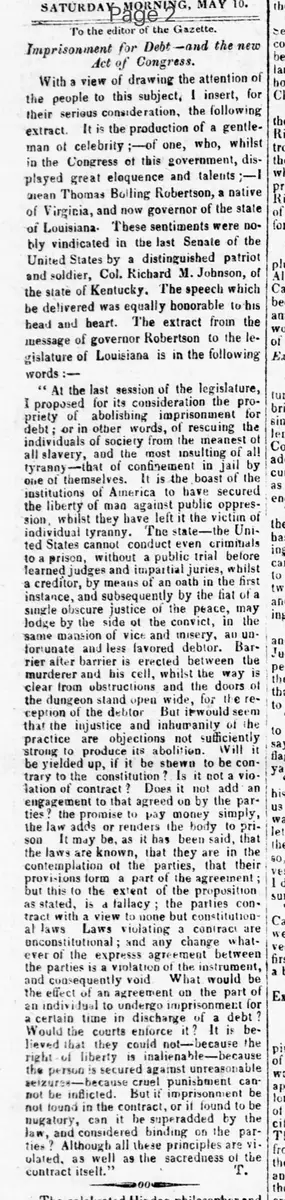
To the editor of the Gazette.
Imprisonment for Debt--and the new
Act of Congress.
With a view of drawing the attention of
the people to this subject, I insert, for
their serious consideration, the following
extract. It is the production of a gentle-
man of celebrity; of one, who, whilst
in the Congress of this government, dis-
played great eloquence and talents;--I
mean Thomas Bolling Robertson, a native
of Virginia, and now governor of the state
of Louisiana. These sentiments were no-
bly vindicated in the last Senate of the
United States by a distinguished patriot
and soldier, Col. Richard M. Johnson, of
the state of Kentucky. The speech which
he delivered was equally honorable to his
head and heart. The extract from the
message of governor Robertson to the le-
gislature of Louisiana is in the following
words:--
"At the last session of the legislature,
I proposed for its consideration the pro-
priety of abolishing imprisonment for
debt; or in other words, of rescuing the
individuals of society from the meanest of
all slavery, and the most insulting of all
tyrrany--that of confinement in jail by
one of themselves. It is the boast of the
institutions of America to have secured
the liberty of man against public oppres-
sion, whilst they have left it the victim of
individual tyranny. The state--the Uni-
ted States cannot conduct even criminals
to a prison, without a public trial before
learned judges and impartial juries, whilst
a creditor, by means of an oath in the first
instance, and subsequently by the fiat of a
single obscure justice of the peace, may
lodge by the side of the convict, in the
same mansion of vice and misery, an un-
fortunate and less favored debtor. Bar-
rier after barrier is erected between the
murderer and his cell, whilst the way is
clear from obstructions and the doors of
the dungeon stand open wide, for the re-
ception of the debtor. But it would seem
that the injustice and inhumanity of the
practice are objections not sufficiently
strong to produce its abolition. Will it
be yielded up, if it be shown to be con-
trary to the constitution? Is it not a vio-
lation of contract? Does it not add an
engagement to that agreed on by the par-
ties? the promise to pay money simply
the law adds or renders the body to pri-
son It may be, as it has been said, that
the laws are known, that they are in the
contemplation of the parties, that their
provisions form a part of the agreement;
but this to the extent of the proposition
as stated, is a fallacy; the parties con-
tract with a view to none but constitution-
al laws. Laws violating a contract are
unconstitutional; and any change what-
ever of the express agreement between
the parties is a violation of the instrument,
and consequently void
What would be
the effect of an agreement on the part of
an individual to undergo imprisonment for
a certain time in discharge of a debt?
Would the courts enforce it? It is be-
lieved that they could not--because the
right of liberty is inalienable--because
the person is secured against unreasonable
seizures--because cruel punishment can-
not be inflicted. But if imprisonment be
not found in the contract, or if found to be
nugatory, can it be superadded by the
law, and considered binding on the par-
ties? Although all these principles are vi-
olated, as well as the sacredness of the
contract itself."
T.
Imprisonment for Debt--and the new
Act of Congress.
With a view of drawing the attention of
the people to this subject, I insert, for
their serious consideration, the following
extract. It is the production of a gentle-
man of celebrity; of one, who, whilst
in the Congress of this government, dis-
played great eloquence and talents;--I
mean Thomas Bolling Robertson, a native
of Virginia, and now governor of the state
of Louisiana. These sentiments were no-
bly vindicated in the last Senate of the
United States by a distinguished patriot
and soldier, Col. Richard M. Johnson, of
the state of Kentucky. The speech which
he delivered was equally honorable to his
head and heart. The extract from the
message of governor Robertson to the le-
gislature of Louisiana is in the following
words:--
"At the last session of the legislature,
I proposed for its consideration the pro-
priety of abolishing imprisonment for
debt; or in other words, of rescuing the
individuals of society from the meanest of
all slavery, and the most insulting of all
tyrrany--that of confinement in jail by
one of themselves. It is the boast of the
institutions of America to have secured
the liberty of man against public oppres-
sion, whilst they have left it the victim of
individual tyranny. The state--the Uni-
ted States cannot conduct even criminals
to a prison, without a public trial before
learned judges and impartial juries, whilst
a creditor, by means of an oath in the first
instance, and subsequently by the fiat of a
single obscure justice of the peace, may
lodge by the side of the convict, in the
same mansion of vice and misery, an un-
fortunate and less favored debtor. Bar-
rier after barrier is erected between the
murderer and his cell, whilst the way is
clear from obstructions and the doors of
the dungeon stand open wide, for the re-
ception of the debtor. But it would seem
that the injustice and inhumanity of the
practice are objections not sufficiently
strong to produce its abolition. Will it
be yielded up, if it be shown to be con-
trary to the constitution? Is it not a vio-
lation of contract? Does it not add an
engagement to that agreed on by the par-
ties? the promise to pay money simply
the law adds or renders the body to pri-
son It may be, as it has been said, that
the laws are known, that they are in the
contemplation of the parties, that their
provisions form a part of the agreement;
but this to the extent of the proposition
as stated, is a fallacy; the parties con-
tract with a view to none but constitution-
al laws. Laws violating a contract are
unconstitutional; and any change what-
ever of the express agreement between
the parties is a violation of the instrument,
and consequently void
What would be
the effect of an agreement on the part of
an individual to undergo imprisonment for
a certain time in discharge of a debt?
Would the courts enforce it? It is be-
lieved that they could not--because the
right of liberty is inalienable--because
the person is secured against unreasonable
seizures--because cruel punishment can-
not be inflicted. But if imprisonment be
not found in the contract, or if found to be
nugatory, can it be superadded by the
law, and considered binding on the par-
ties? Although all these principles are vi-
olated, as well as the sacredness of the
contract itself."
T.
What sub-type of article is it?
Persuasive
Informative
Ethical Moral
What themes does it cover?
Constitutional Rights
Crime Punishment
Morality
What keywords are associated?
Imprisonment For Debt
Constitutional Violation
Debtor Liberty
Thomas Bolling Robertson
Richard M Johnson
Louisiana Legislature
Us Senate
What entities or persons were involved?
T.
To The Editor Of The Gazette.
Letter to Editor Details
Author
T.
Recipient
To The Editor Of The Gazette.
Main Argument
imprisonment for debt should be abolished as it constitutes unconstitutional tyranny, violates contracts by adding unagreed penalties, and infringes on inalienable personal liberty, contrasting with protections against public oppression.
Notable Details
Quotes Thomas Bolling Robertson's Message To Louisiana Legislature
References Col. Richard M. Johnson's Speech In U.S. Senate
Argues Against Debtor Prisons As Slavery And Individual Tyranny