Thank you for visiting SNEWPapers!
Sign up free
Literary
March 28, 1805
The Enquirer
Richmond, Henrico County, Virginia
What is this article about?
Variety section from the London Monthly Magazine (Dec 1804) with notices on Herculaneum papyri unrolling under Prince of Wales' auspices, including Rev. Hayter's letter extract; vaccination experiments; new lamps; upcoming publications like Select Modern Classics and works on insanity; collections of manuscripts and maps; scientific discoveries in chemistry, botany, and mechanics; and galvanism cures.
Clipping
OCR Quality
95%
Excellent
Full Text
FROM THE LONDON MONTHLY MAGAZINE FOR DECEMBER 1804.
VARIETY,
LITERARY PHILOSOPHICAL,
Including Notices of Works in Hand, Domestic and Foreign.
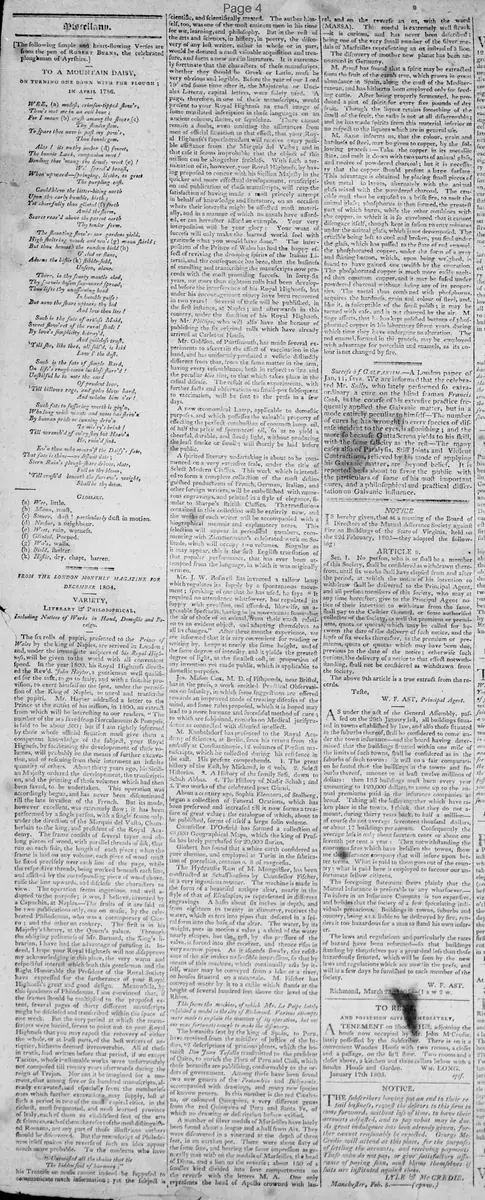
The six rolls of papiri, presented to the Prince of Wales by the king of Naples, are arrived in London; and, under the immediate auspices of his Royal Highness, will be given to the world with all convenient speed. In the year 1800, his Royal Highness directed the Rev'd. John Hayter, a gentleman well qualified for the task, to go to Italy, and with a suitable provision, to exert himself on the spot, under the permission of the King of Naples, to unroll and transcribe the papiri. Mr. Hayter addressed a letter to the Prince at the outset of his mission, in 1800, an extract from which will be interesting to our readers. "The number of the Mss saved from Herculaneum & Pompeii, is said to be about 500; but if I am rightly informed by those whose official situation must give them a competent knowledge of the subject, your Royal Highness, by facilitating the development of these volumes, will probably be the means of further excavation, and of rescuing from their interment an infinite quantity of others. About thirty years ago, his Sicilian Majesty ordered the development, the transcription, and the printing of those volumes which had then been saved, to be undertaken. This operation was accordingly begun, and has never been discontinued till the late invasion of the French. But its mode, however excellent, was extremely slow; it has been performed by a single person, with a single frame only, under the direction of the Marquis del Vafto, Chamberlain to the king, and president of the Royal Academy. The frame consists of several taper and oblong pieces of wood, with parallel threads of silk, that run on each side, the length of each piece; when the frame is laid on any volume, each piece of wood must be fixed precisely over each line of the page, while the respective threads, being worked beneath each line, and assisted by the corresponding piece of wood above, raise the line upwards, and disclose the characters to view. The operation seems ingenious, and well adapted to the purpose; it was, I believe, invented by a Capuchin, at Naples. The fruits of it are said to be two publications only, one on music, by the celebrated Philodemus, who was a contemporary of Cicero; and the other on cookery. The first is in his Majesty's library, at the Queen's palace. Through the obliging politeness of Mr. Barnard, the King's librarian, I have had the advantage of perusing it. Indeed, I hope your Royal Highness will not disapprove my acknowledging in this place, the very warm and respectful interest which both this gentleman and the Right Honorable the President of the Royal Society have expressed for the furtherance of your Royal Highness's great and good design. Meanwhile, by this specimen of Philodemus, I am convinced that, if the frames should be multiplied to the proposed extent, several pages of thirty different manuscripts might be disclosed and transcribed within the space of one week. But the very period at which the manuscripts were buried, serves to point out to your Royal Highness that you may expect the recovery of either the whole, or at least parts, of the best writers of antiquity, hitherto deemed irrecoverable. All of these, in truth, had written before that period, if we except Tacitus, whose estimable works were unfortunately not composed till twenty years afterwards during the reign of Trajan. Nor can it be imagined for a moment, that among five or six hundred manuscripts, already excavated, and especially from the numberless ones which further excavations may supply, lost at such a period in two of the most capital cities, in the richest, most frequented, and most learned province of Italy, each of them an established seat of the arts & sciences, each of them the resort of the most distinguished Romans, not any part of those illustrious authors should be discovered. But the manuscript of Philodemus itself makes the reverse of such an idea appear much more probable. To the moderns who have
"Untroiled all the chains that tie
The hidden soul of harmony:"
his Treatise on music cannot indeed be supposed to communicate much information; yet the subject is scientific, and scientifically treated. The author himself, too, was one of the most eminent men in his time for wit, learning, and philosophy. But in the rest of the arts and sciences, in history, in poetry, the discovery of any lost writer, either in whole or in part, would be deemed a most valuable acquisition and treasure, and form a new era in literature. It is extremely fortunate that the characters of these manuscripts, whether they should be Greek or Latin, must be very obvious and legible. Before the year of our Lord 79, and some time after it, the Majuscule or Uncial Letters, capital letters, were solely used. A page, therefore, in one of these manuscripts, would present to your Royal Highness an exact image of some mutilated inscription in those languages on an ancient column, statue, or sepulchre. There cannot remain a doubt, even omitting the assurances from men of official situation to that effect, that your Royal Highness's superintendent will receive every possible assistance from the Marquis del Vafto; and in that case it seems improbable that the object of this mission can be altogether fruitless. With such a termination of it, however, your Royal Highness, by having proposed to concur with his Sicilian Majesty in the quicker and more effectual development, transcription and publication of these manuscripts, will reap the satisfaction of having made a most princely attempt in behalf of knowledge and literature, on an occasion where their interests might be affected most materially, and in a manner of which no annals have afforded, or can hereafter afford an example. Your very interposition will be your glory: Your want of success will only make the learned world feel with gratitude what you would have done." The interposition of the Prince of Wales has had the happy effect of reviving the drooping spirits of the Italian Literati, and the consequence has been, that the business of unrolling and transcribing the manuscripts now proceeds with the most promising success. In forty-six years, not more than eighteen rolls had been developed before the interference of his Royal Highness, but under his encouragement ninety have been recovered in two years! Several of these will be published, in the first instance, at Naples; and afterwards in this country, under the sanction of his Royal Highness, by Mr. Phillips, who will also have the honour of publishing the six original rolls which have already arrived at Carleton House.
Mr. Goldson, of Portsmouth, has made several experiments to ascertain the effect of vaccination in the hand, and has uniformly produced a vesicle distinctly different from that, from the same matter in the arm, having every resemblance, both in respect to size and the peculiar blue tint, to that which takes place in the casual disease. The result of these experiments, with further facts and observations on small-pox subsequent to vaccination, will be sent to the press in a few days.
A new economical Lamp, applicable to domestic purposes, and which possesses the valuable property of effecting the perfect combustion of common lamp oil, of half the price of spermaceti oil, so as to yield a cheerful, durable, and steady light, without producing the least smoke or smell; will shortly be laid before the public.
A spirited literary undertaking is about to be commenced on a very extensive scale, under the title of Select Modern Classics. This work which is intended to form a complete collection of the most distinguished productions of French, German, Italian, and other foreign writers, will be embellished with numerous engravings, and printed in a style of elegance, similar to Sharpe's British Classics. The translations contained in this collection will be entirely new, and the works of each writer will be accompanied with a biographical memoir and explanatory notes. This selection will appear in periodical numbers, commencing with Zimmerman's celebrated work on Solitude, which will occupy two volumes. Singular as it may appear, this is the first English translation of that popular performance, that has ever been attempted from the language, in which it was originally written.
Mr. J. W. Boswell has invented a tallow lamp which regulates its supply by a spontaneous movement; speaking of one that he has used, he says "It required no attendance whatsoever, but regulated its supply with precision, and afforded, likewise, an agreeable spectacle, having in its movements somewhat the air of those of an animal, from their exact relation to an evident object, and adapting themselves to all its changes." After three months experience, we are informed that it is very convenient for reading or writing by, keeps at nearly the same height, and of the same degree of intensity, and it yields the greatest degree of light, at the smallest cost, in proportion of any invention yet made public, which is applicable to domestic purposes.
Jos. Mason Cox, M. D. of Fishponds, near Bristol, has in the press, a work entitled Practical Observations on Insanity, in which some suggestions are offered towards an improved mode of treating diseases of the mind, and some rules proposed, which it is hoped may lead to a more humane and successful method of cure: to which are subjoined, remarks on Medical jurisprudence as connected with diseased intellect.
M. Knobelsdorf has presented to the Royal Academy of Sciences, at Berlin, since his return from the embassy at Constantinople, 12 volumes of Persian manuscripts, which he collected during his residence in the east. His present comprehends, 1. The great history of the East, by Mirkond, in 6 vols. 2. Select Histories. 3. A History of the family Sefi, down to Schah Abbas. 4. The History of Nadir Schah; and 5. Two works of the celebrated poet Giami.
About a century ago, Sophia Eleonora, of Stolberg began a collection of Funeral Orations, which has been preserved and increased till it now forms a treasure of great value; the catalogue of which, about to be published, forms of itself a large folio volume.
Counsellor D'Oesfeld has formed a collection of 68,000 Geographical Maps, which the king of Prussia has lately purchased for 20,000 florins.
Giobert has found that a white earth considered as pure alumina, and employed at Turin in the fabrication of porcelain, contains 0.8 of magnesia.
The Hydraulic Ram of M. Montgolfier, has been constructed at Schaffhausen by Counsellor Fischer, in a very ingenious manner. The machine is made in the form of a beautiful antique altar, nearly in the style of that of Esculapius, as represented in different engravings. A basin about six inches in depth, and from eighteen to twenty in diameter, receives the water, which enters into pipes that descend in a spiral form into the base of the altar. The water, by its weight, puts in motion a valve; a third of the water nearly escapes, but the rest, by the pressure of the valve, is forced into the receiver, and thence rises in very narrow pipes. As it ascends slowly, the resistance of the air makes no sensible impression, so that by means of this machine, which continually acts by itself, water may be conveyed from a lake or a river, on houses situated on a mountain. M. Fischer has conveyed water by it to a castle which stands at the height of several hundred feet above the level of the Rhine.
This seems the machine, of which Mr. Le Poivre lately exhibited a model in the city of Richmond. Various attempts were made to explain the manner of its operation, but not one was fortunate enough to make the discovery.
The botanists sent by the king of Spain, to Peru, have received from the minister of justice of the Indies, 52 descriptions of precious plants, which the botanist Don Juan Tafalla transmitted to the president of Quito, to enrich the Flora of Peru and Chili, which those botanists are publishing, conformably to the orders of government. Among these have been found two new genera of the Pentandria and Didynamia, accompanied with drawings, and many new species of known genera. In this number is the red Cinchona, or coloured Quinquina, a very different genus from the red Quinquina of Peru and Santa Fe, of which no drawing or description before existed.
A number of silver medals of Marseilles have lately been found about a league and a half from Aix. They were discovered in a vineyard at the depth of three feet, in an earthen pot. There were about sixty of the same size, and bearing the same impression as generally met with on the medals of Marseilles, the head of Diana, and a lion on the reverse: about 130 of a smaller kind divided into four compartments on the reverse with the letters M. A. One only represents the head of Apollo crowned with laurel, and on the reverse an ox, with the word (MASSA). This medal is extremely well struck—it is curious, and has never been described; being one of the very small number of the Silver medals of Marseilles representing an ox instead of a lion.
The discovery of another new planet has been announced in Germany.
M. Prou? has found that a spirit may be extracted from the fruit of the carob tree, which grows in great abundance in Spain, along the coast of the Mediterranean, and has hitherto been employed only for feeding cattle. After being properly fermented, he produced a pint of spirit for every five pounds of dry fruit. Though the liquor retains something of the smell of the fruit, the taste is not at all disagreeable: and he has made spirits from this material inferior in no respect to the liquors which are in general use.
M. Sage informs us, that the colour, grain and hardness of steel, may be given to copper, by the following process :--Take the copper in its metallic state, and melt it down with two parts of animal glass, and twelve of powdered charcoal: but it is necessary that the copper should present a large surface. This advantage is obtained by placing small pieces of that metal in layers, alternately with the animal glass mixed with the powdered charcoal. The crucible must then be exposed to a brisk fire, to melt the animal glass; phosphorus is then formed, the greatest part of which burns, while the other combines with the copper, in which it is so enveloped that it cannot disengage itself, though kept in fusion twenty minutes under the animal glass, which is not decomposed. The crucible being left to cool and broken, you find under the glass, which has passed to the state of red enamel, the phosphorated copper, under the form of a grey and shining button, which, upon being weighed, is found to have gained one twelfth by the operation. The phosphorated copper is much more easily melted than common copper, and it may be fused under powdered charcoal without losing any of its properties. The metal thus combined with phosphorus, acquires the hardness, grain and colour of steel, and, like it, is susceptible of the finest polish: it may be turned with ease, and is not changed by the air. M. Sage asserts, that he has kept polished buttons of phosphorated copper in his laboratory fifteen years during which time they have undergone no alteration. The red enamel, formed in this process, may be employed with advantage for porcelain and enamels, as its colour is not changed by fire.
Success of GALVANISM.--A London paper of Jan. 11, says, We are informed that the celebrated Mr. Sully, who lately performed so extraordinary a cure on the blind seaman Francis Cook, in the course of his extensive practice frequently applied the Galvanic matter, but in a mode entirely peculiar to himself--The number of cures he has wrought in every species of disease incident to the eyes, is astonishing; and the more so because Gutta Serena yields to his skill with the same facility as the rest--The many cases also of Palsy, Stiff Joints and Violent Contractions, relieved by his mode of applying his Galvanic matter, are beyond belief. It is reported he is about to favor the public with the particulars of some of his most important cures, and a philosophical and practical dissertation on Galvanic influence.
VARIETY,
LITERARY PHILOSOPHICAL,
Including Notices of Works in Hand, Domestic and Foreign.
The six rolls of papiri, presented to the Prince of Wales by the king of Naples, are arrived in London; and, under the immediate auspices of his Royal Highness, will be given to the world with all convenient speed. In the year 1800, his Royal Highness directed the Rev'd. John Hayter, a gentleman well qualified for the task, to go to Italy, and with a suitable provision, to exert himself on the spot, under the permission of the King of Naples, to unroll and transcribe the papiri. Mr. Hayter addressed a letter to the Prince at the outset of his mission, in 1800, an extract from which will be interesting to our readers. "The number of the Mss saved from Herculaneum & Pompeii, is said to be about 500; but if I am rightly informed by those whose official situation must give them a competent knowledge of the subject, your Royal Highness, by facilitating the development of these volumes, will probably be the means of further excavation, and of rescuing from their interment an infinite quantity of others. About thirty years ago, his Sicilian Majesty ordered the development, the transcription, and the printing of those volumes which had then been saved, to be undertaken. This operation was accordingly begun, and has never been discontinued till the late invasion of the French. But its mode, however excellent, was extremely slow; it has been performed by a single person, with a single frame only, under the direction of the Marquis del Vafto, Chamberlain to the king, and president of the Royal Academy. The frame consists of several taper and oblong pieces of wood, with parallel threads of silk, that run on each side, the length of each piece; when the frame is laid on any volume, each piece of wood must be fixed precisely over each line of the page, while the respective threads, being worked beneath each line, and assisted by the corresponding piece of wood above, raise the line upwards, and disclose the characters to view. The operation seems ingenious, and well adapted to the purpose; it was, I believe, invented by a Capuchin, at Naples. The fruits of it are said to be two publications only, one on music, by the celebrated Philodemus, who was a contemporary of Cicero; and the other on cookery. The first is in his Majesty's library, at the Queen's palace. Through the obliging politeness of Mr. Barnard, the King's librarian, I have had the advantage of perusing it. Indeed, I hope your Royal Highness will not disapprove my acknowledging in this place, the very warm and respectful interest which both this gentleman and the Right Honorable the President of the Royal Society have expressed for the furtherance of your Royal Highness's great and good design. Meanwhile, by this specimen of Philodemus, I am convinced that, if the frames should be multiplied to the proposed extent, several pages of thirty different manuscripts might be disclosed and transcribed within the space of one week. But the very period at which the manuscripts were buried, serves to point out to your Royal Highness that you may expect the recovery of either the whole, or at least parts, of the best writers of antiquity, hitherto deemed irrecoverable. All of these, in truth, had written before that period, if we except Tacitus, whose estimable works were unfortunately not composed till twenty years afterwards during the reign of Trajan. Nor can it be imagined for a moment, that among five or six hundred manuscripts, already excavated, and especially from the numberless ones which further excavations may supply, lost at such a period in two of the most capital cities, in the richest, most frequented, and most learned province of Italy, each of them an established seat of the arts & sciences, each of them the resort of the most distinguished Romans, not any part of those illustrious authors should be discovered. But the manuscript of Philodemus itself makes the reverse of such an idea appear much more probable. To the moderns who have
"Untroiled all the chains that tie
The hidden soul of harmony:"
his Treatise on music cannot indeed be supposed to communicate much information; yet the subject is scientific, and scientifically treated. The author himself, too, was one of the most eminent men in his time for wit, learning, and philosophy. But in the rest of the arts and sciences, in history, in poetry, the discovery of any lost writer, either in whole or in part, would be deemed a most valuable acquisition and treasure, and form a new era in literature. It is extremely fortunate that the characters of these manuscripts, whether they should be Greek or Latin, must be very obvious and legible. Before the year of our Lord 79, and some time after it, the Majuscule or Uncial Letters, capital letters, were solely used. A page, therefore, in one of these manuscripts, would present to your Royal Highness an exact image of some mutilated inscription in those languages on an ancient column, statue, or sepulchre. There cannot remain a doubt, even omitting the assurances from men of official situation to that effect, that your Royal Highness's superintendent will receive every possible assistance from the Marquis del Vafto; and in that case it seems improbable that the object of this mission can be altogether fruitless. With such a termination of it, however, your Royal Highness, by having proposed to concur with his Sicilian Majesty in the quicker and more effectual development, transcription and publication of these manuscripts, will reap the satisfaction of having made a most princely attempt in behalf of knowledge and literature, on an occasion where their interests might be affected most materially, and in a manner of which no annals have afforded, or can hereafter afford an example. Your very interposition will be your glory: Your want of success will only make the learned world feel with gratitude what you would have done." The interposition of the Prince of Wales has had the happy effect of reviving the drooping spirits of the Italian Literati, and the consequence has been, that the business of unrolling and transcribing the manuscripts now proceeds with the most promising success. In forty-six years, not more than eighteen rolls had been developed before the interference of his Royal Highness, but under his encouragement ninety have been recovered in two years! Several of these will be published, in the first instance, at Naples; and afterwards in this country, under the sanction of his Royal Highness, by Mr. Phillips, who will also have the honour of publishing the six original rolls which have already arrived at Carleton House.
Mr. Goldson, of Portsmouth, has made several experiments to ascertain the effect of vaccination in the hand, and has uniformly produced a vesicle distinctly different from that, from the same matter in the arm, having every resemblance, both in respect to size and the peculiar blue tint, to that which takes place in the casual disease. The result of these experiments, with further facts and observations on small-pox subsequent to vaccination, will be sent to the press in a few days.
A new economical Lamp, applicable to domestic purposes, and which possesses the valuable property of effecting the perfect combustion of common lamp oil, of half the price of spermaceti oil, so as to yield a cheerful, durable, and steady light, without producing the least smoke or smell; will shortly be laid before the public.
A spirited literary undertaking is about to be commenced on a very extensive scale, under the title of Select Modern Classics. This work which is intended to form a complete collection of the most distinguished productions of French, German, Italian, and other foreign writers, will be embellished with numerous engravings, and printed in a style of elegance, similar to Sharpe's British Classics. The translations contained in this collection will be entirely new, and the works of each writer will be accompanied with a biographical memoir and explanatory notes. This selection will appear in periodical numbers, commencing with Zimmerman's celebrated work on Solitude, which will occupy two volumes. Singular as it may appear, this is the first English translation of that popular performance, that has ever been attempted from the language, in which it was originally written.
Mr. J. W. Boswell has invented a tallow lamp which regulates its supply by a spontaneous movement; speaking of one that he has used, he says "It required no attendance whatsoever, but regulated its supply with precision, and afforded, likewise, an agreeable spectacle, having in its movements somewhat the air of those of an animal, from their exact relation to an evident object, and adapting themselves to all its changes." After three months experience, we are informed that it is very convenient for reading or writing by, keeps at nearly the same height, and of the same degree of intensity, and it yields the greatest degree of light, at the smallest cost, in proportion of any invention yet made public, which is applicable to domestic purposes.
Jos. Mason Cox, M. D. of Fishponds, near Bristol, has in the press, a work entitled Practical Observations on Insanity, in which some suggestions are offered towards an improved mode of treating diseases of the mind, and some rules proposed, which it is hoped may lead to a more humane and successful method of cure: to which are subjoined, remarks on Medical jurisprudence as connected with diseased intellect.
M. Knobelsdorf has presented to the Royal Academy of Sciences, at Berlin, since his return from the embassy at Constantinople, 12 volumes of Persian manuscripts, which he collected during his residence in the east. His present comprehends, 1. The great history of the East, by Mirkond, in 6 vols. 2. Select Histories. 3. A History of the family Sefi, down to Schah Abbas. 4. The History of Nadir Schah; and 5. Two works of the celebrated poet Giami.
About a century ago, Sophia Eleonora, of Stolberg began a collection of Funeral Orations, which has been preserved and increased till it now forms a treasure of great value; the catalogue of which, about to be published, forms of itself a large folio volume.
Counsellor D'Oesfeld has formed a collection of 68,000 Geographical Maps, which the king of Prussia has lately purchased for 20,000 florins.
Giobert has found that a white earth considered as pure alumina, and employed at Turin in the fabrication of porcelain, contains 0.8 of magnesia.
The Hydraulic Ram of M. Montgolfier, has been constructed at Schaffhausen by Counsellor Fischer, in a very ingenious manner. The machine is made in the form of a beautiful antique altar, nearly in the style of that of Esculapius, as represented in different engravings. A basin about six inches in depth, and from eighteen to twenty in diameter, receives the water, which enters into pipes that descend in a spiral form into the base of the altar. The water, by its weight, puts in motion a valve; a third of the water nearly escapes, but the rest, by the pressure of the valve, is forced into the receiver, and thence rises in very narrow pipes. As it ascends slowly, the resistance of the air makes no sensible impression, so that by means of this machine, which continually acts by itself, water may be conveyed from a lake or a river, on houses situated on a mountain. M. Fischer has conveyed water by it to a castle which stands at the height of several hundred feet above the level of the Rhine.
This seems the machine, of which Mr. Le Poivre lately exhibited a model in the city of Richmond. Various attempts were made to explain the manner of its operation, but not one was fortunate enough to make the discovery.
The botanists sent by the king of Spain, to Peru, have received from the minister of justice of the Indies, 52 descriptions of precious plants, which the botanist Don Juan Tafalla transmitted to the president of Quito, to enrich the Flora of Peru and Chili, which those botanists are publishing, conformably to the orders of government. Among these have been found two new genera of the Pentandria and Didynamia, accompanied with drawings, and many new species of known genera. In this number is the red Cinchona, or coloured Quinquina, a very different genus from the red Quinquina of Peru and Santa Fe, of which no drawing or description before existed.
A number of silver medals of Marseilles have lately been found about a league and a half from Aix. They were discovered in a vineyard at the depth of three feet, in an earthen pot. There were about sixty of the same size, and bearing the same impression as generally met with on the medals of Marseilles, the head of Diana, and a lion on the reverse: about 130 of a smaller kind divided into four compartments on the reverse with the letters M. A. One only represents the head of Apollo crowned with laurel, and on the reverse an ox, with the word (MASSA). This medal is extremely well struck—it is curious, and has never been described; being one of the very small number of the Silver medals of Marseilles representing an ox instead of a lion.
The discovery of another new planet has been announced in Germany.
M. Prou? has found that a spirit may be extracted from the fruit of the carob tree, which grows in great abundance in Spain, along the coast of the Mediterranean, and has hitherto been employed only for feeding cattle. After being properly fermented, he produced a pint of spirit for every five pounds of dry fruit. Though the liquor retains something of the smell of the fruit, the taste is not at all disagreeable: and he has made spirits from this material inferior in no respect to the liquors which are in general use.
M. Sage informs us, that the colour, grain and hardness of steel, may be given to copper, by the following process :--Take the copper in its metallic state, and melt it down with two parts of animal glass, and twelve of powdered charcoal: but it is necessary that the copper should present a large surface. This advantage is obtained by placing small pieces of that metal in layers, alternately with the animal glass mixed with the powdered charcoal. The crucible must then be exposed to a brisk fire, to melt the animal glass; phosphorus is then formed, the greatest part of which burns, while the other combines with the copper, in which it is so enveloped that it cannot disengage itself, though kept in fusion twenty minutes under the animal glass, which is not decomposed. The crucible being left to cool and broken, you find under the glass, which has passed to the state of red enamel, the phosphorated copper, under the form of a grey and shining button, which, upon being weighed, is found to have gained one twelfth by the operation. The phosphorated copper is much more easily melted than common copper, and it may be fused under powdered charcoal without losing any of its properties. The metal thus combined with phosphorus, acquires the hardness, grain and colour of steel, and, like it, is susceptible of the finest polish: it may be turned with ease, and is not changed by the air. M. Sage asserts, that he has kept polished buttons of phosphorated copper in his laboratory fifteen years during which time they have undergone no alteration. The red enamel, formed in this process, may be employed with advantage for porcelain and enamels, as its colour is not changed by fire.
Success of GALVANISM.--A London paper of Jan. 11, says, We are informed that the celebrated Mr. Sully, who lately performed so extraordinary a cure on the blind seaman Francis Cook, in the course of his extensive practice frequently applied the Galvanic matter, but in a mode entirely peculiar to himself--The number of cures he has wrought in every species of disease incident to the eyes, is astonishing; and the more so because Gutta Serena yields to his skill with the same facility as the rest--The many cases also of Palsy, Stiff Joints and Violent Contractions, relieved by his mode of applying his Galvanic matter, are beyond belief. It is reported he is about to favor the public with the particulars of some of his most important cures, and a philosophical and practical dissertation on Galvanic influence.
What sub-type of article is it?
Periodical Notices
Literary Intelligence
What keywords are associated?
Herculaneum Papyri
Prince Of Wales
Philodemus
Vaccination
Economical Lamp
Select Modern Classics
Insanity Treatment
Persian Manuscripts
Hydraulic Ram
Galvanism
What entities or persons were involved?
From The London Monthly Magazine
Literary Details
Title
Variety, Literary Philosophical, Including Notices Of Works In Hand, Domestic And Foreign
Author
From The London Monthly Magazine
Subject
Notices Of Works In Hand, Domestic And Foreign
Key Lines
"The Number Of The Mss Saved From Herculaneum & Pompeii, Is Said To Be About 500; But If I Am Rightly Informed... Your Want Of Success Will Only Make The Learned World Feel With Gratitude What You Would Have Done."
"Untroiled All The Chains That Tie The Hidden Soul Of Harmony:"
In Forty Six Years, Not More Than Eighteen Rolls Had Been Developed Before The Interference Of His Royal Highness, But Under His Encouragement Ninety Have Been Recovered In Two Years!