Thank you for visiting SNEWPapers!
Sign up free
Editorial
October 13, 1836
Martinsburg Gazette
Martinsburg, Berkeley County, West Virginia
What is this article about?
This editorial from the Tennessee Journal reflects on the lack of lasting fame for newspaper editors, despite their profound influence on public opinion and politics. It contrasts their ephemeral renown with the enduring recognition of warriors, poets, and philosophers, emphasizing the press as a powerful lever moved by unseen conductors.
Clipping
OCR Quality
95%
Excellent
Full Text
From the Tennessee Journal.
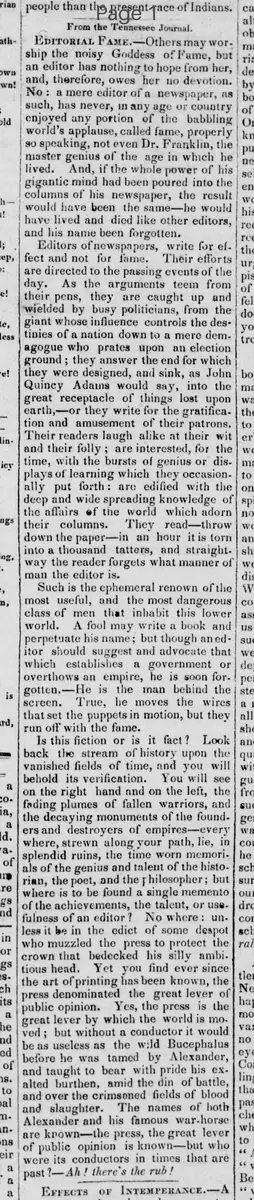
EDITORIAL FAME.—Others may worship the noisy Goddess of Fame, but an editor has nothing to hope from her, and, therefore, owes her no devotion. No: a mere editor of a newspaper, as such, has never, in any age or country enjoyed any portion of the babbling world's applause, called fame, properly so speaking, not even Dr. Franklin, the master genius of the age in which he lived. And, if the whole power of his gigantic mind had been poured into the columns of his newspaper, the result would have been the same—he would have lived and died like other editors. and his name been forgotten.
Editors of newspapers, write for effect and not for fame. Their efforts are directed to the passing events of the day. As the arguments teem from their pens, they are caught up and wielded by busy politicians, from the giant whose influence controls the destinies of a nation down to a mere demagogue who prates upon an election ground; they answer the end for which they were designed, and sink, as John Quincy Adams would say, into the great receptacle of things lost upon earth, or they write for the gratification and amusement of their patrons. Their readers laugh alike at their wit and their folly: are interested, for the time, with the bursts of genius or displays of learning which they occasionally put forth: are edified with the deep and wide spreading knowledge of the affairs of the world which adorn their columns. They read—throw down the paper—in an hour it is torn into a thousand tatters, and straightway the reader forgets what manner of man the editor is.
Such is the ephemeral renown of the most useful, and the most dangerous class of men that inhabit this lower world. A fool may write a book and perpetuate his name; but though an editor should suggest and advocate that which establishes a government or overthrows an empire, he is soon forgotten.—He is the man behind the screen. True, he moves the wires that set the puppets in motion, but they run off with the fame.
Is this fiction or is it fact? Look back the stream of history upon the vanished fields of time, and you will behold its verification. You will see on the right hand and on the left, the fading plumes of fallen warriors, and the decaying monuments of the founders and destroyers of empires—everywhere, strewn along your path, lie, in splendid ruins, the time worn memorials of the genius and talent of the historian, the poet, and the philosopher; but where is to be found a single memento of the achievements, the talent, or usefulness of an editor? No where: unless it be in the edict of some despot who muzzled the press to protect the crown that bedecked his silly ambitious head. Yet you find ever since the art of printing has been known, the press denominated the great lever of public opinion. Yes, the press is the great lever by which the world is moved; but without a conductor it would be as useless as the wild Bucephalus before he was tamed by Alexander, and taught to bear with pride his exalted burthen, amid the din of battle. and over the crimsoned fields of blood and slaughter. The names of both Alexander and his famous war-horse are known—the press, the great lever of public opinion is known—but who were its conductors in times that are past?—Ah! there's the rub!
EDITORIAL FAME.—Others may worship the noisy Goddess of Fame, but an editor has nothing to hope from her, and, therefore, owes her no devotion. No: a mere editor of a newspaper, as such, has never, in any age or country enjoyed any portion of the babbling world's applause, called fame, properly so speaking, not even Dr. Franklin, the master genius of the age in which he lived. And, if the whole power of his gigantic mind had been poured into the columns of his newspaper, the result would have been the same—he would have lived and died like other editors. and his name been forgotten.
Editors of newspapers, write for effect and not for fame. Their efforts are directed to the passing events of the day. As the arguments teem from their pens, they are caught up and wielded by busy politicians, from the giant whose influence controls the destinies of a nation down to a mere demagogue who prates upon an election ground; they answer the end for which they were designed, and sink, as John Quincy Adams would say, into the great receptacle of things lost upon earth, or they write for the gratification and amusement of their patrons. Their readers laugh alike at their wit and their folly: are interested, for the time, with the bursts of genius or displays of learning which they occasionally put forth: are edified with the deep and wide spreading knowledge of the affairs of the world which adorn their columns. They read—throw down the paper—in an hour it is torn into a thousand tatters, and straightway the reader forgets what manner of man the editor is.
Such is the ephemeral renown of the most useful, and the most dangerous class of men that inhabit this lower world. A fool may write a book and perpetuate his name; but though an editor should suggest and advocate that which establishes a government or overthrows an empire, he is soon forgotten.—He is the man behind the screen. True, he moves the wires that set the puppets in motion, but they run off with the fame.
Is this fiction or is it fact? Look back the stream of history upon the vanished fields of time, and you will behold its verification. You will see on the right hand and on the left, the fading plumes of fallen warriors, and the decaying monuments of the founders and destroyers of empires—everywhere, strewn along your path, lie, in splendid ruins, the time worn memorials of the genius and talent of the historian, the poet, and the philosopher; but where is to be found a single memento of the achievements, the talent, or usefulness of an editor? No where: unless it be in the edict of some despot who muzzled the press to protect the crown that bedecked his silly ambitious head. Yet you find ever since the art of printing has been known, the press denominated the great lever of public opinion. Yes, the press is the great lever by which the world is moved; but without a conductor it would be as useless as the wild Bucephalus before he was tamed by Alexander, and taught to bear with pride his exalted burthen, amid the din of battle. and over the crimsoned fields of blood and slaughter. The names of both Alexander and his famous war-horse are known—the press, the great lever of public opinion is known—but who were its conductors in times that are past?—Ah! there's the rub!
What sub-type of article is it?
Press Freedom
Satire
What keywords are associated?
Editorial Fame
Press Influence
Newspaper Editors
Public Opinion
Ephemeral Renown
What entities or persons were involved?
Dr. Franklin
John Quincy Adams
Alexander
Bucephalus
Editorial Details
Primary Topic
The Ephemeral Fame Of Newspaper Editors
Stance / Tone
Ironic Reflection On Editors' Unrecognized Influence
Key Figures
Dr. Franklin
John Quincy Adams
Alexander
Bucephalus
Key Arguments
Editors Receive No Lasting Fame Despite Their Influence
Their Arguments Shape Politics But Are Forgotten
Editors Are The Unseen Conductors Of Public Opinion
History Remembers Warriors And Poets, But Not Editors
The Press Is A Powerful Lever, But Its Operators Are Unknown