Thank you for visiting SNEWPapers!
Sign up free
Literary
March 24, 1939
The Midland Journal
Rising Sun, Cecil County, Maryland
What is this article about?
In this serial fiction chapter, Richard Exon, aiding Elizabeth (true heir to Austrian nobility), discovers a hidden chamber in Brief's tower revealing a 15th-century secret: Elizabeth's lineage traces to a king, making her a royal descendant. They uncover documents confirming betrayal and royal marriage, positioning Elizabeth to reclaim her title with potential aid from the Duchess of Whelp.
Merged-components note: Merged top image as illustration for the serial fiction story due to spatial overlap.
Clipping
OCR Quality
75%
Good
Full Text
MIDLAND JOURNAL, RISING SUN, MD.
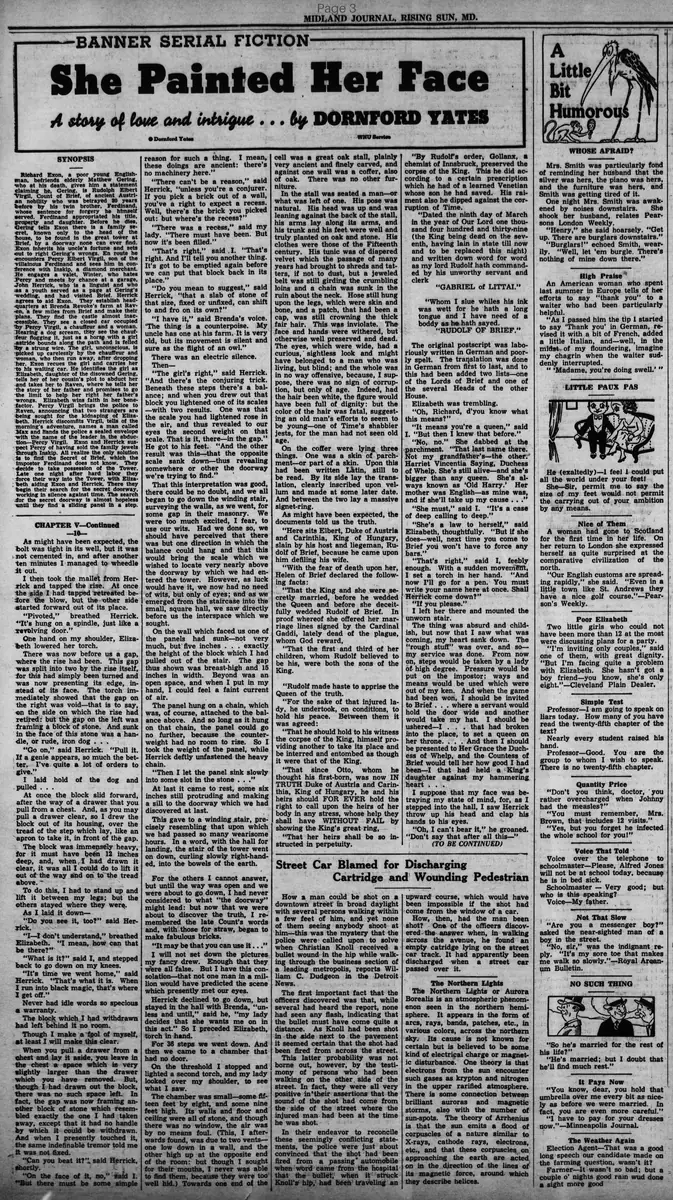
BANNER SERIAL FICTION
She Painted Her Face
A story of love and intrigue ... by DORNFORD YATES
SYNOPSIS
Richard Exon, a poor young Englishman, befriends elderly Matthew Gering, who at his death, gives him a statement claiming he, Gering, is Rudolph Elbert Virgil, Count of Brief, of ancient Austrian nobility who was betrayed 20 years before by his twin brother, Ferdinand, whose sentence for forgery he himself served. Ferdinand appropriated his title, property and daughter. Before he dies, Gering tells Exon there is a family secret, known only to the head of the house, to be found in the great tower at Brief, by a doorway none can ever find.
Exon inherits his uncle's fortune and sets out to right Gering's wrongs. En route he encounters Percy Elbert Virgil, son of the villainous Ferdinand and sees him in conference with Inskip, a diamond merchant.
He engages a valet, Winter, who hates Percy and meets by chance at a garage, John Herrick, who is a linguist and who as a youth served as a page at Gering's wedding, and had visited Brief. Herrick agrees to aid Exon. They establish headquarters at Brenda Revoke's farm at Raven, a few miles from Brief and make their plans. They find the castle almost inaccessible. They see a closed car occupied by Percy Virgil, a chauffeur and a woman. Hearing a dog scream, they see the chauffeur flogging it, just as a horse with a girl astride bounds along the path and is felled by a strung wire. The girl, unconscious, is picked up carelessly by the chauffeur and woman, who then run away, after dropping her. Exon rescues the girl and carries her to his waiting car. He identifies the girl as Elizabeth, daughter of the disowned Gering, tells her of her cousin's plot to abduct her and takes her to Raven, where he tells her the story of her father and promises to go the limit to help her right her father's wrongs. Elizabeth wins faith in her benefactor. Percy Virgil brings the police to Raven, announcing that two strangers are being sought for the kidnaping of Elizabeth. Herrick discomfits Virgil, tells of the morning's adventure, names a man called Max and hands the police a sealed envelope with the name of the leader in the abduction—Percy Virgil. Exon and Herrick suspect Percy of having sold the family jewels through Inskip. All realize the only solution is to find the Secret of Brief, which the impostor Ferdinand does not know. They decide to take possession of the Tower.
Late one night after hard labor they force their way into the Tower, with Elizabeth aiding Exon and Herrick. There they begin their search for the secret doorway, working in silence against time. The search for the secret doorway is almost hopeless until they find a sliding panel in a step.
CHAPTER V—Continued
As might have been expected, the bolt was tight in its well, but it was not cemented in, and after another ten minutes I managed to wheedle it out.
I then took the mallet from Herrick and tapped the rise. At once the side I had tapped retreated before the blow, but the other side started forward out of its place.
"Pivoted," breathed Herrick.
"It's hung on a spindle, just like a revolving door."
One hand on my shoulder, Elizabeth lowered her torch.
There was now before us a gap, where the rise had been. This gap was split into two by the rise itself, for this had simply been turned and was now presenting its edge, instead of its face. The torch immediately showed that the gap on the right was void—that is to say, on the side on which the rise had retired: but the gap on the left was framing a block of stone. And sunk in the face of this stone was a handle, or rude, iron dog.
"Go on," said Herrick. "Pull it. If a genie appears, so much the better. I've quite a lot of orders to give."
I laid hold of the dog and pulled.
At once the block slid forward, after the way of a drawer that you pull from a chest. And, as you may pull a drawer clear, so I drew the block out of its housing, over the tread of the step which lay, like an apron to take it, in front of the gap.
The block was immensely heavy, for it must have been 12 inches deep, and, when I had drawn it clear, it was all I could do to lift it out of the way and on to the tread above.
To do this, I had to stand up and lift it between my legs; but the others stayed where they were.
As I laid it down—
"Do you see it, too?" said Herrick.
"I—I don't understand," breathed Elizabeth. "I mean, how can that be there?"
"What is it?" said I, and stepped back to go down on my knees.
"It's time we went home," said Herrick. "That's what it is. When I run into black magic, that's where I get off."
Never had idle words so specious a warranty.
The block which I had withdrawn had left behind it no room.
Though I make a fool of myself, at least I will make this clear.
When you pull a drawer from a chest and lay it aside, you leave in the chest a space which is very slightly larger than the drawer which you have removed. But, though I had drawn out the block, there was no such space left. In fact, the gap was now framing another block of stone which resembled exactly the one I had taken away, except that it had no handle by which it could be withdrawn.
And when I presently touched it, the same indefinable tremor told me it was not fixed.
"Can you beat it?" said Herrick, shortly.
"On the face of it, no," said I. "But there must be some simple reason for such a thing. I mean, these doings are ancient: there's no machinery here."
"There can't be a reason," said Herrick, "unless you're a conjurer. If you pick a brick out of a wall, you've a right to expect a recess. Well, there's the brick you picked out: but where's the recess?"
"There was a recess," said my lady. "There must have been. But now it's been filled."
"That's right," said I. "That's right. And I'll tell you another thing. It's got to be emptied again before we can put that block back in its place."
"Do you mean to suggest," said Herrick, "that a slab of stone of that size, fixed or unfixed, can shift to and fro on its own?"
"I have it," said Brenda's voice. "The thing is a counterpoise. My uncle has one at his farm. It is very old, but its movement is silent and sure as the flight of an owl."
There was an electric silence.
Then—
"The girl's right," said Herrick. "And there's the conjuring trick. Beneath these steps there's a balance; and when you drew out that block you lightened one of its scales—with two results. One was that the scale you had lightened rose in the air, and thus revealed to our eyes the second weight on that scale. That is it, there—in the gap."
He got to his feet. "And the other result was this—that the opposite scale sank down—thus revealing somewhere or other the doorway we're trying to find."
That this interpretation was good, there could be no doubt, and we all began to go down the winding stair, surveying the walls, as we went, for some gap in their masonry. We were too much excited, I fear, to use our wits. Had we done so, we should have perceived that there was but one direction in which the balance could hang and that this would bring the scale which we wished to locate very nearly above the doorway by which we had entered the tower. However, as luck would have it, we now had no need of wits, but only of eyes; and as we emerged from the staircase into the small, square hall, we saw directly before us the interspace which we sought.
On the wall which faced us one of the panels had sunk—not very much, but five inches ... exactly the height of the block which I had pulled out of the stair. The gap thus shown was breast-high and 15 inches in width. Beyond was an open space, and when I put in my hand, I could feel a faint current of air.
The panel hung on a chain, which was, of course, attached to the balance above. And so long as it hung on that chain, the panel could go no further, because the counterweight had no room to rise. So I took the weight of the panel, while Herrick deftly unfastened the heavy chain.
Then I let the panel sink slowly into some slot in the stone ...
At last it came to rest, some six inches still protruding and making a sill to the doorway which we had discovered at last.
This gave to a winding stair, precisely resembling that upon which we had passed so many wearisome hours. In a word, with the hall for landing, the stair of the tower went on down, curling slowly right-handed, into the bowels of the earth.
For the others I cannot answer, but until the way was open and we were about to go down, I had never considered to what "the doorway" might lead: but now that we were about to discover the truth, I remembered the late Count's words and, with those for straw, began to make fabulous bricks.
"It may be that you can use it..."
I will not set down the pictures my fancy drew. Enough that they were all false. But I have this consolation—that not one man in a million would have predicted the scene which presently met our eyes.
Herrick declined to go down, but stayed in the hall with Brenda, "unless and until," said he, "my lady decides that she wants me on in this act." So I preceded Elizabeth, torch in hand.
For 36 steps we went down. And then we came to a chamber that had no door.
On the threshold I stopped and lighted a second torch, and my lady looked over my shoulder, to see what I saw.
The chamber was small—some fifteen feet by eight, and some nine feet high. Its walls and floor and ceiling were all of stone, and though there was no window, the air was by no means foul. (This, I afterwards found, was due to two vents—one low down in a wall, and the other high up at the opposite end of the room: but though I sought for their mouths, I never was able to find them, because they were too well hid.) Towards one end of the cell was a great oak stall, plainly very ancient and finely carved, and against one wall was a coffer, also of oak. There was no other furniture.
In the stall was seated a man—or what was left of one. His pose was natural. His head was up and was leaning against the back of the stall, his arms lay along its arms, and his trunk and his feet were well and truly planted on oak and stone. His clothes were those of the Fifteenth century. His tunic was of diapered velvet which the passage of many years had brought to shreds and tatters, if not to dust, but a jeweled belt was still girding the crumbling loins and a chain was sunk in the ruin about the neck. Hose still hung upon the legs, which were skin and bone, and a patch, that had been a cap, was still crowning the thick fair hair. This was inviolate. The face and hands were withered, but otherwise well preserved and dead. The eyes, which were wide, had a curious, sightless look and might have belonged to a man who was living, but blind; and the whole was in no way offensive, because, I suppose, there was no sign of corruption, but only of age. Indeed, had the hair been white, the figure would have been full of dignity: but the color of the hair was fatal, suggesting an old man's efforts to seem to be young—one of Time's shabbier jests, for the man had not seen old age.
On the coffer were lying three things. One was a skin of parchment—or part of a skin. Upon this had been written Latin, still to be read. By its side lay the translation, clearly inscribed upon vellum and made at some later date. And between the two lay a massive signet-ring.
As might have been expected, the documents told us the truth.
"Here sits Elbert, Duke of Austria and Carinthia, King of Hungary, slain by his host and liegeman, Rudolph of Brief, because he came upon him defiling his wife.
"With the fear of death upon her, Helen of Brief declared the following facts:
"That the King and she were secretly married, before he wedded the Queen and before she deceitfully wedded Rudolf of Brief. In proof whereof she offered her marriage lines signed by the Cardinal Gaddi, lately dead of the plague, whom God reward.
"That the first and third of her children, whom Rudolf believed to be his, were both the sons of the King.
"Rudolf made haste to apprise the Queen of the truth.
"For the sake of that injured lady, he undertook, on conditions, to hold his peace. Between them it was agreed:
"That he should hold to his witness the corpse of the King, himself providing another to take its place and be interred and entombed as though it were that of the King.
"That since Otto, whom he thought his first-born, was now IN TRUTH Duke of Austria and Carinthia, King of Hungary, he and his heirs should FOR EVER hold the right to call upon the heirs of her body in any stress, whose help they shall have WITHOUT FAIL by showing the King's great ring.
"That her heirs shall be so instructed in perpetuity.
"By Rudolf's order, Gollanx, a chemist of Innsbruck, preserved the corpse of the King. This he did according to a certain prescription which he had of a learned Venetian whose son he had saved. His raiment also he dipped against the corruption of Time.
"Dated the ninth day of March in the year of Our Lord one thousand four hundred and thirty-nine (the King being dead on the seventh, having lain in state till now and to be replaced this night) and written down word for word as my lord Rudolf hath commanded by his unworthy servant and clerk
"GABRIEL of LITTAI."
"Whom I slue whiles his ink was wett for he hath a long tongue and I have need of a boddy as he hath sayed.
"RUDOLF OF BRIEF."
The original postscript was laboriously written in German and poorly spelt. The translation was done in German from first to last, and to this had been added two lists—one of the Lords of Brief and one of the several Heads of the other House.
Elizabeth was trembling.
"Oh, Richard, d'you know what this means?"
"It means you're a queen," said I. "But then I knew that before."
"No, no." She dabbed at the parchment. "That last name there. Not my grandfather's—the other. Harriet Vincentia Saying, Duchess of Whelp. She's still alive—and she's bigger than any queen. She's always known as 'Old Harry.' Her mother was English—as mine was, and if she'll take up my cause ..."
"She must," said I. "It's a case of deep calling to deep."
"She's a law to herself," said Elizabeth, thoughtfully. "But if she does—well, next time you come to Brief you won't have to force any bars."
"That's right," said I, feebly enough. With a sudden movement, I set a torch in her hand. "And now I'll go for a pen. You must write your name here at once. Shall Herrick come down?"
"If you please."
I left her there and mounted the unworn stair.
The thing was absurd and childish, but now that I saw what was coming, my heart sank down. The "rough stuff" was over, and so—my service was done. From now on, steps would be taken by a lady of high degree. Pressure would be put on the impostor: ways and means would be used which were out of my ken. And when the game had been won, I should be invited to Brief ... where a servant would hold the door wide and another would take my hat. I should be ushered—I ... that had broken into the place, to set a queen on her throne. ... And then I should be presented to Her Grace the Duchess of Whelp, and the Countess of Brief would tell her how good I had been—I that had held a King's daughter against my hammering heart..
I suppose that my face was betraying my state of mind, for, as I stepped into the hall, I saw Herrick throw up his head and clap his hands to his eyes.
"Oh, I can't bear it," he groaned. "Don't say that after all this"
(TO BE CONTINUED)
BANNER SERIAL FICTION
She Painted Her Face
A story of love and intrigue ... by DORNFORD YATES
SYNOPSIS
Richard Exon, a poor young Englishman, befriends elderly Matthew Gering, who at his death, gives him a statement claiming he, Gering, is Rudolph Elbert Virgil, Count of Brief, of ancient Austrian nobility who was betrayed 20 years before by his twin brother, Ferdinand, whose sentence for forgery he himself served. Ferdinand appropriated his title, property and daughter. Before he dies, Gering tells Exon there is a family secret, known only to the head of the house, to be found in the great tower at Brief, by a doorway none can ever find.
Exon inherits his uncle's fortune and sets out to right Gering's wrongs. En route he encounters Percy Elbert Virgil, son of the villainous Ferdinand and sees him in conference with Inskip, a diamond merchant.
He engages a valet, Winter, who hates Percy and meets by chance at a garage, John Herrick, who is a linguist and who as a youth served as a page at Gering's wedding, and had visited Brief. Herrick agrees to aid Exon. They establish headquarters at Brenda Revoke's farm at Raven, a few miles from Brief and make their plans. They find the castle almost inaccessible. They see a closed car occupied by Percy Virgil, a chauffeur and a woman. Hearing a dog scream, they see the chauffeur flogging it, just as a horse with a girl astride bounds along the path and is felled by a strung wire. The girl, unconscious, is picked up carelessly by the chauffeur and woman, who then run away, after dropping her. Exon rescues the girl and carries her to his waiting car. He identifies the girl as Elizabeth, daughter of the disowned Gering, tells her of her cousin's plot to abduct her and takes her to Raven, where he tells her the story of her father and promises to go the limit to help her right her father's wrongs. Elizabeth wins faith in her benefactor. Percy Virgil brings the police to Raven, announcing that two strangers are being sought for the kidnaping of Elizabeth. Herrick discomfits Virgil, tells of the morning's adventure, names a man called Max and hands the police a sealed envelope with the name of the leader in the abduction—Percy Virgil. Exon and Herrick suspect Percy of having sold the family jewels through Inskip. All realize the only solution is to find the Secret of Brief, which the impostor Ferdinand does not know. They decide to take possession of the Tower.
Late one night after hard labor they force their way into the Tower, with Elizabeth aiding Exon and Herrick. There they begin their search for the secret doorway, working in silence against time. The search for the secret doorway is almost hopeless until they find a sliding panel in a step.
CHAPTER V—Continued
As might have been expected, the bolt was tight in its well, but it was not cemented in, and after another ten minutes I managed to wheedle it out.
I then took the mallet from Herrick and tapped the rise. At once the side I had tapped retreated before the blow, but the other side started forward out of its place.
"Pivoted," breathed Herrick.
"It's hung on a spindle, just like a revolving door."
One hand on my shoulder, Elizabeth lowered her torch.
There was now before us a gap, where the rise had been. This gap was split into two by the rise itself, for this had simply been turned and was now presenting its edge, instead of its face. The torch immediately showed that the gap on the right was void—that is to say, on the side on which the rise had retired: but the gap on the left was framing a block of stone. And sunk in the face of this stone was a handle, or rude, iron dog.
"Go on," said Herrick. "Pull it. If a genie appears, so much the better. I've quite a lot of orders to give."
I laid hold of the dog and pulled.
At once the block slid forward, after the way of a drawer that you pull from a chest. And, as you may pull a drawer clear, so I drew the block out of its housing, over the tread of the step which lay, like an apron to take it, in front of the gap.
The block was immensely heavy, for it must have been 12 inches deep, and, when I had drawn it clear, it was all I could do to lift it out of the way and on to the tread above.
To do this, I had to stand up and lift it between my legs; but the others stayed where they were.
As I laid it down—
"Do you see it, too?" said Herrick.
"I—I don't understand," breathed Elizabeth. "I mean, how can that be there?"
"What is it?" said I, and stepped back to go down on my knees.
"It's time we went home," said Herrick. "That's what it is. When I run into black magic, that's where I get off."
Never had idle words so specious a warranty.
The block which I had withdrawn had left behind it no room.
Though I make a fool of myself, at least I will make this clear.
When you pull a drawer from a chest and lay it aside, you leave in the chest a space which is very slightly larger than the drawer which you have removed. But, though I had drawn out the block, there was no such space left. In fact, the gap was now framing another block of stone which resembled exactly the one I had taken away, except that it had no handle by which it could be withdrawn.
And when I presently touched it, the same indefinable tremor told me it was not fixed.
"Can you beat it?" said Herrick, shortly.
"On the face of it, no," said I. "But there must be some simple reason for such a thing. I mean, these doings are ancient: there's no machinery here."
"There can't be a reason," said Herrick, "unless you're a conjurer. If you pick a brick out of a wall, you've a right to expect a recess. Well, there's the brick you picked out: but where's the recess?"
"There was a recess," said my lady. "There must have been. But now it's been filled."
"That's right," said I. "That's right. And I'll tell you another thing. It's got to be emptied again before we can put that block back in its place."
"Do you mean to suggest," said Herrick, "that a slab of stone of that size, fixed or unfixed, can shift to and fro on its own?"
"I have it," said Brenda's voice. "The thing is a counterpoise. My uncle has one at his farm. It is very old, but its movement is silent and sure as the flight of an owl."
There was an electric silence.
Then—
"The girl's right," said Herrick. "And there's the conjuring trick. Beneath these steps there's a balance; and when you drew out that block you lightened one of its scales—with two results. One was that the scale you had lightened rose in the air, and thus revealed to our eyes the second weight on that scale. That is it, there—in the gap."
He got to his feet. "And the other result was this—that the opposite scale sank down—thus revealing somewhere or other the doorway we're trying to find."
That this interpretation was good, there could be no doubt, and we all began to go down the winding stair, surveying the walls, as we went, for some gap in their masonry. We were too much excited, I fear, to use our wits. Had we done so, we should have perceived that there was but one direction in which the balance could hang and that this would bring the scale which we wished to locate very nearly above the doorway by which we had entered the tower. However, as luck would have it, we now had no need of wits, but only of eyes; and as we emerged from the staircase into the small, square hall, we saw directly before us the interspace which we sought.
On the wall which faced us one of the panels had sunk—not very much, but five inches ... exactly the height of the block which I had pulled out of the stair. The gap thus shown was breast-high and 15 inches in width. Beyond was an open space, and when I put in my hand, I could feel a faint current of air.
The panel hung on a chain, which was, of course, attached to the balance above. And so long as it hung on that chain, the panel could go no further, because the counterweight had no room to rise. So I took the weight of the panel, while Herrick deftly unfastened the heavy chain.
Then I let the panel sink slowly into some slot in the stone ...
At last it came to rest, some six inches still protruding and making a sill to the doorway which we had discovered at last.
This gave to a winding stair, precisely resembling that upon which we had passed so many wearisome hours. In a word, with the hall for landing, the stair of the tower went on down, curling slowly right-handed, into the bowels of the earth.
For the others I cannot answer, but until the way was open and we were about to go down, I had never considered to what "the doorway" might lead: but now that we were about to discover the truth, I remembered the late Count's words and, with those for straw, began to make fabulous bricks.
"It may be that you can use it..."
I will not set down the pictures my fancy drew. Enough that they were all false. But I have this consolation—that not one man in a million would have predicted the scene which presently met our eyes.
Herrick declined to go down, but stayed in the hall with Brenda, "unless and until," said he, "my lady decides that she wants me on in this act." So I preceded Elizabeth, torch in hand.
For 36 steps we went down. And then we came to a chamber that had no door.
On the threshold I stopped and lighted a second torch, and my lady looked over my shoulder, to see what I saw.
The chamber was small—some fifteen feet by eight, and some nine feet high. Its walls and floor and ceiling were all of stone, and though there was no window, the air was by no means foul. (This, I afterwards found, was due to two vents—one low down in a wall, and the other high up at the opposite end of the room: but though I sought for their mouths, I never was able to find them, because they were too well hid.) Towards one end of the cell was a great oak stall, plainly very ancient and finely carved, and against one wall was a coffer, also of oak. There was no other furniture.
In the stall was seated a man—or what was left of one. His pose was natural. His head was up and was leaning against the back of the stall, his arms lay along its arms, and his trunk and his feet were well and truly planted on oak and stone. His clothes were those of the Fifteenth century. His tunic was of diapered velvet which the passage of many years had brought to shreds and tatters, if not to dust, but a jeweled belt was still girding the crumbling loins and a chain was sunk in the ruin about the neck. Hose still hung upon the legs, which were skin and bone, and a patch, that had been a cap, was still crowning the thick fair hair. This was inviolate. The face and hands were withered, but otherwise well preserved and dead. The eyes, which were wide, had a curious, sightless look and might have belonged to a man who was living, but blind; and the whole was in no way offensive, because, I suppose, there was no sign of corruption, but only of age. Indeed, had the hair been white, the figure would have been full of dignity: but the color of the hair was fatal, suggesting an old man's efforts to seem to be young—one of Time's shabbier jests, for the man had not seen old age.
On the coffer were lying three things. One was a skin of parchment—or part of a skin. Upon this had been written Latin, still to be read. By its side lay the translation, clearly inscribed upon vellum and made at some later date. And between the two lay a massive signet-ring.
As might have been expected, the documents told us the truth.
"Here sits Elbert, Duke of Austria and Carinthia, King of Hungary, slain by his host and liegeman, Rudolph of Brief, because he came upon him defiling his wife.
"With the fear of death upon her, Helen of Brief declared the following facts:
"That the King and she were secretly married, before he wedded the Queen and before she deceitfully wedded Rudolf of Brief. In proof whereof she offered her marriage lines signed by the Cardinal Gaddi, lately dead of the plague, whom God reward.
"That the first and third of her children, whom Rudolf believed to be his, were both the sons of the King.
"Rudolf made haste to apprise the Queen of the truth.
"For the sake of that injured lady, he undertook, on conditions, to hold his peace. Between them it was agreed:
"That he should hold to his witness the corpse of the King, himself providing another to take its place and be interred and entombed as though it were that of the King.
"That since Otto, whom he thought his first-born, was now IN TRUTH Duke of Austria and Carinthia, King of Hungary, he and his heirs should FOR EVER hold the right to call upon the heirs of her body in any stress, whose help they shall have WITHOUT FAIL by showing the King's great ring.
"That her heirs shall be so instructed in perpetuity.
"By Rudolf's order, Gollanx, a chemist of Innsbruck, preserved the corpse of the King. This he did according to a certain prescription which he had of a learned Venetian whose son he had saved. His raiment also he dipped against the corruption of Time.
"Dated the ninth day of March in the year of Our Lord one thousand four hundred and thirty-nine (the King being dead on the seventh, having lain in state till now and to be replaced this night) and written down word for word as my lord Rudolf hath commanded by his unworthy servant and clerk
"GABRIEL of LITTAI."
"Whom I slue whiles his ink was wett for he hath a long tongue and I have need of a boddy as he hath sayed.
"RUDOLF OF BRIEF."
The original postscript was laboriously written in German and poorly spelt. The translation was done in German from first to last, and to this had been added two lists—one of the Lords of Brief and one of the several Heads of the other House.
Elizabeth was trembling.
"Oh, Richard, d'you know what this means?"
"It means you're a queen," said I. "But then I knew that before."
"No, no." She dabbed at the parchment. "That last name there. Not my grandfather's—the other. Harriet Vincentia Saying, Duchess of Whelp. She's still alive—and she's bigger than any queen. She's always known as 'Old Harry.' Her mother was English—as mine was, and if she'll take up my cause ..."
"She must," said I. "It's a case of deep calling to deep."
"She's a law to herself," said Elizabeth, thoughtfully. "But if she does—well, next time you come to Brief you won't have to force any bars."
"That's right," said I, feebly enough. With a sudden movement, I set a torch in her hand. "And now I'll go for a pen. You must write your name here at once. Shall Herrick come down?"
"If you please."
I left her there and mounted the unworn stair.
The thing was absurd and childish, but now that I saw what was coming, my heart sank down. The "rough stuff" was over, and so—my service was done. From now on, steps would be taken by a lady of high degree. Pressure would be put on the impostor: ways and means would be used which were out of my ken. And when the game had been won, I should be invited to Brief ... where a servant would hold the door wide and another would take my hat. I should be ushered—I ... that had broken into the place, to set a queen on her throne. ... And then I should be presented to Her Grace the Duchess of Whelp, and the Countess of Brief would tell her how good I had been—I that had held a King's daughter against my hammering heart..
I suppose that my face was betraying my state of mind, for, as I stepped into the hall, I saw Herrick throw up his head and clap his hands to his eyes.
"Oh, I can't bear it," he groaned. "Don't say that after all this"
(TO BE CONTINUED)
What sub-type of article is it?
Prose Fiction
What themes does it cover?
Political
Love Romance
Moral Virtue
What keywords are associated?
Serial Fiction
Noble Intrigue
Family Secret
Austrian Royalty
Betrayal Legacy
Hidden Chamber
Royal Heritage
What entities or persons were involved?
By Dornford Yates
Literary Details
Title
She Painted Her Face
Author
By Dornford Yates
Subject
A Story Of Love And Intrigue
Key Lines
"It Means You're A Queen," Said I. "But Then I Knew That Before."
"Here Sits Elbert, Duke Of Austria And Carinthia, King Of Hungary, Slain By His Host And Liegeman, Rudolph Of Brief, Because He Came Upon Him Defiling His Wife."
The Thing Was Absurd And Childish, But Now That I Saw What Was Coming, My Heart Sank Down. The "Rough Stuff" Was Over, And So—My Service Was Done.