Thank you for visiting SNEWPapers!
Sign up free
The Madisonian
Washington, District Of Columbia
What is this article about?
On July 4, 1843, in New York, the writer celebrates the 67th anniversary of American independence, praising the foresight of the Founding Fathers in creating balanced institutions. He lauds President John Tyler's principled vetoes against party pressure, economic advancements in trade and manufactures, and calls for deliberate political wisdom amid upcoming elections.
Clipping
OCR Quality
Full Text
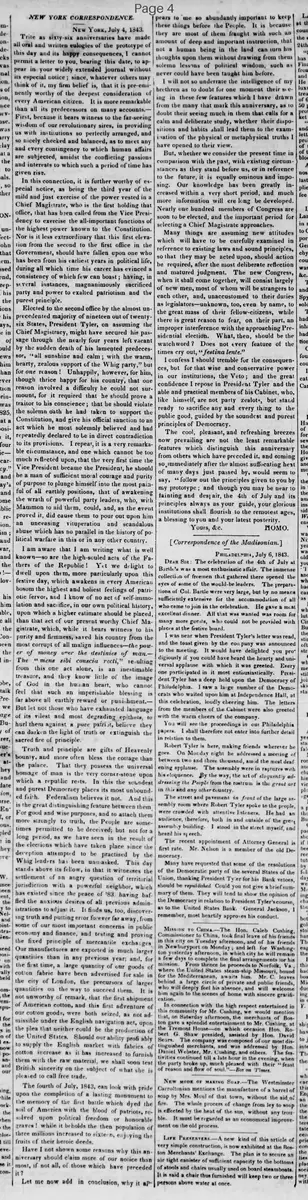
New York, July 4, 1843
Trite as sixty-six anniversaries have made all oral and written eulogies of the prototype of this day and its happy consequences, I cannot permit a letter to you, bearing this date, to appear in your widely extended journal without its especial notice; since, whatever others may think of it, my firm belief is, that it is pre-eminently worthy of the deepest consideration of every American citizen. It is more remarkable than all its predecessors on many accounts.—
First, because it bears witness to the far-seeing wisdom of our revolutionary sires, in providing us with institutions so perfectly arranged, and so nicely checked and balanced, as to meet any and every contingency to which human affairs are subjected, amidst the conflicting passions and interests to which such a period of time has given rise.
In this connection, it is further worthy of especial notice, as being the third year of the mild and just exercise of the power vested in a Chief Magistrate, who is the first holding that office, that has been called from the Vice Presidency to exercise the all-important functions of the highest power known to the Constitution. Nor is it less extraordinary that this first elevation from the second to the first office in the Government, should have fallen upon one who has been from his earliest years in political life, during all which time his career has evinced a consistency of which few can boast; having, in several instances, magnanimously sacrificed party and power to exalted patriotism and the purest principle.
Elected to the second office by the almost unprecedented majority of nineteen out of twenty-six States, President Tyler, on assuming the Chief Magistracy, might have secured his passage through the nearly four years left vacant by the sudden death of his lamented predecessor, "all sunshine and calm; with the warm, hearty, zealous support of the Whig party," but for one reason! Unhappily, however, for him, though thrice happy for his country, that one reason involved a difficulty he could not surmount, for it required that he should prove a traitor to his conscience; that he should violate the solemn oath he had taken to support the Constitution, and give his official sanction to an act which he most solemnly believed and had repeatedly declared to be in direct contradiction to its provisions. I repeat, it is a very remarkable circumstance, and one which cannot be too much reflected upon, that the very first time the Vice President became the President, he should be a man of sufficient moral courage and purity of purpose to plunge himself into the most painful of all earthly positions, that of awakening the wrath of powerful party leaders, who, with Mammon to aid them, could, and, as the event proved it, did cause them to pour out upon him an unceasing vituperation and scandalous abuse which has no parallel in the history of political warfare in this or in any other country.
I am aware that I am writing what is well known—so are the high-souled acts of the Fathers of the Republic! Yet we delight to dwell upon them, more particularly upon this festive day, which awakens in every American bosom the highest and holiest feelings of patriotic fervor, and I know of no act of self-immolation and sacrifice, in our own political history, upon which a higher estimate should be placed, than that act of our present worthy Chief Magistrate, which, while it bears witness to his purity and firmness, saved his country from the most corrupt of all malign influences—the power of money over the destinies of man.—
The "mens sibi conscia recti," resulting from this one act alone, is an inestimable treasure, and they know little of the image of God in the human heart, who cannot feel that such an imperishable blessing is far above all earthly reward or punishment.—
But let not those who have exhausted language of its vilest and most degrading epithets, to hurl them against a pure patriot, believe they can darken the light of truth or extinguish the sacred fire of principle.
Truth and principle are gifts of Heavenly bounty, and more often bless the cottage than the palace. That they possess the universal homage of man is the very corner-stone upon which a republic rests. In this the soundest and purest Democracy places its most unbounded faith. Federalism believes it not. And this is the great distinguishing feature between them.
For good and wise purposes, and to attach them more strongly to truth, the People are sometimes permitted to be deceived; but not for a long period, as we have seen in the result of the elections which have taken place since the deception attempted to be practised by the Whig leaders has been unmasked. This day stands above its fellow, in that it witnesses the settlement of an angry question of territorial jurisdiction with a powerful neighbor, which has existed since the peace of '83, having baffled the anxious desires of all previous administrations to adjust it. It finds us, too, discovering truth and putting error forever far away, from some of our most important concerns in public economy and finance, and testing and proving the fixed principle of mercantile exchanges.
Our manufactures are exported in much larger quantities than in any previous year; and, for the first time, a large quantity of our goods of cotton fabric have been advertised for sale in the city of London, the precursors of larger quantities on the way to succeed them. It is not unworthy of remark, that the first shipment of American cotton, and this first adventure of our cotton goods, were both seized, as not admissible under the English navigation act, upon the plea that neither could be the production of the United States. Should our ability profitably to supply the English market with fabrics of cotton increase as it has increased to furnish them with the raw material, we shall soon test British sincerity on the subject of what she is pleased to call free trade.
The fourth of July, 1843, can look with pride upon the completion of a lasting monument to the memory of the first battle which dyed the soil of America with the blood of patriots, resolved upon political freedom or honorable graves! while it beholds the then population of three millions increased to sixteen, enjoying the fruits of their heroic deeds.
Have I not shown some reasons why this anniversary should claim more of our notice than most, if not all, of those which have preceded it?
Let me now add in conclusion, why it appears to me so abundantly important to keep these things before the People. It is because they are most of them fraught with such an amount of deep and important instruction, that not a human being in the land can turn his thoughts upon them without drawing from them solemn lessons of political wisdom, such as never could have been taught him before.
I will not so underrate the intelligence of my brethren as to doubt for one moment their seeing in these few features which I have drawn from the many that mark this anniversary, as to doubt their seeing much in them that calls for a calm and deliberate study, whether their dispositions and habits shall lead them to the examination of the physical or metaphysical truths I have opened to their view.
But, whether we consider the present time in comparison with the past, with existing circumstances as they stand before us, or in reference to the future, it is equally ominous and imposing. Our knowledge has been greatly increased within a very short period, and much more information will ere long be developed. Nearly one hundred members of Congress are soon to be elected, and the important period for selecting a Chief Magistrate approaches. Many things are assuming new attitudes which will have to be carefully examined in reference to existing laws and sound principles, so that they may be acted upon, should action be required, after the most deliberate reflection and matured judgment. The new Congress, when it shall come together, will consist largely of new men, most of whom will be strangers to each other, and, unaccustomed to their duties as legislators—unknown, too, even by name, to the great mass of their fellow-citizens, while there is great reason to fear, on their part, an improper interference with the approaching Presidential election. What, then, should be the watchword? Does not every feature of the times cry out, "festina lente."
I confess I should tremble for the consequences, but for that wise and conservative power in our institutions, the Veto; and the great confidence I repose in President Tyler and the able and practical members of his Cabinet, who, like himself, are not party zealots, but stand ready to sacrifice any and every thing to the public good, guided by the soundest and purest principles of Democracy.
The cool, pleasant, and refreshing breezes now prevailing are not the least remarkable features which distinguish this anniversary from others which have preceded it, and coming so immediately after the almost suffocating heat of many days just passed by, would seem to say, "follow out the principles given to you by my prototype; and though you may be near to fainting and despair, the 4th of July and its principles always as your guide, your glorious institutions shall flourish to the remotest ages, a blessing to you and your latest posterity."
Yours, &c.
HOMO.
What sub-type of article is it?
What themes does it cover?
What keywords are associated?
What entities or persons were involved?
Letter to Editor Details
Author
Homo.
Recipient
Your Widely Extended Journal
Main Argument
the 67th anniversary of july 4th is particularly noteworthy for demonstrating the strength of american institutions, president tyler's moral courage in upholding constitutional principles against party pressure, economic progress, and the need for deliberate political wisdom in upcoming elections.
Notable Details