Thank you for visiting SNEWPapers!
Sign up free
Alexandria Daily Advertiser
Alexandria, Virginia
What is this article about?
In the U.S. House of Representatives on January 5, Mr. J. Randolph defends his motion for a committee to inquire into Associate Justice Samuel Chase's official conduct, arguing against postponement and emphasizing the need for immediate action based on existing evidence of misconduct.
Merged-components note: Continuation of the congressional debate on Mr. Randolph's motion regarding Samuel Chase across columns; text flows directly.
Clipping
OCR Quality
Full Text
OF THE
UNITED STATES.
HOUSE OF REPRESENTATIVES.
THURSDAY, January 5.
DEBATE
On Mr. Randolph's motion for the appointment of a committee of enquiry into the official conduct of
SAMUEL CHASE.
(Continued.)
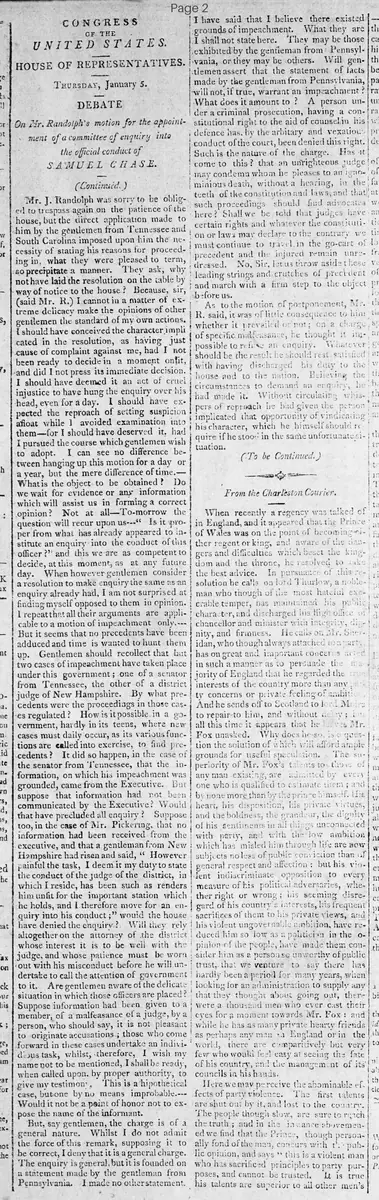
Mr. J. Randolph was sorry to be obliged to trespass again on the patience of the house, but the direct application made to him by the gentlemen from Tennessee and South Carolina imposed upon him the necessity of stating his reasons for proceeding in, what they were pleased to term, so precipitate a manner. They ask, why not have laid the resolution on the table by way of notice to the house? Because, sir, (said Mr. R.) I cannot in a matter of extreme delicacy make the opinions of other gentlemen the standard of my own actions. I should have conceived the character implicated in the resolution, as having just cause of complaint against me, had I not been ready to decide in a moment on it, and did I not press its immediate decision. I should have deemed it an act of cruel injustice to have hung the enquiry over his head, even for a day. I should have expected the reproach of setting suspicion afloat while I avoided examination into them—for I should have deserved it, had I pursued the course which gentlemen wish to adopt. I can see no difference between hanging up this motion for a day or a year, but the mere difference of time. What is the object to be obtained? Do we wait for evidence or any information which will assist us in forming a correct opinion? Not at all—To-morrow the question will recur upon us—" Is it proper from what has already appeared to institute an enquiry into the conduct of this officer?" and this we are as competent to decide, at this moment, as at any future day. When however gentlemen consider a resolution to make enquiry the same as an enquiry already had, I am not surprised at finding myself opposed to them in opinion. I repeat that all their arguments are applicable to a motion of impeachment only. But it seems that no precedents have been adduced and time is wanted to hunt them up.
Gentlemen should recollect that but two cases of impeachment have taken place under this government; one of a senator from Tennessee, the other of a district judge of New Hampshire. By what precedents were the proceedings in those cases regulated? How is it possible, in a government, hardly in its teens, where new cases must daily occur, as its various functions are called into exercise, to find precedents? It did so happen, in the case of the senator from Tennessee, that the information, on which his impeachment was grounded, came from the Executive. But suppose that information had not been communicated by the Executive? Would that have precluded all enquiry? Suppose too, in the case of Mr. Pickering, that no information had been received from the executive, and that a gentleman from New Hampshire had risen and said, " However painful the task, I deem it my duty to state the conduct of the judge of the district, in which I reside, has been such as renders him unfit for the important station which he holds, and I therefore move for an enquiry into his conduct;" would the house have denied the enquiry? Will they rely altogether on the attorney of the district whose interest it is to be well with the judge, and whose patience must be worn out with his misconduct before he will undertake to call the attention of government to it. Are gentlemen aware of the delicate situation in which those officers are placed? Suppose information had been given to a member, of a malfeasance of a judge, by a person, who should say, it is not pleasant to originate accusations; those who come forward in these cases undertake an invidious task, whilst, therefore, I wish my name not to be mentioned, I shall be ready, when called upon, by proper authority, to give my testimony. This is a hypothetical case, but one by no means improbable. Would it not be a point of honor not to expose the name of the informant.
But, say gentlemen, the charge is of a general nature. Whilst I do not admit the force of this remark, supposing it to be correct, I deny that it is a general charge. The enquiry is general, but it is founded on a statement made by the gentleman from Pennsylvania. I made no other statement, I have said—that I believe there existed grounds of impeachment. What they are I shall not state here. They may be those exhibited by the gentleman from Pennsylvania, or they may be others. Will gentlemen assert that the statement of facts made by the gentleman from Pennsylvania, will not, if true, warrant an impeachment? What does it amount to? A person under a criminal prosecution, having a constitutional right to the aid of counsel in his defence has, by the arbitrary and vexatious conduct of the court, been denied this right. Such is the nature of the charge. Has it come to this? that an unrighteous judge may condemn whom he pleases to an ignominious death, without a hearing, in the teeth of the constitution and laws, and that such proceedings should find advocates here? Shall we be told that judges have certain rights and whatever the constitution or laws may declare to the contrary we must continue to travel in the go-cart of precedent and the injured remain undressed. No, Sir, let us throw aside these leading strings and crutches of precedent and march with a firm step to the object before us.
As to the motion of postponement, Mr. R. said, it was of little consequence to him whether it prevailed or not; on a charge of specific malfeasance, he thought it impossible to refuse an enquiry. Whatever should be the result he should rest satisfied with having discharged his duty to the house and to the nation. Believing the circumstances to demand an enquiry, he had made it. Without circulating whispers of reproach he had given the person implicated that opportunity of vindicating his character, which he himself should require if he stood in the same unfortunate situation.
(To be Continued.)
What sub-type of article is it?
What themes does it cover?
What keywords are associated?
What entities or persons were involved?
Where did it happen?
Story Details
Key Persons
Location
House Of Representatives, United States Congress
Event Date
Thursday, January 5
Story Details
Mr. J. Randolph defends his motion for a committee to investigate Samuel Chase's conduct, rejecting postponement, citing prior impeachments, and arguing the charge involves denial of counsel in a trial, warranting immediate inquiry.