Thank you for visiting SNEWPapers!
Sign up free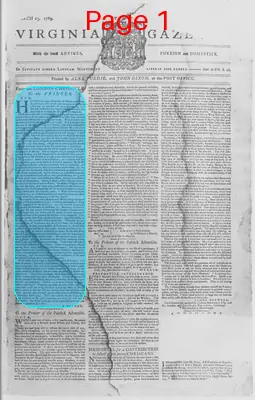
Letter to Editor
March 23, 1769
The Virginia Gazette
Richmond, Williamsburg, Richmond County, Virginia
What is this article about?
A British correspondent opposes taxing the American colonies, arguing that lost exports of manufactures will exceed tax revenue, harming British economy and risking colonial independence amid shared interests.
Clipping
OCR Quality
96%
Excellent
Full Text
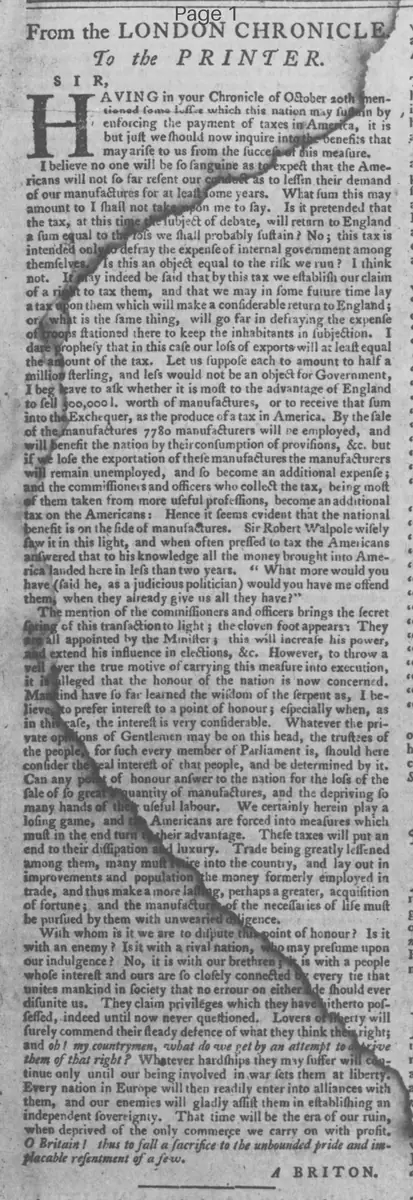
From the LONDON CHRONICLE
To the PRINTER.
SIR,
Having in your Chronicle of October 20th mentioned some loss which this nation may sustain by enforcing the payment of taxes in America, it is but just we should now inquire into the benefits that may arise to us from the success of this measure.
I believe no one will be so sanguine as to expect that the Americans will not so far resent our conduct as to lessen their demand of our manufactures for at least some years. What sum this may amount to I shall not take upon me to say. Is it pretended that the tax, at this time the subject of debate, will return to England a sum equal to the loss we shall probably sustain? No; this tax is intended only to defray the expense of internal government among themselves. Is this an object equal to the risk we run? I think not. It may indeed be said that by this tax we establish our claim of a right to tax them, and that we may in some future time lay a tax upon them which will make a considerable return to England; or what is the same thing, will go far in defraying the expense of troops stationed there to keep the inhabitants in subjection. I dare prophecy that in this case our loss of exports will at least equal the amount of the tax. Let us suppose each to amount to half a million sterling, and less would not be an object for Government.
I beg leave to ask whether it is most to the advantage of England to sell 500,000 l. worth of manufactures, or to receive that sum into the Exchequer, as the produce of a tax in America. By the sale of the manufactures 500,000 manufacturers will be employed, and will benefit the nation by their consumption of provisions, &c. but if we lose the exportation of these manufactures the manufacturers will remain unemployed, and so become an additional expense; and the commissioners and officers who collect the tax, being most of them taken from more useful professions, become an additional tax on the Americans: Hence it seems evident that the national benefit is on the side of manufactures. Sir Robert Walpole wisely saw it in this light, and when often pressed to tax the Americans answered that to his knowledge all the money brought into America landed here in less than two years. "What more would you have (said he, as a judicious politician) would you have me offend them, when they already give us all they have?"
The mention of the commissioners and officers brings the secret spring of this transaction to light; the cloven foot appears: They are all appointed by the Minister; this will increase his power, and extend his influence in elections, &c. However, to throw a veil over the true motive of carrying this measure into execution, it is alleged that the honour of the nation is now concerned. Mankind have so far learned the wisdom of the serpent as, I believe to prefer interest to a point of honour; especially when, as in this case, the interest is very considerable. Whatever the private opinions of Gentlemen may be on this head, the trustees of the people (for such every member of Parliament is) should here consider the real interest of that people, and be determined by it.
Can any point of honour answer to the nation for the loss of the sale of so great a quantity of manufactures, and the depriving so many hands of useful labour. We certainly herein play a losing game, and Americans are forced into measures which must in the end turn to their advantage. These taxes will put an end to their dissipation and luxury. Trade being greatly lessened among them, many must retire into the country, and lay out in improvements and population the money formerly employed in trade, and thus make a more lasting, perhaps a greater, acquisition of fortune; and the manufacture of the necessaries of life must be pursued by them with unwearied diligence.
With whom is it we are to dispute the point of honour? Is it with an enemy? Is it with a rival nation, who may presume upon our indulgence? No, it is with our brethren; it is with a people whose interest and ours are so closely connected every tie that unites mankind in society that no error on either side should ever disunite us. They claim privileges which they have hitherto possessed, indeed until now never questioned. Lovers of Liberty will surely commend their steady defence of what they think the right; and oh! my countrymen, what do we get by an attempt to drive them of that right? Whatever hardships they may suffer will continue only until our being involved in war sets them at liberty.
Every nation in Europe will then readily enter into alliances with them, and our enemies will gladly assist them in establishing an independent sovereignty. That time will be the era of our ruin, when deprived of the only commerce we carry on with profit.
O Britain! thus to fall a sacrifice to the unbounded pride and implacable resentment of a few.
A BRITON.
To the PRINTER.
SIR,
Having in your Chronicle of October 20th mentioned some loss which this nation may sustain by enforcing the payment of taxes in America, it is but just we should now inquire into the benefits that may arise to us from the success of this measure.
I believe no one will be so sanguine as to expect that the Americans will not so far resent our conduct as to lessen their demand of our manufactures for at least some years. What sum this may amount to I shall not take upon me to say. Is it pretended that the tax, at this time the subject of debate, will return to England a sum equal to the loss we shall probably sustain? No; this tax is intended only to defray the expense of internal government among themselves. Is this an object equal to the risk we run? I think not. It may indeed be said that by this tax we establish our claim of a right to tax them, and that we may in some future time lay a tax upon them which will make a considerable return to England; or what is the same thing, will go far in defraying the expense of troops stationed there to keep the inhabitants in subjection. I dare prophecy that in this case our loss of exports will at least equal the amount of the tax. Let us suppose each to amount to half a million sterling, and less would not be an object for Government.
I beg leave to ask whether it is most to the advantage of England to sell 500,000 l. worth of manufactures, or to receive that sum into the Exchequer, as the produce of a tax in America. By the sale of the manufactures 500,000 manufacturers will be employed, and will benefit the nation by their consumption of provisions, &c. but if we lose the exportation of these manufactures the manufacturers will remain unemployed, and so become an additional expense; and the commissioners and officers who collect the tax, being most of them taken from more useful professions, become an additional tax on the Americans: Hence it seems evident that the national benefit is on the side of manufactures. Sir Robert Walpole wisely saw it in this light, and when often pressed to tax the Americans answered that to his knowledge all the money brought into America landed here in less than two years. "What more would you have (said he, as a judicious politician) would you have me offend them, when they already give us all they have?"
The mention of the commissioners and officers brings the secret spring of this transaction to light; the cloven foot appears: They are all appointed by the Minister; this will increase his power, and extend his influence in elections, &c. However, to throw a veil over the true motive of carrying this measure into execution, it is alleged that the honour of the nation is now concerned. Mankind have so far learned the wisdom of the serpent as, I believe to prefer interest to a point of honour; especially when, as in this case, the interest is very considerable. Whatever the private opinions of Gentlemen may be on this head, the trustees of the people (for such every member of Parliament is) should here consider the real interest of that people, and be determined by it.
Can any point of honour answer to the nation for the loss of the sale of so great a quantity of manufactures, and the depriving so many hands of useful labour. We certainly herein play a losing game, and Americans are forced into measures which must in the end turn to their advantage. These taxes will put an end to their dissipation and luxury. Trade being greatly lessened among them, many must retire into the country, and lay out in improvements and population the money formerly employed in trade, and thus make a more lasting, perhaps a greater, acquisition of fortune; and the manufacture of the necessaries of life must be pursued by them with unwearied diligence.
With whom is it we are to dispute the point of honour? Is it with an enemy? Is it with a rival nation, who may presume upon our indulgence? No, it is with our brethren; it is with a people whose interest and ours are so closely connected every tie that unites mankind in society that no error on either side should ever disunite us. They claim privileges which they have hitherto possessed, indeed until now never questioned. Lovers of Liberty will surely commend their steady defence of what they think the right; and oh! my countrymen, what do we get by an attempt to drive them of that right? Whatever hardships they may suffer will continue only until our being involved in war sets them at liberty.
Every nation in Europe will then readily enter into alliances with them, and our enemies will gladly assist them in establishing an independent sovereignty. That time will be the era of our ruin, when deprived of the only commerce we carry on with profit.
O Britain! thus to fall a sacrifice to the unbounded pride and implacable resentment of a few.
A BRITON.
What sub-type of article is it?
Persuasive
Political
Reflective
What themes does it cover?
Taxation
Economic Policy
Politics
What keywords are associated?
American Taxes
British Manufactures
Colonial Trade Loss
Economic Benefits
Sir Robert Walpole
Ministerial Influence
Colonial Independence
What entities or persons were involved?
A Briton
To The Printer
Letter to Editor Details
Author
A Briton
Recipient
To The Printer
Main Argument
imposing taxes on america will cause britain greater economic loss through reduced colonial demand for manufactures than the revenue gained, while risking colonial resentment and potential independence that harms british interests.
Notable Details
References Sir Robert Walpole's View On American Trade
Estimates Loss And Tax At Half A Million Sterling
Criticizes Ministerial Appointments For Political Influence
Warns Of European Alliances Aiding American Sovereignty