Thank you for visiting SNEWPapers!
Sign up free
The Independent
Honolulu, Honolulu County, Hawaii
What is this article about?
In the Costa Rica Packet case, arbitrator M. de Martens ruled at The Hague that the Dutch Government must pay £8,550 with interest from November 2, 1891, plus £250 costs, to the captain, crew, and owners of the Australian whaler wrongfully seized in the Moluccas in 1891.
Clipping
OCR Quality
Full Text
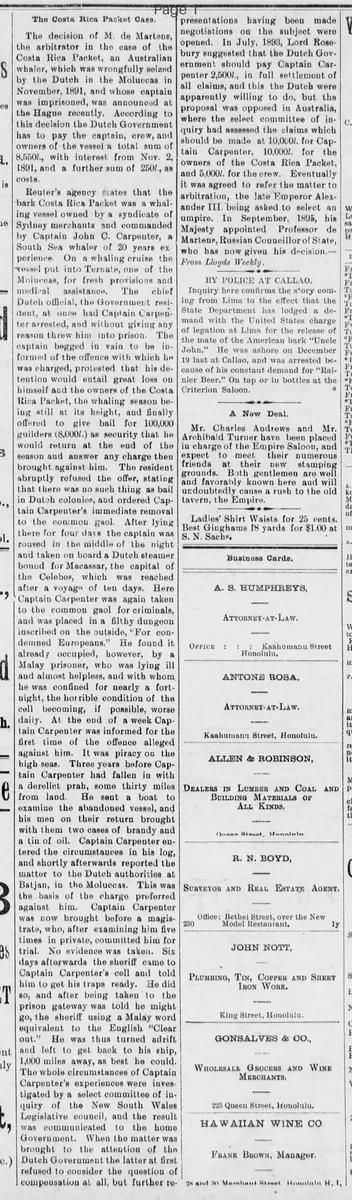
The decision of M. de Martens,
the arbitrator in the case of the
Costa Rica Packet, an Australian
whaler, which was wrongfully seized
by the Dutch in the Moluccas in
November, 1891, and whose captain
was imprisoned, was announced at
the Hague recently. According to
this decision the Dutch Government
has to pay the captain, crew, and
owners of the vessel a total sum of
8,550l., with interest from Nov. 2.
1891, and a further sum of 250l., as
costs.
Reuter's agency states that the
bark Costa Rica Packet was a whal-
ing vessel owned by a syndicate of
Sydney merchants and commanded
by Captain John C. Carpenter, a
South Sea whaler of 20 years ex.
perience. On a whaling cruise the
vessel put into Ternate, one of the
Moluccas, for fresh provisions and
medical assistance. The chief
Dutch official, the Government resi-
dent, at once had Captain Carpen-
ter arrested, and without giving any
reason threw him into prison. The
captain begged in vain to be in-
formed of the offence with which he
was charged, protested that his de-
tention would entail great loss on
himself and the owners of the Costa
Rica Packet, the whaling season be-
ing still at its height, and finally
offered to give bail for 100,000
guilders (8,000l.) as security that he
would return at the end of the
season and answer any charge then
brought against him. The resident
abruptly refused the offer, stating
that there was no such thing as bail
in Dutch colonies, and ordered Cap-
tain Carpenter's immediate removal
to the common gaol. After lying
there for four days the captain was
roused in the middle of the night
and taken on board a Dutch steamer
bound for Macassar, the capital of
the Celebes, which was reached
after a voyage of ten days. Here
Captain Carpenter was again taken
to the common gaol for criminals,
and was placed in a filthy dungeon
inscribed on the outside, "For con-
demned Europeans." He found it
already occupied, however, by a
Malay prisoner, who was lying ill
and almost helpless, and with whom
he was confined for nearly a fort-
night, the horrible condition of the
cell becoming, if possible, worse
daily. At the end of a week Cap-
tain Carpenter was informed for the
first time of the offence alleged
against him. It was piracy on the
high seas. Three years before Cap-
tain Carpenter had fallen in with
a derelict prahu, some thirty miles
from land. He sent a boat to
examine the abandoned vessel, and
his men on their return brought
with them two cases of brandy and
a tin of oil. Captain Carpenter en-
tered the circumstances in his log,
and shortly afterwards reported the
matter to the Dutch authorities at
Batjan, in the Moluccas. This was
the basis of the charge preferred
against him. Captain Carpenter
was now brought before a magis-
trate, who, after examining him five
times in private, committed him for
trial. No evidence was taken. Six
days afterwards the sheriff came to
Captain Carpenter's cell and told
him to get his traps ready. He did
so, and after being taken to the
prison gateway was told he might
go, the sheriff using a Malay word
equivalent to the English "Clear
out." He was thus turned adrift
and left to get back to his ship,
1,000 miles away, as best he could.
The whole circumstances of Captain
Carpenter's experiences were inves.
tigated by a select committee of in-
quiry of the New South Wales
Legislative council, and the result
was communicated to the home
Government. When the matter was
brought to the attention of the
Dutch Government the latter at first
refused to consider the question of
compensation at all, but further re-
presentations having been made
negotiations on the subject were
opened. In July, 1893, Lord Rose-
bury suggested that the Dutch Gov-
ernment should pay Captain Car-
peneter 2,500l., in full settlement of
all claims, and this the Dutch were
apparently willing to do, but the
proposal was opposed in Australia,
where the select committee of in-
quiry had assessed the claims which
should be made at 10,000l. for Cap-
tain Carpenter, 10,000l. for the
owners of the Costa Rica Packet,
and 5,000l. for the crew. Eventually
it was agreed to refer the matter to
arbitration, the late Emperor Alex-
ander III. being asked to select an
umpire. In September, 1895, his
Majesty appointed Professor de
Martens, Russian Councillor of State,
who has now given his decision.
From Lloyd's Weekly.
What sub-type of article is it?
What keywords are associated?
What entities or persons were involved?
Where did it happen?
Foreign News Details
Primary Location
Moluccas
Event Date
November 1891
Key Persons
Outcome
dutch government to pay 8,550l. with interest from nov. 2, 1891, and 250l. as costs to captain, crew, and owners
Event Details
Australian whaler Costa Rica Packet seized by Dutch in Moluccas; Captain Carpenter imprisoned without cause, accused of piracy based on prior derelict incident; after harsh treatment and release without trial, case led to arbitration awarding compensation.