Thank you for visiting SNEWPapers!
Sign up free
Editorial
July 27, 1804
Berkeley And Jefferson Intelligencer
Martinsburg, Berkeley County, Virginia
What is this article about?
Editorial in the United States' Gazette criticizes the Jefferson administration's practice of sending short-term Democratic ambassadors to France, incurring high outfit and salary costs, contrasting it with frugal Federalist policies under Washington and Adams. It details Robert Livingston's diplomatic blunders and anticipates similar for Gen. Armstrong.
Clipping
OCR Quality
98%
Excellent
Full Text
From the United States' Gazette.
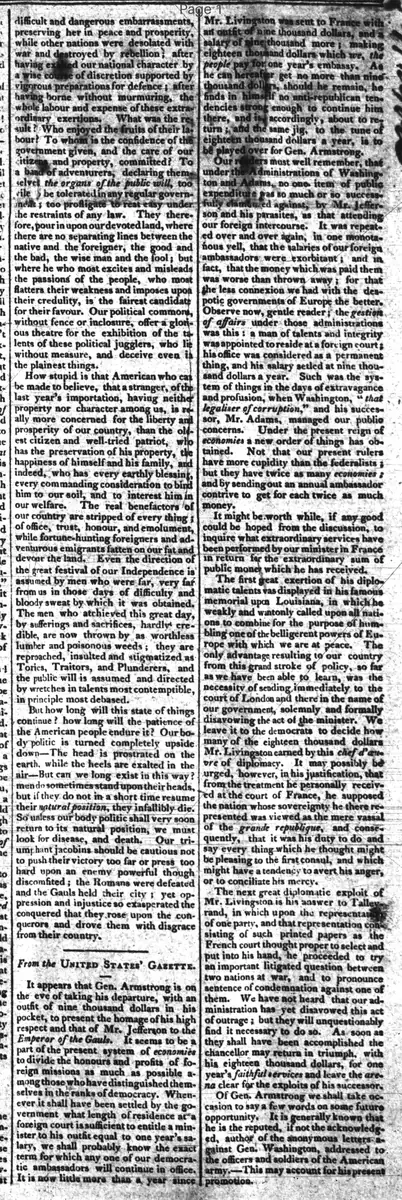
It appears that Gen. Armstrong is on the eve of taking his departure, with an outfit of nine thousand dollars in his pocket, to present the homage of his high respect and that of Mr. Jefferson to the Emperor of the Gauls. It seems to be a part of the present system of economies to divide the honours and profits of foreign missions as much as possible among those who have distinguished themselves in the ranks of democracy. Whenever it shall have been settled by the government what length of residence at a foreign court is sufficient to entitle a minister to his outfit equal to one year's salary, we shall probably know the exact term for which any one of our democratic ambassadors will continue in office. It is now little more than a year since Mr. Livingston was sent to France with an outfit of nine thousand dollars and salary of nine thousand more; making eighteen thousand dollars which we, the people pay for one year's embassy. As he can hereafter get no more than nine thousand dollars, should he remain: he finds in himself no anti-republican tendencies strong enough to continue him there, and is, accordingly, about to return; and the same jig, to the tune of eighteen thousand dollars a year, is to be played over for Gen. Armstrong.
Our readers must well remember, that under the Administrations of Washington and Adams, no one item of public expenditure was so much or so successfully clamoured against by Mr. Jefferson and his parasites, as that attending our foreign intercourse. It was repeated over and over again, in one monotonous yell, that the salaries of our foreign ambassadors were exorbitant; and in fact, that the money which was paid them was worse than thrown away; for that the less connexion we had with the despotic governments of Europe the better.
Observe now, gentle reader; the gestion of affairs under those administrations was this: a man of talents and integrity was appointed to reside at a foreign court; his office was considered as a permanent thing, and his salary settled at nine thousand dollars a year. Such was the system of things in the days of extravagance and profusion, when Washington, "that legaliser of corruption," and his successor, Mr. Adams, managed our public concerns. Under the present reign of economies a new order of things has obtained. Not that our present rulers have more cupidity than the federalists but they have twice as many economies; and by sending out an annual ambassador contrive to get for each twice as much money.
It might be worth while, if any good could be hoped from the discussion, to inquire what extraordinary services have been performed by our minister in France in return for the extraordinary sum of public money which he has received. The first great exertion of his diplomatic talents was displayed in his famous memorial upon Louisiana, in which he weakly and wantonly called upon all nations to combine for the purpose of humbling one of the belligerent powers of Europe with which we are at peace. The only advantage resulting to our country from this grand stroke of policy, so far as we have been able to learn, was the necessity of sending immediately to the court of London and there in the name of our government, solemnly and formally disavowing the act of the minister. We leave it to the democrats to decide how many of the eighteen thousand dollars Mr. Livingston earned by this chef d'oeuvre of diplomacy. It may possibly be urged, however, in his justification, that from the treatment he personally received at the court of France, he supposed the nation whose sovereignty he there represented was viewed as the mere vassal of the grande republique, and consequently, that it was his duty to do and say every thing which he thought might be pleasing to the first consul, and which might have a tendency to avert his anger, or to conciliate his mercy.
The next great diplomatic exploit of Mr. Livingston is his answer to Talleyrand, in which upon the representation of one party, and that representation consisting of such printed papers as the French court thought proper to select and put into his hand, he proceeded to try an important litigated question between two nations at war, and to pronounce sentence of condemnation against one of them. We have not heard that our administration has yet disavowed this act of outrage; but they will unquestionably find it necessary to do so. As soon as they shall have been accomplished the chancellor may return in triumph, with his eighteen thousand dollars, for one year's faithful services and leave the arena clear for the exploits of his successor.
Of Gen. Armstrong we shall take occasion to say a few words on some future opportunity. It is generally known that he is the reputed, if not the acknowledged, author of the anonymous letters against Gen. Washington, addressed to the officers and soldiers of the American army.—This may account for his present.
It appears that Gen. Armstrong is on the eve of taking his departure, with an outfit of nine thousand dollars in his pocket, to present the homage of his high respect and that of Mr. Jefferson to the Emperor of the Gauls. It seems to be a part of the present system of economies to divide the honours and profits of foreign missions as much as possible among those who have distinguished themselves in the ranks of democracy. Whenever it shall have been settled by the government what length of residence at a foreign court is sufficient to entitle a minister to his outfit equal to one year's salary, we shall probably know the exact term for which any one of our democratic ambassadors will continue in office. It is now little more than a year since Mr. Livingston was sent to France with an outfit of nine thousand dollars and salary of nine thousand more; making eighteen thousand dollars which we, the people pay for one year's embassy. As he can hereafter get no more than nine thousand dollars, should he remain: he finds in himself no anti-republican tendencies strong enough to continue him there, and is, accordingly, about to return; and the same jig, to the tune of eighteen thousand dollars a year, is to be played over for Gen. Armstrong.
Our readers must well remember, that under the Administrations of Washington and Adams, no one item of public expenditure was so much or so successfully clamoured against by Mr. Jefferson and his parasites, as that attending our foreign intercourse. It was repeated over and over again, in one monotonous yell, that the salaries of our foreign ambassadors were exorbitant; and in fact, that the money which was paid them was worse than thrown away; for that the less connexion we had with the despotic governments of Europe the better.
Observe now, gentle reader; the gestion of affairs under those administrations was this: a man of talents and integrity was appointed to reside at a foreign court; his office was considered as a permanent thing, and his salary settled at nine thousand dollars a year. Such was the system of things in the days of extravagance and profusion, when Washington, "that legaliser of corruption," and his successor, Mr. Adams, managed our public concerns. Under the present reign of economies a new order of things has obtained. Not that our present rulers have more cupidity than the federalists but they have twice as many economies; and by sending out an annual ambassador contrive to get for each twice as much money.
It might be worth while, if any good could be hoped from the discussion, to inquire what extraordinary services have been performed by our minister in France in return for the extraordinary sum of public money which he has received. The first great exertion of his diplomatic talents was displayed in his famous memorial upon Louisiana, in which he weakly and wantonly called upon all nations to combine for the purpose of humbling one of the belligerent powers of Europe with which we are at peace. The only advantage resulting to our country from this grand stroke of policy, so far as we have been able to learn, was the necessity of sending immediately to the court of London and there in the name of our government, solemnly and formally disavowing the act of the minister. We leave it to the democrats to decide how many of the eighteen thousand dollars Mr. Livingston earned by this chef d'oeuvre of diplomacy. It may possibly be urged, however, in his justification, that from the treatment he personally received at the court of France, he supposed the nation whose sovereignty he there represented was viewed as the mere vassal of the grande republique, and consequently, that it was his duty to do and say every thing which he thought might be pleasing to the first consul, and which might have a tendency to avert his anger, or to conciliate his mercy.
The next great diplomatic exploit of Mr. Livingston is his answer to Talleyrand, in which upon the representation of one party, and that representation consisting of such printed papers as the French court thought proper to select and put into his hand, he proceeded to try an important litigated question between two nations at war, and to pronounce sentence of condemnation against one of them. We have not heard that our administration has yet disavowed this act of outrage; but they will unquestionably find it necessary to do so. As soon as they shall have been accomplished the chancellor may return in triumph, with his eighteen thousand dollars, for one year's faithful services and leave the arena clear for the exploits of his successor.
Of Gen. Armstrong we shall take occasion to say a few words on some future opportunity. It is generally known that he is the reputed, if not the acknowledged, author of the anonymous letters against Gen. Washington, addressed to the officers and soldiers of the American army.—This may account for his present.
What sub-type of article is it?
Foreign Affairs
Partisan Politics
What keywords are associated?
Foreign Ambassadors
Diplomatic Costs
Jefferson Administration
Livingston France
Armstrong Appointment
What entities or persons were involved?
Gen. Armstrong
Mr. Jefferson
Emperor Of The Gauls
Mr. Livingston
Washington
Adams
Talleyrand
Editorial Details
Primary Topic
Criticism Of Short Term Democratic Ambassadors To France And Their Costs
Stance / Tone
Strongly Critical Of Jefferson Administration's Diplomacy
Key Figures
Gen. Armstrong
Mr. Jefferson
Emperor Of The Gauls
Mr. Livingston
Washington
Adams
Talleyrand
Key Arguments
Annual Ambassadors Allow Double Compensation Through Outfit And Salary
Jefferson Hypocritically Criticized Federalist Foreign Expenditures But Now Exceeds Them
Livingston's Louisiana Memorial Required Disavowal In London
Livingston's Response To Talleyrand Overstepped By Judging War Between Nations
Armstrong Authored Anti Washington Letters