Thank you for visiting SNEWPapers!
Sign up free
Gazette Of The United States
New York, New York County, New York
What is this article about?
A letter to Mr. Dunlap reflects on the French Revolution's dangers from radical factions, expresses American sympathy for Lafayette and liberty, and warns U.S. citizens against similar domestic agitators undermining stable government. Urges vigilance and support for order. Signed CATO.
Merged-components note: This is a continuation of the same letter to Mr. Dunlap discussing the French revolution, split across pages. The second part was mislabeled as editorial.
Clippings
1 of 2
OCR Quality
Full Text
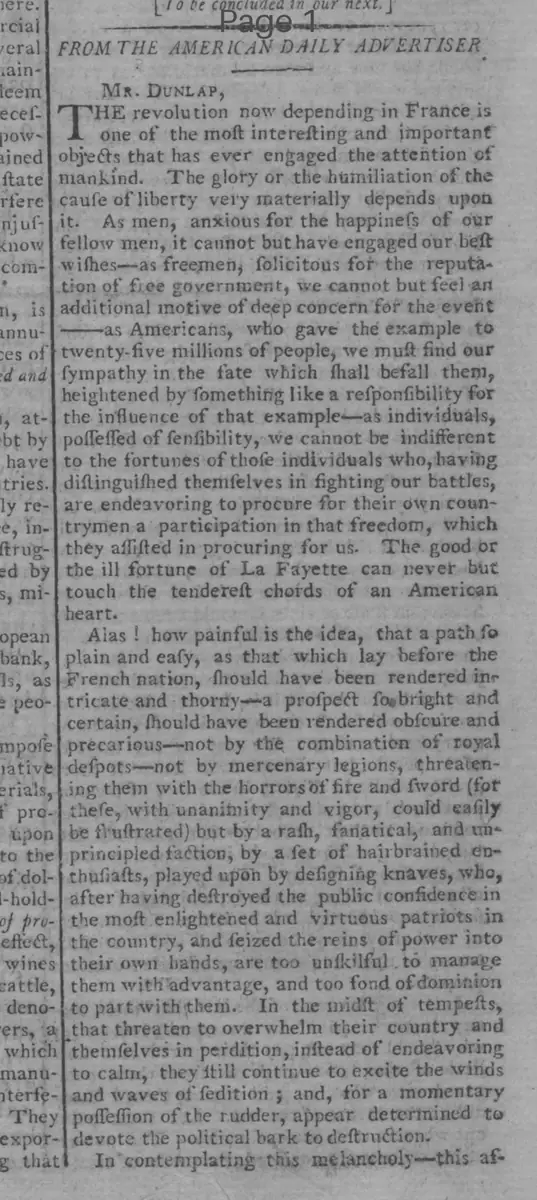
MR. DUNLAP,
THE revolution now depending in France is
one of the most interesting and important
objects that has ever engaged the attention of
mankind. The glory or the humiliation of the
cause of liberty very materially depends upon
it. As men, anxious for the happiness of our
fellow men, it cannot but have engaged our best
wishes—as freemen, solicitous for the reputa-
tion of free government, we cannot but feel an
additional motive of deep concern for the event
—as Americans, who gave the example to
twenty-five millions of people, we must find our
sympathy in the fate which shall befall them,
heightened by something like a responsibility for
the influence of that example—as individuals.
possessed of sensibility, we cannot be indifferent
to the fortunes of those individuals who, having
distinguished themselves in fighting our battles,
are endeavoring to procure for their own coun-
try-men a participation in that freedom, which
they assisted in procuring for us. The good or
the ill fortune of La Fayette can never but
touch the tenderest chords of an American
heart.
Alas! how painful is the idea, that a path so
plain and easy, as that which lay before the
French nation, should have been rendered in-
tricate and thorny—a prospect so bright and
certain, should have been rendered obscure and
precarious—not by the combination of royal
despots—not by mercenary legions, threaten-
ing them with the horrors of fire and sword (for
these, with unanimity and vigor, could easily
be frustrated) but by a rash, fanatical, and un-
principled faction, by a set of hairbrained en-
thusiasts, played upon by designing knaves, who.
after having destroyed the public confidence in
the most enlightened and virtuous patriots in
the country, and seized the reins of power into
their own hands, are too unskillful to manage
them with advantage, and too fond of dominion
to part with them. In the midst of tempests,
that threaten to overwhelm their country and
themselves in perdition, instead of endeavoring
to calm, they still continue to excite the winds
and waves of sedition; and, for a momentary
possession of the rudder, appear determined to
devote the political bark to destruction.
In contemplating this melancholy—this afflicting
and distressing scene, exhibited in another nation—amidst our prayers to the great Ruler of the universe to avert the danger which hangs over it—to still the rage of faction—harmonize the discordant councils, and protect the liberty and happiness of so large and interesting a portion of mankind—it is incumbent upon us, as prudent men, and citizens, to derive from it a solemn warning to ourselves—a lesson of caution, circumspection, and vigilance, for the direction of our own conduct.
It becomes every reflecting man in the United States, to ask himself this serious question,—are there not among us too many of a character exactly similar to the men, who have plunged the affairs of France into the extreme disorder and jeopardy, in which they are now involved? Are there not men among us, who seem discontented with every thing that bears the semblance of regular and stable government? who seem to have no other object, than to keep the community in an unsettled, convulsed, and feverish state? who call all government tyranny, resistance to constitutional and necessary laws, patriotism, the friends of the laws and of rational liberty aristocrates, conspirators, and despots? who seem to think the business of government consists in perpetual change? that to undo and to do over, are things of synonymous import? and that the people can never be happy or safe, but when they are uneasy and alarmed?
If there are such men among us—for the love of country, for the sake of peace, for the sake of every thing that is dear and precious to us as men, as fathers, and as citizens, let us be upon our guard against their machinations, let us watch them with eagle eye; let us listen with caution to their smooth and deceitful tales; let us withhold from them the means of doing mischief; let us put our confidence in those whom we have found the steady advocates for good government and good order—neither liberty nor property can be safe without both.
The present is a very momentous crisis in the affairs of the United States—factious men are unusually active & noisy—They prove by the violence of their efforts the violence of the disease—Let the event teach them that the citizens of these States have discernment enough to detect their designs, and steadiness enough to defeat them.
CATO.
What sub-type of article is it?
What themes does it cover?
What keywords are associated?
What entities or persons were involved?
Letter to Editor Details
Author
Cato
Recipient
Mr. Dunlap
Main Argument
the french revolution's turmoil from radical factions serves as a warning to americans to guard against similar domestic agitators who undermine stable government, urging vigilance, caution, and support for rational liberty and order.
Notable Details