Thank you for visiting SNEWPapers!
Sign up free
Editorial
March 27, 1920
Batesville Daily Guard
Batesville, Independence County, Arkansas
What is this article about?
William E. Towne's editorial promotes winning cooperation by providing mutual service, applying the law of compensation to personal relations and employment, urging efficient aid to others' goals for reciprocal benefits.
Clipping
OCR Quality
98%
Excellent
Full Text
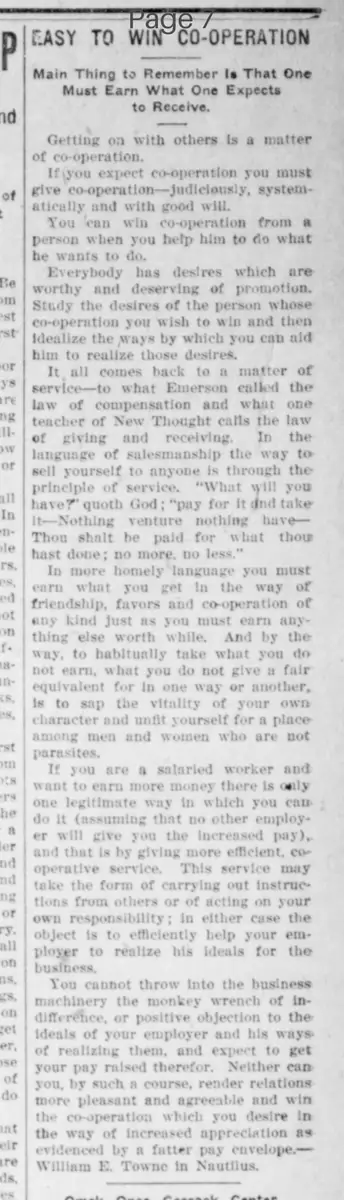
EASY TO WIN CO-OPERATION
Main Thing to Remember Is That One Must Earn What One Expects to Receive.
Getting on with others is a matter of co-operation. If you expect co-operation you must give co-operation—judiciously, systematically and with good will.
You can win co-operation from a person when you help him to do what he wants to do. Everybody has desires which are worthy and deserving of promotion. Study the desires of the person whose co-operation you wish to win and then idealize the ways by which you can aid him to realize those desires.
It all comes back to a matter of service—to what Emerson called the law of compensation and what one teacher of New Thought calls the law of giving and receiving. In the language of salesmanship the way to sell yourself to anyone is through the principle of service. "What will you have?" quoth God; "pay for it and take it—Nothing venture nothing have— Thou shalt be paid for what thou hast done; no more, no less."
In more homely language you must earn what you get in the way of friendship, favors and co-operation of any kind just as you must earn anything else worth while. And by the way, to habitually take what you do not earn, what you do not give a fair equivalent for in one way or another, is to sap the vitality of your own character and unfit yourself for a place among men and women who are not parasites.
If you are a salaried worker and want to earn more money there is only one legitimate way in which you can do it (assuming that no other employer will give you the increased pay), and that is by giving more efficient, co-operative service. This service may take the form of carrying out instructions from others or of acting on your own responsibility; in either case the object is to efficiently help your employer to realize his ideals for the business.
You cannot throw into the business machinery the monkey wrench of indifference, or positive objection to the ideals of your employer and his ways of realizing them, and expect to get your pay raised therefor. Neither can you, by such a course, render relations more pleasant and agreeable and win the co-operation which you desire in the way of increased appreciation as evidenced by a fatter pay envelope.—William E. Towne in Nautilus
Main Thing to Remember Is That One Must Earn What One Expects to Receive.
Getting on with others is a matter of co-operation. If you expect co-operation you must give co-operation—judiciously, systematically and with good will.
You can win co-operation from a person when you help him to do what he wants to do. Everybody has desires which are worthy and deserving of promotion. Study the desires of the person whose co-operation you wish to win and then idealize the ways by which you can aid him to realize those desires.
It all comes back to a matter of service—to what Emerson called the law of compensation and what one teacher of New Thought calls the law of giving and receiving. In the language of salesmanship the way to sell yourself to anyone is through the principle of service. "What will you have?" quoth God; "pay for it and take it—Nothing venture nothing have— Thou shalt be paid for what thou hast done; no more, no less."
In more homely language you must earn what you get in the way of friendship, favors and co-operation of any kind just as you must earn anything else worth while. And by the way, to habitually take what you do not earn, what you do not give a fair equivalent for in one way or another, is to sap the vitality of your own character and unfit yourself for a place among men and women who are not parasites.
If you are a salaried worker and want to earn more money there is only one legitimate way in which you can do it (assuming that no other employer will give you the increased pay), and that is by giving more efficient, co-operative service. This service may take the form of carrying out instructions from others or of acting on your own responsibility; in either case the object is to efficiently help your employer to realize his ideals for the business.
You cannot throw into the business machinery the monkey wrench of indifference, or positive objection to the ideals of your employer and his ways of realizing them, and expect to get your pay raised therefor. Neither can you, by such a course, render relations more pleasant and agreeable and win the co-operation which you desire in the way of increased appreciation as evidenced by a fatter pay envelope.—William E. Towne in Nautilus
What sub-type of article is it?
Social Reform
Moral Or Religious
What keywords are associated?
Co Operation
Service
Law Of Compensation
Giving And Receiving
Work Ethic
Self Improvement
What entities or persons were involved?
William E. Towne
Emerson
Editorial Details
Primary Topic
Winning Cooperation Through Service
Stance / Tone
Advisory And Exhortative
Key Figures
William E. Towne
Emerson
Key Arguments
Co Operation Requires Giving Co Operation Judiciously And With Good Will
Win Co Operation By Helping Others Realize Their Desires
Service Follows The Law Of Compensation And Giving And Receiving
Earn Friendship, Favors, And Co Operation Through Equivalent Service
Salaried Workers Earn More By Providing Efficient, Co Operative Service
Indifference Or Objection To Employer's Ideals Hinders Advancement