Thank you for visiting SNEWPapers!
Sign up free
Editorial
August 15, 1836
Lynchburg Virginian
Lynchburg, Virginia
What is this article about?
This editorial defends General William Henry Harrison's military reputation and personal character against attacks from Van Buren supporters during the 1836 presidential campaign. It cites historical praises from figures like Madison, Shelby, Perry, and Congress, while supporting Judge White as the preferred candidate. It also questions attacks on Harrison versus White and retorts to the Enquirer on military actions.
Clipping
OCR Quality
95%
Excellent
Full Text
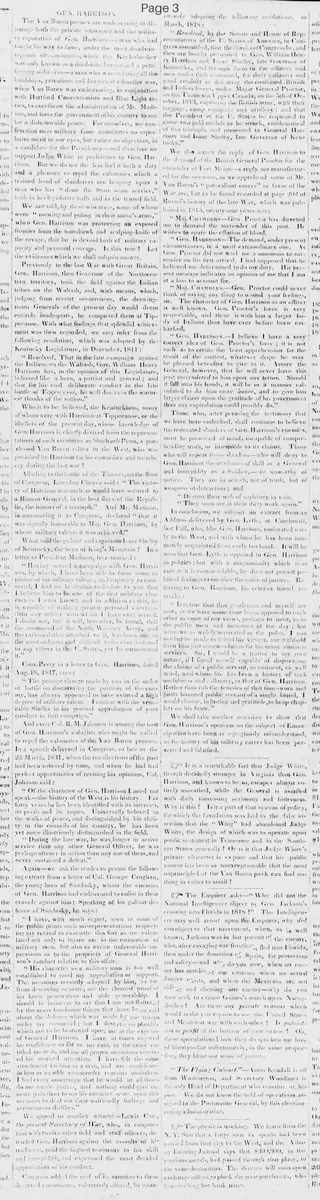
The Van Buren presses are endeavoring to disparage both the private character and the military reputation of Gen. Harrison—a man who fought his way to fame, under the most disadvantageous circumstances, when the Kinderhooker was only known as a third-rate lawyer at a pettifogging politician—a man who was undergoing all the hardships, privations and dangers of a frontier war, when Van Buren was endeavoring, in conjunction with Hartford Conventionists and Blue Light tories, to overthrow the administration of Mr. Madison, and force the government of his country to sue for a dishonorable peace. For ourselves, we confess that mere military fame constitutes no superlative merit in our eyes, but rather an objection, in a candidate for the Presidency—and therefore we support Judge White in preference to Gen. Harrison. But we do not the less feel it both a duty and a pleasure to repel the calumnies which a trained band of slanderers are heaping upon a man who has "done the State some service," both in her legislative halls and in the tented field.
We are told, by these wiseacres, some of whom were "mewing and puling in their nurse's arms," when Gen. Harrison was protecting an exposed frontier from the tomahawk and scalping-knife of the savage, that he is devoid both of military capacity and personal courage. Is this true? Let the evidences which we shall subjoin answer.
Previously to the last War with Great Britain, Gen. Harrison, then Governor of the Northwestern territory, took the field against the Indian tribes on the Wabash, and, with means, which, judging from recent occurrences, the drawing-room Generals of the present day would deem entirely inadequate, he conquered them at Tippecanoe. With what feelings that splendid achievement was then regarded, we may infer from the following resolution, which was adopted by the Kentucky Legislature, in December, 1811:
"Resolved, That in the late campaign against the Indians on the Wabash, Gov. William Henry Harrison has, in the opinion of this Legislature, behaved like a hero, a patriot and general; and that for his cool deliberate conduct in the late battle of Tippecanoe, he well deserves the warmest thanks of the nation."
Who is to be believed, the Kentuckians, many of whom were with Harrison at Tippecanoe, or the libellers of the present day, whose knowledge of Gen. Harrison is chiefly derived from the representations of such creatures as Shadrach Penn, a purchased Van Buren editor in the West, who was punished by Harrison for his cowardice and treachery during the last war?
Alluding to the battle of the Thames, on the floor of Congress, Langdon Cheves said: "The victory of Harrison was such as would have secured to a Roman General, in the best days of the Republic, the honors of a triumph." And Mr. Madison, in announcing it to Congress, declared "that it was signally honorable to Maj. Gen. Harrison, by whose military talents it was achieved."
What said the gallant and sagacious Isaac Shelby of Kentucky, the hero of King's Mountain? In a letter to President Madison, he remarked:
"Having served a campaign with Gen. Harrison, by which, I have been able to form some estimation of his military talents, and capacity to command, I feel no hesitation to declare to you that I believe him to be one of the first military characters I ever knew: and in addition to this, he is capable of making greater personal exertions than any officer with whom I have ever served. I doubt not, but it will, hereafter, be found, that the command of the North Western Army, and the various duties attached to it, has been one of the most arduous and difficult tasks ever assigned to any officer in the U. States, yet he surmounted it."
Com. Perry in a letter to Gen. Harrison, dated Aug. 18, 1813, says:
"The prompt change made by you in the order of battle on discovering the position of the enemy, has always appeared to me to have evinced a high degree of military talent. I concur with the venerable Shelby in his general approbation of your conduct in that campaign."
And even Col. R. M. Johnson is among the host of Gen. Harrison's eulogists who might be called to repel the calumnies of the Van Buren presses. In a speech delivered in Congress, so late as the 22d March, 1831, when the recollections of the past had been sobered by time, and when he had had perfect opportunities of revising his opinions, Col. Johnson said:
"Of the character of Gen. Harrison I need not speak—the history of the West is his history. For forty years he has been identified with its interests, its perils and its hopes. Universally beloved in the walks of peace, and distinguished by his ability in the councils of his country, he has been yet more illustriously distinguished in the field.
"During the late war, he was longer in active service than any other General Officer, he was perhaps oftener in action than any one of them, and never sustained a defeat."
Again—we ask the reader to peruse the following extract from a letter of Col. George Croghan, the young hero of Sandusky, whom the enemies of Gen. Harrison had endeavored to enlist in their crusade against him: Speaking of his gallant defence of Sandusky, he says:
"I have, with much regret, seen in some of the public prints such misrepresentations respecting my refusal to evacuate this fort as are calculated not only to injure me in the estimation of military men, but also to excite unfavorable impressions as to the propriety of General Harrison's conduct relative to this affair.
"His character as a military man is too well established to need my approbation or support. The measures recently adopted by him, so far from deserving censure, are the clearest proof of his keen penetration and able generalship. I should be insincere to say that I am not flattered by the many handsome things that have been said about the defence which was made by the troops under my command; but I deserve no plaudits which are to be bestowed upon me at the expense of General Harrison. I have at times enjoyed his confidence so far as my rank in the army entitled me to it, and on all proper occasions received his marked attention. I have felt the same attachment for him as a man, and my confidence in him as an able commander remains unshaken. I feel every assurance that he would at all times do me ample justice, and nothing could give me more pain than to see his enemies seize upon this occasion to deal out their unfriendly feelings and acrimonious dislikes."
We appeal to another witness—Lewis Cass, the present Secretary of War, who, in conjunction with twelve other field and staff officers, defended Gen. Harrison against the assaults of his traducers, paid the highest testimony to his skill and intrepidity, and expressed the most decided approbation of his conduct.
Congress added the seal of its sanction to these testimonials, voluntarily offered, by unanimously adopting the following resolutions, on 3d March, 1818:
"Resolved, by the Senate and House of Representatives of the U. States of America, in Congress assembled, that the thanks of Congress be, and they are hereby presented to Gen. William Henry Harrison and Isaac Shelby, late Governor of Kentucky, and through them to the officers and men under their command, for their gallantry and good conduct in defeating the combined British and Indian forces, under Major General Proctor, on the Thames in Upper Canada, on the 5th of October, 1813, capturing the British army, with their baggage, camp equipage and artillery: and that the President of the U. States be requested to cause two gold medals to be struck, emblematical of this triumph, and presented to General Harrison and Isaac Shelby, late Governor of Kentucky."
We also annex the reply of Gen. Harrison to the demand of the British General Proctor for the surrender of Fort Meigs—a reply not manufactured for the occasion, as we apprehend some of Mr. Van Buren's "pot-valiant essays" in favor of the War are, but to be found recorded at page 202 of Russell's history of the late War, which was published in 1815, twenty-one years ago:
"Maj. Dickson—Gen. Proctor has directed me to demand the surrender of this post. He wishes to spare the effusion of blood.
"Gen. Harrison—The demand, under present circumstances, is a most extraordinary one. As Gen. Proctor did not send me a summons to surrender on his first arrival, I had supposed that he believed me determined to do my duty. His present message indicates an opinion of me that I am at a loss to account for.
"Maj. Dickson—Gen. Proctor could never think of saying any thing to wound your feelings, sir. The character of Gen. Harrison as an officer is well known. Gen. Proctor's force is very respectable, and there is with him a larger body of Indians than have ever before been embarked.
"Gen. Harrison—I believe I have a very correct idea of Gen. Proctor's force; it is not such as to create the least apprehension for the result of the contest, whatever shape he may be pleased hereafter to give to it. Assure the General, however, that he will never have this post surrendered to him upon any terms. Should it fall into his hands, it will be in a manner calculated to do him more honor, and to give him larger claims upon the gratitude of his government than any capitulation could possibly do."
Those who, after perusing the testimony that we have here embodied, shall continue to believe the reiterated slanders of Gen. Harrison's enemies, must be possessed of minds incapable of comprehending truth, or insensible to its claims. Those who will repeat those slanders—who will deny to Gen. Harrison the attributes of skill as a General and intrepidity as a Soldier,—are unworthy of notice. They are in search, not of truth, but of weapons of detraction; and
"Destroy their web of sophistry in vain.
"They soon are at their dirty work again."
In conclusion, we subjoin an extract from an Address delivered by Gen. Lytle, at Cincinnati, last Fall, who, like Gen. Harrison, emigrated early to the West, and with whom he has been intimately acquainted from early boyhood. It will be seen that Gen. Lytle is opposed to Gen. Harrison in politics; but with a magnanimity which is as rare as it is commendable, he does not permit political feelings to smother the voice of justice. Referring to Gen. Harrison, his veteran friend remarks:
"It is true that that gentleman and myself are now, as we have some time been, opposed to each other in some of our views, perhaps in most, as to the public men and measures of the day; but were we as widely separated as the poles, I can neither be made to forget his virtues, nor withhold from him just commendation for his many eminent services. Sir, I would be a traitor to my own nature, if I found myself capable of disparaging the claims of a public servant, so eminent, so well tried, and whose life has been a history of such usefulness and gallantry, as that of Gen. Harrison. Rather than rob the temples of that time-worn and justly honored public servant of a single laurel, I would choose, in justice and gratitude, to heap chaplets on his brow."
We shall take another occasion to show that Gen. Harrison's opinions on the subject of Emancipation have been as egregiously misunderstood, as the history of his military career has been perverted and falsified.
It is a remarkable fact that Judge White, though decidedly stronger in Virginia than Gen. Harrison, and known to be so, escapes almost entirely unscathed, while the General is assailed with daily increasing acrimony and bitterness. Why is this? Is it a part of that system of policy, for which the foundation was laid in the false assertion that the "Whig" had abandoned Judge White, the design of which was to operate upon public sentiment in Tennessee and in the Southern States generally? Or is it that Judge White's private character is so pure and his public course has been so unexceptionable that the most unprincipled of the Van Buren pack can find nothing in either to assail?
The Enquirer asks—"Why did not the National Intelligencer object to Gen. Jackson's crossing into Florida in 1818?" The Intelligencer may well retort upon the Enquirer, why did you object to that movement, when, as well known, Jackson was in hot pursuit of the enemy, who, after ravaging our frontier, fled into Florida, then under the dominion of Spain, for protection and safety—and why do you now, when no enemy has murdered our citizens, when no actual danger exists, and when the Mexicans are not aiding and abetting our enemy—why do you now seek to excuse Gaines's march upon Nacogdoches? Are there any private reasons which would make you rejoice to see the United States and Mexico at war with each other? Is patriotism or profit at the bottom of your course? Oh, these speculations! how they do quicken our love of liberty—but unfortunately, in the same proportion, they blunt our sense of justice.
We are told, by these wiseacres, some of whom were "mewing and puling in their nurse's arms," when Gen. Harrison was protecting an exposed frontier from the tomahawk and scalping-knife of the savage, that he is devoid both of military capacity and personal courage. Is this true? Let the evidences which we shall subjoin answer.
Previously to the last War with Great Britain, Gen. Harrison, then Governor of the Northwestern territory, took the field against the Indian tribes on the Wabash, and, with means, which, judging from recent occurrences, the drawing-room Generals of the present day would deem entirely inadequate, he conquered them at Tippecanoe. With what feelings that splendid achievement was then regarded, we may infer from the following resolution, which was adopted by the Kentucky Legislature, in December, 1811:
"Resolved, That in the late campaign against the Indians on the Wabash, Gov. William Henry Harrison has, in the opinion of this Legislature, behaved like a hero, a patriot and general; and that for his cool deliberate conduct in the late battle of Tippecanoe, he well deserves the warmest thanks of the nation."
Who is to be believed, the Kentuckians, many of whom were with Harrison at Tippecanoe, or the libellers of the present day, whose knowledge of Gen. Harrison is chiefly derived from the representations of such creatures as Shadrach Penn, a purchased Van Buren editor in the West, who was punished by Harrison for his cowardice and treachery during the last war?
Alluding to the battle of the Thames, on the floor of Congress, Langdon Cheves said: "The victory of Harrison was such as would have secured to a Roman General, in the best days of the Republic, the honors of a triumph." And Mr. Madison, in announcing it to Congress, declared "that it was signally honorable to Maj. Gen. Harrison, by whose military talents it was achieved."
What said the gallant and sagacious Isaac Shelby of Kentucky, the hero of King's Mountain? In a letter to President Madison, he remarked:
"Having served a campaign with Gen. Harrison, by which, I have been able to form some estimation of his military talents, and capacity to command, I feel no hesitation to declare to you that I believe him to be one of the first military characters I ever knew: and in addition to this, he is capable of making greater personal exertions than any officer with whom I have ever served. I doubt not, but it will, hereafter, be found, that the command of the North Western Army, and the various duties attached to it, has been one of the most arduous and difficult tasks ever assigned to any officer in the U. States, yet he surmounted it."
Com. Perry in a letter to Gen. Harrison, dated Aug. 18, 1813, says:
"The prompt change made by you in the order of battle on discovering the position of the enemy, has always appeared to me to have evinced a high degree of military talent. I concur with the venerable Shelby in his general approbation of your conduct in that campaign."
And even Col. R. M. Johnson is among the host of Gen. Harrison's eulogists who might be called to repel the calumnies of the Van Buren presses. In a speech delivered in Congress, so late as the 22d March, 1831, when the recollections of the past had been sobered by time, and when he had had perfect opportunities of revising his opinions, Col. Johnson said:
"Of the character of Gen. Harrison I need not speak—the history of the West is his history. For forty years he has been identified with its interests, its perils and its hopes. Universally beloved in the walks of peace, and distinguished by his ability in the councils of his country, he has been yet more illustriously distinguished in the field.
"During the late war, he was longer in active service than any other General Officer, he was perhaps oftener in action than any one of them, and never sustained a defeat."
Again—we ask the reader to peruse the following extract from a letter of Col. George Croghan, the young hero of Sandusky, whom the enemies of Gen. Harrison had endeavored to enlist in their crusade against him: Speaking of his gallant defence of Sandusky, he says:
"I have, with much regret, seen in some of the public prints such misrepresentations respecting my refusal to evacuate this fort as are calculated not only to injure me in the estimation of military men, but also to excite unfavorable impressions as to the propriety of General Harrison's conduct relative to this affair.
"His character as a military man is too well established to need my approbation or support. The measures recently adopted by him, so far from deserving censure, are the clearest proof of his keen penetration and able generalship. I should be insincere to say that I am not flattered by the many handsome things that have been said about the defence which was made by the troops under my command; but I deserve no plaudits which are to be bestowed upon me at the expense of General Harrison. I have at times enjoyed his confidence so far as my rank in the army entitled me to it, and on all proper occasions received his marked attention. I have felt the same attachment for him as a man, and my confidence in him as an able commander remains unshaken. I feel every assurance that he would at all times do me ample justice, and nothing could give me more pain than to see his enemies seize upon this occasion to deal out their unfriendly feelings and acrimonious dislikes."
We appeal to another witness—Lewis Cass, the present Secretary of War, who, in conjunction with twelve other field and staff officers, defended Gen. Harrison against the assaults of his traducers, paid the highest testimony to his skill and intrepidity, and expressed the most decided approbation of his conduct.
Congress added the seal of its sanction to these testimonials, voluntarily offered, by unanimously adopting the following resolutions, on 3d March, 1818:
"Resolved, by the Senate and House of Representatives of the U. States of America, in Congress assembled, that the thanks of Congress be, and they are hereby presented to Gen. William Henry Harrison and Isaac Shelby, late Governor of Kentucky, and through them to the officers and men under their command, for their gallantry and good conduct in defeating the combined British and Indian forces, under Major General Proctor, on the Thames in Upper Canada, on the 5th of October, 1813, capturing the British army, with their baggage, camp equipage and artillery: and that the President of the U. States be requested to cause two gold medals to be struck, emblematical of this triumph, and presented to General Harrison and Isaac Shelby, late Governor of Kentucky."
We also annex the reply of Gen. Harrison to the demand of the British General Proctor for the surrender of Fort Meigs—a reply not manufactured for the occasion, as we apprehend some of Mr. Van Buren's "pot-valiant essays" in favor of the War are, but to be found recorded at page 202 of Russell's history of the late War, which was published in 1815, twenty-one years ago:
"Maj. Dickson—Gen. Proctor has directed me to demand the surrender of this post. He wishes to spare the effusion of blood.
"Gen. Harrison—The demand, under present circumstances, is a most extraordinary one. As Gen. Proctor did not send me a summons to surrender on his first arrival, I had supposed that he believed me determined to do my duty. His present message indicates an opinion of me that I am at a loss to account for.
"Maj. Dickson—Gen. Proctor could never think of saying any thing to wound your feelings, sir. The character of Gen. Harrison as an officer is well known. Gen. Proctor's force is very respectable, and there is with him a larger body of Indians than have ever before been embarked.
"Gen. Harrison—I believe I have a very correct idea of Gen. Proctor's force; it is not such as to create the least apprehension for the result of the contest, whatever shape he may be pleased hereafter to give to it. Assure the General, however, that he will never have this post surrendered to him upon any terms. Should it fall into his hands, it will be in a manner calculated to do him more honor, and to give him larger claims upon the gratitude of his government than any capitulation could possibly do."
Those who, after perusing the testimony that we have here embodied, shall continue to believe the reiterated slanders of Gen. Harrison's enemies, must be possessed of minds incapable of comprehending truth, or insensible to its claims. Those who will repeat those slanders—who will deny to Gen. Harrison the attributes of skill as a General and intrepidity as a Soldier,—are unworthy of notice. They are in search, not of truth, but of weapons of detraction; and
"Destroy their web of sophistry in vain.
"They soon are at their dirty work again."
In conclusion, we subjoin an extract from an Address delivered by Gen. Lytle, at Cincinnati, last Fall, who, like Gen. Harrison, emigrated early to the West, and with whom he has been intimately acquainted from early boyhood. It will be seen that Gen. Lytle is opposed to Gen. Harrison in politics; but with a magnanimity which is as rare as it is commendable, he does not permit political feelings to smother the voice of justice. Referring to Gen. Harrison, his veteran friend remarks:
"It is true that that gentleman and myself are now, as we have some time been, opposed to each other in some of our views, perhaps in most, as to the public men and measures of the day; but were we as widely separated as the poles, I can neither be made to forget his virtues, nor withhold from him just commendation for his many eminent services. Sir, I would be a traitor to my own nature, if I found myself capable of disparaging the claims of a public servant, so eminent, so well tried, and whose life has been a history of such usefulness and gallantry, as that of Gen. Harrison. Rather than rob the temples of that time-worn and justly honored public servant of a single laurel, I would choose, in justice and gratitude, to heap chaplets on his brow."
We shall take another occasion to show that Gen. Harrison's opinions on the subject of Emancipation have been as egregiously misunderstood, as the history of his military career has been perverted and falsified.
It is a remarkable fact that Judge White, though decidedly stronger in Virginia than Gen. Harrison, and known to be so, escapes almost entirely unscathed, while the General is assailed with daily increasing acrimony and bitterness. Why is this? Is it a part of that system of policy, for which the foundation was laid in the false assertion that the "Whig" had abandoned Judge White, the design of which was to operate upon public sentiment in Tennessee and in the Southern States generally? Or is it that Judge White's private character is so pure and his public course has been so unexceptionable that the most unprincipled of the Van Buren pack can find nothing in either to assail?
The Enquirer asks—"Why did not the National Intelligencer object to Gen. Jackson's crossing into Florida in 1818?" The Intelligencer may well retort upon the Enquirer, why did you object to that movement, when, as well known, Jackson was in hot pursuit of the enemy, who, after ravaging our frontier, fled into Florida, then under the dominion of Spain, for protection and safety—and why do you now, when no enemy has murdered our citizens, when no actual danger exists, and when the Mexicans are not aiding and abetting our enemy—why do you now seek to excuse Gaines's march upon Nacogdoches? Are there any private reasons which would make you rejoice to see the United States and Mexico at war with each other? Is patriotism or profit at the bottom of your course? Oh, these speculations! how they do quicken our love of liberty—but unfortunately, in the same proportion, they blunt our sense of justice.
What sub-type of article is it?
Partisan Politics
Military Affairs
What keywords are associated?
Harrison Defense
Military Reputation
Van Buren Slander
Tippecanoe Battle
Thames Victory
War Of 1812
Judge White Support
Presidential Campaign
What entities or persons were involved?
Gen. Harrison
Van Buren
Judge White
Mr. Madison
Isaac Shelby
Com. Perry
Col. R. M. Johnson
Col. George Croghan
Lewis Cass
Gen. Lytle
Gen. Jackson
Gen. Gaines
Editorial Details
Primary Topic
Defense Of Gen. Harrison's Military Reputation Against Van Buren Slander
Stance / Tone
Strongly Supportive Of Harrison's Character And Service, Critical Of Van Buren Supporters
Key Figures
Gen. Harrison
Van Buren
Judge White
Mr. Madison
Isaac Shelby
Com. Perry
Col. R. M. Johnson
Col. George Croghan
Lewis Cass
Gen. Lytle
Gen. Jackson
Gen. Gaines
Key Arguments
Harrison's Achievements At Tippecanoe Praised By Kentucky Legislature In 1811
Victory At Thames Lauded By Langdon Cheves And Madison
Shelby Praises Harrison's Military Talents And Exertions
Perry Commends Harrison's Tactical Decisions
Johnson Highlights Harrison's Undefeated Service In The War Of 1812
Croghan Defends Harrison's Generalship At Sandusky
Cass And Officers Approve Harrison's Conduct
Congress Thanks Harrison And Awards Medals For Thames Victory In 1818
Harrison's Defiant Reply To Proctor At Fort Meigs
Lytle Praises Harrison Despite Political Differences