Thank you for visiting SNEWPapers!
Sign up free
Jenks' Portland Gazette
Portland, Cumberland County, Maine
What is this article about?
A catastrophic storm and flood struck Funchal, Madeira on October 9, killing around 800 people, destroying vineyards, wine stores worth 10,000 pipes, and property exceeding one million pounds sterling. The small town of Machico was also ruined.
Clipping
OCR Quality
Full Text
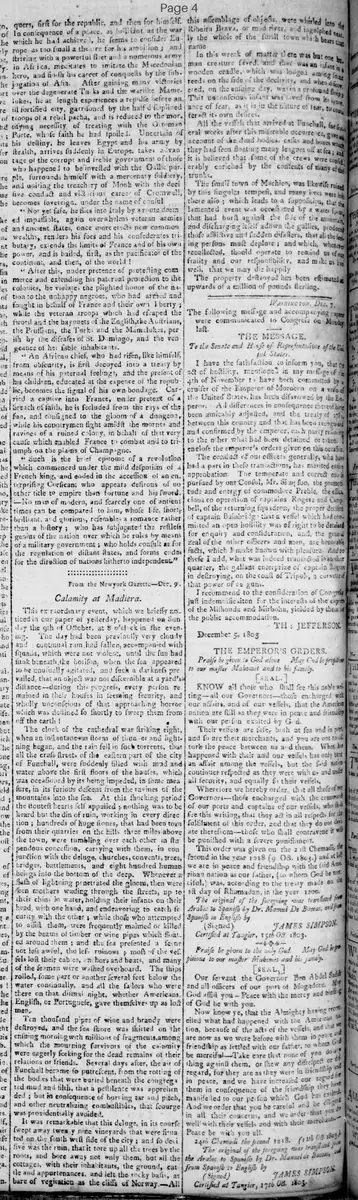
Calamity at Madeira.
This extraordinary event, which we briefly noticed in our paper of yesterday, happened on Sunday the 9th of October, at 8 o'clock in the evening. The day had been previously very cloudy and continual rain had fallen, accompanied with squalls, which were not violent, until the sun had sunk beneath the horizon, when the sea appeared to be unusually agitated, and such a darkness prevailed, that an object was not discernible at a yard's distance--during this progress, every person remained in their houses in seeming security, and wholly unconscious of that approaching horror which was destined so shortly to sweep them from off the earth!
The clock of the cathedral was striking eight, when an instantaneous storm of thunder and lightning began, and the rain fell in such torrents, that all the cross streets of those eastern part of the city of Funchal, were suddenly filled with mud and water above the first floors of the houses, which was occasioned by its being impeded, in some measure, in its furious descent from the ravines of the mountains into the sea. At this shocking period the stoutest hearts felt appalled: nothing was to be heard but the din of ruin, working in every direction; hundreds of huge stones, that had been torn from their quarries on the hills three miles above the town, were tumbling over each other in tremendous concussion, carrying with them, in conjunction with the deluge, churches, convents, trees, bridges, battlements, and eight hundred human beings into the bottom of the deep. Whenever a flash of lightning penetrated the gloom, then were seen mothers wading through the streets, up to their chins in water, holding their infants on their head, with one hand, and endeavoring to catch security with the other: while those who attempted to assist them, were frequently maimed or killed by the beams of timber or wine pipes which floated around them; and the sea presented a scene not less awful, though less ruinous: most of the vessels lost their cables, anchors and boats, and many of the seamen were washed overboard. The ships rolled, some part or another several feet below the water continually, and all the sailors who were there on that dismal night, whether Americans, English, or Portuguese, gave themselves up as lost men.
Ten thousand pipes of wine and brandy were destroyed, and the sea shore was strewed on the ensuing morning with millions of fragments, among which the mourning survivors of the calamity were eagerly seeking for the dead remains of their relations or friends. Several days after, the air of Funchal became so putrescent, from the rotting of the bodies that were buried beneath the congregated mud and filth, that a pestilence was apprehended; but in consequence of burning tar and pitch, and other neutralizing combustibles, that scourge was providentially avoided.
It was remarkable that this deluge, in its course swept away twenty nine vineyards that were situated on the south west side of the city; and so decisive was the ruin, that it tore up all the trees by the roots, and bore away not only them, but all the cottages, with their inhabitants, the ground, cattle and appurtenances, and left the rocky basis, as bare of vegetation as the cliffs of Norway. All this assemblage of objects, were whirled into the Ribeira Brava or mad river and engulfed by the whole of the small town which bears that name.
In this wreck of matter there was but one human creature saved, which was an infant in a wooden cradle, that was lodged among the infant on the side of the declivity and when discovered unconscious on the ensuing day was in a profound sleep our protector to counteract its own desires.
All the vessels that arrived at Funchal, for several accounts weeks after the dead bodies miserable casks occurred and boxes etc. gave us which they had seen floating many leagues off at sea and it is believed that some of the crews were considerably enriched by the contents of many of the trunks.
The small town of Machico, was likewise ruined by this singular tempest, and many lives were lost there also; which leads to a supposition, that the lamented event was occasioned by a water spout that had burst against the side of the mountain, and discharging itself adown the gullies, produced those afflicting and sudden disasters, that all the feeling persons must deplore; and which, whenever recollected, should operate to remind us of our frailty and our responsibility, and make us live well. that we may die happily
The property destroyed has been estimated upwards of a million of pounds sterling.
What sub-type of article is it?
What keywords are associated?
Where did it happen?
Foreign News Details
Primary Location
Funchal, Madeira
Event Date
Sunday The 9th Of October
Outcome
eight hundred human beings killed in funchal, many more in machico; ten thousand pipes of wine and brandy destroyed; twenty-nine vineyards swept away; property loss estimated upwards of a million pounds sterling; one infant miraculously saved.
Event Details
A sudden violent storm with thunder, lightning, and torrential rain struck Funchal at 8 PM, causing floods from mountain ravines that filled streets with mud and water, dislodged huge stones, and carried away buildings, people, and debris into the sea. Vessels at anchor suffered damage and loss of crew. The deluge also destroyed the town of Ribeira Brava and Machico, likely caused by a waterspout bursting on the mountain.