Thank you for visiting SNEWPapers!
Sign up free
Story
October 18, 1925
Casper Daily Tribune
Casper, Natrona County, Wyoming
What is this article about?
Article challenges the myth of Columbus discovering America, highlighting evidence of earlier European and possibly African contacts, including Norse landings, Danish expedition in 1472, and Columbus's prior knowledge from sailors.
Clipping
OCR Quality
75%
Good
Full Text
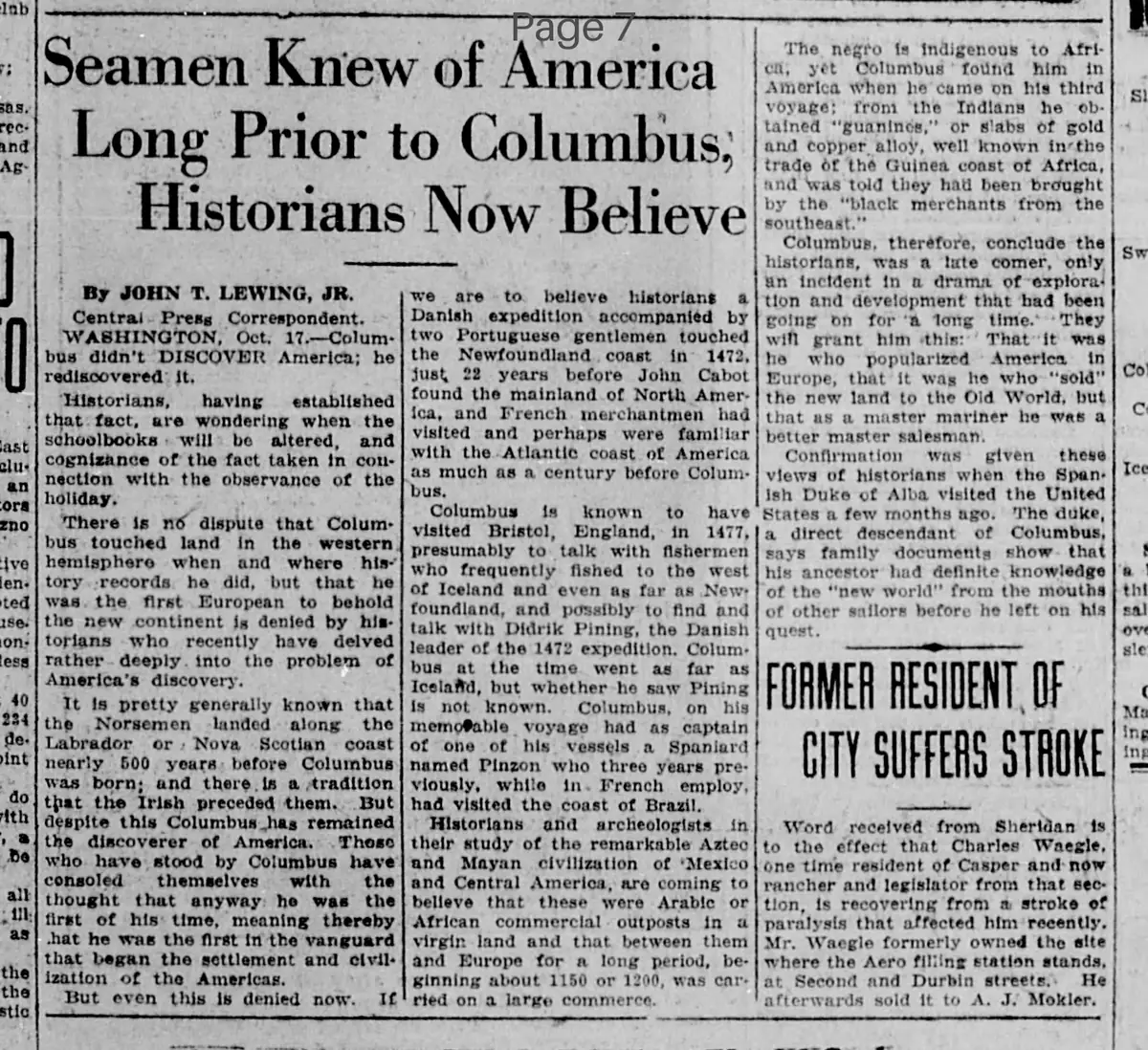
By JOHN T. LEWING, JR.
Central-Press Correspondent.
WASHINGTON, Oct. 17.-Columbus didn't DISCOVER America; he rediscovered it.
Historians, having established that fact, are wondering when the schoolbooks will be altered and cognizance of the fact taken in connection with the observance of the holiday.
There is no dispute that Columbus touched land in the western hemisphere when and where history records he did, but that he was the first European to behold the new continent is denied by historians who recently have delved rather deeply into the problem of America's discovery.
It is pretty generally known that the Norsemen landed along the Labrador or Nova Scotian coast nearly 500 years before Columbus was born; and there is a tradition that the Irish preceded them. But despite this Columbus has remained the discoverer of America. Those who have stood by Columbus have consoled themselves with the thought that anyway he was the first of his time, meaning thereby that he was the first in the vanguard that began the settlement and civilization of the Americas.
But even this is denied now. If we are to believe historians a Danish expedition accompanied by two Portuguese gentlemen touched the Newfoundland coast in 1472, just 22 years before John Cabot found the mainland of North America, and French merchantmen had visited and perhaps were familiar with the Atlantic coast of America as much as a century before Columbus.
Columbus is known to have visited Bristol, England, in 1477, presumably to talk with fishermen who frequently fished to the west of Iceland and even as far as Newfoundland, and possibly to find and talk with Didrik Pining, the Danish leader of the 1472 expedition. Columbus at the time went as far as Iceland, but whether he saw Pining is not known. Columbus, on his memorable voyage had as captain of one of his vessels a Spaniard named Pinzon who three years previously, while in French employ, had visited the coast of Brazil.
Historians and archeologists in their study of the remarkable Aztec and Mayan civilization of Mexico and Central America, are coming to believe that these were Arabic or African commercial outposts in a virgin land and that between them and Europe for a long period, beginning about 1150 or 1200, was carried on a large commerce.
The negro is indigenous to Africa, yet Columbus found him in America when he came on his third voyage; from the Indians he obtained "guanines," or slabs of gold and copper alloy, well known in the trade of the Guinea coast of Africa, and was told they had been brought by the "black merchants from the southeast."
Columbus, therefore, conclude the historians, was a late comer, only an incident in a drama of exploration and development that had been going on for a long time. They will grant him this: That it was he who popularized America in Europe, that it was he who "sold" the new land to the Old World, but that as a master mariner he was a better master salesman.
Confirmation was given these views of historians when the Spanish Duke of Alba visited the United States a few months ago. The duke, a direct descendant of Columbus, says family documents show that his ancestor had definite knowledge of the "new world" from the mouths of other sailors before he left on his quest.
Central-Press Correspondent.
WASHINGTON, Oct. 17.-Columbus didn't DISCOVER America; he rediscovered it.
Historians, having established that fact, are wondering when the schoolbooks will be altered and cognizance of the fact taken in connection with the observance of the holiday.
There is no dispute that Columbus touched land in the western hemisphere when and where history records he did, but that he was the first European to behold the new continent is denied by historians who recently have delved rather deeply into the problem of America's discovery.
It is pretty generally known that the Norsemen landed along the Labrador or Nova Scotian coast nearly 500 years before Columbus was born; and there is a tradition that the Irish preceded them. But despite this Columbus has remained the discoverer of America. Those who have stood by Columbus have consoled themselves with the thought that anyway he was the first of his time, meaning thereby that he was the first in the vanguard that began the settlement and civilization of the Americas.
But even this is denied now. If we are to believe historians a Danish expedition accompanied by two Portuguese gentlemen touched the Newfoundland coast in 1472, just 22 years before John Cabot found the mainland of North America, and French merchantmen had visited and perhaps were familiar with the Atlantic coast of America as much as a century before Columbus.
Columbus is known to have visited Bristol, England, in 1477, presumably to talk with fishermen who frequently fished to the west of Iceland and even as far as Newfoundland, and possibly to find and talk with Didrik Pining, the Danish leader of the 1472 expedition. Columbus at the time went as far as Iceland, but whether he saw Pining is not known. Columbus, on his memorable voyage had as captain of one of his vessels a Spaniard named Pinzon who three years previously, while in French employ, had visited the coast of Brazil.
Historians and archeologists in their study of the remarkable Aztec and Mayan civilization of Mexico and Central America, are coming to believe that these were Arabic or African commercial outposts in a virgin land and that between them and Europe for a long period, beginning about 1150 or 1200, was carried on a large commerce.
The negro is indigenous to Africa, yet Columbus found him in America when he came on his third voyage; from the Indians he obtained "guanines," or slabs of gold and copper alloy, well known in the trade of the Guinea coast of Africa, and was told they had been brought by the "black merchants from the southeast."
Columbus, therefore, conclude the historians, was a late comer, only an incident in a drama of exploration and development that had been going on for a long time. They will grant him this: That it was he who popularized America in Europe, that it was he who "sold" the new land to the Old World, but that as a master mariner he was a better master salesman.
Confirmation was given these views of historians when the Spanish Duke of Alba visited the United States a few months ago. The duke, a direct descendant of Columbus, says family documents show that his ancestor had definite knowledge of the "new world" from the mouths of other sailors before he left on his quest.
What sub-type of article is it?
Historical Event
Curiosity
What themes does it cover?
Exploration
What keywords are associated?
Columbus Rediscovery
Pre Columbian Exploration
Norsemen Landing
Danish Expedition
African Commerce
Historical Correction
What entities or persons were involved?
Columbus
John Cabot
Didrik Pining
Pinzon
Duke Of Alba
Where did it happen?
Western Hemisphere
Story Details
Key Persons
Columbus
John Cabot
Didrik Pining
Pinzon
Duke Of Alba
Location
Western Hemisphere
Event Date
Various Dates Including 1472 And 1477
Story Details
Historians argue Columbus rediscovered America, not discovered it, citing earlier Norse, Irish, Danish, Portuguese, and French explorations, as well as possible African commerce. Columbus gained knowledge from prior sailors and popularized the continent in Europe.