Thank you for visiting SNEWPapers!
Sign up free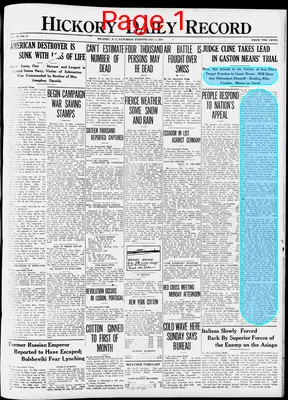
Hickory Daily Record
Hickory, Catawba County, North Carolina
What is this article about?
In Concord court, Judge Cline intervenes in the tense cross-examination of Gaston B. Means, charged with murdering Mrs. Maude A. King, ordering the sheriff to maintain order and conducting questioning himself. Means testifies about loans to King and details the accidental shooting during a car outing.
Merged-components note: Merged split coverage of Gaston Means murder trial; text flows continuously from headline to detailed testimony, same topic and spatial adjacency.
Clipping
OCR Quality
Full Text
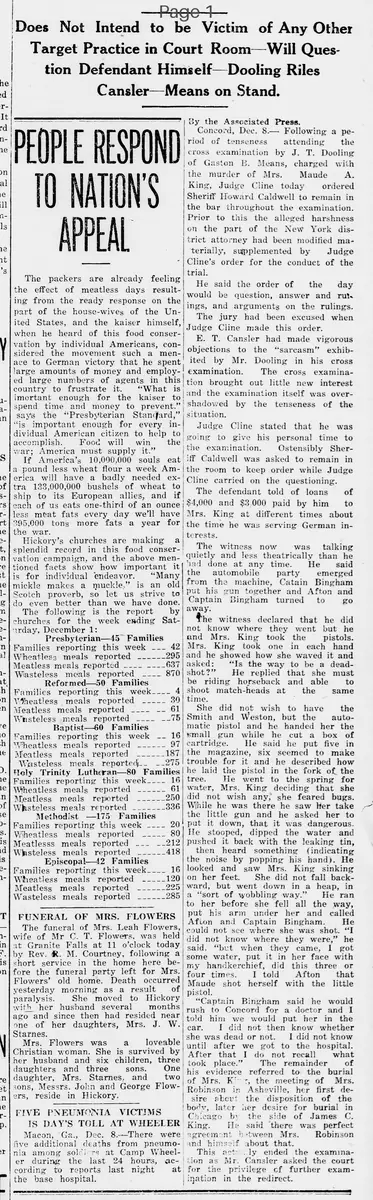
By the Associated Press.
Concord, Dec. 8.—Following a period of tenseness attending the cross examination by J. T. Dooling of Gaston B. Means, charged with the murder of Mrs. Maude A. King, Judge Cline today ordered Sheriff Howard Caldwell to remain in the bar throughout the examination.
Prior to this the alleged harshness on the part of the New York district attorney had been modified materially, supplemented by Judge Cline's order for the conduct of the trial.
He said the order of the day would be question, answer and rulings, and arguments on the rulings. The jury had been excused when Judge Cline made this order.
E. T. Cansler had made vigorous objections to the "sarcasm exhibited by Mr. Dooling in his cross examination."
The cross examination brought out little new interest and the examination itself was overshadowed by the tenseness of the situation.
Judge Cline stated that he was going to give his personal time to the examination. Ostensibly Sheriff Caldwell was asked to remain in the room to keep order while Judge Cline carried on the questioning.
The defendant told of loans of $4,000 and $3,000 paid by him to Mrs. King at different times about the time he was serving German interests.
The witness now was talking quietly and less theatrically than he had done at any time.
He said the automobile party emerged from the machine, Captain Bingham put his gun together and Afton and Captain Bingham turned to go away.
The witness declared that he did not know where they went but he and Mrs. King took the pistols. Mrs. King took one in each hand and he showed how she waved it and asked: "Is the way to be a dead-shot?"
He replied that she must be riding horseback and able to shoot match-heads at the same time.
She did not wish to have the Smith and Wesson, but the automatic pistol and he handed her the small gun while he cut a box of cartridge.
He said he put five in the magazine, six seemed to make trouble for it and he described how he laid the pistol in the fork of the tree.
He went to the spring for water, Mrs. King deciding that she did not wish any, she feared bugs. While he was there he saw her take the little gun and he asked her to put it down, that it was dangerous.
He stooped, dipped the water and pushed it back with the leaking tin, then heard something (indicating the noise by popping his hand). He looked and saw Mrs. King sinking on her feet. She did not fall backward, but went down in a heap, in a "sort of wobbling way." He ran to her before she fell all the way, put his arm under her and called Afton and Captain Bingham.
He could not see where she was shot. "I did not know where they were," he said, "but when they came, I got some water, put it in her face with my handkerchief, did this three or four times.
I told Afton that Maude shot herself with the little pistol.
"Captain Bingham said he would rush to Concord for a doctor and I told him we would put her in the car. I did not then know whether she was dead or not. I did not know until after we got to the hospital.
After that I do not recall what took place."
The remainder of his evidence referred to the burial of Mrs. King, the meeting of Mrs. Robinson in Asheville, her first desire about the disposition of the body, later her desire for burial in Chicago by the side of James C. King.
He said there was perfect agreement between Mrs. Robinson and himself about that.
This act fully ended the examination as Mr. Cansler asked the court for the privilege of further examination in the redirect.
What sub-type of article is it?
What themes does it cover?
What keywords are associated?
What entities or persons were involved?
Where did it happen?
Story Details
Key Persons
Location
Concord
Event Date
Dec. 8
Story Details
During the murder trial of Gaston B. Means for killing Mrs. Maude A. King, tensions rise in cross-examination by J. T. Dooling, prompting Judge Cline to order Sheriff Caldwell to maintain order and take over questioning. Means testifies about loans to King and recounts the alleged accidental shooting: while handling pistols during an outing, King shoots herself, collapses, and dies en route to the hospital. Further testimony covers her burial arrangements agreed with Mrs. Robinson.