Thank you for visiting SNEWPapers!
Sign up free
Literary
February 3, 1958
The Nome Nugget
Nome, Nome County, Alaska
What is this article about?
Olaf Halverson's notes on a German astronomer's catalog of over 324,000 stars in the northern hemisphere to 9.5 magnitude, equating their light to 7,300 sixth-magnitude stars. Telescopic stars provide over three times the light of visible ones. Assuming symmetry, total sky has about 600,000 such stars, with light equal to 1/80th of a full moon. Ten first-magnitude stars in north.
Clipping
OCR Quality
98%
Excellent
Full Text
Astronomy Notes
By OLAF HALVERSON
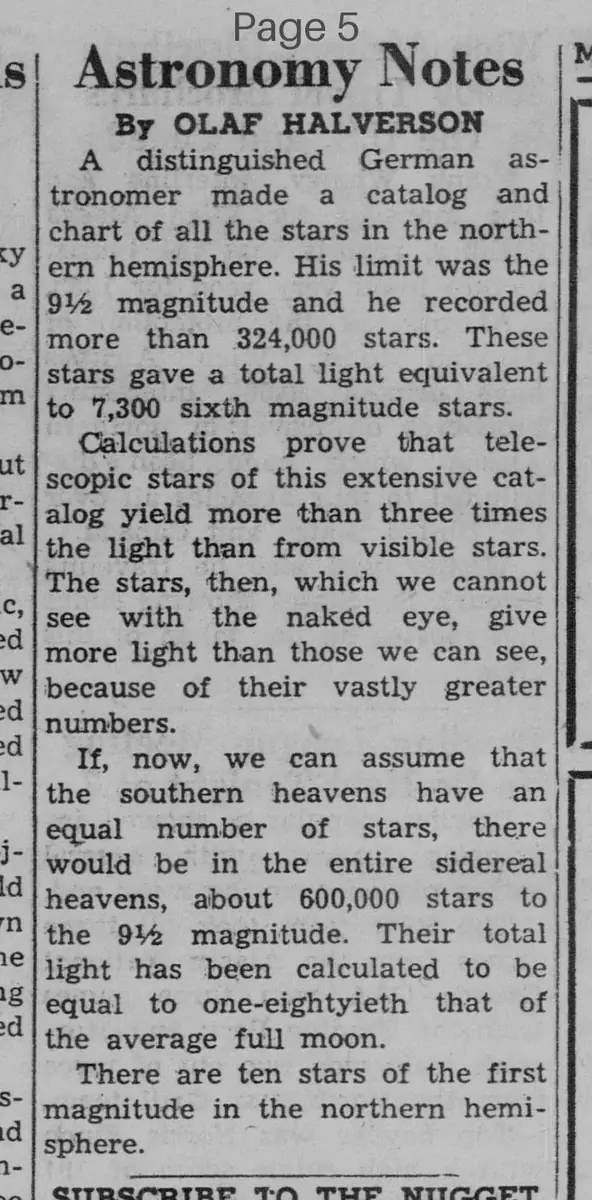
A distinguished German astronomer made a catalog and chart of all the stars in the northern hemisphere. His limit was the 9½ magnitude and he recorded more than 324,000 stars. These stars gave a total light equivalent to 7,300 sixth magnitude stars.
Calculations prove that telescopic stars of this extensive catalog yield more than three times the light than from visible stars.
The stars, then, which we cannot see with the naked eye, give more light than those we can see, because of their vastly greater numbers.
If, now, we can assume that the southern heavens have an equal number of stars, there would be in the entire sidereal heavens, about 600,000 stars to the 9½ magnitude.
Their total light has been calculated to be equal to one-eightieth that of the average full moon.
There are ten stars of the first magnitude in the northern hemisphere.
By OLAF HALVERSON
A distinguished German astronomer made a catalog and chart of all the stars in the northern hemisphere. His limit was the 9½ magnitude and he recorded more than 324,000 stars. These stars gave a total light equivalent to 7,300 sixth magnitude stars.
Calculations prove that telescopic stars of this extensive catalog yield more than three times the light than from visible stars.
The stars, then, which we cannot see with the naked eye, give more light than those we can see, because of their vastly greater numbers.
If, now, we can assume that the southern heavens have an equal number of stars, there would be in the entire sidereal heavens, about 600,000 stars to the 9½ magnitude.
Their total light has been calculated to be equal to one-eightieth that of the average full moon.
There are ten stars of the first magnitude in the northern hemisphere.
What sub-type of article is it?
Essay
What themes does it cover?
Nature
What keywords are associated?
Astronomy Notes
Star Catalog
Northern Hemisphere
Stellar Magnitude
Telescopic Stars
Sidereal Heavens
What entities or persons were involved?
By Olaf Halverson
Literary Details
Title
Astronomy Notes
Author
By Olaf Halverson
Key Lines
A Distinguished German Astronomer Made A Catalog And Chart Of All The Stars In The Northern Hemisphere.
These Stars Gave A Total Light Equivalent To 7,300 Sixth Magnitude Stars.
The Stars, Then, Which We Cannot See With The Naked Eye, Give More Light Than Those We Can See, Because Of Their Vastly Greater Numbers.
Their Total Light Has Been Calculated To Be Equal To One Eightieth That Of The Average Full Moon.