Thank you for visiting SNEWPapers!
Sign up free
Literary
July 15, 1789
Gazette Of The United States
New York, New York County, New York
What is this article about?
An essay critiquing the rigid classical education system in universities, arguing it overvalues abstract knowledge and uniformity, neglecting practical preparation for professions. Advocates tailoring education to individual destinies for societal benefit, using the analogy of youth as spring.
Clipping
OCR Quality
95%
Excellent
Full Text
[No. XXVII.]
THE TABLET.-NO. XXVII.
The loss which the commonwealth suffers by the mismanagement of its youth, is like the loss which the year would suffer by the destruction of the spring.
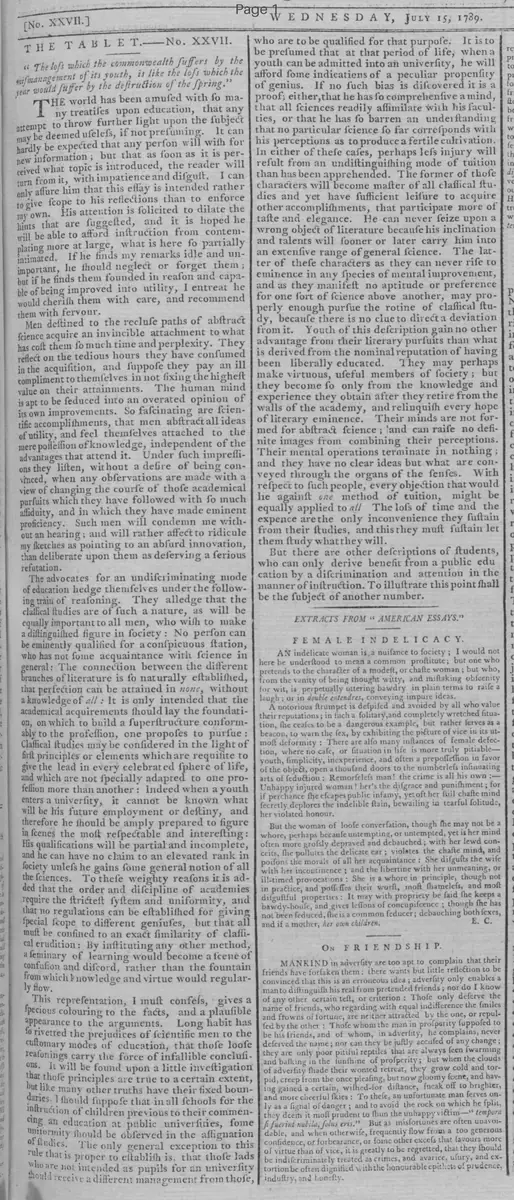
THE world has been amused with so many treatises upon education, that any attempt to throw further light upon the subject may be deemed useless, if not presuming. It can hardly be expected that any person will wish for new information; but that as soon as it is perceived what topic is introduced, the reader will turn from it, with impatience and disgust. I can only assure him that this essay is intended rather to give scope to his reflections than to enforce my own. His attention is solicited to dilate the subject more at large, what is here so partially intimated. If he finds my remarks idle and unimportant, he should neglect or forget them; but if he finds them founded in reason and capable of being improved into utility, I entreat he would cherish them with care, and recommend them with fervour.
Men destined to the reclusive paths of abstract science acquire an invincible attachment to what has cost them so much time and perplexity. They reflect on the tedious hours they have consumed in the acquisition, and suppose they pay an ill compliment to themselves in not fixing the highest value on their attainments. The human mind is apt to be seduced into an overrated opinion of its own improvements. So fascinating are scientific accomplishments, that men abstract all ideas of utility, and feel themselves attached to the mere possession of knowledge, independent of the advantages that attend it. Under such impressions they listen, without a desire of being convinced, when any observations are made with a view of changing the course of those academical pursuits which they have followed with so much assiduity, and in which they have made eminent proficiency. Such men will condemn me without a hearing; and will rather affect to ridicule my sketches as pointing to an absurd innovation, than deliberate upon them as deserving a serious refutation.
The advocates for an undiscriminating mode of education hedge themselves under the following train of reasoning. They allege that the classical studies are of such a nature, as will be equally important to all men, who wish to make a distinguished figure in society: No person can be eminently qualified for a conspicuous station, who has not some acquaintance with science in general: The connection between the different branches of literature is so naturally established, that perfection can be attained in none, without a knowledge of all: It is only intended that the academical acquirements should lay the foundation, on which to build a superstructure conformably to the profession, one proposes to pursue: Classical studies may be considered in the light of first principles or elements which are requisite to give the lead in every celebrated sphere of life, and which are not specially adapted to one profession more than another: Indeed when a youth enters a university, it cannot be known what will be his future employment or destiny, and therefore he should be amply prepared to figure in scenes the most respectable and interesting: His qualifications will be partial and incomplete, and he can have no claim to an elevated rank in society unless he gains some general notion of all the sciences. To these weighty reasons it is added that the order and discipline of academies require the strictest system and uniformity, and that no regulations can be established for giving special scope to different geniuses, but that all must be confined to an exact similarity of classical erudition: By instituting any other method, a seminary of learning would become a scene of confusion and discord, rather than the fountain from which knowledge and virtue would regularly flow.
This representation, I must confess, gives a specious colouring to the facts, and a plausible appearance to the arguments. Long habit has so rivetted the prejudices of scientific men to the customary modes of education, that those loose reasonings carry the force of infallible conclusions. It will be found upon a little investigation that those principles are true to a certain extent, but like many other truths have their fixed boundaries. I should suppose that in all schools for the instruction of children previous to their commencing an education at public universities, some uniformity should be observed in the assignation of studies. The only general exception to this rule that is proper to establish is, that those lads who are not intended as pupils for an university should receive a different management from those,
THE TABLET.-NO. XXVII.
The loss which the commonwealth suffers by the mismanagement of its youth, is like the loss which the year would suffer by the destruction of the spring.
THE world has been amused with so many treatises upon education, that any attempt to throw further light upon the subject may be deemed useless, if not presuming. It can hardly be expected that any person will wish for new information; but that as soon as it is perceived what topic is introduced, the reader will turn from it, with impatience and disgust. I can only assure him that this essay is intended rather to give scope to his reflections than to enforce my own. His attention is solicited to dilate the subject more at large, what is here so partially intimated. If he finds my remarks idle and unimportant, he should neglect or forget them; but if he finds them founded in reason and capable of being improved into utility, I entreat he would cherish them with care, and recommend them with fervour.
Men destined to the reclusive paths of abstract science acquire an invincible attachment to what has cost them so much time and perplexity. They reflect on the tedious hours they have consumed in the acquisition, and suppose they pay an ill compliment to themselves in not fixing the highest value on their attainments. The human mind is apt to be seduced into an overrated opinion of its own improvements. So fascinating are scientific accomplishments, that men abstract all ideas of utility, and feel themselves attached to the mere possession of knowledge, independent of the advantages that attend it. Under such impressions they listen, without a desire of being convinced, when any observations are made with a view of changing the course of those academical pursuits which they have followed with so much assiduity, and in which they have made eminent proficiency. Such men will condemn me without a hearing; and will rather affect to ridicule my sketches as pointing to an absurd innovation, than deliberate upon them as deserving a serious refutation.
The advocates for an undiscriminating mode of education hedge themselves under the following train of reasoning. They allege that the classical studies are of such a nature, as will be equally important to all men, who wish to make a distinguished figure in society: No person can be eminently qualified for a conspicuous station, who has not some acquaintance with science in general: The connection between the different branches of literature is so naturally established, that perfection can be attained in none, without a knowledge of all: It is only intended that the academical acquirements should lay the foundation, on which to build a superstructure conformably to the profession, one proposes to pursue: Classical studies may be considered in the light of first principles or elements which are requisite to give the lead in every celebrated sphere of life, and which are not specially adapted to one profession more than another: Indeed when a youth enters a university, it cannot be known what will be his future employment or destiny, and therefore he should be amply prepared to figure in scenes the most respectable and interesting: His qualifications will be partial and incomplete, and he can have no claim to an elevated rank in society unless he gains some general notion of all the sciences. To these weighty reasons it is added that the order and discipline of academies require the strictest system and uniformity, and that no regulations can be established for giving special scope to different geniuses, but that all must be confined to an exact similarity of classical erudition: By instituting any other method, a seminary of learning would become a scene of confusion and discord, rather than the fountain from which knowledge and virtue would regularly flow.
This representation, I must confess, gives a specious colouring to the facts, and a plausible appearance to the arguments. Long habit has so rivetted the prejudices of scientific men to the customary modes of education, that those loose reasonings carry the force of infallible conclusions. It will be found upon a little investigation that those principles are true to a certain extent, but like many other truths have their fixed boundaries. I should suppose that in all schools for the instruction of children previous to their commencing an education at public universities, some uniformity should be observed in the assignation of studies. The only general exception to this rule that is proper to establish is, that those lads who are not intended as pupils for an university should receive a different management from those,
What sub-type of article is it?
Essay
What themes does it cover?
Moral Virtue
Political
Social Manners
What keywords are associated?
Education
Classical Studies
Youth Mismanagement
University
Practical Learning
Social Figure
Literary Details
Title
The Tablet. No. Xxvii.
Subject
On The Mismanagement Of Youth And Education
Key Lines
The Loss Which The Commonwealth Suffers By The Mismanagement Of Its Youth, Is Like The Loss Which The Year Would Suffer By The Destruction Of The Spring.
Classical Studies May Be Considered In The Light Of First Principles Or Elements Which Are Requisite To Give The Lead In Every Celebrated Sphere Of Life, And Which Are Not Specially Adapted To One Profession More Than Another: