Thank you for visiting SNEWPapers!
Sign up free
Gazette Of The United States
Philadelphia, Philadelphia County, Pennsylvania
What is this article about?
Detailed account of the trial by a military commission in Paris of eight National Convention members accused of instigating the 1st Prairial insurrection. Romme, Duroy, Duquenoy, Bourbotte, Soubrany, and Gougeon were sentenced to death; three died by self-inflicted wounds before execution, the others were guillotined. Peysard banished, Forestier imprisoned. Dated 30th Prairial, reported August 24.
Clipping
OCR Quality
Full Text
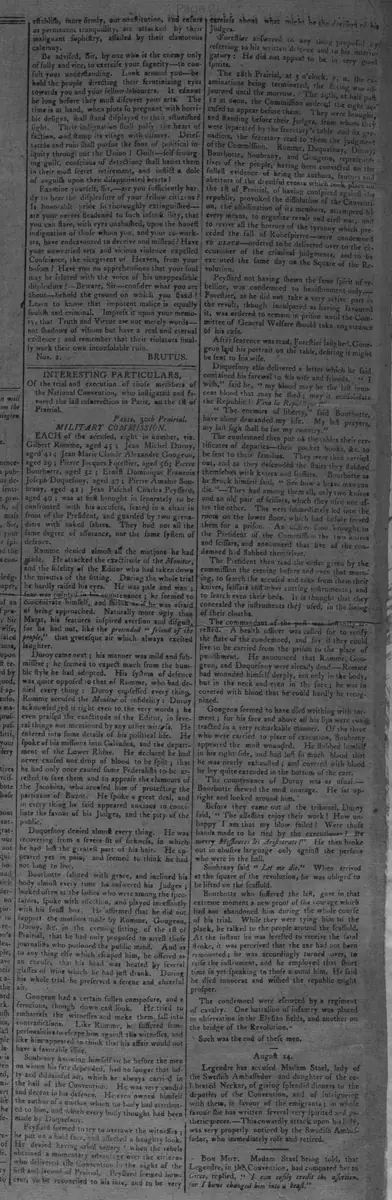
Of the trial and execution of those members of
the National Convention, who instigated and favored
the last insurrection in Paris, on the 1st of
Prairial.
Paris, 30th Prairial.
MILITARY COMMISSION.
EACH of the accused, eight in number, viz.
Gilbert Romme, aged 45; Jean Michel Duroy,
aged 41; Jean Marie Claude Alexandre Gougeon,
aged 29; Pierre Jacques Forestier, aged 56; Pierre
Bourbotte, aged 32; Ernest Dominique Francois
Joseph Duquenoy, aged 47; Pierre Amable Soubrany,
aged 42; Jean Paschal Charles Peysard,
aged 40; was at first brought in separately to be
confronted with his accusers, seated in a chair in
front of the President, and guarded by two grenadiers
with naked sabres. They had not all the
same degree of assurance, nor the same system of
defence.
Romme denied almost all the motions he had
made. He attacked the exactitude of the Monitor,
and the fidelity of the Editor who had taken down
the minutes of the sitting. During the whole trial
he hardly raised his eyes. He was pale and wan;
fear was painted in his countenance; he seemed to
concentrate himself, and shrink as if he was afraid
of being approached. Naturally more ugly than
Marat, his features inspired aversion and disgust,
for he had not, like the pretended "friend of the
people," that grotesque air which always excited
laughter.
Duroy came next; his manner was mild and submissive;
he seemed to expect much from the humble
style he had adopted. His system of defence
was quite opposed to that of Romme, who had denied
every thing: Duroy confessed every thing.
Romme accused the Monitor of infidelity: Duroy
acknowledged it right even to the very words; he
even praised the exactitude of the Editor, in several
things not mentioned by any other witnesses. He
entered into some details of his political life. He
spoke of his missions into Calvados, and the department
of the Lower Rhine. He declared he had
never caused one drop of blood to be spilt; that
he had only once caused some Federalists to be arrested
to save them and to appease the clamours of
the Jacobins, who accused him of protecting the
partizans of Buzot. He spoke a great deal, and
in every thing he said appeared anxious to conciliate
the favour of his Judges, and the pity of the
public.
Duquenoy denied almost every thing. He was
recovering from a severe fit of sickness, in which
he had lost the greatest part of his hair. He appeared
yet in pain, and seemed to think he had
not long to live.
Bourbotte saluted with grace, and inclined his
body almost every time he answered his Judges;
looked often at the ladies who were among the spectators,
spoke with affection, and played incessantly
with his snuff box. He affirmed that he did not
support the motions made by Romme, Gougeon,
Duroy, &c. in the evening sitting of the 1st of
Prairial, that he had only proposed to arrest those
journalists who poisoned the public mind. And as
to any thing else which escaped him, he offered as
an excuse, that his head was heated by several
glasses of wine which he had just drank. During
his whole trial he preserved a serene and cheerful
air.
Gougeon had a certain sullen composure, and a
ferocious, though down cast look. He tried to
embarrass the witnesses and make them fall into
contradictions. Like Romme, he suffered some
personalities to escape him against the witnesses, and
like him appeared to think that his affair would not
have a favorable issue.
Soubrany knowing himself to be before the men
on whom his fate depended, had no longer that lofty
and disdainful air, which he always carried in
the hall of the Convention. He was very candid
and decent in his defence. He even owned himself
the author of a motion which no body had attributed
to him, and which every body thought had been
made by Duquenoy.
Peysard seemed to try to overawe the witnesses;
he put on a bold face, and affected a haughty look.
He denied having cried victory when the rebels
obtained a momentary advantage over the citizens
who delivered the Convention in the night of the
first and second of Prairial. Peysard seemed however,
to be reconciled to his fate, and to be very
careless about what might be the decision of his
Judges.
Forestier answered to any thing proposed by
referring to his written defence and to his interrogatory:
He did not appear to be in very good
spirits.
The 28th Prairial, at 3 o'clock, P. M. the examinations
being terminated, the sitting was adjourned
until the morrow. The 29th, at half past
12 at noon, the Commission ordered the eight accused
to appear before them. They were brought,
and standing before their Judges, from whom they
were separated by the secretary's table and six grenadiers,
the secretary read to them the judgment
of the Commission. Romme, Duquenoy, Duroy;
Bourbotte, Soubrany, and Gougeon, representatives
of the people, having been convicted on the
fullest evidence of being the authors, fautors and
abettors of the dreadful events which took place on
the 1st of Prairial, of having conspired against the
republic, provoked the dissolution of the Convention,
the assassination of its members, attempted by
every means, to organize revolt and civil war, and
to revive all the horrors of the tyranny which preceded
the fall of Robespierre-were condemned
To DEATH-ordered to be delivered over to the executioner
of the criminal judgments, and to be
executed the same day on the Square of the Revolution.
Peysard not having shewn the same spirit of rebellion,
was condemned to banishment only.-
Forestier, as he did not take a very active part in
the revolt, though inculpated as having favoured
it, was ordered to remain in prison until the Committee
of General Welfare should take cognizance
of his case.
After sentence was read; Forestier laughed. Gougeon
laid his portrait on the table, desiring it might
be sent to his wife.
Duquenoy also delivered a letter which he said
contained his farewell to his wife and friends. "I
wish," said he, " my blood may be the last innocent
blood that may be shed; may it consolidate
the Republic! Vive la Republique!"
" The enemies of liberty," said Bourbotte,
have alone demanded my life. My last prayers,
my last sigh shall be for my country."
The condemned then put on the tables their certificates
of deputies-their pocket books, &c. to
be sent to their families. They were then carried
out, and as they descended the stairs they stabbed
themselves with knives and scissors. Bourbotte as
he struck himself said, " See how a brave man can
die."They had among them all, only two knives
and an old pair of scissors, which they used one after
the other. They were immediately led into the
room on the lower floor, which had before served
them for a prison. An officer soon brought to
the President of the Commission the two knives
and scissors, and announced that five of the condemned
had stabbed themselves.
The President then read the order given by the
commission the evening before and even that morning,
to search the accused and take from them their
knives, scissors and other cutting instruments; and
to search even their beds. It is thought that they
concealed the instruments they used, in the lining
of their cloaths.
The commandant of the post was instantly arrested.
A health officer was called for to verify
the state of the condemned, and say if they could
live to be carried from the prison to the place of
punishment. He announced that Romme, Gougeon,
and Duquenoy were already dead.-Romme
had wounded himself deeply, not only in the body,
but in the neck and even in the face ; he was so
covered with blood that he could hardly be recognized.
Gougeon seemed to have died writhing with torment ;
for his face and above all his lips were contracted
in a very remarkable manner. Of the three
who were carried to place of execution, Soubrany
appeared the most wounded. He stabbed himself
in his right side, and had lost so much blood that
he was nearly exhausted; and covered with blood
he lay quite extended in the bottom of the cart.
The countenance of Duroy was as usual.-
Bourbotte shewed the most courage. He sat upright
and looked around him.
Before they came out of the tribunal, Duroy
said, " The assassins enjoy their work! How unhappy
I am that my blow failed! Were those
hands made to be tied by the executioner? Be
merry Messieurs les Aristocrates!" He then broke
out in abusive language only against the persons
who were in the hall.
Soubrany said " Let me die." When arrived
at the square of the revolution, he was obliged to
be lifted on the scaffold.
Bourbotte who suffered the last, gave in that
extreme moment a new proof of the courage which
had not abandoned him during the whole course
of his trial. While they were tying him to the
plank, he talked to the people around the scaffold.
At the instant he was levelled to receive the fatal
stroke, it was perceived that the axe had not been
remounted; he was accordingly turned over, to
raise the instrument, and he employed that short
time in yet speaking to those around him. He said
he died innocent and wished the republic might
prosper.
The condemned were escorted by a regiment
of cavalry. One battalion of infantry was placed
in observation in the Elysian fields, and another on
the bridge of the Revolution.-
Such was the end of these men.
August 24.
What sub-type of article is it?
What keywords are associated?
What entities or persons were involved?
Where did it happen?
Foreign News Details
Primary Location
Paris
Event Date
30th Prairial (Insurrection On 1st Prairial; Trial 28th 29th Prairial)
Key Persons
Outcome
romme, gougeon, and duquenoy died from self-inflicted wounds before execution; duroy, bourbotte, and soubrany guillotined on square of the revolution; peysard banished; forestier imprisoned pending review.
Event Details
Eight accused National Convention members tried by military commission for instigating 1st Prairial insurrection. Detailed accounts of their defenses and demeanors during trial. Six convicted and sentenced to death on 29th Prairial; attempted suicide en route to execution, resulting in three deaths; remaining three executed. Peysard and Forestier received lesser sentences.