Thank you for visiting SNEWPapers!
Sign up free
Rutland Herald
Rutland, Rutland County, Vermont
What is this article about?
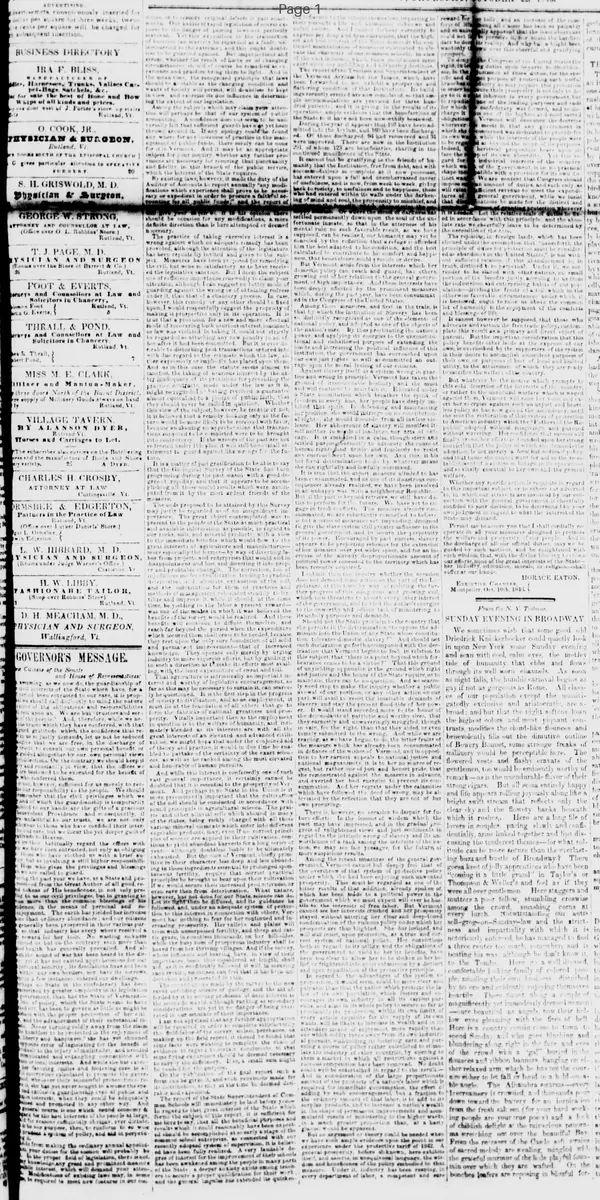
Governor Horace Eaton's October 1846 message to Vermont's legislature emphasizes moral duties of officials, state prosperity from abundant harvests and health, praises simple governance, geological survey for agriculture, common schools, asylum for the insane, and criticizes national policies expanding slavery and abandoning protective tariffs.
Merged-components note: These two components are parts of the same continuous Governor's message, as indicated by the text flow and adjacent reading orders (3 and 5) with spatially proximate bounding boxes.
Clipping
OCR Quality
Full Text
Gentlemen of the Senate
and House of Representatives:
Assuming as we now do, the guardianship of
the interests of the State, which have, for the
past year, been entrusted to our care, it is proper
that we should call distinctly to mind the nature
and extent of the obligations and responsibilities
now upon us. We are but trustees and servants
of the people. And, therefore, while we do
their bidding which they have conferred, with that
gratitude which the confidence thus reposed in us so justly demands, let us not be seduced
by the desire to feel free, in the discharge of
our trust, to consult our own personal benefit, or
guided altogether by our own personal views
and predilections. On the contrary, we should keep constantly in view, that the offices we
are called upon to fill, were bestowed to be executed for the benefit of
those who conferred them.
But, however, sufficient for us merely to recognize our responsibility to the people. We should
remember that the civil privileges which we
guard, and of which the guardianship is temporarily
committed to our hands, are the gifts of a gracious
and beneficent Providence; and consequently, if
we are unfaithful to our trusts, we are not only
traitorous to those who have confided their interests
to our care, but we incur the yet deeper guilt of
ingratitude to Heaven.
Let us then habitually regard the offices with
which we have been entrusted, not only as obliging
us to those who have clothed us with a brief authority,
but as involving a still higher responsibility
to Him who gives the privileges and blessings
we are called to guard.
During the past year we have, as a State and people,
received from the Great Author of all good, renewed
tokens of His beneficence, in not only preserving to
us our civil privileges, but in granting to
us more than the common blessings of His
providence, in the means of personal and social
enjoyment. The earth has yielded her increase
in more than ordinary abundance, and our citizens
have generally been prospered in their various pursuits,
so that industry has everywhere received a
reward for her toils. No wasting sickness
has visited us, but on the contrary even more than
usual good health has generally prevailed. And although
the sound of war has been heard in the distance,
yet it has not excited any fears for our
personal security. Its desolations have not reached
our own borders, nor have its sorrows
in a few instances entered our dwellings.
Perhaps no State in the confederacy has been
presented by greater simplicity in its legislation.
Government has had as little to do as might be
with the proper protection of her citizens,
and the advancement of their substantial interests.
Never turning coldly away from the claims
of the humblest to be protected in the enjoyment of
liberty and happiness, she has yet shunned
the opposite error of legislating for the benefit of
the few to the injury of multitudes, and avoided
complicated and entangling connections with
the affairs of individual interests.
And while she
has carefully watched over her own interests and fostered
care to all
measures calculated to promote
the general welfare wherever their successful prosecution required
her aid, she has yet never sought to assume their peculiar
and exclusive guardianship
over the interests of her citizens when they could be
adequately
managed and
promoted
in any
other way. And
her general course
is one which
sound economy &
care for the best interests of the people at large.
For reasons sufficiently
obvious, it is to our purpose, then, to conform
our practices and policy, and aid in perpetuating
to our
State free institutions.
In like manner the ordinary annual appropriations
have been made
in the proper field of legislation, there is no
doubt but that any grand and prominent measure
of public policy or
amendment of existing laws may, in some
cases, be required to meet new features in our condition.
Among the subjects which may claim your attention
will perhaps be that of our system of justice.
A confidence does not seem to be universally felt that sufficient guards have yet been
thrown around it. If any apology could be found
anywhere, for any looseness of practice in the management
of public funds, there surely can be none
for it in Vermont. And it may be an appropriate
subject for your inquiry whether any further provisions
are necessary for securing that punctuality
and fidelity in this branch of the public service,
which the interest of the State requires.
By existing laws, however, it is made the duty of the
Auditor of Accounts to report annually "any modifications
which experience shall prove to be necessary
or expedient in order to procure a faithful accounting
for all public funds," and he reports that in his opinion there
should be occasion for any modifications, a more
definite direction than is here attempted or deemed
necessary.
The practice of taking excessive interest is a
wrong against which no adequate remedy has been
provided, although the attention of the legislature
has been repeatedly invited and given to the subject.
Measures have been proposed for remedying
the evil, but none so satisfactory as to have received
the legislative sanction. But I deem the subject
of sufficient importance renewedly to claim our
attention, although I can suggest no better mode of
guarding against the wrong or of obtaining redress
under it, than that of a chancery process. In case
however this remedy or any other should be fixed
upon, I would respectfully suggest the propriety of
making it prospective only in its operation. It is
true that a provision for a new and more effectual
mode of recovering back usurious interest, inasmuch
as law was violated in taking it, could not strictly
be regarded as attaching any new penalty to an offence
after it had been committed. But it is ever desirable
to avoid disturbing past transactions entered into
with due regard to the estimate which the law expressly
or impliedly placed upon them.
And as in this case the statute seems almost to
sanction the taking of usurious interest by the utter
inadequacy of its provisions for preventing the
practice, contracts made under the law as it is
might perhaps be regarded as having received a guarantee
almost equivalent to a pledge of public faith, that
they should never be called into question. Whether
this view of the subject, however, be tenable or not,
it is believed that a remedy looking only to the future
would be more likely to be received with favor,
because awakening no apprehensions that transactions
suitably completed were to be brought
into controversy. If the wrongs of the past are not
redressed under this plan it will still be no small attainment
to guard against like wrongs of the future.
It is a matter of just gratification to be able to say
that the Geological Survey of the State has been
progressing during the past season with a good degree
of rapidity, and that it appears to be accomplishing
those useful results which were anticipated from it by the most ardent friends of the
measure.
The ends proposed to be attained by this Survey
may justly be regarded as of no insignificant importance.
The great object contemplated was to
present to the people of the State as much practical
and available information as possible, in regard to
our rocks, soils and mineral products, with a view
to the immediate benefits which would flow to the
great interests of agriculture and manufactures--
more especially the former--by way of diverting labor
from fruitless and enterprising that would end in
disappointment and loss and directing it into proper
and profitable channels. The correction, too, of
injurious modes of cultivation tending to gradual
decay and ultimate exhaustion of the soil,
and the substitution for them of practices and
methods of management calculated steadily to fertilize
and improve it while it should at the same
time be yielding to the labor a present reward--
was one of the main ways in which it was believed the
benefits of the survey would be realized. And these
benefits will continue to diffuse themselves, and
reach far beyond the period when the expenditure
which secured them shall cease to be needed, because
they rest upon the only sure foundation of all solid
and permanent improvement--that of increased
knowledge. They operate not merely by urging
industry to more vigorous efforts, but by guiding it
in such a direction as to make its efforts most available,
with the least expenditure of sweat and toil.
That agriculture is intrinsically an important interest
and worthy of legislative encouragement, so
far as this may be necessary to sustain it, can scarcely
be questioned. It is the first step in the progress
of society to civilization, and as an employment, it
must lie at the foundation of all others that go to
form the fabric of national greatness and prosperity.
Vitally important then as the employment
in question is to the welfare of humanity, and intimately
blended as its interests are with all the
great interests of an elevated and advanced civilization,
we might hope that under the conjoined aid
of theory and practice it would in due time be enabled
to partake of the certainty of the exact sciences
as well as be ranked among the most elevated
and honorable of human pursuits.
And while this interest is confessedly one of such
vast general importance, it certainly cannot be
doubted that it is essential to the prosperity of Vermont.
And perhaps in no State in the Union is it
so preeminently important that the cultivation
of the soil should be conducted in accordance with
sound principles in agricultural science. The prairies
and other alluvial soils which abound in many
of the states, being richly charged with all those
various mineral elements which enter into different
vegetable products, may, even if no correct principles
of science are applied in their cultivation, continue
to yield abundant harvests for a long series of years,
although doubtless liable to be ultimately
exhausted. But the soils of Vermont chiefly primitive
in their character, less deep and less abounding
in those ingredients essential to prolonged spontaneous
fertility, require that correct practical
principles be brought to bear upon their cultivation
if we would secure their increased productiveness, or
even save them from deterioration. What nature,
however, has not done for our State, science can do.
Let its light then be diffused, and its guidance be
followed, and, under an adequate system of protection
to this interest in connection with others, Vermont
has nothing to fear for her continued and increasing
prosperity. Her valleys and plains will
teem with unsurpassed fertility, and sheep and cattle
graze, in countless thousands, on her hill-sides,
while the busy hum of prosperous industry shall be
heard from her thriving villages. And if the survey,
whose influence and bearing have in view of their
importance but thus casually considered at length, shall
add as it is confidently believed it will, in no small
degree, to the wealth and happiness of our citizens, none
can feel that it has been uselessly bestowed.
The gratitude by the people to the new
branch of science of geology and the aid of
science to it in answering problems of deep interest to
the husbandman although rather secondary
considerations are yet in no danger of being over
rated in our estimate of their importance.
I am doubtful if any further appropriation
will be required in order to complete satisfactorily
the field labor of the survey and even, perchance on
making up the field report it should be found that
some facts were wanting to complete the chain of
evidence in regard to certain conclusions so that
to supply the deficiency, no, a small sum might
be deemed necessary
but to what extent.
In the distribution of the final report such
arrangements as can be given it, and each provision made for
On the last cost of the final report such
In Common Schools will immediately be laid before you.
The report of the State Superintendent of Common
Schools--
In regard to that great interest of the State which
forms the subject of the report it is sufficient for
me here to say, that all the beneficial purposes and
results which it could reasonably have been expected
would be accomplished at so early a stage of the
common school enterprise, a connected such our
recently adopted system of supervision, it is believed have been fully realized. A very laudable degree
of interest for the improvement of their schools
has been awakened among the people in many parts
of the State, a deeper anxiety exists among teachers
and the general public has extended its quickening
The result of the enlargements and betterments of
the Vermont Asylum for the Insane which have
been forwarded in February report us and
flattering condition of that Institution. Its buildings
recently erected are now completed so that accommodations
are provided for three hundred patients, and it is giving in the results of its
operation, ample evidence that the benefactions of
the State to it have not been unworthily bestowed.
During the year it appears that 157 have been admitted
into the Asylum and 130 have been discharged.
Of those discharged 91 had recovered and 34
were improved. There are now in the Institution
291 of whom 123 are beneficiaries, sharing in the
continued munificence of the State.
It cannot but be gratifying to the friends of humanity
that the Institution, free from debt, and with
accommodations so complete as it now possesses,
has entered upon a full and unembarrassed career
of usefulness, and is now, from week to week, giving
back to society, to usefulness and to happiness, those
who had entered within its walls under the darkening
of mind and soul, the propensity to mischief, and
settled permanently down upon the soul of the unfortunate
inmate, so that in the uttermost of his
mental ruin no such favorable result, as we have
supposed, can be realized, our humanity may yet be
consoled by the reflection that a refuge is afforded
him the best adapted to his condition, and the best
calculated to contribute to his comfort and happiness,
that benevolence could ever devise.
But Vermont aside from the interests which her
domestic policy can reach and guard, has others,
growing out of her relations to the general government,
of high importance. And these interests have
been deeply affected by the prominent measures
which, during the past year have been consummated
in the Congress of the United States.
Among the measures, and first in the train, is
that by which the institution of Slavery has been
distinctly recognized as one of the elements of
national policy and adopted as one of the objects of
the nation's care. By thus prostituting the nation's
power, and applying its energies to the unconstitutional
and unhallowed purpose of extending the
limits and increasing the political influence of this
institution, the government has encroached upon
our own just rights as well as committed an outrage
upon the moral feeling of our citizens.
Against slavery itself as a system wrong in practice
and wrong in principle, Vermont has taken the
ground of irreconcilable hostility; and she must
and will continue to maintain it. Educated under
a State constitution which breathes the spirit of
freedom in every line, her people have deeply imbibed
that spirit. In defending and maintaining
her position, she would infringe no constitutional right;
she would dissuade from all lawless violence.
Her abhorrence of slavery will manifest itself neither
in words of insolence nor acts of outrage. It is cherished
in a calm though stern and settled purpose
earnestly to advocate the cause of human rights and
manfully and fearlessly to resist any encroachments
upon her own. And this, it is her fixed determination to do by whatever means
she can rightfully and lawfully command.
It is true that the unjust measure alluded to has
been consummated, and as one of its disastrous consequences
already realized, we have been involved
in an unhappy war with a neighboring Republic.
But if the past is beyond retrieve we still have duties
to perform for the future. We have yet to engage
in fresh conflicts. The measure already consummated
we are reluctantly compelled to believe
is but a series of measures yet impending, designed
to give the slave system still greater influence in the
general government and to secure the perpetuity
of its power. Encouraged by past success slavery
appears to be projecting schemes for the extension
of her domains over yet wider expanse, and for an increase
of the already disproportionate amount of
political power conceded to the territory which has
been recently acquired.
Is it not the duty of the Legislature at once to demand
of the North the further progress of this dangerous and growing evil
which now threatens so thoroughly the interests
of the government, and tied the Nation's energies
to their unworthy and unholy purposes and demands?
Should not the State in maintaining her determination to oppose the admission
into the Union of any State whose constitution
tolerates domestic slavery? And should not
such declaration go forth accompanied with the declaration
that Vermont begins to feel, in relation to
this subject that there is a point beyond which forbearance
ceases to be a virtue? That this ground
of unyielding opposition is the ground which right
and justice and the honor of the State require us to
maintain, there can be no question. And we scarcely
need stop to make the inquiry whether a public
avowal of our position or any other action on our
part will avail to resist the insatiable demands of
slavery and stay the present flood tide of her power.
It would stand recorded more to the honor of
the descendants of patriotic and worthy sires, that
they earnestly and unwaveringly struggled, though
in vain, for the right than that they aided, or even
tamely submitted to the wrong. And while we are
reaping, as we have begun to do, the bitter fruits of
the measure which has already been consummated
in defiance of the wishes of Vermont, and in opposition
to her earnest appeals to national justice and
national magnanimity it is to her no source of regret,
but rather one of just and honest pride that
she remonstrated against the measure in advance,
and exerted her best energies to prevent its consummation.
And her regrets under the calamities
which have followed the deed of wrong may be alleviated
by the reflection that they are not of her
own procuring.
There is, however, no occasion to despair for future
effort. In the lessons of wisdom which the
past may have impressed, and in the gradual growth
of enlightened views and just sentiments in
regard to the intrinsic wrong of slavery and its unworthiness
of a rank among the interests of the nation,
we may see fair presages for the future of
more auspicious results.
Among the recent measures of the general government,
Vermont cannot but deeply feel that of
the overthrow of that system of protective policy
under which she had been enjoying such unwonted
prosperity. This must be regarded as one of the
bitter results of that addition, already spoken of,
which has been made to a political power in the
government which we must expect will ever be hostile
to the interests of free labor. But Vermont
cannot see her interests crushed and her prosperity
stayed without uttering her clear and deep-toned
condemnation of the ruinous policy under which her
projects are thus blighted. She has insisted and
will still insist, upon protection, as a true and correct
system of national policy. Her convictions
both in regard to its utility and the obligations
of the government to yield to her its benefits, have
been too clear to allow her to be shaken from her belief
either frightened into easy submission by a distant threat
and ever repudiation of the protective principle.
In regard to the advantages of the system it
would seem could be more clearly read
valuable than that action which protects the laborer
in its ultimate which foster and encourages
industry in all its various pursuits
and in its whole policy to secure so far as
possible its protection within its own limits of
every article requisite for the daily consumption of its own
inhabitants will be likely to increase in wealth and in its
attendant means of enjoyment more rapidly than
one which would force us from our own industry.
At a percentage paid leading its enterprising care, and putting
a course of policy rather calculated to stimulate the industry
of other countries, by opening to
them a market in which all restrictions against
ruinous competition have been removed. No doubt
could well be entertained in regard to the result.
And in consideration of the large proportionate
amount of the product of a nation's labor which is
required for immediate consumption the effect of
adding by such encouragement, but a fraction to
the ordinary supply of that labor is to add to its
surplus products and to increase a nation's wealth
in the shape of permanent improvements and accumulated
means of ministering to the higher wants
in a much greater proportion, than, at a hasty
glance, would be apparent.
But no argument or theory could be needed when
we have such ample evidence upon the point in our
experience under the protective tariff of 1842. A general
prosperity, before unknown, here exhibited
itself, and now cries, in unequivocal language, the wisdom
and beneficence of the policy embodied in that
measure. Under it, industry has been reaping, in
every department of labor, a competent and sure
reward for its toils and an increase of the common
funds of wealth
and so much
has led to prosperity
and so faith
It appears important that she learns elsewhere
could not
perceive it, but could her heart has
dare to deny its reality. And why be a light behind
was only
near this cheerful and gratifying
prosperity.
To deny
The Congress of the United States the
right, in laying
duties upon imports, to discriminate,
in the
amount of these duties for the specific and
direct purpose of protecting such useful
branches of
industry. By future issues
do they
enter their prosperity? Do they
by toil
inherent in every government? But
to repudiate
the leading jury on ours
for which
confederacy was formed, and to discharge
the
more high trust imposed
obligations
Vermont will denounce the doctrine
wherever
meets it, that any government in
which she
concerned was instituted beside for
its own
while the interest of the people were
to be regulated
by the edicts
Indeed,
her eternal position be a joint in t
face the
policy of Heaven no belittle yet r.
guard for
industrial interests of the country
which w
of the government is in practical
shape incompatible with a portion first. own ds
to net wa
We are content that Congress should
impose
an amount of duties, and such only as
will raise
sufficient revenue to meet the expenditures
of
general government, while we insist
that discriminations
be made for the direct and
incidental protection however
Let the relative scale of duties be regulated
in accordance with this principle and the absolute
rate we cheerfully leave to be determined by
the necessities of the case.
The rejoicing, in foreign lands, which has been
elicited under the assumption that hence forth the
principle of duties for protection must be considered
as abandoned in the United States, is not without sufficient
comment if the enemies merit it, in
truth destined to be perpetual. Under it, we shall
render to be shared with other nations, no small portion
of the benefits justly accruing to us from the
industrious and enterprising habits of our people--
accumulating the fruits and which in the
otherwise favorable circumstances under which it
is bestowed, ought to raise us above the common
lot of humanity in the enjoyment of the comforts
and blessings of life.
It cannot however be supposed, that those who
advocate and sustain the free trade policy, contemplate
this result as a primary and direct object of
pursuit. But the important consideration that this
policy benefits other lands at the expense of our
own, is overlooked by the supporters of the system
in their desire to subserve selfish coincident purposes of
their own or purposes best of local and limited
utility, to the attainment of which they are ready
to sacrifice the welfare of the country.
But whatever be the motive which tempts to
this cold desertion of the interests of the country,
or rather to the unholy warfare which is waged
against them, Vermont will reserve her energies against
such an unjust or threatless
policy as has now gained the ascendancy, until
she sees the restoration of that system of protection
to American industry which the Fathers of the
Republic adopted without misgivings and pursued
without wavering. Her final success will
rest upon her strong
conviction that the policy of protection in the
adoption, is not merely a best but national policy
and that hope she cherishes for and in the restoration
of the policy
and so vitally essential to her own and the general
welfare.
Whether any specific action, here united in regard
to this important subject or others not material
to, in which our interests are involved by our connection
with the general government is cheerfully
confided to your decision, to be determined by your
own judgment in regard to what the interest of the
State may demand.
Permit me to assure you that I shall cordially co-operate
in all your measures designed to promote
the welfare and prosperity of our people. And
in the discharge of all our official duties may we be
guided by such motives, and be enlightened with
such wisdom, that with the divine blessing on our
efforts, none of the great interests of the State--
her industry education, morals, or religion--shall
suffer at our hands.
HORACE EATON.
EXECUTIVE CHAMBER,
Montpelier Oct. 10th, 1846.
What sub-type of article is it?
What keywords are associated?
What entities or persons were involved?
Editorial Details
Primary Topic
Gubernatorial Address On State Duties, Prosperity, Reforms, And Opposition To Slavery Expansion And Free Trade
Stance / Tone
Moral Exhortation Advocating Protectionism, Anti Slavery, And State Improvements
Key Figures
Key Arguments