Thank you for visiting SNEWPapers!
Sign up free
Norfolk Gazette And Publick Ledger
Norfolk, Virginia
What is this article about?
In the House of Commons, eight articles of impeachment against Henry Lord Viscount Melville for high crimes and misdemeanours related to financial misconduct as Treasurer of the Navy were read and agreed to. Mr. Whitbread proposed an additional article concerning payments to Mr. Mark Trotter.
Merged-components note: Split article detailing articles of impeachment against Lord Melville; sequential reading order on same page.
Clipping
OCR Quality
Full Text
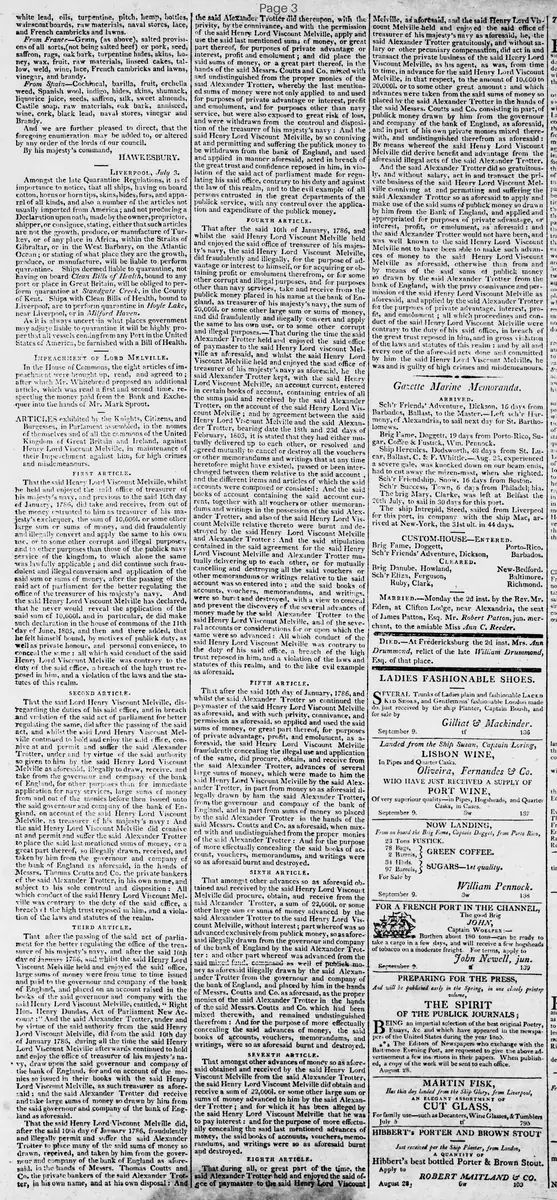
In the House of Commons, the eight articles of impeachment were brought up, read, and agreed to; after which Mr. Whitbread proposed an additional article, which was read a first and second time, respecting the money paid from the Bank and Exchequer into the hands of Mr. Mark Trotter.
ARTICLES exhibited by the Knights, Citizens, and Burgesses in Parliament assembled, in the names of themselves and of all the commons of the United Kingdom of Great Britain and Ireland, against Henry Lord Viscount Melville, in maintenance of their Impeachment against him, for high crimes and misdemeanours.
FIRST ARTICLE.
That the said Henry Lord Viscount Melville, whilst he held and enjoyed the said office of treasurer of his majesty's navy, and previous to the said 10th day of January, 1786, did take and receive, from out of the money entrusted to him as treasurer of his majesty's exchequer, the sum of 10,000l. or some other large sum or sums of money, and did fraudulently and illegally convert and apply the same to his own use, or to some other corrupt and illegal purposes, and to other purposes than those of the publick navy service of the kingdom, to which alone the same was lawfully applicable: and did continue such fraudulent and illegal conversion and application of the said sum or sums of money, after the passing of the said act of parliament for the better regulating the office of the treasurer of his majesty's navy. And the said Henry Lord Viscount Melville has declared that he never would reveal the application of the said sum of 10,000l. and in particular, he did make such declaration in the house of commons of the 11th day of June, 1805, and then and there added, that he felt himself bound, by motives of publick duty, as well as private honour, and personal convenience, to conceal the same: all which said conduct of the said Henry Lord Viscount Melville was contrary to the duty of the said office, a breach of the high trust reposed in him, and a violation of the laws and the statutes of this realm.
SECOND ARTICLE.
That the said Lord Henry Viscount Melville, disregarding the duties of his said office, and in breach and violation of the said act of parliament for better regulating the same, did after the passing of the said act, and whilst the said Lord Henry Viscount Melville continued to hold and enjoy the said office, connive at and permit and suffer the said Alexander Trotter, under and by virtue of the said authority so given to him by the said Henry Lord Viscount Melville as aforesaid, illegally to draw, receive, and take from the governour and company of the bank of England, for other purposes than for immediate application for navy services, large sums of money from and out of the monies before then issued unto the said governour and company of the bank of England, on account of the said Henry Lord Viscount Melville, as treasurer of his majesty's navy: And the said Henry Lord Viscount Melville did connive at and permit and suffer the said Alexander Trotter to place the said last mentioned sums of money, or a great part thereof, so illegally drawn, received, and taken by him from the governour and company of the bank of England as aforesaid, in the hands of Messrs. Thomas Coutts and Co. the private bankers of the said Alexander Trotter, in his own name, and subject to his sole controul and disposition: All which conduct of the said Henry Lord Viscount Melville was contrary to the duty of the said office, a breach of the high trust reposed in him, and a violation of the laws and statutes of the realm.
THIRD ARTICLE.
That after the passing of the said act of parliament for the better regulating the office of the treasurer of his majesty's navy, and after the said 10th day of January 1786, and whilst the said Henry Lord Viscount Melville held and enjoyed the said office, large sums of money were from time to time issued and paid to the governour and company of the bank of England, and placed on an account raised in the books of the said governour and company with the said Henry Lord Viscount Melville, entitled, "Right Hon. Henry Dundas, Act of Parliament New Account:" And the said Alexander Trotter, under and by virtue of the said authority from the said Henry Lord Viscount Melville, did from the said 10th day of January 1786, during all the time the said Henry Lord Viscount Melville afterwards continued to hold and enjoy the office of treasurer of his majesty's navy, draw upon the said governour and company of the bank of England, for and on account of the monies so issued in their books with the said Henry Lord Viscount Melville, as such treasurer as aforesaid: and the said Alexander Trotter did receive and take large sums of money so drawn by him from the said governour and company of the bank of England as aforesaid.
That the said Henry Lord Viscount Melville did, after the said 10th day of January 1786, fraudulently and illegally permit and suffer the said Alexander Trotter to place many of the said sums of money so drawn, received, and taken by him from the governour and company of the bank of England as aforesaid, in the hands of Messrs. Thomas Coutts and Co. the private bankers of the said Alexander Trotter, in his own name, and at his own disposal: And the said Alexander Trotter did thereupon, with the privity, by the connivance, and with the permission of the said Henry Lord Viscount Melville, apply and use the said last mentioned sums of money, or great part thereof, for purposes of private advantage or interest, profit and emolument; and did place the said sums of money, or a great part thereof, in the hands of the said Messrs. Coutts and Co. mixed with and undistinguished from the proper monies of the said Alexander Trotter, whereby the last mentioned sums of money were not only applied to and used for purposes of private advantage or interest, profit and emolument, and for purposes other than navy service, but were also exposed to great risk of loss, and were withdrawn from the controul and disposition of the treasurer of his majesty's navy: And the said Henry Lord Viscount Melville, by so conniving at and permitting and suffering the publick money to be withdrawn from the bank of England, and used and applied in manner aforesaid, acted in breach of the great trust and confidence reposed in him, in violations of the said act of parliament made for regulating his said office, contrary to his duty and against the law of this realm, and to the evil example of all persons entrusted in the great departments of the publick service, with any controul over the application and expenditure of the publick money.
FOURTH ARTICLE.
That after the said 10th of January, 1786, and whilst the said Henry Lord Viscount Melville held and enjoyed the said office of treasurer of his majesty's navy, the said Henry Lord Viscount Melville, did fraudulently and illegally, for the purpose of advantage or interest to himself, or for acquiring or obtaining profit or emolument therefrom, or for some other corrupt and illegal purposes, and for purposes other than navy services, take and receive from the publick money placed in his name at the bank of England, as treasurer of his majesty's navy, the sum of 20,000l. or some other large sum or sums of money, and did fraudulently and illegally convert and apply the same to his own use, or to some other corrupt and illegal purposes.—That during the time the said Alexander Trotter held and enjoyed the said office of paymaster to the said Henry Lord viscount Melville as aforesaid, and whilst the said Henry Lord Viscount Melvilie held and enjoyed the said office of treasurer of his majesty's navy as aforesaid, he the said Alexander Trotter kept, with the said Henry Lord Viscount Melville, an account current, entered in certain books of account, containing entries of all the sums paid and received by the said Alexander Trotter, on the account of the said Henry Lord Viscount Melvilie; and by agreement between the said Henry Lord Viscount Melvilie and the said Alexander Trotter, bearing date the 18th and 23d days of February, 1803, it is stated that they had either mutually delivered up to each other, or resolved and agreed mutually to cancel or destroy all the vouchers or other memorandums and writings that at any time heretofore might have existed, passed or been interchanged between them relative to the said account, and the different items and articles of which the said accounts were composed or consisted: And the said books of account containing the said account current, together with all vouchers or other memorandums and writings in the possession of the said Alexander Trotter, and also of the said Henry Lord Viscount Mclville relative thereto were burnt and destroyed by the said Henry Lord Viscount Melville and Alexander Trotter: And the said stipulation contained in the said agreement for the said Henry Lord Viscount Melville and Alexander Trotter mutually delivering up to each other, or for mutually cancelling and destroying all the said vouchers or other memorandums or writings relative to the said account was so entered into; and the said books of accounts, vouchers, memorandums, and writings, were so burnt and destroyed, with a view to conceal and prevent the discovery of the several advances of money made by the said Alexander Trotter to the said Henry Lord Viscount Melville, and of the several accounts or considerations for or upon which the same were so advanced: All which conduct of the said Henry Lord Viscount Melville was contrary to the duty of his said office, a breach of the high trust reposed in him, and a violation of the laws and statutes of this realm, and to the like evil example as aforesaid.
FIFTH ARTICLE.
That after the said 10th day of January, 1786, and whilst the said Alexander Trotter so continued the paymaster of the said Henry Lord Viscount Melville as aforesaid, and with such privity, connivance, and permission as aforesaid, so applied and used the said sums of money, or great part thereof, for purposes of private advantage, profit, and emolument, as aforesaid, the said Henry Lord Viscount Melville fraudulently concealing the illegal use and application of the same, did procure, obtain, and receive from the said Alexander Trotter, advances of several large sums of money, which were made to him the said Henry Lord Viscount Melville by the said Alexander Trotter, in part from money so as aforesaid illegally drawn by him the said Alexander Trotter, from the governour and company of the bank of England, and in part from sums of money so placed by the said Alexander Trotter in the hands of the said Messrs. Coutts and Co. as aforesaid, when mixed with and undistinguished from the proper monies of the said Alexander Trotter: And for the purpose of more effectually concealing the said books of account, vouchers, memorandums, and writings were so as aforesaid burnt and destroyed.
SIXTH ARTICLE.
That amongst other advances so as aforesaid obtained and received by the said Henry Lord Viscount Melville did procure, obtain, and receive from the said Alexander Trotter, a sum of 23,000l. or some other large sum or sums of money advanced by the said Alexander Trotter to the said Henry Lord Viscount Melville, without interest; part whereof was so advanced exclusively from publick money, so as aforesaid illegally drawn from the governour and company of the bank of England by the said Alexander Trotter: and other part whereof was advanced from the said mixed fund. composed as well of publick money as aforesaid illegally drawn by the said Alexander Trotter from the governour and company of the bank of England, and placed by him in the hands of Messrs. Coutts and Co. as aforesaid, as the proper monies of the said Alexander Trotter in the hands of the said Messrs. Coutts and Co. which had been mixed therewith, and remained undistinguished therefrom: And for the purpose of more effectually concealing the said advances of money, the said books of accounts, vouchers, memorandums, and writings, were so as aforesaid burnt and destroyed.
SEVENTH ARTICLE.
That amongst other advances of money so as aforesaid obtained and received by the said Henry Lord Viscount Melville from the said Alexander Trotter, the said Henry Lord Viscount Melville did obtain and receive a sum of 22,000l. or some other large sum or sums of money advanced to him by the said Alexander Trotter; and for which it has been alleged by the said Henry Lord Viscount Melville that he was to pay interest: and for the purpose of more effectually concealing the said last mentioned advances of money, the said books of accounts, vouchers, memorandums, and writings were so as aforesaid burnt and destroyed.
EIGHTH ARTICLE.
That during all, or great part of the time, the said Alexander Trotter held and enjoyed the said office of paymaster to the said Henry Lord Viscount Melville, as aforesaid, and the said Henry Lord Viscount Melville held and enjoyed the said office of treasurer of his majesty's navy as aforesaid, he, the said Alexander Trotter gratuitously, and without salary or other pecuniary compensation, did act in and transact the private business of the said Henry Lord Viscount Melville, as his agent, as was, from time to time, in advance for the said Henry Lord Viscount Melville, in that respect, to the amount of 10,000 to 20,000l. or to some other great amount: and which advances were taken from the said sums of money so placed by the said Alexander Trotter in the hands of the said Messrs. Coutts and Co. consisting in part, of publick money drawn by him from the governour and company of the bank of England, as aforesaid, and in part of his own private money mixed therewith, and undistinguished therefrom as aforesaid: By means whereof the said Henry Lord Viscount Melville did derive benefit and advantage from the aforesaid illegal acts of the said Alexander Trotter. And the said Alexander Trotter did so gratuitously, and without salary, act in and transact the private business of the said Henry Lord Viscount Melville conniving at and permitting and suffering the said Alexander Trotter so as aforesaid to apply and make use of the said sums of publick money so drawn by him from the Bank of England, and applied and appropriated for purposes of private advantage, or interest, profit, or emolument, as aforesaid: and the said Alexander Trotter would not have been, and was well known to the said Henry Lord Viscount Melville not to have been able to make such advances of money to the said Henry Lord Viscount Melville as aforesaid, otherwise than from and by means of the said sums of publick money so drawn by the said Alexander Trotter from the bank of England, with the privy connivance and permission of the said Henry Lord Viscount Melville as aforesaid, and applied by the said Alexander Trotter for the purposes of private advantage, interest, profit, and emolument; all which proceedings and conduct of the said Henry Lord Viscount Melville were contrary to the duty of his said office, in breach of the great trust reposed in him, and in gross violation of the laws and statutes of this realm: and by all and every one of the aforesaid acts done and committed by him the said Henry Lord Viscount Melville, he was and is guilty of high crimes and misdemeanours.
What sub-type of article is it?
What keywords are associated?
What entities or persons were involved?
Where did it happen?
Foreign News Details
Primary Location
House Of Commons
Event Date
11th Day Of June, 1805
Key Persons
Outcome
eight articles of impeachment read and agreed to; additional article proposed and read first and second time
Event Details
The House of Commons brought up, read, and agreed to eight articles of impeachment against Henry Lord Viscount Melville for high crimes and misdemeanours involving fraudulent and illegal handling of navy funds, including conversions to private use, connivance at illegal drawings by Alexander Trotter, placements in private banks, advances received, and destruction of accounts to conceal actions.