Thank you for visiting SNEWPapers!
Sign up free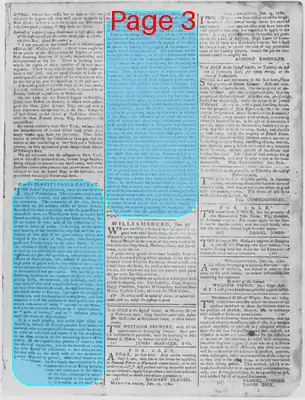
Editorial
January 22, 1780
The Virginia Gazette
Richmond, Williamsburg, Richmond County, Virginia
What is this article about?
Editorial from the Pennsylvania Packet extolling the benefits of commerce to Pennsylvania and Philadelphia's prosperity, defending merchants against accusations of avarice, and quoting Abbé Raynal on the noble role of commerce and the genius of merchants in global trade.
Clipping
OCR Quality
95%
Excellent
Full Text
From the PENNSYLVANIA PACKET.
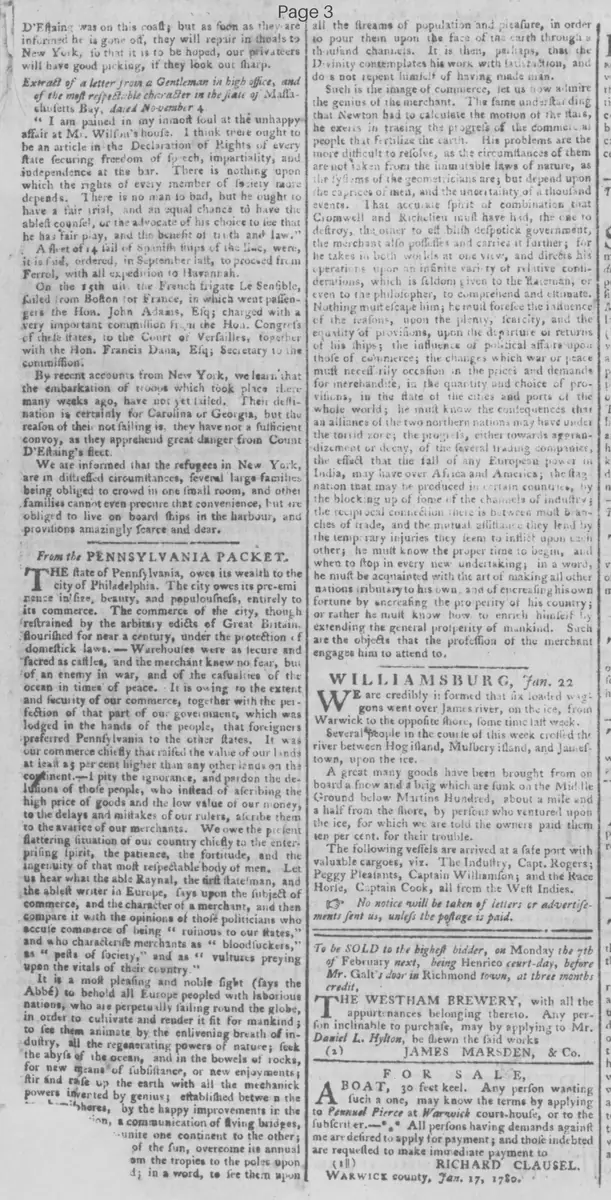
The state of Pennsylvania, owes its wealth to the city of Philadelphia. The city owes its pre-eminence in size, beauty, and populousness, entirely to its commerce. The commerce of the city, though restrained by the arbitrary edicts of Great Britain, flourished for near a century, under the protection of domestic laws. - Warehouses were as secure and sacred as castles, and the merchant knew no fear, but of an enemy in war, and of the casualties of the ocean in times of peace. It is owing to the extent and security of our commerce, together with the perfection of that part of our government, which was lodged in the hands of the people, that foreigners preferred Pennsylvania to the other states. It was our commerce chiefly that raised the value of our lands at least as per cent higher than any other lands on the continent. I pity the ignorance, and pardon the delusions of those people, who instead of ascribing the high price of goods and the low value of our money, to the delays and mistakes of our rulers, ascribe them to the avarice of our merchants. We owe the present flattering situation of our country chiefly to the enterprising spirit, the patience, the fortitude, and the ingenuity of that most respectable body of men. Let us hear what the able Raynal, the first statesman, and the ablest writer in Europe, says upon the subject of commerce, and the character of a merchant, and then compare it with the opinions of those politicians who accuse commerce of being "ruinous to our States," and who characterize merchants as "bloodsuckers," as "pests of society," and as "vultures preying upon the vitals of their country."
It is a most pleasing and noble sight (says the Abbé) to behold all Europe peopled with laborious nations, who are perpetually sailing round the globe, in order to cultivate and render it fit for mankind; to see them animate by the enlivening breath of industry, all the regenerating powers of nature; seek in the abyss of the ocean, and in the bowels of rocks, for new means of subsistence, or new enjoyments; stir and tear up the earth with all the mechanic powers invented by genius; established between the hemispheres, by the happy improvements in the art of navigation, a communication of flying bridges, -unite one continent to the other; of the sun, overcome its annual distance from the tropics to the poles upon the face of the earth; in a word, to see them upon all the streams of population and pleasure, in order to pour them upon the face of the earth through a thousand channels. It is then, perhaps, that the Divinity contemplates his work with satisfaction, and does not repent himself of having made man.
Such is the image of commerce, let us now admire the genius of the merchant. The same understanding that Newton had to calculate the motion of the stars, he exerts in tracing the progress of the commercial people that fertilize the earth. His problems are the more difficult to resolve, as the circumstances of them are not akin from the immutable laws of nature, as the systems of the geometricians are; but depend upon the caprices of men, and the uncertainty of a thousand events. That acute spirit of combination that Cromwell and Richelieu must have had, the one to destroy, the other to establish despotic government, the merchant also possesses and carries it further; for he takes in both worlds at one view, and directs his operations upon an infinite variety of relative considerations, which is seldom given to the statesman, or even to the philosopher, to comprehend and calculate. Nothing must escape him: he must foresee the influence of the seasons, upon the plenty, scarcity, and the equality of provisions, upon the departure or returns of his ships; the influence of political affairs upon those of commerce; the changes which war or peace must necessarily occasion in the prices and demands for merchandise, in the quantity and choice of provisions, in the state of the cities and ports of the whole world; he must know the consequences the an alliance of the two northern nations may have under the sound zone; the progress, either towards aggrandizement or decay, of the several trading companies, the effect that the fall of any European power in India, may have over Africa and America; the stagnation that may be produced in certain countries, by the blocking up of some of the channels of industry; the reciprocal connection herein between moles and branches of trade, and the mutual assistance they lend by the temporary injuries they seem to inflict upon each other; he must know the proper time to begin, and when to stop in every new undertaking; in a word, he must be acquainted with the art of making all other nations tributary to his own, and of increasing his own fortune by increasing the prosperity of his country; or rather he must know how to enrich himself by extending the general prosperity of mankind. Such are the objects that the profession of the merchant engages him to attend to,
The state of Pennsylvania, owes its wealth to the city of Philadelphia. The city owes its pre-eminence in size, beauty, and populousness, entirely to its commerce. The commerce of the city, though restrained by the arbitrary edicts of Great Britain, flourished for near a century, under the protection of domestic laws. - Warehouses were as secure and sacred as castles, and the merchant knew no fear, but of an enemy in war, and of the casualties of the ocean in times of peace. It is owing to the extent and security of our commerce, together with the perfection of that part of our government, which was lodged in the hands of the people, that foreigners preferred Pennsylvania to the other states. It was our commerce chiefly that raised the value of our lands at least as per cent higher than any other lands on the continent. I pity the ignorance, and pardon the delusions of those people, who instead of ascribing the high price of goods and the low value of our money, to the delays and mistakes of our rulers, ascribe them to the avarice of our merchants. We owe the present flattering situation of our country chiefly to the enterprising spirit, the patience, the fortitude, and the ingenuity of that most respectable body of men. Let us hear what the able Raynal, the first statesman, and the ablest writer in Europe, says upon the subject of commerce, and the character of a merchant, and then compare it with the opinions of those politicians who accuse commerce of being "ruinous to our States," and who characterize merchants as "bloodsuckers," as "pests of society," and as "vultures preying upon the vitals of their country."
It is a most pleasing and noble sight (says the Abbé) to behold all Europe peopled with laborious nations, who are perpetually sailing round the globe, in order to cultivate and render it fit for mankind; to see them animate by the enlivening breath of industry, all the regenerating powers of nature; seek in the abyss of the ocean, and in the bowels of rocks, for new means of subsistence, or new enjoyments; stir and tear up the earth with all the mechanic powers invented by genius; established between the hemispheres, by the happy improvements in the art of navigation, a communication of flying bridges, -unite one continent to the other; of the sun, overcome its annual distance from the tropics to the poles upon the face of the earth; in a word, to see them upon all the streams of population and pleasure, in order to pour them upon the face of the earth through a thousand channels. It is then, perhaps, that the Divinity contemplates his work with satisfaction, and does not repent himself of having made man.
Such is the image of commerce, let us now admire the genius of the merchant. The same understanding that Newton had to calculate the motion of the stars, he exerts in tracing the progress of the commercial people that fertilize the earth. His problems are the more difficult to resolve, as the circumstances of them are not akin from the immutable laws of nature, as the systems of the geometricians are; but depend upon the caprices of men, and the uncertainty of a thousand events. That acute spirit of combination that Cromwell and Richelieu must have had, the one to destroy, the other to establish despotic government, the merchant also possesses and carries it further; for he takes in both worlds at one view, and directs his operations upon an infinite variety of relative considerations, which is seldom given to the statesman, or even to the philosopher, to comprehend and calculate. Nothing must escape him: he must foresee the influence of the seasons, upon the plenty, scarcity, and the equality of provisions, upon the departure or returns of his ships; the influence of political affairs upon those of commerce; the changes which war or peace must necessarily occasion in the prices and demands for merchandise, in the quantity and choice of provisions, in the state of the cities and ports of the whole world; he must know the consequences the an alliance of the two northern nations may have under the sound zone; the progress, either towards aggrandizement or decay, of the several trading companies, the effect that the fall of any European power in India, may have over Africa and America; the stagnation that may be produced in certain countries, by the blocking up of some of the channels of industry; the reciprocal connection herein between moles and branches of trade, and the mutual assistance they lend by the temporary injuries they seem to inflict upon each other; he must know the proper time to begin, and when to stop in every new undertaking; in a word, he must be acquainted with the art of making all other nations tributary to his own, and of increasing his own fortune by increasing the prosperity of his country; or rather he must know how to enrich himself by extending the general prosperity of mankind. Such are the objects that the profession of the merchant engages him to attend to,
What sub-type of article is it?
Trade Or Commerce
Economic Policy
What keywords are associated?
Commerce
Merchants
Pennsylvania
Philadelphia
Raynal
Trade Prosperity
Economic Criticism
What entities or persons were involved?
Pennsylvania
Philadelphia
Great Britain
Raynal
Newton
Cromwell
Richelieu
Editorial Details
Primary Topic
Defense Of Commerce And Merchants In Pennsylvania
Stance / Tone
Strongly Supportive Of Commerce And Merchants, Critical Of Anti Commerce Politicians
Key Figures
Pennsylvania
Philadelphia
Great Britain
Raynal
Newton
Cromwell
Richelieu
Key Arguments
Pennsylvania's Wealth Derives From Philadelphia's Commerce
Commerce Flourished Under Domestic Laws Despite British Restrictions
Merchants' Enterprise Drives The Country's Prosperity
Critics Wrongly Blame Merchants For High Prices Instead Of Rulers' Errors
Abbé Raynal Praises Commerce As Noble And Beneficial To Humanity
Merchants Possess Genius Comparable To Great Thinkers And Statesmen In Navigating Global Trade Complexities