Thank you for visiting SNEWPapers!
Sign up free
Literary
August 6, 1842
Richmond Palladium
Richmond, Wayne County, Indiana
What is this article about?
An article cataloging eminent historical figures who began as shoemakers or apprentices, including Linnaeus, David Pareus, Hans Sachs, Benedict Baddouri, Holcroft, Gifford, Bloomfield, John Brand, Winckelman, George Fox, and Roger Sherman, who achieved greatness in botany, theology, poetry, literature, antiquarianism, and politics, inspiring contemporary shoemakers to aspire higher.
Clipping
OCR Quality
95%
Excellent
Full Text
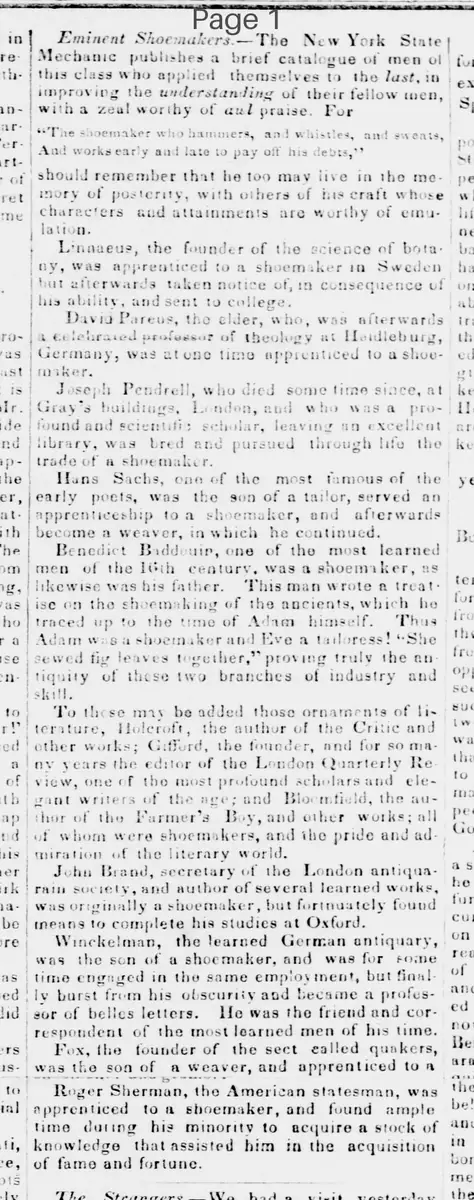
Eminent Shoemakers.—The New York State Mechanic publishes a brief catalogue of men of this class who applied themselves to the last, in improving the understanding of their fellow men, with a zeal worthy of all praise. For
"The shoemaker who hammers, and whistles, and sweats,
And works early and late to pay off his debts,"
should remember that he too may live in the memory of posterity, with others of his craft whose characters and attainments are worthy of emulation.
Linnaeus, the founder of the science of botany, was apprenticed to a shoemaker in Sweden but afterwards taken notice of, in consequence of his ability, and sent to college.
David Pareus, the elder, who was afterwards a celebrated professor of theology at Heidelberg, Germany, was at one time apprenticed to a shoemaker.
Joseph Pendrell, who died some time since, at Gray's buildings, London, and who was a profound and scientific scholar, leaving an excellent library, was bred and pursued through life the trade of a shoemaker.
Hans Sachs, one of the most famous of the early poets, was the son of a tailor, served an apprenticeship to a shoemaker, and afterwards become a weaver, in which he continued.
Benedict Baddouri, one of the most learned men of the 17th century, was a shoemaker. as likewise was his father. This man wrote a treatise on the shoemaking of the ancients, which he traced up to the time of Adam himself. Thus Adam was a shoemaker and Eve a tailoress! "She sewed fig leaves together." proving truly the antiquity of these two branches of industry and skill.
To these may be added those ornaments of literature, Holcroft, the author of the Critic and other works; Gifford, the founder, and for so many years the editor of the London Quarterly Review, one of the most profound scholars and elegant writers of the age; and Bloomfield, the author of the Farmer's Boy, and other works; all of whom were shoemakers, and the pride and admiration of the literary world.
John Brand, secretary of the London antiquarian society, and author of several learned works, was originally a shoemaker, but fortunately found means to complete his studies at Oxford.
Winckelman, the learned German antiquary, was the son of a shoemaker. and was for some time engaged in the same employment, but finally burst from his obscurity and became a professor of belles letters. He was the friend and correspondent of the most learned men of his time.
Fox, the founder of the sect called quakers, was the son of a weaver, and apprenticed to a shoemaker.
Roger Sherman, the American statesman, was apprenticed to a shoemaker, and found ample time during his minority to acquire a stock of knowledge that assisted him in the acquisition of fame and fortune.
"The shoemaker who hammers, and whistles, and sweats,
And works early and late to pay off his debts,"
should remember that he too may live in the memory of posterity, with others of his craft whose characters and attainments are worthy of emulation.
Linnaeus, the founder of the science of botany, was apprenticed to a shoemaker in Sweden but afterwards taken notice of, in consequence of his ability, and sent to college.
David Pareus, the elder, who was afterwards a celebrated professor of theology at Heidelberg, Germany, was at one time apprenticed to a shoemaker.
Joseph Pendrell, who died some time since, at Gray's buildings, London, and who was a profound and scientific scholar, leaving an excellent library, was bred and pursued through life the trade of a shoemaker.
Hans Sachs, one of the most famous of the early poets, was the son of a tailor, served an apprenticeship to a shoemaker, and afterwards become a weaver, in which he continued.
Benedict Baddouri, one of the most learned men of the 17th century, was a shoemaker. as likewise was his father. This man wrote a treatise on the shoemaking of the ancients, which he traced up to the time of Adam himself. Thus Adam was a shoemaker and Eve a tailoress! "She sewed fig leaves together." proving truly the antiquity of these two branches of industry and skill.
To these may be added those ornaments of literature, Holcroft, the author of the Critic and other works; Gifford, the founder, and for so many years the editor of the London Quarterly Review, one of the most profound scholars and elegant writers of the age; and Bloomfield, the author of the Farmer's Boy, and other works; all of whom were shoemakers, and the pride and admiration of the literary world.
John Brand, secretary of the London antiquarian society, and author of several learned works, was originally a shoemaker, but fortunately found means to complete his studies at Oxford.
Winckelman, the learned German antiquary, was the son of a shoemaker. and was for some time engaged in the same employment, but finally burst from his obscurity and became a professor of belles letters. He was the friend and correspondent of the most learned men of his time.
Fox, the founder of the sect called quakers, was the son of a weaver, and apprenticed to a shoemaker.
Roger Sherman, the American statesman, was apprenticed to a shoemaker, and found ample time during his minority to acquire a stock of knowledge that assisted him in the acquisition of fame and fortune.
What sub-type of article is it?
Essay
What themes does it cover?
Moral Virtue
What keywords are associated?
Eminent Shoemakers
Biographical Sketches
Apprenticeship
Scholarly Achievement
Moral Emulation
Literary Details
Title
Eminent Shoemakers.
Subject
Catalogue Of Famous Individuals Who Were Shoemakers And Achieved Scholarly Or Political Eminence
Key Lines
"The Shoemaker Who Hammers, And Whistles, And Sweats,
And Works Early And Late To Pay Off His Debts,"
Thus Adam Was A Shoemaker And Eve A Tailoress! "She Sewed Fig Leaves Together." Proving Truly The Antiquity Of These Two Branches Of Industry And Skill.