Thank you for visiting SNEWPapers!
Sign up free
Burlington Free Press
Burlington, Chittenden County, Vermont
What is this article about?
On May 30, 1838, a gang of 30-40 men, possibly Canadian refugees, attacked the British steamboat Sir Robert Peel near French Creek, New York, forcing passengers ashore, looting, and burning the vessel valued at £11,000. One passenger wounded, pilot burned; three arrests made amid US-Canada tensions.
Merged-components note: Continuation of the same article about the destruction of the British steamer 'Sir Robert Peel'; text flows directly from one component to the next across pages.
Clippings
1 of 2
OCR Quality
Full Text
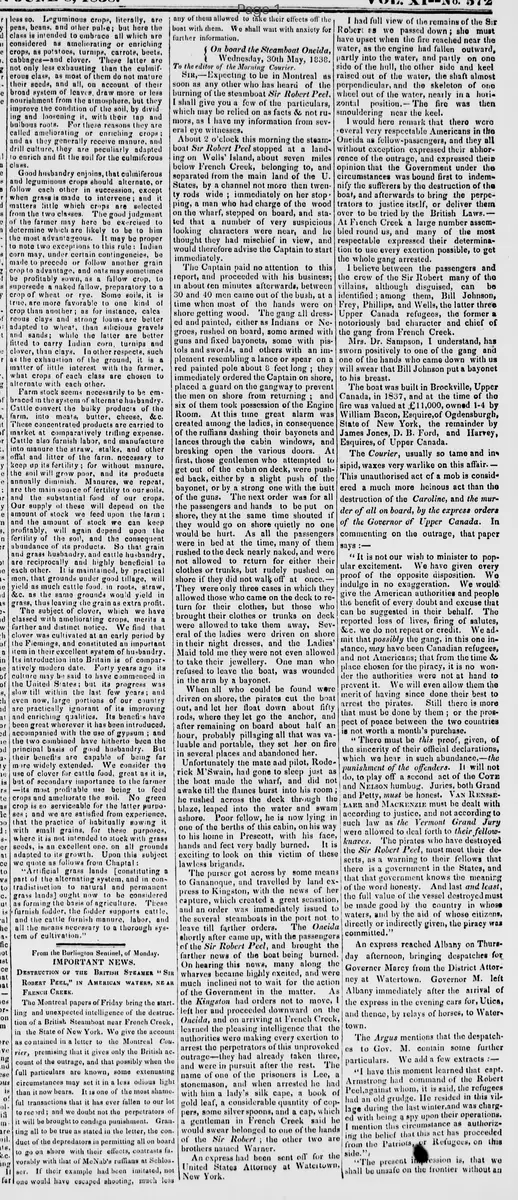
IMPORTANT NEWS.
Destruction of the British Steamer "Sir Robert Peel," in American Waters, near French Creek.
The Montreal papers of Friday bring the startling and unexpected intelligence of the destruction of a British Steamboat near French Creek, in the State of New York. We give the account as contained in a letter to the Montreal Courier, premising that it gives only the British account of the outrage, and that possibly when the full particulars are known, some extenuating circumstances may set it in a less odious light than it now bears. It is one of the most shameful transactions that it has ever fallen to our lot to record; and we doubt not the perpetrators of it will be brought to condign punishment. Granting all to be true as stated in the letter, the conduct of the depredators in permitting all on board to go on shore with their effects, contrasts favorably with that of McNab's ruffians at Schlosser. If their example had been imitated, not one would have escaped shooting, much less any of them allowed to take their effects off the boat with them. We shall wait with anxiety for further information.
(On board the Steamboat Oneida,
Wednesday, 30th May, 1838.
To the editor of the Morning Courier.
SIR,-Expecting to be in Montreal as soon as any other who has heard of the burning of the steamboat Sir Robert Peel, I shall give you a few of the particulars, which may be relied on as facts & not rumors, as I have my information from several eye witnesses.
About 2 o'clock this morning the steamboat Sir Robert Peel stopped at a landing on Wells' Island, about seven miles below French Creek, belonging to, and separated from the main land of the U. States, by a channel not more than twenty rods wide ; immediately on her stopping, a man who had charge of the wood on the wharf, stepped on board, and stated that a number of very suspicious looking characters were near, and he thought they had mischief in view, and would therefore advise the Captain to start immediately.
The Captain paid no attention to this report, and proceeded with his business; in about ten minutes afterwards, between 30 and 40 men came out of the bush, at a time when most of the hands were on shore getting wood. The gang all dressed and painted, either as Indians or Negroes, rushed on board, some armed with guns and fixed bayonets, some with pistols and swords, and others with an implement resembling a lance or spear on a red painted pole about 8 feet long ; they immediately ordered the Captain on shore, placed a guard on the gangway to prevent the men on shore from returning ; and six of them took possession of the Engine Room. At this time great alarm was created among the ladies, in consequence of the ruffians dashing their bayonets and lances through the cabin windows, and breaking open the various doors. At first, those gentlemen who attempted to get out of the cabin on deck, were pushed back, either by a slight push of the bayonet, or by a strong one with the butt of the guns. The next order was for all the passengers and hands to be put on shore, they at the same time shouted if they would go on shore quietly no one would be hurt. As all the passengers were in bed at the time, many of them rushed to the deck nearly naked, and were not allowed to return for either their clothes or trunks, but rudely pushed on shore if they did not walk off at once.- They were only three cases in which they allowed those who came on the deck to return for their clothes, but those who brought their clothes or trunks on deck were allowed to take them away. Several of the ladies were driven on shore in their night dresses, and the Ladies' Maid told me they were not even allowed to take their jewellery. One man who refused to leave the boat, was wounded in the arm by a bayonet.
When all who could be found were driven on shore, the pirates cut the boat out, and let her float down about fifty rods, where they let go the anchor, and after remaining on board about half an hour, probably pillaging all that was valuable and portable, they set her on fire in several places and abandoned her.
Unfortunately the mate and pilot, Roderick M'Swain, had gone to sleep just as the boat made the wharf, and did not awake till the flames burst into his room ; he rushed across the deck through the blaze, leaped into the water and swam ashore. Poor fellow, he is now lying in one of the berths of this cabin, on his way to his home in Prescott, with his face, hands and feet very badly burned. It is exciting to look on this victim of these lawless brigands.
The purser got across by some means to Gananoque, and travelled by land express to Kingston, with the news of her capture, which created a great sensation, and an order was immediately issued to the several steamboats in the port not to leave till farther orders. The Oneida shortly after came up, with the passengers of the Sir Robert Peel, and brought the farther news of the boat being burned. On hearing this news, many along the wharves became highly excited, and were much inclined not to wait for the action of the Government in the matter. As the Kingston had orders not to move, I left her and proceeded downward on the Oneida, and on arriving at French Creek, learned the pleasing intelligence that the authorities were making every exertion to arrest the perpetrators of this unprovoked outrage--they had already taken three, and were in pursuit after the rest. The name of one of the prisoners is Lee, a stonemason, and when arrested he had with him a lady's silk cape, a book of gold leaf, a considerable quantity of copper, some silver spoons, and a cap, which a gentleman in French Creek said he would swear belonged to one of the hands of the Sir Robert ; the other two are brothers named Warner.
An express had been sent off for the United States Attorney at Watertown, New York.
I had full view of the remains of the Sir Robert as we passed down: she must have upset when the fire reached near the water, as the engine had fallen outward, partly into the water, and partly on one side of the hull, the other side and keel raised out of the water, the shaft almost perpendicular, and the skeleton of one wheel out of the water, nearly in a horizontal position.-The fire was then smouldering near the keel.
I would here remark that there were several very respectable Americans in the Oneida as fellow-passengers, and they all without exception expressed their abhorrence of the outrage, and expressed their opinion that the Government under the circumstances was bound first to indemnify the sufferers by the destruction of the boat, and afterwards to bring the perpetrators to justice itself, or deliver them over to be tried by the British Laws.- At French Creek a large number assembled round us, and many of the most respectable expressed their determination to use every exertion possible, to get the whole gang arrested.
I believe between the passengers and the crew of the Sir Robert many of the villains, although disguised, can be identified: among them, Bill Johnson, Frey, Phillips, and Wells, the latter three Upper Canada refugees, the former a notoriously bad character and chief of the gang from French Creek. Mrs. Dr. Sampson, I understand, has sworn positively to one of the gang and one of the hands who came down with us will swear that Bill Johnson put a bayonet to his breast.
The boat was built in Brockville, Upper Canada, in 1837, and at the time of the fire was valued at £11,000, owned 1-4 by William Bacon, Esquire, of Ogdensburgh, State of New York, the remainder by James Jones, D. B. Ford, and Harvey, Esquires, of Upper Canada.
The Courier, usually so tame and insipid, waxes very warlike on this affair.- This unauthorised act of a mob is considered a much more heinous act than the destruction of the Caroline, and the murder of all on board, by the express orders of the Governor of Upper Canada. In commenting on the outrage, that paper says :-
" It is not our wish to minister to popular excitement. We have given every proof of the opposite disposition. We indulge in no exaggeration. We would give the American authorities and people the benefit of every doubt and excuse that can be suggested in their behalf. The reported loss of lives, firing of salutes, &c. we do not repeat or credit. We admit that possibly the gang, in this one instance, may have been Canadian refugees, and not Americans; that from the time & place chosen for the piracy, it is no wonder the authorities were not at hand to prevent it. We will even allow them the merit of having since done their best to arrest the pirates. Still there is more that must be done by them; or the prospect of peace between the two countries is not worth a month's purchase.
" There must be this proof, given, of the sincerity of their official declarations, which we hear in such abundance,-the punishment of the offenders. It will not do, to play off a second act of the Cole and Nelson humbug. Juries, both Grand and Petty, must be honest. Van Rensselaer and Mackenzie must be dealt with according to justice, and not according to such law as the Vermont Grand Jury were allowed to deal forth to their fellow-knaves. The pirates who have destroyed the Sir Robert Peel, must meet their deserts, as a warning to their fellows that there is a government in the States, and that that government knows the meaning of the word honesty. And last and least, the full value of the vessel destroyed must be made good by the country in whose waters, and by the aid of whose citizens, directly or indirectly given, the piracy was committed."
An express reached Albany on Thursday afternoon, bringing despatches for Governor Marcy from the District Attorney at Watertown. Governor M. left Albany immediately after the arrival of the express in the evening cars for, Utica, and thence, by relays of horses, to Watertown.
The Argus mentions that the despatches to Gov. M. contain some further particulars. We add a few extracts :-
"I have this moment learned that capt. Armstrong had command of the Robert Peel, against whom, it is said, the refugees had an old grudge. He resided in this village during the last winter, and was charged with being a spy upon their operations. I mention this circumstance as authorizing the belief that this act has proceeded from the Patriots, or Refugees, on this side."
"The present impression is, that we shall be unsafe on the frontier without an"
armed force: and immediate measures will be required to afford ample protection to British vessels in our waters, or all confidence and intercourse will be broken up.
"I have thought it advisable that Gen. Cross, of the militia, should call out one or two companies of dragoons, to go to French Creek; whither I shall proceed with the sheriff this afternoon.
"No person to our knowledge was recognized as having been engaged in this outrage, but individuals residing at French Creek have been missing for several days."
From Jason Fairbanks, Deputy Marshal:
"I intend immediately to repair to French Creek with Doctor Carrier, the collector and an officer, authorized to call out the militia if necessary. A letter has just been received from French Creek calling for a force to protect them from being burnt tonight as a measure of retaliation.
"All is excitement here: and a rumor is afloat that the arrangements of the pirates were to make a simultaneous attack upon eight different boats at different places."
What sub-type of article is it?
What keywords are associated?
What entities or persons were involved?
Where did it happen?
Domestic News Details
Primary Location
French Creek, State Of New York
Event Date
1838 05 30
Key Persons
Outcome
steamboat sir robert peel burned and destroyed, valued at £11,000; one man wounded in arm by bayonet; pilot roderick m'swain badly burned on face, hands, and feet; three suspects arrested (lee and warner brothers); authorities pursuing others; heightened excitement and calls for militia.
Event Details
Around 2 AM on May 30, 1838, the British steamboat Sir Robert Peel stopped at Wells' Island near French Creek, NY. A gang of 30-40 men, disguised as Indians or Negroes and armed with bayonets, pistols, swords, and spears, boarded, forced captain ashore, guarded gangway, seized engine room, alarmed passengers by breaking windows and doors. Ordered all passengers and crew ashore, many in nightclothes without belongings; one resister wounded. Looted for half hour, set fire in several places, abandoned. Pilot escaped through flames but burned. News caused sensation in Kingston; US authorities arrested three, sent for attorney; Governor Marcy dispatched to scene.