Thank you for visiting SNEWPapers!
Sign up free
Letter to Editor
April 19, 1844
Southern Christian Advocate
Charleston, Charleston County, South Carolina
What is this article about?
Bishop James O. Andrew describes his challenging horseback journey through flooded prairies, swamps, and creeks in Texas to reach the Methodist Conference in Montgomery, encountering frontier widows, wildlife, and an Indian village remnant. Dated December 1843.
Clipping
OCR Quality
98%
Excellent
Full Text
For the Southern Christian Advocate.
BISHOP ANDREW'S LETTERS.—No. 12.
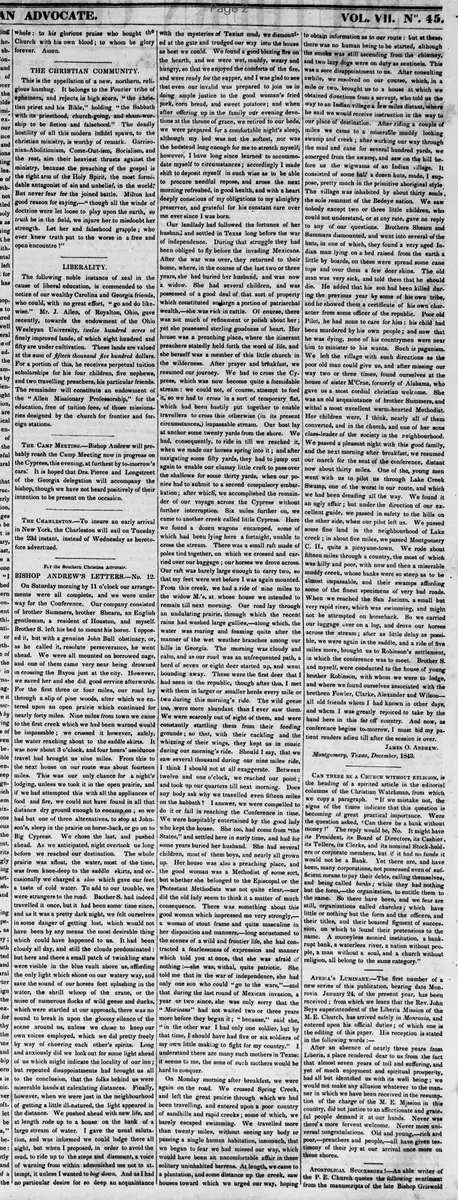
On Saturday morning by 11 o'clock our arrangements were all complete, and we were under way for the Conference. Our company consisted of brother Summers, brother Shearn, an English gentleman, a resident of Houston, and myself. Brother S. left his bed to mount his horse. I opposed it, but with a genuine John Bull obstinacy, or, as he called it, resolute perseverance, he went ahead. We were all mounted on borrowed nags, and one of them came very near being drowned in crossing the Bayou just at the city. However, we saved her and she did good service afterwards. For the first three or four miles, our road lay through a slip of pine woods, after which we entered upon an open prairie which continued for nearly forty miles. Nine miles from town we came to the first creek which we had been warned would be impassable; we crossed it however, safely, the water reaching about to the saddle skirts. It was now about 3 o'clock, and four hours' assiduous travel had brought us nine miles. From this to the next house on our route was about fourteen miles. This was our only chance for a night's lodging, unless we took it in the open prairie, and if we had attempted this with all the appliances of food and fire, we could not have found in all that distance dry ground enough to encamp on; so we had but one of three alternatives, to stop at Johnson's, sleep in the prairie on horse-back, or go on to Big Cypress. We chose the last, and pushed ahead. As we anticipated, night overtook us long before we reached our destination. The whole prairie was afloat, the water, most of the time, was from knee-deep to the saddle skirts, and occasionally we charged a slough which gave our feet a taste of cold water. To add to our trouble, we were strangers to the road. Brother S. had indeed travelled it once, but it had been some time since, and as it was a pretty dark night, we felt ourselves in some danger of getting lost, which would not have been by any means the most desirable thing which could have happened to us. It had been cloudy all day, and still the clouds predominated: but here and there a small patch of twinkling stars were visible in the blue vault above us, affording the only light which shone on our watery way, and save the sound of our horses feet splashing in the water, the shrill whoop of the crane, or the noise of numerous flocks of wild geese and ducks, which were startled at our approach, there was no sound to break in upon the gloomy silence of the scene around us, unless we chose to keep our own voices employed, which we did pretty freely by way of cheering each other's spirits. Long and anxiously did we look out for some light ahead of us which might indicate the locality of our inn; but repeated disappointments had brought us all to the conclusion, that the folks behind us were miserable hands at calculating distances. Finally however, when we were just in the neighbourhood of getting a little ill-natured, the light appeared in the distance. We pushed ahead with new life, and at length rode up to a house on the bank of a large stream of water. I gave the usual salutation, and was informed we could lodge there all night, but when I proposed, in order to avoid the mud, to ride up to the steps and dismount, a voice of warning from within admonished me not to attempt it unless I wanted to bog down. And as I had no particular desire for so deep an acquaintance with the mysteries of Texian mud, we dismounted at the gate and trudged our way into the house as best we could. We found a good blazing fire on the hearth, and we were wet, muddy, weary and hungry, so that we enjoyed the comforts of the fire, and were ready for the supper, and I was glad to see that even our invalid was prepared to join us in doing ample justice to the good woman's fried pork, corn bread, and sweet potatoes; and when after offering up in the family our evening devotions at the throne of grace, we retired to our beds, we were prepared for a comfortable night's sleep, although my bed was not the softest, nor was the bedstead long enough for me to stretch myself: however, I have long since learned to accommodate myself to circumstances; accordingly I made shift to deposit myself in such wise as to be able to procure needful repose, and arose the next morning refreshed, in good health, and with a heart deeply conscious of my obligations to my almighty preserver, and grateful for his constant care over me ever since I was born.
Our landlady had followed the fortunes of her husband and settled in Texas long before the war of independence. During that struggle they had been obliged to fly before the invading Mexicans. After the war was over, they returned to their home, where, in the course of the last two or three years, she had buried her husband, and was now a widow. She had several children, and was possessed of a good deal of that sort of property which constituted so large a portion of patriarchal wealth,—she was rich in cattle. Of course, there was not much of refinement or polish about her; yet she possessed sterling goodness of heart. Her house was a preaching place, where the itinerant preachers statedly held forth the word of life, and she herself was a member of this little church in the wilderness. After prayer and breakfast, we resumed our journey. We had to cross the Cypress, which was now become quite a formidable stream: we could not, of course, attempt to ford it, so we had to cross in a sort of temporary flat, which had been hastily put together to enable travellers to cross this otherwise (in its present circumstances,) impassable stream. Our boat lay at anchor some twenty yards from the shore. We had, consequently, to ride in till we reached it, when we made our horses spring into it; and after navigating some fifty yards, they had to jump out again to enable our clumsy little craft to pass over the shallows for some thirty yards, when our ponies had to submit to a second compulsory embarkation; after which, we accomplished the remainder of our voyage across the Cypress without further interruption. Six miles further on, we came to another creek called little Cypress. Here we found a dozen wagons encamped, some of which had been lying here a fortnight, unable to cross the stream. There was a small raft made of poles tied together, on which we crossed and carried over our baggage; our horses we drove across. Our raft was barely large enough to carry two, so that my feet were wet before I was again mounted. From this creek, we had a ride of nine miles to the widow M.'s, at whose house we intended to remain till next morning. Our road lay through an undulating prairie, through which the recent rains had washed large gullies,—along which, the water was roaring and foaming quite after the manner of the wet weather branches among our hills in Georgia. The morning was cloudy and calm, and as our road was an unfrequented path, a herd of seven or eight deer started up, and went bounding away. These were the first deer that I had seen in the republic, though after this, I met with them in larger or smaller herds every mile or two during this morning's ride. The wild geese too, were more abundant than I ever saw them. We were scarcely out of sight of them, and were constantly startling them from their feeding grounds; so that, with their cackling and the whizzing of their wings, they kept us in music during our morning's ride. Should I say, that we saw several thousand during our nine miles ride, I think I should not at all exaggerate. Between twelve and one o'clock, we reached our point; and took up our quarters till next morning. Does anybody ask why we travelled even fifteen miles on the Sabbath? I answer, we were compelled to do it or fail in reaching the Conference in time. We were hospitably entertained by the good lady who kept the house. She too, had come from "the States," and settled here in early time, and had for some years buried her husband. She had several children, most of them boys, and nearly all grown up. Her house was also a preaching place, and the good woman was a Methodist of some sort, but whether she belonged to the Episcopal or the Protestant Methodists was not quite clear,—nor did the old lady seem to think it a matter of much consequence. There was something about this good woman which impressed me very strongly,— a woman of stout frame and quite masculine in her disposition and manners,—long accustomed to the scenes of a wild and frontier life, she had contracted a fearlessness of expression and manner which told you at once, that she was afraid of nothing: she was, withal, quite patriotic. She told me that in the war of independence, she had only one son who could "go to the wars,"—and that during the last round of Mexican invasion, a year or two since, she was only sorry that the "Mexicans" had not waited two or three years more before they began it; "because," said she, "in the other war I had only one soldier, but by that time, I should have had five or six soldiers of my own making to fight for my country." I understand there are many such mothers in Texas: it seems to me, the sons of such mothers would be hard to conquer.
On Monday morning after breakfast, we were again on the road. We crossed Spring Creek, and left the great prairie through which we had been travelling, and entered upon a poor country of sandhills and rapid creeks; some of which, we barely escaped swimming. We travelled more than twenty miles, without seeing any body or passing a single human habitation, insomuch, that we began to fear we had missed our way, which would have been an uncomfortable affair in those solitary uninhabited barrens. At length, we came to a plantation, and some distance up the creek, saw houses toward which we urged our way, hoping to obtain information as to our route: but at these, there was no human being to be started, although the smoke was still ascending from the chimney, and two lazy dogs were on duty as sentinels. This was a sore disappointment to us. After consulting awhile, we resolved on our course, which, in a mile or two, brought us to a house at which we obtained directions from a servant, who told us the way to an Indian village a few miles distant, where he said we would receive instruction in the way to our place of destination. After riding a couple of miles we came to a miserable muddy looking swamp and creek; after working our way through the mud and cane for several hundred yards, we emerged from the swamp, and saw on the hill before us the wigwams of an Indian village. It consisted of some half a dozen huts, made, I suppose, pretty much in the primitive aboriginal style. The village was inhabited by about thirty souls the sole remnant of the Bedeye nation. We saw nobody except two or three little children, who could not understand, or at any rate, gave no reply to any of our questions. Brothers Shearn and Summers dismounted, and went into several of the huts, in one of which, they found a very aged Indian man lying on a bed raised from the earth a little by boards, on these were spread some cane tops and over them a few deer skins. The old man was very sick, and told them that he should die. He added that his son had been killed during the previous year by some of his own tribe, and he showed them a certificate of his own character from some officer of the republic. Poor old Pilot, he had none to care for him: his child had been murdered by his own people; and now that he was dying, none of his countrymen were near him to minister to his wants. Such is paganism. We left the village with such directions as the poor old man could give us, and after missing our way two or three times, found ourselves at the house of sister M'Crae, formerly of Alabama, who gave us a most cordial christian welcome. She was an old acquaintance of brother Summers, and withal a most excellent warm-hearted Methodist. Her children were, I think, nearly all of them converted, and in the church, and one of her sons class-leader of the society in the neighbourhood. We passed a pleasant night with this good family, and the next morning after breakfast, we resumed our march for the seat of the conference, distant now about thirty miles. One of the young men went with us to pilot us through Lake Creek Swamp, one of the worst in our route, and which we had been dreading all the way. We found it an ugly affair; but under the direction of our excellent guide, we passed in safety to the hills on the other side, when our pilot left us. We passed some fine land in the neighbourhood of Lake creek; in about five miles, we passed Montgomery C. H., quite a picayune-town. We rode about fifteen miles through a country, the most of which was hilly and poor, with now and then a miserable muddy creek, whose banks were so steep as to be almost impassable, and their swamps affording some of the finest specimens of very bad roads. When we reached the San Jacinto, a small but very rapid river, which was swimming, and might not be attempted on horseback. So we carried our luggage over on a log, and drove our horses across the stream; after as little delay as possible, we were again in the saddle, and a ride of five miles more, brought us to Robinson's settlement, in which the conference was to meet. Brother S. and myself, were conducted to the house of young brother Robinson, with whom we were to lodge, and where we found ourselves associated with the brethren Fowler, Clarke, Alexander and Wilson— all old friends whom I had known in other days, and whom I was greatly rejoiced to take by the hand here in this far off country. And now, as conference begins to-morrow, I must bid my patient readers adieu till after the session is over.
JAMES O. ANDREW.
Montgomery, Texas, December, 1843.
BISHOP ANDREW'S LETTERS.—No. 12.
On Saturday morning by 11 o'clock our arrangements were all complete, and we were under way for the Conference. Our company consisted of brother Summers, brother Shearn, an English gentleman, a resident of Houston, and myself. Brother S. left his bed to mount his horse. I opposed it, but with a genuine John Bull obstinacy, or, as he called it, resolute perseverance, he went ahead. We were all mounted on borrowed nags, and one of them came very near being drowned in crossing the Bayou just at the city. However, we saved her and she did good service afterwards. For the first three or four miles, our road lay through a slip of pine woods, after which we entered upon an open prairie which continued for nearly forty miles. Nine miles from town we came to the first creek which we had been warned would be impassable; we crossed it however, safely, the water reaching about to the saddle skirts. It was now about 3 o'clock, and four hours' assiduous travel had brought us nine miles. From this to the next house on our route was about fourteen miles. This was our only chance for a night's lodging, unless we took it in the open prairie, and if we had attempted this with all the appliances of food and fire, we could not have found in all that distance dry ground enough to encamp on; so we had but one of three alternatives, to stop at Johnson's, sleep in the prairie on horse-back, or go on to Big Cypress. We chose the last, and pushed ahead. As we anticipated, night overtook us long before we reached our destination. The whole prairie was afloat, the water, most of the time, was from knee-deep to the saddle skirts, and occasionally we charged a slough which gave our feet a taste of cold water. To add to our trouble, we were strangers to the road. Brother S. had indeed travelled it once, but it had been some time since, and as it was a pretty dark night, we felt ourselves in some danger of getting lost, which would not have been by any means the most desirable thing which could have happened to us. It had been cloudy all day, and still the clouds predominated: but here and there a small patch of twinkling stars were visible in the blue vault above us, affording the only light which shone on our watery way, and save the sound of our horses feet splashing in the water, the shrill whoop of the crane, or the noise of numerous flocks of wild geese and ducks, which were startled at our approach, there was no sound to break in upon the gloomy silence of the scene around us, unless we chose to keep our own voices employed, which we did pretty freely by way of cheering each other's spirits. Long and anxiously did we look out for some light ahead of us which might indicate the locality of our inn; but repeated disappointments had brought us all to the conclusion, that the folks behind us were miserable hands at calculating distances. Finally however, when we were just in the neighbourhood of getting a little ill-natured, the light appeared in the distance. We pushed ahead with new life, and at length rode up to a house on the bank of a large stream of water. I gave the usual salutation, and was informed we could lodge there all night, but when I proposed, in order to avoid the mud, to ride up to the steps and dismount, a voice of warning from within admonished me not to attempt it unless I wanted to bog down. And as I had no particular desire for so deep an acquaintance with the mysteries of Texian mud, we dismounted at the gate and trudged our way into the house as best we could. We found a good blazing fire on the hearth, and we were wet, muddy, weary and hungry, so that we enjoyed the comforts of the fire, and were ready for the supper, and I was glad to see that even our invalid was prepared to join us in doing ample justice to the good woman's fried pork, corn bread, and sweet potatoes; and when after offering up in the family our evening devotions at the throne of grace, we retired to our beds, we were prepared for a comfortable night's sleep, although my bed was not the softest, nor was the bedstead long enough for me to stretch myself: however, I have long since learned to accommodate myself to circumstances; accordingly I made shift to deposit myself in such wise as to be able to procure needful repose, and arose the next morning refreshed, in good health, and with a heart deeply conscious of my obligations to my almighty preserver, and grateful for his constant care over me ever since I was born.
Our landlady had followed the fortunes of her husband and settled in Texas long before the war of independence. During that struggle they had been obliged to fly before the invading Mexicans. After the war was over, they returned to their home, where, in the course of the last two or three years, she had buried her husband, and was now a widow. She had several children, and was possessed of a good deal of that sort of property which constituted so large a portion of patriarchal wealth,—she was rich in cattle. Of course, there was not much of refinement or polish about her; yet she possessed sterling goodness of heart. Her house was a preaching place, where the itinerant preachers statedly held forth the word of life, and she herself was a member of this little church in the wilderness. After prayer and breakfast, we resumed our journey. We had to cross the Cypress, which was now become quite a formidable stream: we could not, of course, attempt to ford it, so we had to cross in a sort of temporary flat, which had been hastily put together to enable travellers to cross this otherwise (in its present circumstances,) impassable stream. Our boat lay at anchor some twenty yards from the shore. We had, consequently, to ride in till we reached it, when we made our horses spring into it; and after navigating some fifty yards, they had to jump out again to enable our clumsy little craft to pass over the shallows for some thirty yards, when our ponies had to submit to a second compulsory embarkation; after which, we accomplished the remainder of our voyage across the Cypress without further interruption. Six miles further on, we came to another creek called little Cypress. Here we found a dozen wagons encamped, some of which had been lying here a fortnight, unable to cross the stream. There was a small raft made of poles tied together, on which we crossed and carried over our baggage; our horses we drove across. Our raft was barely large enough to carry two, so that my feet were wet before I was again mounted. From this creek, we had a ride of nine miles to the widow M.'s, at whose house we intended to remain till next morning. Our road lay through an undulating prairie, through which the recent rains had washed large gullies,—along which, the water was roaring and foaming quite after the manner of the wet weather branches among our hills in Georgia. The morning was cloudy and calm, and as our road was an unfrequented path, a herd of seven or eight deer started up, and went bounding away. These were the first deer that I had seen in the republic, though after this, I met with them in larger or smaller herds every mile or two during this morning's ride. The wild geese too, were more abundant than I ever saw them. We were scarcely out of sight of them, and were constantly startling them from their feeding grounds; so that, with their cackling and the whizzing of their wings, they kept us in music during our morning's ride. Should I say, that we saw several thousand during our nine miles ride, I think I should not at all exaggerate. Between twelve and one o'clock, we reached our point; and took up our quarters till next morning. Does anybody ask why we travelled even fifteen miles on the Sabbath? I answer, we were compelled to do it or fail in reaching the Conference in time. We were hospitably entertained by the good lady who kept the house. She too, had come from "the States," and settled here in early time, and had for some years buried her husband. She had several children, most of them boys, and nearly all grown up. Her house was also a preaching place, and the good woman was a Methodist of some sort, but whether she belonged to the Episcopal or the Protestant Methodists was not quite clear,—nor did the old lady seem to think it a matter of much consequence. There was something about this good woman which impressed me very strongly,— a woman of stout frame and quite masculine in her disposition and manners,—long accustomed to the scenes of a wild and frontier life, she had contracted a fearlessness of expression and manner which told you at once, that she was afraid of nothing: she was, withal, quite patriotic. She told me that in the war of independence, she had only one son who could "go to the wars,"—and that during the last round of Mexican invasion, a year or two since, she was only sorry that the "Mexicans" had not waited two or three years more before they began it; "because," said she, "in the other war I had only one soldier, but by that time, I should have had five or six soldiers of my own making to fight for my country." I understand there are many such mothers in Texas: it seems to me, the sons of such mothers would be hard to conquer.
On Monday morning after breakfast, we were again on the road. We crossed Spring Creek, and left the great prairie through which we had been travelling, and entered upon a poor country of sandhills and rapid creeks; some of which, we barely escaped swimming. We travelled more than twenty miles, without seeing any body or passing a single human habitation, insomuch, that we began to fear we had missed our way, which would have been an uncomfortable affair in those solitary uninhabited barrens. At length, we came to a plantation, and some distance up the creek, saw houses toward which we urged our way, hoping to obtain information as to our route: but at these, there was no human being to be started, although the smoke was still ascending from the chimney, and two lazy dogs were on duty as sentinels. This was a sore disappointment to us. After consulting awhile, we resolved on our course, which, in a mile or two, brought us to a house at which we obtained directions from a servant, who told us the way to an Indian village a few miles distant, where he said we would receive instruction in the way to our place of destination. After riding a couple of miles we came to a miserable muddy looking swamp and creek; after working our way through the mud and cane for several hundred yards, we emerged from the swamp, and saw on the hill before us the wigwams of an Indian village. It consisted of some half a dozen huts, made, I suppose, pretty much in the primitive aboriginal style. The village was inhabited by about thirty souls the sole remnant of the Bedeye nation. We saw nobody except two or three little children, who could not understand, or at any rate, gave no reply to any of our questions. Brothers Shearn and Summers dismounted, and went into several of the huts, in one of which, they found a very aged Indian man lying on a bed raised from the earth a little by boards, on these were spread some cane tops and over them a few deer skins. The old man was very sick, and told them that he should die. He added that his son had been killed during the previous year by some of his own tribe, and he showed them a certificate of his own character from some officer of the republic. Poor old Pilot, he had none to care for him: his child had been murdered by his own people; and now that he was dying, none of his countrymen were near him to minister to his wants. Such is paganism. We left the village with such directions as the poor old man could give us, and after missing our way two or three times, found ourselves at the house of sister M'Crae, formerly of Alabama, who gave us a most cordial christian welcome. She was an old acquaintance of brother Summers, and withal a most excellent warm-hearted Methodist. Her children were, I think, nearly all of them converted, and in the church, and one of her sons class-leader of the society in the neighbourhood. We passed a pleasant night with this good family, and the next morning after breakfast, we resumed our march for the seat of the conference, distant now about thirty miles. One of the young men went with us to pilot us through Lake Creek Swamp, one of the worst in our route, and which we had been dreading all the way. We found it an ugly affair; but under the direction of our excellent guide, we passed in safety to the hills on the other side, when our pilot left us. We passed some fine land in the neighbourhood of Lake creek; in about five miles, we passed Montgomery C. H., quite a picayune-town. We rode about fifteen miles through a country, the most of which was hilly and poor, with now and then a miserable muddy creek, whose banks were so steep as to be almost impassable, and their swamps affording some of the finest specimens of very bad roads. When we reached the San Jacinto, a small but very rapid river, which was swimming, and might not be attempted on horseback. So we carried our luggage over on a log, and drove our horses across the stream; after as little delay as possible, we were again in the saddle, and a ride of five miles more, brought us to Robinson's settlement, in which the conference was to meet. Brother S. and myself, were conducted to the house of young brother Robinson, with whom we were to lodge, and where we found ourselves associated with the brethren Fowler, Clarke, Alexander and Wilson— all old friends whom I had known in other days, and whom I was greatly rejoiced to take by the hand here in this far off country. And now, as conference begins to-morrow, I must bid my patient readers adieu till after the session is over.
JAMES O. ANDREW.
Montgomery, Texas, December, 1843.
What sub-type of article is it?
Reflective
Historical
Informative
What themes does it cover?
Religion
Military War
Social Issues
What keywords are associated?
Texas Journey
Methodist Conference
Frontier Travel
Bishop Andrew
Texas Independence
Indian Village
Wildlife Encounters
Religious Hospitality
What entities or persons were involved?
James O. Andrew.
For The Southern Christian Advocate.
Letter to Editor Details
Author
James O. Andrew.
Recipient
For The Southern Christian Advocate.
Main Argument
recounts the arduous multi-day horseback journey through flooded texas terrain to attend the methodist conference, emphasizing frontier hardships, hospitality, and religious reflections.
Notable Details
Travel Companions: Brother Summers, Brother Shearn, English Gentleman From Houston
Encounters: Widow Landlady Rich In Cattle, Widow M. With Patriotic Sons, Dying Indian Chief Of Bedeye Nation
Wildlife: Deer Herds, Thousands Of Wild Geese
Locations: Big Cypress, Little Cypress, Spring Creek, Lake Creek Swamp, San Jacinto, Montgomery C.H.
Sabbath Travel Justified By Need To Reach Conference On Time