Thank you for visiting SNEWPapers!
Sign up free
Camden Journal
Camden, Kershaw County, South Carolina
What is this article about?
Dr. J. V. C. Smith provides a detailed account of daily life in Jerusalem, Palestine, and Syria, covering cleanliness, water supply, fuel scarcity, lack of roads, historical ruins, travel difficulties, and local customs amid insecurity.
Clipping
OCR Quality
Full Text
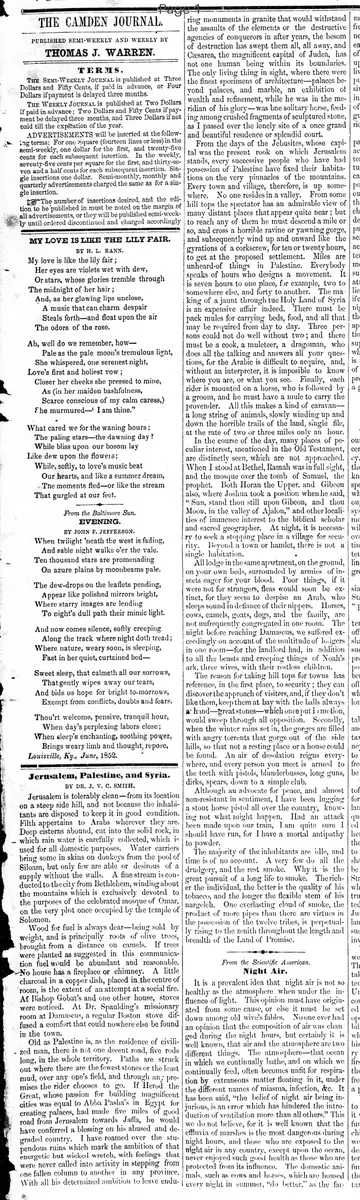
BY DR. J. V. C. SMITH.
Jerusalem is tolerably clean—from its location on a steep side hill, and not because the inhabitants are disposed to keep it in good condition.
Filth appertains to Arabs wherever they are.
Deep cisterns abound, cut into the solid rock, in which rain water is carefully collected, which is used for all domestic purposes. Water carriers bring some in skins on donkeys from the pool of Siloam, but only few are able or desirous of a supply without the walls. A fine stream is conducted to the city from Bethlehem, winding about the mountains which is exclusively devoted to the purposes of the celebrated mosque of Omar, on the very plot once occupied by the temple of Solomon.
Wood for fuel is always dear—being sold by weight, and is principally roots of olive trees, brought from a distance on camels. If trees were planted as suggested in this communication fuel would be abundant and reasonable.
No house has a fireplace or chimney. A little charcoal in a copper dish, placed in the centre of room, is the extent of an attempt at a social fire.
At Bishop Gobat's and one other house, stoves were noticed. At Dr. Spaulding's missionary room at Damascus, a regular Boston stove diffused a comfort that could nowhere else be found in the town.
Old as Palestine is, as the residence of civilized man, there is not one decent road, five rods long, in the whole territory. Paths are struck out where there are the fewest stones or the least mud, over any one's field, and through any premises the rider chooses to go. If Herod the Great, whose passion for building magnificent cities was equal to Abba Pasha's in Egypt for creating palaces, had made five miles of good road from Jerusalem towards Jaffa, he would have conferred a blessing on his abused and degraded country. I have roamed over the stupendous ruins which mark the ambition of that energetic but wicked wretch, with feelings that were never called into activity in stepping from one fallen column to another in any province.
With all his determined ambition to leave enduring monuments in granite that would withstand the assaults of the elements or the destructive agencies of conquerors in after years, the besom of destruction has swept them all, all away, and Caesarea, the magnificent capital of Judea, has not one human being within its boundaries.
The only living thing in sight, where there were the finest specimens of architecture—palaces beyond palaces, and marble, an exhibition of wealth and refinement, while he was in the meridian of his glory—was one solitary horse, feeding among crushed fragments of sculptured stone, as I passed over the lonely site of a once grand and beautiful residence or splendid court.
From the days of the Jebusites, whose capital was the present rock on which Jerusalem stands, every successive people who have had possession of Palestine have fixed their habitations on the very pinnacles of the mountains.
Every town and village, therefore, is up somewhere. No one resides in a valley. From some hill tops the spectator has an admirable view of many distant places that appear quite near; but to reach any of them he must descend a mile or so, and cross a horrible ravine or yawning gorge, and subsequently wind up and onward like the gyrations of a corkscrew, for ten or twenty hours, to get at the proposed settlement. Miles are unheard-of things in Palestine. Everybody speaks of hours who designs a movement. It is seven hours to one place, for example, two to somewhere else, and forty to another. The making of a jaunt through the Holy Land of Syria is an expensive affair indeed. There must be pack mules for carrying beds, food, and all that may be required from day to day. Three persons could not do well without two; and there must be a cook, a muleteer, a dragoman, who does all the talking and answers all your questions, for the Arabic is difficult to acquire, and without an interpreter, it is impossible to know where you are, or what you see. Finally, each rider is mounted on a horse, who is followed by a groom, and he must have a mule to carry the provender. All this makes a kind of caravan—a long string of animals, slowly winding up and down the horrible trails of the land, single file, at the rate of two or three miles only an hour.
In the course of the day, many places of peculiar interest, mentioned in the Old Testament are distinctly seen, which are not approached. When I stood at Bethel, Ramah was in full sight, and the mosque over the tomb of Samuel, the prophet. Both Horan the Upper, and Gibeon also, where Joshua took a position when he said, "Sun, stand thou still upon Gibeon, and thou Moon, in the valley of Ajalon," and other localities of immense interest to the biblical scholar and sacred geographer. At night, it is necessary to seek a stopping place in a village for security. Beyond a town or hamlet, there is not a single habitation.
All lodge in the same apartment, on the ground, on your own beds, surrounded by armies of insects eager for your blood. Poor things, if it were not for strangers, fleas would soon be extinct, for they seem to despise an Arab, who sleeps sound in defiance of their nippers. Horses, cows, camels, goats, dogs, and the family, are not unfrequently congregated in one room. The night before reaching Damascus, we suffered exceedingly on account of the multitude of lodgers in one room—for the landlord had, in addition to all the beasts and creeping things of Noah's ark, three wives, with their restless children.
The reason for taking hill tops for towns has reference, in the first place, to security; they can discover the approach of visitors, and, if they don't like them, keep them at bay with the balls always at hand—great stones—which once put in motion, would sweep through all opposition. Secondly, when the winter rains set in, the gorges are filled with angry torrents that gorge out of the side hills, so that not a resting place or a house could be found. An air of desolation reigns everywhere, and every person you meet is armed to the teeth with pistols, blunderbusses, long guns, dirks, spears, down to a simple club.
Although an advocate for peace, and almost non-resistant in sentiment, I have been lugging a stout horse pistol all over the country, knowing not what might happen. Had an attack been made upon our train, I am quite sure I should have run, for I have a mortal antipathy to powder.
The majority of the inhabitants are idle, and time is of no account. A very few do all the drudgery, and the rest smoke. Why it is the great pursuit of a long life to smoke. The richer the individual, the better is the quality of his tobacco, and the longer the flexible stem of his nargelch. One everlasting cloud of smoke, the product of more pipes than there are virtues in the possession of the twelve tribes, is perpetually rising to the zenith throughout the length and breadth of the Land of Promise.
What sub-type of article is it?
What keywords are associated?
What entities or persons were involved?
Where did it happen?
Foreign News Details
Primary Location
Jerusalem, Palestine, And Syria
Key Persons
Event Details
Dr. J. V. C. Smith describes conditions in Jerusalem and surrounding areas, including cleanliness due to topography, water collection in cisterns and from Siloam and Bethlehem streams, fuel scarcity using olive roots, lack of fireplaces except in missionary homes, absence of roads leading to difficult travel by caravan with mules and guides, historical ruins of Herod's era now desolate, hilltop settlements for security against floods and intruders, armed populace, and idle smoking habits among inhabitants.