Thank you for visiting SNEWPapers!
Sign up free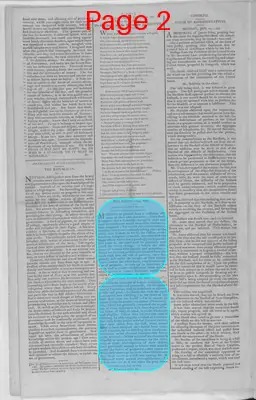
Literary
January 27, 1790
Gazette Of The United States
New York, New York County, New York
What is this article about?
An essay in 'The Guest' series (No. XIV) argues that sudden shifts from poverty to wealth rarely bring happiness, as the mind needs gradual preparation. It critiques those intoxicated by riches, revealing foibles, and praises labor as a divine blessing, quoting poetry on fools and golden asses.
Clipping
OCR Quality
98%
Excellent
Full Text
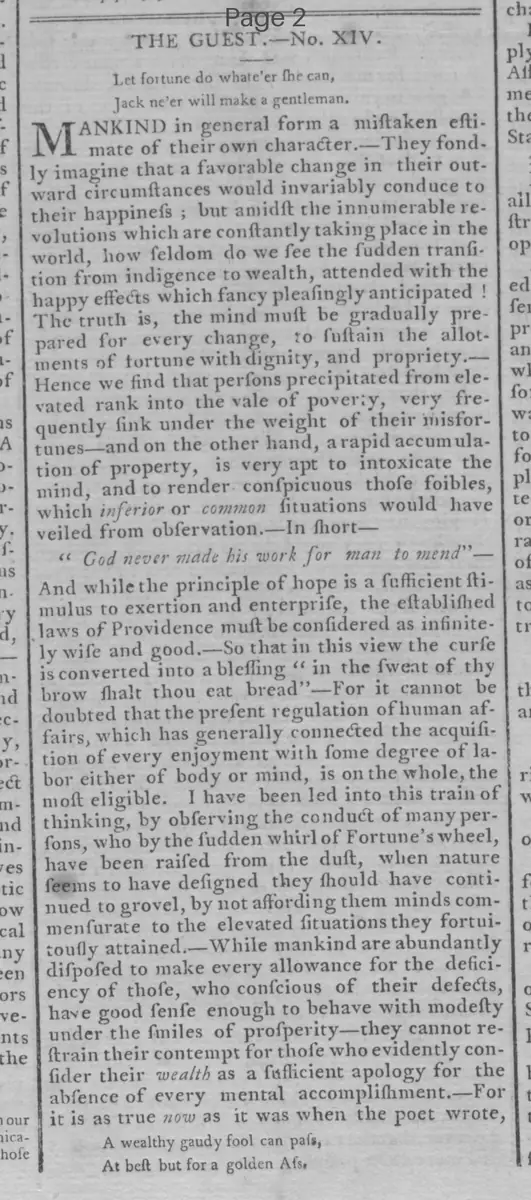
THE GUEST.—No. XIV.
Let fortune do whate'er she can,
Jack ne'er will make a gentleman.
MANKIND in general form a mistaken estimate of their own character.—They fondly imagine that a favorable change in their outward circumstances would invariably conduce to their happiness; but amidst the innumerable revolutions which are constantly taking place in the world, how seldom do we see the sudden transition from indigence to wealth, attended with the happy effects which fancy pleasingly anticipated! The truth is, the mind must be gradually prepared for every change, to sustain the allotments of fortune with dignity, and propriety.—Hence we find that persons precipitated from elevated rank into the vale of poverty, very frequently sink under the weight of their misfortunes and on the other hand, a rapid accumulation of property, is very apt to intoxicate the mind, and to render conspicuous those foibles, which inferior or common situations would have veiled from observation. In short—
"God never made his work for man to mend"—
And while the principle of hope is a sufficient stimulus to exertion and enterprise, the established laws of Providence must be considered as infinitely wise and good.—So that in this view the curse is converted into a blessing "in the sweat of thy brow shalt thou eat bread" —For it cannot be doubted that the present regulation of human affairs, which has generally connected the acquisition of every enjoyment with some degree of labor either of body or mind, is on the whole, the most eligible. I have been led into this train of thinking, by observing the conduct of many persons, who by the sudden whirls of Fortune's wheel, have been raised from the dust, when nature seems to have designed they should have continued to grovel, by not affording them minds commensurate to the elevated situations they fortuitously attained.—While mankind are abundantly disposed to make every allowance for the deficiency of those, who conscious of their defects, have good sense enough to behave with modesty under the smiles of prosperity—they cannot restrain their contempt for those who evidently consider their wealth as a sufficient apology for the absence of every mental accomplishment.—For it is as true now as it was when the poet wrote,
A wealthy gaudy fool can pass,
At best but for a golden ass.
Let fortune do whate'er she can,
Jack ne'er will make a gentleman.
MANKIND in general form a mistaken estimate of their own character.—They fondly imagine that a favorable change in their outward circumstances would invariably conduce to their happiness; but amidst the innumerable revolutions which are constantly taking place in the world, how seldom do we see the sudden transition from indigence to wealth, attended with the happy effects which fancy pleasingly anticipated! The truth is, the mind must be gradually prepared for every change, to sustain the allotments of fortune with dignity, and propriety.—Hence we find that persons precipitated from elevated rank into the vale of poverty, very frequently sink under the weight of their misfortunes and on the other hand, a rapid accumulation of property, is very apt to intoxicate the mind, and to render conspicuous those foibles, which inferior or common situations would have veiled from observation. In short—
"God never made his work for man to mend"—
And while the principle of hope is a sufficient stimulus to exertion and enterprise, the established laws of Providence must be considered as infinitely wise and good.—So that in this view the curse is converted into a blessing "in the sweat of thy brow shalt thou eat bread" —For it cannot be doubted that the present regulation of human affairs, which has generally connected the acquisition of every enjoyment with some degree of labor either of body or mind, is on the whole, the most eligible. I have been led into this train of thinking, by observing the conduct of many persons, who by the sudden whirls of Fortune's wheel, have been raised from the dust, when nature seems to have designed they should have continued to grovel, by not affording them minds commensurate to the elevated situations they fortuitously attained.—While mankind are abundantly disposed to make every allowance for the deficiency of those, who conscious of their defects, have good sense enough to behave with modesty under the smiles of prosperity—they cannot restrain their contempt for those who evidently consider their wealth as a sufficient apology for the absence of every mental accomplishment.—For it is as true now as it was when the poet wrote,
A wealthy gaudy fool can pass,
At best but for a golden ass.
What sub-type of article is it?
Essay
Satire
What themes does it cover?
Moral Virtue
Social Manners
Commerce Trade
What keywords are associated?
Fortune
Wealth
Poverty
Character
Labor
Prosperity
Foibles
Moral
Society
Literary Details
Title
The Guest.—No. Xiv.
Form / Style
Prose Reflection With Poetic Quotations
Key Lines
Let Fortune Do Whate'er She Can,
Jack Ne'er Will Make A Gentleman.
"God Never Made His Work For Man To Mend"—
"In The Sweat Of Thy Brow Shalt Thou Eat Bread"
A Wealthy Gaudy Fool Can Pass,
At Best But For A Golden Ass.