Thank you for visiting SNEWPapers!
Sign up free
Litchfield Enquirer
Litchfield, Litchfield County, Connecticut
What is this article about?
Trial of Jeremiah Orton for the murder of Amos Root in Norfolk on October 29th. Orton accused of beating Root to death with a club during a coal-pit bee. Extensive witness testimony on the altercation and discovery of the body. Jury acquitted Orton after deliberation.
Clipping
OCR Quality
Full Text
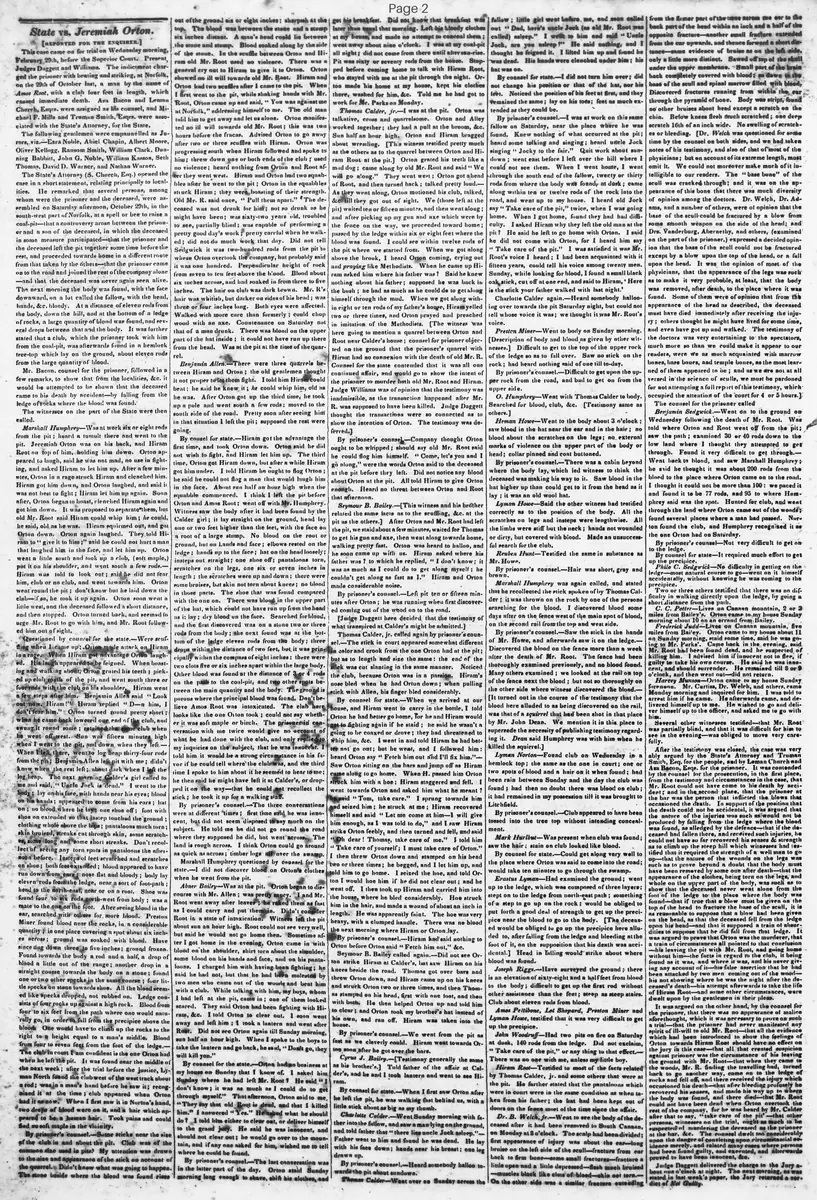
(reported for the Enquirer.)
This case came on for trial on Wednesday morning, February 29th, before the Superior Court. Present Judges Daggett and Williams. The indictment charged the prisoner with beating and striking, at Norfolk, on the 29th of October last, a man by the name of Amos Root, with a club four feet in length, which caused immediate death. Asa Bacon and Lemuel Church, Esqs. were assigned as his counsel, and Michael F. Mills and Truman Smith, Esqs. were associated with the State's Attorney, for the State.
The following gentlemen were empanelled as Jurors, viz. Ezra Noble, Abiel Chapin, Albert Moore, Oliver Kellogg, Ransom Smith, William Clark, Dunning Babbit, John G. Noble, William Kasson, Seth Thomas, David D. Warner, and Nathan Warner.
The State's Attorney (S. Church, Esq.) opened the case in a short statement, relating principally to localities. He remarked that several persons, among whom were the prisoner and the deceased, were assembled on Saturday afternoon, October 29th, in the south-west part of Norfolk, at a spell or bee to raise a coal-pit—that a controversy arose between the prisoner and a son of the deceased, in which the deceased in some measure participated—that the prisoner and the deceased left the pit together some time before the rest, and proceeded towards home in a different route from that taken by the others—that the prisoner came on to the road and joined the rest of the company alone—and that the deceased was never again seen alive.
The next morning the body was found, with the face downward, on a lot called the fallow, with the head, hands, &c. bloody. At a distance of eleven rods from the body, down the hill, and at the bottom of a ledge of rocks, a large quantity of blood was found, and several drops between that and the body. It was further stated that a club, which the prisoner took with him from the coal-pit, was afterwards found in a hemlock tree-top which lay on the ground, about eleven rods from the large quantity of blood.
Mr. Bacon, counsel for the prisoner, followed in a few remarks, to show that from the localities, &c. it would be attempted to be shown that the deceased came to his death by accident—by falling from the ledge of rocks where the blood was found.
The witnesses on the part of the State were then called.
Marshall Humphrey—Was at work six or eight rods from the pit; heard a tumult there and went to the pit. Jeremiah Orton was on his back, and Hiram Root on top of him, holding him down. Orton appeared to laugh, said he was not mad, no use in fighting, and asked Hiram to let him up. After a few minutes, Orton in a rage struck Hiram and clenched him. Hiram got him down, and Orton laughed, and said it was not best to fight; Hiram let him up again. Soon after, Orton began to boast, clenched Hiram again and got him down. It was proposed to separate them, but old Mr. Root said Hiram could whip him; he could, he said, old as he was. Hiram squirmed out, and got Orton down. Orton again laughed. They told Hiram to "give it to him;" said he could not hurt a man that laughed him in the face, and let him up. Orton went a little south and took up a club, (soft maple,) put it on his shoulder, and went south a few rods.—Hiram was told to look out; said he did not fear him, club or no club, and went towards him. Orton went round the pit; don't know but he laid down the club—if so, he took it up again. Orton soon went a little west, and the deceased followed a short distance, and then stopped. Orton turned back, and seemed to urge Mr. Root to go with him, and Mr. Root followed him out of sight.
Questioned by counsel of the state.—Were scuffling when I came up;—Orton made attack on Hiram in a rage. When Hiram got advantage Orton laughed. His laugh appeared to be feigned. When boasting and walking about, Orton grated his teeth; picked up club south of the pit, and went south three or four rods with the club on his shoulder. Hiram went a few steps after him. Benjamin Allen said "Look out now, Hiram!" Hiram replied "D—n him, I don't fear him." Orton turned round pretty short; when he came back lowered one end of the club, and swung it round some; retained the same club when he went off west. Sun was fifteen minutes high when I went to the pit, and down when they left.—When I left there, went to log heap thirty-four rods from the pit; Benjamin Allen left pit with me; didn't know when the rest left; about dark when I left the log heap. The next morning Calder's girl called to me and said, "Uncle Jock is dead." I went to the body: lay on his face, with hands near his eyes; blood on his hands; appeared to come from his ears; hat on; no blood where he lay; one shoe off; foot with shoe on extended so that instep touched the ground; clothing whole above the hips; pantaloons much torn; skin bruised, streaks cut through skin, some scratches, some long and some short streaks. Don't recollect of seeing any torn spots in pantaloons the afternoon before. Insteps of feet scratched and scratches on shoe; both feet extended; blood appeared to have run down from ears nose—flat and bloody; body lay eleven rods from the ledge, near a sort of foot-path; head to the north-east, near or on a root.—Shoe was found out to six rods north-west from body; was a mate to the one on the foot. After seeing blood in the ear, searched with others for more blood. Preston Miner found blood near the rocks, in a considerable quantity; in one place covering a spot about six inches across; ground was soaked with blood. Have since dug down three to five inches; ground frozen. Found towards the body a rod and a half, a drop of blood a little out of the range; another drop in a straight course towards the body on a stone; found one or two other specks in the same course; four little specks on stone towards shoe. All the blood seemed like specks dropped, not rubbed on. Ledge consists of four rocks up against a high rock. Blood from four to six feet from the path where one would naturally go, in order to fall from the precipice above the blood. One would have to climb up the rocks to the right to a height equal to a man's middle. Blood from four to seven feet from the foot of the ledge.—The club in court I am confident is the one Orton had when he left the pit. It was found near the middle of the next week; after the trial before the justice, Lyman North found the club west of the west track about a rod; was in a man's hand before he saw it; recognized it at the time club appeared when Orton had it as now. When I first saw it in Norton's hand, two drops of blood were on it, and a hair which appeared to be a human hair. Took pains and could find no soft maple in the vicinity.
By prisoner's counsel.—Some sticks near the size of the club in and about the pit. Club was of the common size used in pits. My attention was drawn to the size and appearance of the stick on account of the quarrel. Didn't know what was going to happen. The stone beside where the blood was found rises out of the ground six or eight inches; sharpish at the top. The blood was between the stone and a stump six inches distant. A man's head could lie between the stone and stump. Blood soaked along by the side of the stone. In the scuffle between Orton and Hiram old Mr. Root used no violence. There was general cry out to Hiram to give it to Orton. Orton showed no ill will towards old Mr. Root. Hiram and Orton had two scuffles after I came to the pit. When I first went to the pit, while shaking hands with Mr. Root, Orton came up and said, "You was against me at Norfolk," addressing himself to me. The old man told him to get away and let us alone. Orton manifested no ill will towards old Mr. Root; this was two hours before the fracas. Advised Orton to go away after two or three scuffles with Hiram. Orton was progressing south when Hiram followed and spoke to him; threw down one or both ends of the club; used no violence; heard nothing from Orton and Root after they went west. Hiram and Orton had two squabbles after he went to the pit; Orton in the squabbles struck Hiram; they were boasting of their strength. Old Mr. R. said once, "Pull them apart." The deceased was not drunk for him; not so drunk as he might have been; was sixty-two years old, troubled to see, partially blind; was capable of performing a pretty good day's work; pretty careful when he walked; did not do much work that day. Did not tell Sedgwick it was two-hundred rods from the pit to where Orton overtook the company, but probably said it was one hundred. Perpendicular height of rock from seven to ten feet—above the blood. Blood about six inches across, and had soaked in from three to five inches. The hair on club was dark brown. Mr. R's hair was whitish, but darker on sides of his head; was three or four inches long. Both eyes were affected. Walked with more care than formerly; could chop wood with an axe. Countenance on Saturday not that of a man drunk. There was blood on the upper part of the hat inside; it could not have run up there from the head. Was at the pit at the time of the quarrel.
Benjamin Allen—There were three quarrels between Hiram and Orton; the old gentleman thought it not proper to let them fight. I told him Hiram could beat; he said he knew it; he could whip him, old as he was. After Orton got up the third time; he took up a pole and went south a few rods: moved to the south side of the road. Pretty soon after seeing him in that situation I left the pit; supposed the rest were going.
By counsel of state.—Hiram got the advantage the first time, and took Orton down. Orton said he did not wish to fight, and Hiram let him up. The third time, Orton got Hiram down, but after a while Hiram got him under. I told Hiram he ought to flog Orton; he said he could not flog a man that would laugh him in the face. About sun half an hour high when the squabble commenced. I think I left the pit before Orton and Amos Root; went off with Mr. Humphrey. Witness saw the body after it had been found by the Calder girl; it lay straight on the ground, head lay one or two feet higher than the feet, with the face on a root of a large stump. No blood on the root or ground, but on hands and face; elbows rested on the ground; hands up to the face; hat on the head loosely; insteps out straight; one shoe off; pantaloons torn, scratches on the legs, one six or seven inches in length; the scratches were up and down; there were some bruises, but skin not torn about knees; no blood in those parts. The shoe that was found compared with the one on. There was blood in the upper part of the hat, which could not have run up from the head as it lay; dry blood on the face. Searched for blood, and the first discovered was on a stone two or three rods from the body; the next found was at the bottom of the ledge eleven rods from the body; three drops within the distance of two feet, but it was principally within the compass of eight inches; there were two clots five or six inches apart within the large body. Other blood was found at the distance of 3 or 4 rods on the path to the coal-pit, and two other spots between the main quantity and the body: The ground is porous where the principal blood was found. Don't believe Amos Root was intoxicated. The club here looks like the one Orton took; could not say whether it was soft maple or birch. The prisoner in conversation with me twice would give no account of what he had done with the club, and only replied to my inquiries on the subject, that he was innocent. I told him it would be a strong circumstance in his favor if he could tell where the club was, and the third time I spoke to him about it he seemed to hear to me; he then said he might have left it at Calder's, or dropped it on the way—that he could not recollect the stick; he took it up as a walking staff.
By prisoner's counsel.—The three conversations were at different times; first time said he was innocent, but did not seem disposed to say much on the subject. He told me he did not go round the road where they supposed he did, but went across. The land is rough across. I think Orton could go around as quick as across; timber logs all over the swamp.
Marshall Humphrey questioned by counsel of the state.—I did not discover blood on Orton's clothes when he went from the pit.
Abner Bailey—Was at the pit. Orton began to discourse with Mr. Allen; was pretty saucy. I and Mr. Root went away after leaves; he raked them as fast as I could carry and put them in. Didn't consider Root in a state of intoxication. Witness left the pit about sun an hour high. Root could not see very well, but said he would not go home then. Sometime after I got home in the evening, Orton came in with blood on the shoulder, shirt torn about the shoulder, some blood on his hands and face, and on his pantaloons. I charged him with having been fighting; he said he had not, but that he had been molested by two men who came out of the woods and beat him with a club. While talking with him, my boys, whom I had left at the pit, came in; one of them looked scared. They said Orton had been fighting with Hiram, &c. I told Orton to clear out. I soon went away and left him; I took a lantern and went after Root. Did not see Orton again till Sunday morning, sun half an hour high. When I spoke to the boys to take the lantern and go back, he said, "Don't go, they will kill you."
By counsel of the state.—Orton had no business at my house on Sunday that I know of. Asked him Sunday where he had left Mr. Root? He said "I don't know; it was no much as I could do to get through myself." That afternoon, Orton said to me, "They say that old Root is dead, and that I killed him." I answered "Yes." He asked what he should do? I told him either to clear out, or deliver himself to the grand jury. He said he was innocent, and should not clear out; he would go over to the mountain, and if any one asked for him, wished me to tell where he could be found.
By prisoner's counsel.—The last conversation was in the latter part of the day. Orton staid Sunday morning long enough to shave, shift his clothes, and get his breakfast. Did not know that breakfast was later than usual that morning. Left his bloody clothes at my house, and made no attempt to conceal them; went away about nine o'clock. I was at my coal-pit all night; did not come from there until after sun-rise. Pit was sixty or seventy rods from the house. Stopped before coming home to talk with Hiram Root, who stayed with me at the pit through the night. Orton made his home at my house, kept his clothes there, washed for him, &c. Told me he had got to work for Mr. Parks on Monday.
Thomas Calder, jr.—I was at the pit. Orton was talkative, cross and quarrelsome. Orton and Allen worked together; they had a pull at the broom, &c. Sun half an hour high. Orton and Hiram bragged about wrestling. [This witness testified pretty much as the others as to the quarrel between Orton and Hiram Root at the pit.] Orton grated his teeth like a mad dog; came along by old Mr. Root and said "We will go along." They went west; Orton got ahead of Root, and then turned back; talked pretty loud.—As they went along, Orton motioned his club, talked, &c. till they got out of sight. We (those left at the pit) waited ten or fifteen minutes, and then went along; and after picking up my gun and axe which were by the fence on the way, we proceeded toward home; passed by the ledge within six or eight feet where the blood was found. I could see within twelve rods of the pit where we started from. When we got along above the brook, I heard Orton coming, crying out and praying like Methodists. When he came up Hiram asked him where his father was? Said he knew nothing about his father; supposed he was back in the bush; he had as much as he could do to get along himself through the mud. When we got along within eight or ten rods of my father's house, Hiram yelled two or three times, and Orton prayed and preached in imitation of the Methodists. [The witness was here going to mention a quarrel between Orton and Root near Calder's house; counsel for prisoner objected on the ground that the prisoner's quarrel with Hiram had no connexion with the death of old Mr. R. Counsel for the state contended that it was all one continued affair, and would go to show the intent of the prisoner to murder both old Mr. Root and Hiram. Judge Williams was of opinion that the testimony was inadmissible, as the transaction happened after Mr. R. was supposed to have been killed. Judge Daggett thought the transactions were so connected as to show the intention of Orton. The testimony was deferred]
By prisoner's counsel—Company thought Orton ought to be whipped; should say old Mr. Root said he could flog him himself. "Come, let's you and I go along," were the words Orton said to the deceased at the pit before they left. Did not notice any blood about Orton at the pit. All told Hiram to give Orton enough. Heard no threat between Orton and Root that afternoon.
Seymour B. Bailey.—[This witness and his brother related the same facts as to the scuffling, &c. at the pit as the others.] After Orton and Mr. Root had left the pit, we staid about a few minutes, waited for Thomas to get his gun and axe, then went along towards home, walking pretty fast. Orton was heard to halloo, and he soon came up with us. Hiram asked where his father was? to which he replied, "I don't know; it was as much as I could do to get along myself: he couldn't get along as fast as I." Hiram and Orton made considerable noise.
By prisoner's counsel.—Left pit ten or fifteen min. after Orton; he was running when first discovered coming out of the wood on to the road.
Judge Daggett here decided, that the testimony of what transpired at Calder's might be admitted.]
Thomas Calder, jr. called again by prisoner counsel.—The stick in court appeared somewhat different in color and crook from the one Orton had at the pit; but as to length and size the same: the end of the stick was cut slanting in the same manner. Noticed the club, because Orton was in a passion. Hiram's nose bled when he had Orton down; when pulling stick with Allen, his finger bled considerably.
By counsel of state.—When we arrived at our house, and Hiram went to carry in the bottle, I told Orton he had better go home. For he and Hiram would get to fighting again if he staid; he said he wasn't a going to be coaxed or drove; they had threatened to whip him, &c. I went in and told Hiram he had better not go out; but he went, and I followed him: heard Orton say "Fetch him out and I'll fix him."—Saw Orton sitting on the bars and jump off as Hiram came along to go home. When H. passed him Orton struck him with a hoe: Hiram staggered and fell. I went towards Orton and asked him what he meant? he said "Tom, take care." I sprung towards him and seized him; he struck at me; Hiram recovered himself and said "Let me come at him—I will give him enough, as I was told to do," and I saw Hiram strike Orton feebly, and then turned and fell, and said "Oh dear! Thomas, take care of me." I told him "Take care of yourself; I must take care of Orton." I then threw Orton down and stamped on his head two or three times; he begged, and I let him up, and told him to go home. I seized the hoe, and told Orton I would hoe him if he did not clear out; and he went off. I then took up Hiram and carried him into the house, where he bled considerably. Hoe struck him in the hair, and made a wound of about an inch in length. He was apparently hurt. The hoe was very heavy, with a clamped handle. There was no blood the next morning where Hiram or Orton lay.
By prisoner's counsel.—Hiram had said nothing to Orton before Orton said "Fetch him out," &c.
Seymour B. Bailey called again.—Did not see Orton strike Hiram at Calder's, but saw Hiram on his knees beside the road. Thomas got over bars and threw Orton down, and Hiram came up on his knees and struck Orton two or three times, and then Thomas stamped on his head, first with one foot, and then with both. He then helped Orton up and told him to clear; and Orton took my brother's hat instead of his own, and ran off. Hiram was taken into the house.
By prisoner's counsel.—We went from the pit as fast as we cleverly could. Hiram went towards Orton soon after he got over the bars.
Cyrus J. Bailey.—[Testimony generally the same as his brother's.] Told father of the affair at Calder's, and he and I took lantern and went to see Hiram.
By counsel for state.—When I first saw Orton after he left the pit, he was walking fast behind us, with a little stick about as big as my thumb.
Charlotte Calder.—Went Sunday morning with father into the fallow, and saw a man lying on the ground, and told father that "there lies uncle Jock asleep."—Father went to him and found he was dead. He lay with his face down; hands near his breast; one leg drawn up.
By prisoner's counsel.—Heard somebody halloo towards the pit about sundown.
Thomas Calder—Went over on Sunday across the fallow: little girl went before me, and soon called out "Dad, here's uncle Jock (as old Mr. Root was called) asleep." I went to him and said "Uncle Jock, are you asleep?" He said nothing, and I thought he feigned it. I lifted him up and found he was dead. His hands were clenched under him; his hat was on.
By counsel for state.—I did not turn him over; did not change his position or that of the hat, nor his feet. Noticed the position of his feet at first, and they remained the same; lay on his toes; feet as much extended as they could be.
By prisoner's counsel.—I was at work on this same fallow on Saturday, near the place where he was found. Knew nothing of what occurred at the pit; heard some talking and singing: heard uncle Jock singing "Jocky to the fair." Quit work about sun down: went east before I left over the hill where I could not see them. When I went home, I went through the south end of the fallow, twenty or thirty rods from where the body was found; at dusk; came along within ten or twelve rods of the rock into the road, and went up to my house. I heard old Jock say "Take care of the pit," twice, when I was going home. When I got home, found they had had difficulty. I asked Hiram why they left the old man at the pit? He said he left to go home with Orton. I said he did not come with Orton, or I heard him say "Take care of the pit." I was satisfied it was Mr. Root's voice I heard: I had been acquainted with it fifteen years, could tell his voice among twenty men. Sunday, while looking for blood, I found a small black oak stick, cut off at one end, and said to Hiram, 'Here is the stick your father walked with last night.
Charlotte Calder again.—Heard somebody hallooing over towards the pit Saturday night, but could not tell whose voice it was; we thought it was Mr. Root's voice.
Preston Miner—Went to body on Sunday morning [Description of body and blood as given by other witnesses.] Difficult to get to the top of the upper rock of the ledge so as to fall over. Saw no stick on the rock; had heard nothing said of one till to-day.
By prisoner's counsel.—Difficult to get upon the upper rock from the road, and had to get on from the upper side.
O. Humphrey—Went with Thomas Calder to body. Searched for blood, club, &c. [Testimony same as others.]
Heman Howe—Went to the body about 3 o'clock; saw blood in the hat near the ear and in the hair; no blood about the scratches on the legs; no external marks of violence on the upper part of the body or head; collar pinned and coat buttoned.
By prisoner's counsel.—There was a cabin beyond where the body lay, which led witness to think the deceased was making his way to it. Saw blood in the hat higher up than could get to it from the head as it lay; it was an old wool hat.
Lyman Howe—Said the other witness had testified correctly as to the position of the body. All the scratches on legs and insteps were lengthwise. All the limbs were stiff but the neck; hands not wounded or dirty, but covered with blood. Made an unsuccessful search for the club.
Reuben Hunt—Testified the same in substance as Mr. Howe.
By prisoner's counsel.—Hair was short, gray and brown.
Marshall Humphrey was again called, and stated that he recollected the stick spoken of by Thomas Calder; it was thrown on the rock by one of the persons searching for the blood. I discovered blood some days after on the fence west of the main spot of blood, on the second rail from the top and west side.
By prisoner's counsel.—Saw the stick in the hands of Mr. Howe, and afterwards saw it on the ledge.—Discovered the blood on the fence more than a week after the death of Mr. Root. The fence had been thoroughly examined previously, and no blood found. Many others examined; we looked at the rail on top of the fence next the blood; but not so thoroughly on the other side where witness discovered the blood.—[It turned out in the course of this testimony that the blood here alluded to as being discovered on the rail, was that of a squirrel that had been shot in that place by Mr. John Dean. We mention it in this place to supersede the necessity of publishing testimony regarding it. Dean said Humphrey was with him when he killed the squirrel.]
Lyman Norton—Found club on Wednesday in a hemlock top; the same as the one in court; one or two spots of blood and a hair on it when found; had been rain between Sunday and the day the club was found; had then no doubt there was blood on club; it had remained in my possession till it was brought to Litchfield.
By prisoner's counsel.—Club appeared to have been tossed into the tree top without intending concealment.
Mark Hurlbut—Was present when club was found; saw the hair: stain on club looked like blood.
By counsel for state.—Could get along very well to the place where Orton was said to come into the road; would take ten minutes to go through the swamp.
Erastus Lyman—Had examined the ground; went up to the ledge, which was composed of three layers; stept on to the ledge from north-east path; something of a step to go up on the rock; would be obliged to put forth a good deal of strength to get up the precipice near the blood to go to the body. [The deceased would be obliged to go up the precipice here alluded to, after falling from the ledge and bleeding at the foot of it, on the supposition that his death was accidental.] Head in falling would strike about where blood was found.
Joseph Riggs.—Have surveyed the ground; there is an elevation of sixty-eight and a half feet from blood to the body; difficult to get up the first rod without other assistance than the feet; steep as steep stairs. Club about eleven rods from blood.
Amos Pellibone, Lot Shepard, Preston Miner and Lyman Howe, testified that it was very difficult to get up the precipice.
John Woodruff—Had two pits on fire on Saturday at dusk, 140 rods from the ledge. Did not exclaim, "Take care of the pit," or any thing to that effect. There was no one with me, unless my little boy.
-t
Hiram Root—Testified to most of the facts related by Thomas Calder, jr. and some others that were at the pit. He further stated that the pantaloons which were in court were in the same condition as when taken from his father; the hat had been kept out of doors on the fence most of the time since the affair.
Dr. B. Welch, jr.—Went to see the body of the deceased after it had been removed to South Canaan, on Monday at 8 o'clock. The scalp had been divided; first appearance of injury was about the ear long bruise on the left side of the skull fracture from ear back to firm bone—some small fractures—fracture a little open and a little depressed—flesh much bruised—muscles black like clots of blood skin not torn.—On the other side was a similar fracture extending from the upper part of the bone near the ear to the back part of the head within an inch and a half of the opposite fracture—another small fracture extended from the ear upwards, and thence forward a short distance—some evidence of bruise as on the left side, only a little more distinct. Sawed off top of the skull under the upper membrane. Small part of the brain back completely covered with blood; no down to the base of the skull and spinal marrow filled with blood. Discovered fractures running from within the ear through the pyramid of bone. Body was stripped, Sound no other bruises about head except a scratch on the chin. Below knees flesh much scratched; one deep scratch 1/6 of an inch wide. No swelling of scratches or bleeding. Dr. Welch was questioned for some time by the counsel on both sides, and we had taken notes of his testimony, and also of that of most of the physicians; but on account of its extreme length, must omit it. We could not moreover make much of it intelligible to our readers. The "base bone" of the skull was cracked through; and it was on the appearance of this bone that there was much diversity of opinion among the doctors. Dr. Welch, Dr. Adams, and a number of others, were of opinion that the base of the skull could be fractured by a blow from some smooth weapon on the side of the head; and Drs. Vanderburg, Abernethy, and others, (examined on the part of the prisoner,) expressed a decided opinion that the base of the skull could not be fractured except by a blow upon the top of the head, or a fall upon the head. It was the opinion of most of the physicians, that the appearance of the legs was such as to make it very probable, at least, that the body was removed, after death, to the place where it was found. Some of them were of opinion that from the appearance of the head as described, the deceased must have died immediately after receiving the injury: others thought he might have lived for some time, and even have got up and walked. The testimony of the doctors was very entertaining to the spectators, much more so than we could make it appear to our readers, were we as much acquainted with marrow bones, base bones, and temple bones, as the most learned of them appeared to be; and as we are not at all versed in the science of skulls, we must be pardoned for not attempting a full report of this testimony, which occupied the attention of the court for 4 or 5 hours.]
The counsel for the prisoner called Benjamin Sedgwick.—Went on to the ground on Wednesday following the death of Mr. Root. Was told where Orton and Root went off from the pit; saw the path; examined 30 or 40 rods down to the low land where I thought they attempted to get through. Found it very difficult to get through.—Went back to blood, and saw Marshall Humphrey: he said he thought it was about 200 rods from the blood to the place where Orton came on to the road. I thought it could not be more than 100: we paced it and found it to be 77 rods, and 95 to where Humphrey said was the spot. Hunted for club, and went through the land where Orton came out of the woods; found several places where a man had passed. Norton found the club, and Humphrey recognized it as the one Orton had on Saturday.
By prisoner's counsel—Not very difficult to get on to the ledge.
By counsel for state—It required much effort to get up the precipice.
Philo C. Sedgwick—No difficulty in getting on the ledge—most natural course to go—went on it himself accidentally, without knowing he was coming to the precipice.
Two or three others testified that there was no difficulty in walking directly upon the ledge, by going a short distance from the path.
C. C. Potter—Lives on Canaan mountain, 2 or 3 miles from Bailey's. Orton came to my house Sunday morning about 10 on an errand from Bailey.
Frederick Judd—Lives on Canaan mountain, five miles from Bailey. Orton came to my house about 11 on Sunday morning, staid some time, said he was going to Mr. Parks. Came back in the evening, said Mr. Root had been found dead, and he suspected of killing him. I advised him if innocent not to flee. if guilty to take his own course. He said he was innocent, and should surrender. He remained till 8 or 9 o'clock, and then went out—did not return.
Harvey Munson—Orton came to my house Sunday forenoon. Mr. Curtiss, Dr. Welch, and others. came Monday morning and inquired for him. I was told to arrest him if he came. He afterwards came, and delivered himself up to me. He wished to go and deliver himself up to the officer, and asked me to go with him.
Several other witnesses testified—that Mr. Root was partially blind, and that it was difficult for him to see in the evening—was obliged to move very carefully.
After the testimony was closed, the case was very ably argued by the State's Attorney and Truman Smith, Esq. for the people, and by Lemuel Church and Asa Bacon, Esqs. for the prisoner. It was contended by the counsel for the prosecution, in the first place, from the testimony and circumstances in the case, that Mr. Root could not have come to his death by accident; and in the second place, that the prisoner at the bar was the person that inflicted the blows that occasioned the death. In support of the position that the death could not be accidental, it was argued that the nature of the injuries was such as would not be produced by falling from the ledge where the blood was found, as alleged by the defence—that if the deceased had fallen there, and received such injuries, he could not have so far recovered his senses & strength as to climb up the steep hill which witnesses had testified that it required the strength of a well man to go up—that the nature of the wounds on the legs was such as to prove beyond a doubt that the body must have been removed by some one after death—that the appearance of the clothes, being torn on the legs, and whole on the upper part of the body, was such as to show that the deceased never went alone from the foot of the ledge to the place where the body was found—that if true that a blow must be given on the top of the head to fracture the base of the skull, it is as reasonable to suppose that a blow had been given on the head, as that the deceased fell from the ledge upon his head—and that it supported a train of absurdities to suppose that he did fall from that ledge. It was argued to prove that Orton was the murderer, that a train of circumstances all pointed to that conclusion—his leaving the pit with Mr. Root, and going home without him—the facts in regard to the club, it being found as it was, and where it was, and his never giving any account of it—his false assertion that he had been attacked by two men coming out of the wood—his not showing where he was the night after the deceased's death—his attempt afterwards to take the life of Hiram Root—and some other circumstances, were dwelt upon by the gentlemen in their pleas.
It was argued on the other hand, by the counsel for the prisoner, that there was no appearance of malice aforethought, which it was necessary to prove on such a trial—that the prisoner had never manifested any spirit of ill-will to old Mr. Root—that all the evidence which had been introduced to show the feelings of Orton towards Hiram Root should have no effect on the jury in this case—that all that created suspicion against prisoner was the circumstance of his leaving the ground with Mr. Root—that when they came to the woods, Mr. R. finding the travelling bad, turned back to go another way, came on to the ledge of rocks and fell off, and there received the injury which occasioned his death—that after bleeding profusely he recovered his senses, and made his way up to where the body was found, and there died—that Mr. Root could not have been dead when Orton overtook the rest of the company, for he was heard by Mr. Calder after that to say. "take care of the pit'—that other persons, witnesses on the trial, ought as much to be suspected of murdering the deceased as the prisoner at the bar, &c. The counsel dwelt too considerably upon the danger of convicting upon circumstantial evidence merely, and related many cases where persons had been found guilty, and executed, and afterwards proved to have been innocent, &c.
Judge Daggett delivered the charge to the Jury about one o'clock at night.
The next morning, as was entered in last week's paper, the Jury returned a verdict of Not Guilty.
What sub-type of article is it?
What keywords are associated?
What entities or persons were involved?
Where did it happen?
Domestic News Details
Primary Location
Norfolk
Event Date
October 29th Incident; Trial February 29th
Key Persons
Outcome
amos root died from skull fractures; jeremiah orton acquitted by jury.
Event Details
During a coal-pit bee in Norfolk, Jeremiah Orton quarreled with Hiram Root. Orton and Amos Root left together; Root's body found next day with head injuries near a bloodied ledge. Club with blood and hair found nearby. Trial featured witness accounts of scuffle, body discovery, medical opinions on injuries possibly from blow or fall. Defense argued accidental death by fall; prosecution circumstantial evidence of murder. Jury found Orton not guilty.