Thank you for visiting SNEWPapers!
Sign up free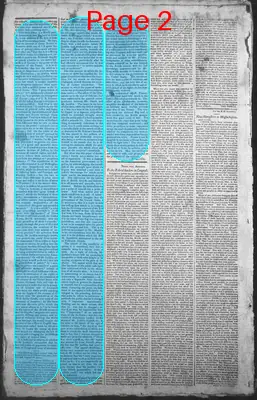
Editorial
January 23, 1810
The New Hampshire Gazette
Portsmouth, Rockingham County, New Hampshire
What is this article about?
An editorial critiquing British diplomat Francis James Jackson's correspondence and policies toward the US, highlighting violations of neutral rights, trade manipulations via colonial goods, and the unresolved Chesapeake affair. It questions British motives in opposing Napoleon and urges consideration of war to defend American honor. Signed PUBLIUS.
Clipping
OCR Quality
98%
Excellent
Full Text
his unhappy companions by referring them to the merciful disposition of the Cyclops, who devoured one of their number each revolving day!
That there either is a British party in America, or that Mr. Jackson thinks so, is too manifest in the style of some parts of his correspondence. He says, that the conduct of Great Britain to America arises out of "a great system of policy, deliberately adopted and acted on," and that it is a strong and solid reason for adhering to it, because it enables his Britannic majesty to oppose a barrier to the entire subjugation of Europe to the power of the emperor of the French. It is to illustrate this idea that the allusion is made to Augereau's proclamation to the Catalonians: an allusion which might do very well if addressed to one of the petty belligerent nations of Europe, but which is totally irrelevant and altogether ludicrous when applied to such a neutral power as the United States. This "great system of policy," so "deliberately adopted and acted on," is to prevent the subjugation of Europe: that is of G.B. for nearly all the rest of Europe is subjugated, or new modelled. And what is this boasted system? It consists in the difference of price of coffee and sugar, occasioned by the conveyance of those articles into France through Hamburg and Tonningen instead of their being landed in the ports of Holland. This difference may be two or three cents on the pound: and these two or three cents are to be the salvation of Europe they are the result of the "great system of policy" pursued by the British; they are the "strong and solid reasons," "worthy (as Mr. Jackson proclaims) to govern the councils of a great and powerful monarch," in a formal departure from the common maxims of Justice, in the violation of neutral rights, and sufficient to induce those councils to refrain from any attempt to "propitiate America!" The expeditions of Sir John Moore and of Lord Wellington, and that magnificent one to the Scheldt, might be diversions in behalf of suffering Spain and Portugal, and bleeding Austria: but the two or three cents difference in price upon sugar and coffee, is the stroke of death to Napoleon! It is the mortal blow, which is to destroy his power forever!
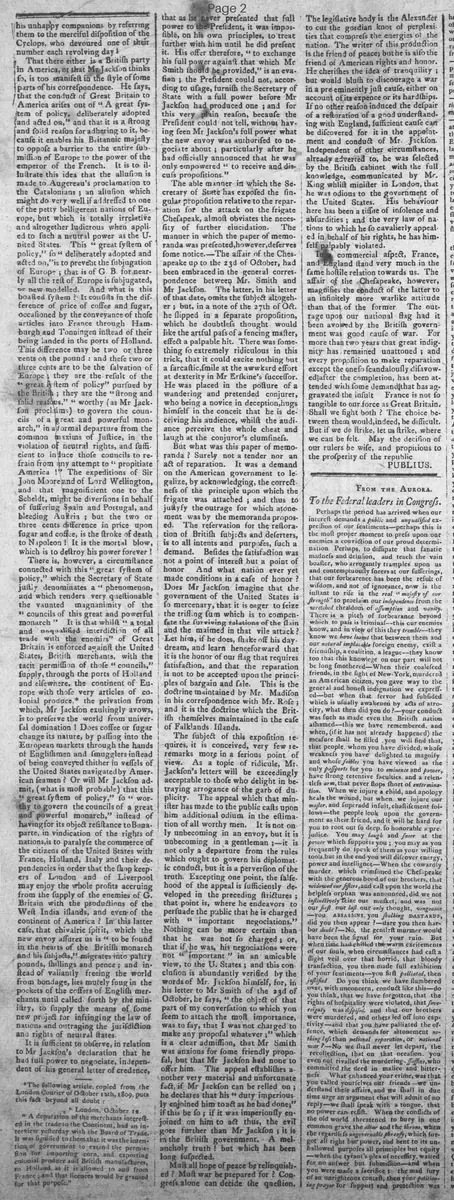
There is, however, a circumstance connected with this "great system of policy," which the Secretary of State justly denominates a "phenomenon," and which renders very questionable the vaunted magnanimity of the "councils of this great and powerful monarch." It is that whilst "a total and unqualified interdiction of all trade with the enemies" of Great Britain is enforced against the United States, British merchants, with the tacit permission of those "councils," supply, through the ports of Holland and elsewhere, the continent of Europe with those very articles of colonial produce, * the privation from which, Mr. Jackson exultingly avows, is to preserve the world from universal domination! Does coffee or sugar change its nature, by passing into the European markets through the hands of Englishmen and smugglers instead of being conveyed thither in vessels of the United States navigated by American seamen? Or will Mr. Jackson admit, (what is most probable) that this "great system of policy," so "worthy to govern the councils of a great and powerful monarch," instead of having for its object resistance to Bonaparte, in vindication of the rights of nations, is to paralyze the commerce of the citizens of the United States with France, Holland, Italy and their dependencies in order that the shop keepers of London and of Liverpool may enjoy the whole profits accruing from the supply of the enemies of G. Britain with the productions of the West India islands, and even of the continent of America? In this latter case, that chivalric spirit, which the new envoy assures us is "to be found in the hearts of the British monarch and his subjects," migrates into paltry pounds, shillings and pence; and instead of valiantly freeing the world from bondage, lies mutely snug in the pockets of the coffers of English merchants until called forth by the ministry, to supply the means of some new project for infringing the law of nations and outraging the jurisdiction and rights of neutral states.
It is sufficient to observe, in relation to Mr. Jackson's declaration that he had full power to negotiate, independent of his general letter of credence, that as he never presented that full power to the President, it was impossible, on his own principles, to treat further with him until he did present it. His offer therefore, "to exchange his full power against that which Mr. Smith should be provided," is an evasion: the President could not, according to usage, furnish the Secretary of State with a full power before Mr. Jackson had produced one; and for this very plain reason, because the President could not tell, without having seen Mr. Jackson's full power what the new envoy was authorized to negotiate about; particularly after he had officially announced that he was only empowered "to receive and discuss propositions."
The able manner in which the Secretary of State has exposed the singular proposition relative to the reparation for the attack on the frigate Chesapeake, almost obviates the necessity of further elucidation. The manner in which the paper of memoranda was presented, however, deserves some notice. The affair of the Chesapeake up to the 23d of October, had been embraced in the general correspondence between Mr. Smith and Mr. Jackson. The latter, in his letter of that date, omits the subject altogether; but, in a note of the 27th of Oct. he slipped in a separate proposition, which he doubtless thought, would like the artful pass of a fencing master, effect a palpable hit. There was something so extremely ridiculous in this trick, that it could excite nothing but a sarcastic smile at the awkward effort at dexterity in Mr. Erskine's successor. He was placed in the posture of a wandering and pretended conjurer, who being a novice in deception, hugs himself in the conceit that he is deceiving his audience, whilst the audience perceive the whole cheat and laugh at the conjuror's clumsiness.
But what was this paper of memoranda? Surely not a tender nor an act of reparation. It was a demand on the American government to legalize, by acknowledging, the correctness of the principle upon which the frigate was attacked; and thus to justify the outrage for which atonement was by the memoranda proposed. The reservation for the restoration of British subjects and deserters, is to all intents and purposes, such a demand. Besides the satisfaction was not a point of interest but a point of honor. And what nation ever yet made conditions in a case of honor? Does Mr. Jackson imagine that the government of the United States is so mercenary, that it is eager to seize the trifling sum which is to compensate the surviving relations of the slain and the maimed in that vile attack? Let him, if he does, shake off his day dream, and learn henceforward that it is the honor of our flag that requires satisfaction, and that the reparation is not to be accepted upon the principles of bargain and sale. This is the doctrine maintained by Mr. Madison in his correspondence with Mr. Rose; and it is the doctrine which the British themselves maintained in the case of Falkland Islands.
The subject of this exposition requires, it is conceived, very few remarks more in a serious point of view. As a topic of ridicule, Mr. Jackson's letters will be exceedingly acceptable to those who delight in betraying arrogance of the garb of duplicity. The appeal which that minister has made to the public casts upon him additional odium in the estimation of all worthy men. It is not only unbecoming in an envoy, but it is unbecoming in a gentleman; it is not only a departure from the rules which ought to govern his diplomatic conduct, but it is a perversion of the truth. Excepting one point, the falsehood of the appeal is sufficiently developed in the preceding strictures; that point is, where he endeavors to persuade the public that he is charged with "important negotiations." Nothing can be more certain than that he was not so charged; or, that if he was, his negotiations were not "important" in an amicable view, to the U. States; and this conclusion is abundantly verified by the words of Mr. Jackson himself, for, in his letter to Mr. Smith of the 23d of October, he says, "the object of that part of my conversation to which you seem to attach the most importance, was to say, that I was not charged to make any proposal whatever;" which is a clear admission, that Mr. Smith was anxious for some friendly proposal, but that Mr. Jackson had none to offer him. The appeal establishes another very material and unfortunate fact, if Mr. Jackson can be relied on; he declares that his "duty imperiously enjoined him to act as he had done;" if this be so; if it was imperiously enjoined on him to act thus, the evil goes further than Mr. Jackson; it is in the British government. - A melancholy truth! but which has been long suspected.
Must all hope of peace be relinquished? Must war be prepared for? Congress alone can decide the question.
The legislative body is the Alexander to cut the gordian knot of perplexities that compres the energies of the nation. The writer of this production is the friend of peace; but he is also the friend of American rights and honor. He cherishes the idea of tranquility; but would blush to discourage a war in a pre-eminently just cause, either on account of its expence or its hardships. If no other reason induced the despair of a restoration of a good understanding with England, sufficient cause can be discovered for it in the appointment and conduct of Mr. Jackson. Independent of other circumstances, already adverted to, he was elected by the British cabinet with the full knowledge, communicated by Mr. King whilst minister in London, that he was odious to the government of the United States. His behaviour here has been a tissue of insolence and absurdities: and the very law of nations to which he so cavalierly appealed in behalf of his rights, he has himself palpably violated.
In commercial aspect, France and England stand very much in the same hostile relation towards us. The affair of the Chesapeake, however, magnifies the conduct of the latter to an infinitely more warlike attitude than that of the former. The outrage upon our national flag had it been avowed by the British government was good cause of war. For more than two years that great indignity has remained unatoned; and every proposition to make reparation except the one scandalously disavowed after the completion, has been attended with some demand that has aggravated the insult France is not so tangible to our force as Great Britain. Shall we fight both? The choice between them would indeed be difficult. But if we do strike, let us strike, where we can be felt. May the decision of our rulers be wise, and propitious to the prosperity of the republic
PUBLIUS.
* The following article, copied from the London Courier of October 12th, 1809, puts this fact beyond all doubt:
"London, October 12.
"A deputation of the merchants interested in the trade to the Continent, had an interview yesterday with the Board of Trade. It was signified to them, that it was the intention of government to extend the permission for importing corn, and exporting colonial produce and British manufactures, to Holland, as it is allowed to and from France; and that licences would be granted for that purpose."
That there either is a British party in America, or that Mr. Jackson thinks so, is too manifest in the style of some parts of his correspondence. He says, that the conduct of Great Britain to America arises out of "a great system of policy, deliberately adopted and acted on," and that it is a strong and solid reason for adhering to it, because it enables his Britannic majesty to oppose a barrier to the entire subjugation of Europe to the power of the emperor of the French. It is to illustrate this idea that the allusion is made to Augereau's proclamation to the Catalonians: an allusion which might do very well if addressed to one of the petty belligerent nations of Europe, but which is totally irrelevant and altogether ludicrous when applied to such a neutral power as the United States. This "great system of policy," so "deliberately adopted and acted on," is to prevent the subjugation of Europe: that is of G.B. for nearly all the rest of Europe is subjugated, or new modelled. And what is this boasted system? It consists in the difference of price of coffee and sugar, occasioned by the conveyance of those articles into France through Hamburg and Tonningen instead of their being landed in the ports of Holland. This difference may be two or three cents on the pound: and these two or three cents are to be the salvation of Europe they are the result of the "great system of policy" pursued by the British; they are the "strong and solid reasons," "worthy (as Mr. Jackson proclaims) to govern the councils of a great and powerful monarch," in a formal departure from the common maxims of Justice, in the violation of neutral rights, and sufficient to induce those councils to refrain from any attempt to "propitiate America!" The expeditions of Sir John Moore and of Lord Wellington, and that magnificent one to the Scheldt, might be diversions in behalf of suffering Spain and Portugal, and bleeding Austria: but the two or three cents difference in price upon sugar and coffee, is the stroke of death to Napoleon! It is the mortal blow, which is to destroy his power forever!
There is, however, a circumstance connected with this "great system of policy," which the Secretary of State justly denominates a "phenomenon," and which renders very questionable the vaunted magnanimity of the "councils of this great and powerful monarch." It is that whilst "a total and unqualified interdiction of all trade with the enemies" of Great Britain is enforced against the United States, British merchants, with the tacit permission of those "councils," supply, through the ports of Holland and elsewhere, the continent of Europe with those very articles of colonial produce, * the privation from which, Mr. Jackson exultingly avows, is to preserve the world from universal domination! Does coffee or sugar change its nature, by passing into the European markets through the hands of Englishmen and smugglers instead of being conveyed thither in vessels of the United States navigated by American seamen? Or will Mr. Jackson admit, (what is most probable) that this "great system of policy," so "worthy to govern the councils of a great and powerful monarch," instead of having for its object resistance to Bonaparte, in vindication of the rights of nations, is to paralyze the commerce of the citizens of the United States with France, Holland, Italy and their dependencies in order that the shop keepers of London and of Liverpool may enjoy the whole profits accruing from the supply of the enemies of G. Britain with the productions of the West India islands, and even of the continent of America? In this latter case, that chivalric spirit, which the new envoy assures us is "to be found in the hearts of the British monarch and his subjects," migrates into paltry pounds, shillings and pence; and instead of valiantly freeing the world from bondage, lies mutely snug in the pockets of the coffers of English merchants until called forth by the ministry, to supply the means of some new project for infringing the law of nations and outraging the jurisdiction and rights of neutral states.
It is sufficient to observe, in relation to Mr. Jackson's declaration that he had full power to negotiate, independent of his general letter of credence, that as he never presented that full power to the President, it was impossible, on his own principles, to treat further with him until he did present it. His offer therefore, "to exchange his full power against that which Mr. Smith should be provided," is an evasion: the President could not, according to usage, furnish the Secretary of State with a full power before Mr. Jackson had produced one; and for this very plain reason, because the President could not tell, without having seen Mr. Jackson's full power what the new envoy was authorized to negotiate about; particularly after he had officially announced that he was only empowered "to receive and discuss propositions."
The able manner in which the Secretary of State has exposed the singular proposition relative to the reparation for the attack on the frigate Chesapeake, almost obviates the necessity of further elucidation. The manner in which the paper of memoranda was presented, however, deserves some notice. The affair of the Chesapeake up to the 23d of October, had been embraced in the general correspondence between Mr. Smith and Mr. Jackson. The latter, in his letter of that date, omits the subject altogether; but, in a note of the 27th of Oct. he slipped in a separate proposition, which he doubtless thought, would like the artful pass of a fencing master, effect a palpable hit. There was something so extremely ridiculous in this trick, that it could excite nothing but a sarcastic smile at the awkward effort at dexterity in Mr. Erskine's successor. He was placed in the posture of a wandering and pretended conjurer, who being a novice in deception, hugs himself in the conceit that he is deceiving his audience, whilst the audience perceive the whole cheat and laugh at the conjuror's clumsiness.
But what was this paper of memoranda? Surely not a tender nor an act of reparation. It was a demand on the American government to legalize, by acknowledging, the correctness of the principle upon which the frigate was attacked; and thus to justify the outrage for which atonement was by the memoranda proposed. The reservation for the restoration of British subjects and deserters, is to all intents and purposes, such a demand. Besides the satisfaction was not a point of interest but a point of honor. And what nation ever yet made conditions in a case of honor? Does Mr. Jackson imagine that the government of the United States is so mercenary, that it is eager to seize the trifling sum which is to compensate the surviving relations of the slain and the maimed in that vile attack? Let him, if he does, shake off his day dream, and learn henceforward that it is the honor of our flag that requires satisfaction, and that the reparation is not to be accepted upon the principles of bargain and sale. This is the doctrine maintained by Mr. Madison in his correspondence with Mr. Rose; and it is the doctrine which the British themselves maintained in the case of Falkland Islands.
The subject of this exposition requires, it is conceived, very few remarks more in a serious point of view. As a topic of ridicule, Mr. Jackson's letters will be exceedingly acceptable to those who delight in betraying arrogance of the garb of duplicity. The appeal which that minister has made to the public casts upon him additional odium in the estimation of all worthy men. It is not only unbecoming in an envoy, but it is unbecoming in a gentleman; it is not only a departure from the rules which ought to govern his diplomatic conduct, but it is a perversion of the truth. Excepting one point, the falsehood of the appeal is sufficiently developed in the preceding strictures; that point is, where he endeavors to persuade the public that he is charged with "important negotiations." Nothing can be more certain than that he was not so charged; or, that if he was, his negotiations were not "important" in an amicable view, to the U. States; and this conclusion is abundantly verified by the words of Mr. Jackson himself, for, in his letter to Mr. Smith of the 23d of October, he says, "the object of that part of my conversation to which you seem to attach the most importance, was to say, that I was not charged to make any proposal whatever;" which is a clear admission, that Mr. Smith was anxious for some friendly proposal, but that Mr. Jackson had none to offer him. The appeal establishes another very material and unfortunate fact, if Mr. Jackson can be relied on; he declares that his "duty imperiously enjoined him to act as he had done;" if this be so; if it was imperiously enjoined on him to act thus, the evil goes further than Mr. Jackson; it is in the British government. - A melancholy truth! but which has been long suspected.
Must all hope of peace be relinquished? Must war be prepared for? Congress alone can decide the question.
The legislative body is the Alexander to cut the gordian knot of perplexities that compres the energies of the nation. The writer of this production is the friend of peace; but he is also the friend of American rights and honor. He cherishes the idea of tranquility; but would blush to discourage a war in a pre-eminently just cause, either on account of its expence or its hardships. If no other reason induced the despair of a restoration of a good understanding with England, sufficient cause can be discovered for it in the appointment and conduct of Mr. Jackson. Independent of other circumstances, already adverted to, he was elected by the British cabinet with the full knowledge, communicated by Mr. King whilst minister in London, that he was odious to the government of the United States. His behaviour here has been a tissue of insolence and absurdities: and the very law of nations to which he so cavalierly appealed in behalf of his rights, he has himself palpably violated.
In commercial aspect, France and England stand very much in the same hostile relation towards us. The affair of the Chesapeake, however, magnifies the conduct of the latter to an infinitely more warlike attitude than that of the former. The outrage upon our national flag had it been avowed by the British government was good cause of war. For more than two years that great indignity has remained unatoned; and every proposition to make reparation except the one scandalously disavowed after the completion, has been attended with some demand that has aggravated the insult France is not so tangible to our force as Great Britain. Shall we fight both? The choice between them would indeed be difficult. But if we do strike, let us strike, where we can be felt. May the decision of our rulers be wise, and propitious to the prosperity of the republic
PUBLIUS.
* The following article, copied from the London Courier of October 12th, 1809, puts this fact beyond all doubt:
"London, October 12.
"A deputation of the merchants interested in the trade to the Continent, had an interview yesterday with the Board of Trade. It was signified to them, that it was the intention of government to extend the permission for importing corn, and exporting colonial produce and British manufactures, to Holland, as it is allowed to and from France; and that licences would be granted for that purpose."
What sub-type of article is it?
Foreign Affairs
War Or Peace
Trade Or Commerce
What keywords are associated?
Mr Jackson
British Policy
Neutral Rights
Chesapeake Affair
American Honor
Trade Restrictions
War Preparation
What entities or persons were involved?
Mr. Jackson
British Government
United States
Napoleon
Secretary Of State
Mr. Smith
Mr. Madison
Mr. Erskine
Publius
Editorial Details
Primary Topic
Critique Of Mr. Jackson's Diplomacy And British Policy Toward Us Neutral Rights
Stance / Tone
Strongly Critical Of British Conduct, Supportive Of American Honor And Potential Just War
Key Figures
Mr. Jackson
British Government
United States
Napoleon
Secretary Of State
Mr. Smith
Mr. Madison
Mr. Erskine
Publius
Key Arguments
British Policy Violates Us Neutral Rights Through Trade Restrictions
Mr. Jackson's 'Great System Of Policy' Is Hypocritical And Profit Driven
Chesapeake Attack Demands Honor Based Reparation Without Conditions
British Merchants Supply Enemies Via Indirect Routes While Blocking Us Trade
Jackson's Conduct And Appointment Show British Hostility
War May Be Necessary To Defend American Rights Against Britain