Thank you for visiting SNEWPapers!
Sign up free
Editorial
March 15, 1867
The Union Flag
Jonesboro, Jonesborough, Washington County, Tennessee
What is this article about?
Editorial praises Wm. A. Cook's argument before the D.C. Supreme Court challenging the U.S. Supreme Court's ruling against the constitutionality of the Congressional test oath for lawyers, citing historical precedents and Washington's support.
Clipping
OCR Quality
95%
Excellent
Full Text
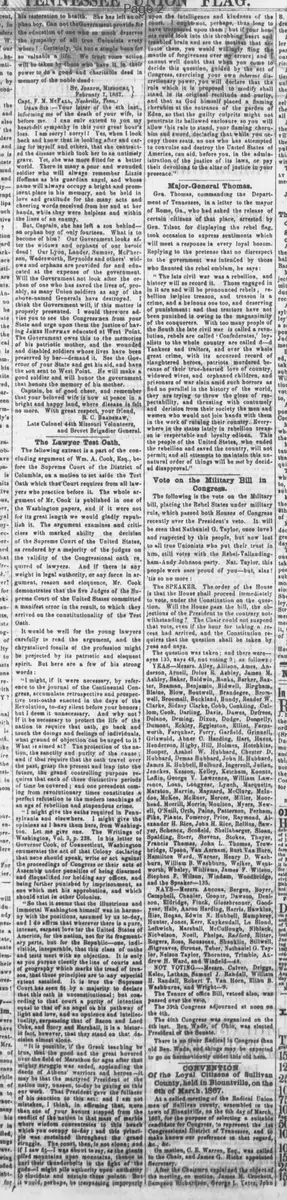
The Lawyer Test Oath,
The following extract is a part of the concluding argument of Wm. A. Cook, Esq., before the Supreme Court of the District of Columbia, on a motion to set aside the Test Oath which that Court requires from all lawyers who practice before it. The whole argument of Mr. Cook is published in one of the Washington papers, and if it were not for its great length we would gladly republish it. The argument examines and criticises with marked ability the decision of the Supreme Court of the United States, as rendered by a majority of the judges on the validity of the Congressional oath required of lawyers. And if there is any weight in legal authority, or any force in argument, reason and eloquence, Mr. Cook demonstrates that the five Judges of the Supreme Court of the United States committed a manifest error in the result, to which they arrived on the constitutionality of the Test Oath.
It would be well for the young lawyers carefully to read the argument, and the crystallized fossils of the profession might be profited by its patriotic and eloquent spirit. But here are a few of his strong words:
"I might, if it were necessary, by reference to the journal of the Continental Congress, accumulate retrospective and prospective test-oaths enacted in the days of the Revolution, to-day silent before your honors; but I deem it unnecessary. And why not? If it be necessary to protect the life of the nation to require that oath, go back and touch the doings and feelings of individuals, what ground of objection can be urged to it? What is aimed at? The protection of the nation, the sanctity and purity of the cause; and if that require that the oath travel over the past, grasp the present and leap into the future, the grand controlling purpose requires that each of these distinctive periods of time be covered; and one precedent coming from revolutionary times constitutes a perfect refutation to the modern teachings of an age of rebellion and stupendous crime."
I might give the oaths required in Pennsylvania and elsewhere. I might give the opinions as I have them here, from Washington. Let me give one. The Writings of Washington, Vol. 3, p. 228. In his letter to Governor Cook, of Connecticut, Washington enumerates the act of that Colony declaring that none should speak, write or act against the proceedings of Congress or their acts of Assembly under penalties of being disarmed and disqualified for holding any offices, and being further punished by imprisonment, as one which met his approbation, and which should exist in other Colonies.
"So that it seems that the illustrious and immortal Washington himself was in harmony with the positions, assumed by us to-day, and I do affirm that wherever there is a pure, intense, earnest love for the United States of America, for the nation, not for its fragmentary parts, but for the Republic—one, indivisible, inseparable, that this class of oaths and tests meet with no objection. It is only as you pursue closely the line of courts and of geography which marks the tread of treason, that these principles are to any especial extent assailed. It is true the Supreme Court has seen fit by a majority to declare that this oath is unconstitutional; but conceding to that court a purity of intention equal to that of an angel on his pathway of light and love, and an opulence and intellectuality, surpassing that of Bacon and Lord Coke, and Story and Marshall, it is a historic fact, however, that they stand on that decision almost alone.
"It is possible, if the Greek teaching be true, that the good and the great hovered over the field of Marathon for ages after that mighty struggle was ended, applauding the deeds of Athens' warriors and heroes —it may be that the martyred President of the nation may, unseen, to-day be gazing on this our work. That President gave the fullness of his sanction to this act: and I am not mistaken, I think, in affirming that, more than one of your honors stepped from the conflict of the nation in that mass of marble where wisdom concentrates to this bench which you occupy to-day; and this principle was sustained throughout the grand struggle. The court, then, is not alone; and if I saw fit I was about to say, as the giants piled mountains upon mountains, thence to hurl their thunderbolts in the fight of the gods—I might pile authority upon authority to elucidate and sustain these points. But it would, perhaps, be trespassing improperly upon the intelligence and kindness of the court. I ought not, perhaps, thus long to have trespassed upon them; but if your honors could look into this throbbing heart and troubled brain and see the motives that actuate them, you would willingly fling the mantle of forgiveness over my errors; and I cannot well doubt that when you come to decide this question, guided by the act of Congress, exercising your own inherent discretionary power, you will declare that the rule which it is proposed to modify shall stand in its original rectitude and purity.
and that as God himself placed a flaming cherubim at the entrance of the garden of Eden, so that the guilty culprits might not penetrate its hallowed enclosure, so you will allow this rule to stand, your flaming cherubim and sword, declaring that while you occupy those seats, no one who has attempted to convulse and destroy the United States of America, can aid, before you, in the administration of the justice of its laws, or pay their devotions to the altar of justice in your presence."
The following extract is a part of the concluding argument of Wm. A. Cook, Esq., before the Supreme Court of the District of Columbia, on a motion to set aside the Test Oath which that Court requires from all lawyers who practice before it. The whole argument of Mr. Cook is published in one of the Washington papers, and if it were not for its great length we would gladly republish it. The argument examines and criticises with marked ability the decision of the Supreme Court of the United States, as rendered by a majority of the judges on the validity of the Congressional oath required of lawyers. And if there is any weight in legal authority, or any force in argument, reason and eloquence, Mr. Cook demonstrates that the five Judges of the Supreme Court of the United States committed a manifest error in the result, to which they arrived on the constitutionality of the Test Oath.
It would be well for the young lawyers carefully to read the argument, and the crystallized fossils of the profession might be profited by its patriotic and eloquent spirit. But here are a few of his strong words:
"I might, if it were necessary, by reference to the journal of the Continental Congress, accumulate retrospective and prospective test-oaths enacted in the days of the Revolution, to-day silent before your honors; but I deem it unnecessary. And why not? If it be necessary to protect the life of the nation to require that oath, go back and touch the doings and feelings of individuals, what ground of objection can be urged to it? What is aimed at? The protection of the nation, the sanctity and purity of the cause; and if that require that the oath travel over the past, grasp the present and leap into the future, the grand controlling purpose requires that each of these distinctive periods of time be covered; and one precedent coming from revolutionary times constitutes a perfect refutation to the modern teachings of an age of rebellion and stupendous crime."
I might give the oaths required in Pennsylvania and elsewhere. I might give the opinions as I have them here, from Washington. Let me give one. The Writings of Washington, Vol. 3, p. 228. In his letter to Governor Cook, of Connecticut, Washington enumerates the act of that Colony declaring that none should speak, write or act against the proceedings of Congress or their acts of Assembly under penalties of being disarmed and disqualified for holding any offices, and being further punished by imprisonment, as one which met his approbation, and which should exist in other Colonies.
"So that it seems that the illustrious and immortal Washington himself was in harmony with the positions, assumed by us to-day, and I do affirm that wherever there is a pure, intense, earnest love for the United States of America, for the nation, not for its fragmentary parts, but for the Republic—one, indivisible, inseparable, that this class of oaths and tests meet with no objection. It is only as you pursue closely the line of courts and of geography which marks the tread of treason, that these principles are to any especial extent assailed. It is true the Supreme Court has seen fit by a majority to declare that this oath is unconstitutional; but conceding to that court a purity of intention equal to that of an angel on his pathway of light and love, and an opulence and intellectuality, surpassing that of Bacon and Lord Coke, and Story and Marshall, it is a historic fact, however, that they stand on that decision almost alone.
"It is possible, if the Greek teaching be true, that the good and the great hovered over the field of Marathon for ages after that mighty struggle was ended, applauding the deeds of Athens' warriors and heroes —it may be that the martyred President of the nation may, unseen, to-day be gazing on this our work. That President gave the fullness of his sanction to this act: and I am not mistaken, I think, in affirming that, more than one of your honors stepped from the conflict of the nation in that mass of marble where wisdom concentrates to this bench which you occupy to-day; and this principle was sustained throughout the grand struggle. The court, then, is not alone; and if I saw fit I was about to say, as the giants piled mountains upon mountains, thence to hurl their thunderbolts in the fight of the gods—I might pile authority upon authority to elucidate and sustain these points. But it would, perhaps, be trespassing improperly upon the intelligence and kindness of the court. I ought not, perhaps, thus long to have trespassed upon them; but if your honors could look into this throbbing heart and troubled brain and see the motives that actuate them, you would willingly fling the mantle of forgiveness over my errors; and I cannot well doubt that when you come to decide this question, guided by the act of Congress, exercising your own inherent discretionary power, you will declare that the rule which it is proposed to modify shall stand in its original rectitude and purity.
and that as God himself placed a flaming cherubim at the entrance of the garden of Eden, so that the guilty culprits might not penetrate its hallowed enclosure, so you will allow this rule to stand, your flaming cherubim and sword, declaring that while you occupy those seats, no one who has attempted to convulse and destroy the United States of America, can aid, before you, in the administration of the justice of its laws, or pay their devotions to the altar of justice in your presence."
What sub-type of article is it?
Constitutional
Legal Reform
What keywords are associated?
Test Oath
Lawyers
Constitutionality
Supreme Court
Revolution Precedents
National Protection
What entities or persons were involved?
Wm. A. Cook
Supreme Court Of The United States
Supreme Court Of The District Of Columbia
George Washington
President Lincoln
Editorial Details
Primary Topic
Constitutionality Of The Lawyer Test Oath
Stance / Tone
Supportive Of Test Oath And Critical Of Supreme Court Decision
Key Figures
Wm. A. Cook
Supreme Court Of The United States
Supreme Court Of The District Of Columbia
George Washington
President Lincoln
Key Arguments
The Supreme Court Erred In Declaring The Congressional Test Oath Unconstitutional.
Historical Precedents From The Revolution Support Test Oaths.
Washington Approved Similar Oaths In Colonies.
Test Oaths Protect The Nation And Purity Of Justice.
The Oath Covers Past, Present, And Future To Safeguard The Republic.