Thank you for visiting SNEWPapers!
Sign up free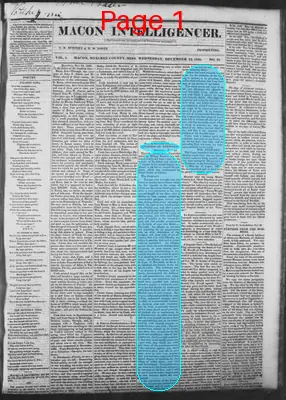
Story
December 12, 1838
Macon Intelligencer
Macon, Noxubee County, Mississippi
What is this article about?
In Baltimore on November 13, William Stewart, convicted of second-degree murder in the killing of his father, is sentenced by Judge Nesbit to 20 years in the penitentiary, during which he proclaims his innocence.
Clipping
OCR Quality
95%
Excellent
Full Text
From the Baltimore Chronicle.
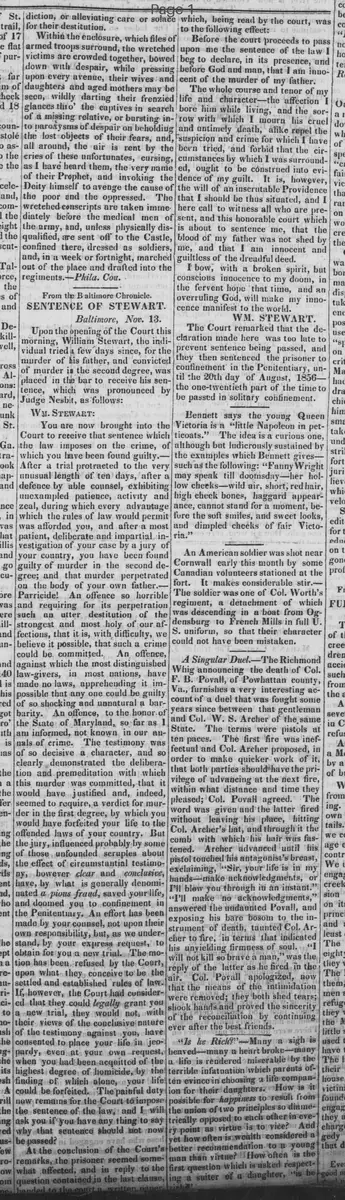
SENTENCE OF STEWART.
Baltimore, Nov. 13.
Upon the opening of the Court this morning, William Stewart, the individual tried a few days since, for the murder of his father, and convicted of murder in the second degree, was placed in the bar to receive his sentence, which was pronounced by Judge Nesbit, as follows:
WM. STEWART:
You are now brought into the Court to receive that sentence which the law imposes on the crime, of which you have been found guilty.—After a trial protracted to the very unusual length of ten days, after a defence by able counsel, exhibiting unexampled patience, activity and zeal, during which every advantage which the rules of law would permit was afforded you, and after a most patient, deliberate and impartial investigation of your case by a jury of your country, you have been found guilty of murder in the second degree; and that murder perpetrated on the body of your own father.—Parricide! An offence so horrible and requiring for its perpetration such an utter destitution of the strongest and most holy of our affections, that it is, with difficulty, we believe it possible, that such a crime could be committed. An offence, against which the most distinguished law-givers, in most nations, have made no laws, apprehending it impossible that any one could be guilty of so shocking and unnatural a barbarity. An offence, to the honor of the State of Maryland, so far as I am informed, not known in our annals of crime. The testimony was of so decisive a character, and so clearly demonstrated the deliberation and premeditation with which this murder was committed, that it would have justified and, indeed, seemed to require, a verdict for murder in the first degree, by which you would have forfeited your life to the offended laws of your country. But the jury, influenced probably by some of those, unfounded scruples about the effect of circumstantial testimony, however clear and conclusive, have, by what is generally denominated a pious fraud, saved your life, and doomed you to confinement in the Penitentiary. An effort has been made by your counsel, not upon their own responsibility, but, as we understand, by your express request, to obtain for you a new trial. The motion has been refused by the Court, upon what they conceive to be the settled and established rules of law. If, however, the Court had considered that they could legally grant you a new trial, they would not, with their views of the conclusive nature of the testimony against you, have consented to place your life in jeopardy, even at your own request, when you had been acquitted of the highest degree of homicide, by the finding of which alone, your life could be forfeited. The painful duty now remains for the Court to impose the sentence of the law, and I will ask you if you have any thing to say why that sentence should not now be passed?
At the conclusion of the Court's remarks, the prisoner seemed somewhat affected, and in reply to the question contained in the last clause, which, being read by the court, was to the following effect:
Before the court proceeds to pass upon me the sentence of the law I beg to declare, in its presence, and before God and man, that I am innocent of the murder of my father. The whole course and tenor of my life and character—the affection I bore him while living, and the sorrow with which I mourn his cruel and untimely death, alike repel the suspicion and crime for which I have been tried, and forbid that the circumstances by which I was surrounded, ought to be construed into evidence of my guilt. It is, however, the will of an inscrutable Providence that I should be thus situated, and I here call to witness all who are present, and this honorable court which is about to sentence me, that the blood of my father was not shed by me, and that I am innocent and guiltless of the dreadful deed.
I bow, with a broken spirit, but conscious innocence to my doom, in the fervent hope that time, and an overruling God, will make my innocence manifest to the world.
WM. STEWART.
The Court remarked that the declaration made here was too late to prevent sentence being passed, and they then sentenced the prisoner to confinement in the Penitentiary, until the 20th day of August, 1856—the one-twentieth part of the time to be passed in solitary confinement.
SENTENCE OF STEWART.
Baltimore, Nov. 13.
Upon the opening of the Court this morning, William Stewart, the individual tried a few days since, for the murder of his father, and convicted of murder in the second degree, was placed in the bar to receive his sentence, which was pronounced by Judge Nesbit, as follows:
WM. STEWART:
You are now brought into the Court to receive that sentence which the law imposes on the crime, of which you have been found guilty.—After a trial protracted to the very unusual length of ten days, after a defence by able counsel, exhibiting unexampled patience, activity and zeal, during which every advantage which the rules of law would permit was afforded you, and after a most patient, deliberate and impartial investigation of your case by a jury of your country, you have been found guilty of murder in the second degree; and that murder perpetrated on the body of your own father.—Parricide! An offence so horrible and requiring for its perpetration such an utter destitution of the strongest and most holy of our affections, that it is, with difficulty, we believe it possible, that such a crime could be committed. An offence, against which the most distinguished law-givers, in most nations, have made no laws, apprehending it impossible that any one could be guilty of so shocking and unnatural a barbarity. An offence, to the honor of the State of Maryland, so far as I am informed, not known in our annals of crime. The testimony was of so decisive a character, and so clearly demonstrated the deliberation and premeditation with which this murder was committed, that it would have justified and, indeed, seemed to require, a verdict for murder in the first degree, by which you would have forfeited your life to the offended laws of your country. But the jury, influenced probably by some of those, unfounded scruples about the effect of circumstantial testimony, however clear and conclusive, have, by what is generally denominated a pious fraud, saved your life, and doomed you to confinement in the Penitentiary. An effort has been made by your counsel, not upon their own responsibility, but, as we understand, by your express request, to obtain for you a new trial. The motion has been refused by the Court, upon what they conceive to be the settled and established rules of law. If, however, the Court had considered that they could legally grant you a new trial, they would not, with their views of the conclusive nature of the testimony against you, have consented to place your life in jeopardy, even at your own request, when you had been acquitted of the highest degree of homicide, by the finding of which alone, your life could be forfeited. The painful duty now remains for the Court to impose the sentence of the law, and I will ask you if you have any thing to say why that sentence should not now be passed?
At the conclusion of the Court's remarks, the prisoner seemed somewhat affected, and in reply to the question contained in the last clause, which, being read by the court, was to the following effect:
Before the court proceeds to pass upon me the sentence of the law I beg to declare, in its presence, and before God and man, that I am innocent of the murder of my father. The whole course and tenor of my life and character—the affection I bore him while living, and the sorrow with which I mourn his cruel and untimely death, alike repel the suspicion and crime for which I have been tried, and forbid that the circumstances by which I was surrounded, ought to be construed into evidence of my guilt. It is, however, the will of an inscrutable Providence that I should be thus situated, and I here call to witness all who are present, and this honorable court which is about to sentence me, that the blood of my father was not shed by me, and that I am innocent and guiltless of the dreadful deed.
I bow, with a broken spirit, but conscious innocence to my doom, in the fervent hope that time, and an overruling God, will make my innocence manifest to the world.
WM. STEWART.
The Court remarked that the declaration made here was too late to prevent sentence being passed, and they then sentenced the prisoner to confinement in the Penitentiary, until the 20th day of August, 1856—the one-twentieth part of the time to be passed in solitary confinement.
What sub-type of article is it?
Crime Story
Historical Event
Tragedy
What themes does it cover?
Crime Punishment
Justice
Family
What keywords are associated?
Parricide
Murder Trial
Sentencing
Second Degree Murder
Baltimore Court
Innocence Claim
What entities or persons were involved?
William Stewart
Judge Nesbit
Where did it happen?
Baltimore
Story Details
Key Persons
William Stewart
Judge Nesbit
Location
Baltimore
Event Date
November 13
Story Details
William Stewart, convicted of second-degree murder for killing his father, receives a sentence of 20 years in the penitentiary from Judge Nesbit, who notes the crime's premeditation warranted a first-degree verdict. Stewart proclaims his innocence before sentencing.