Thank you for visiting SNEWPapers!
Sign up free
The Enquirer
Richmond, Henrico County, Virginia
What is this article about?
Editorial argues that Britain's financial instability from excessive paper money, debt, and war expenses weakens its ability to withhold justice from the US, highlighting US advantages in resources, militia, and domestic growth. Concludes with expectations for presidential action on British blockades and neutral rights.
Merged-components note: Merged continuation of editorial on Britain's situation and US policy across page boundary; relabeled second component from story to editorial.
Clippings
1 of 2
OCR Quality
Full Text
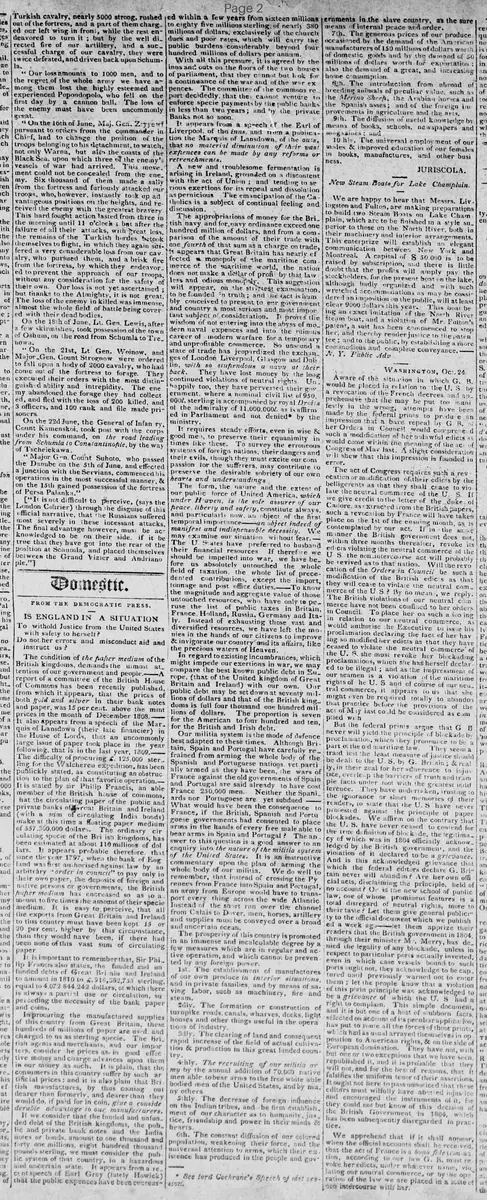
FROM THE DEMOCRATIC PRESS.
IS ENGLAND IN A SITUATION
To withhold Justice from the United States
with safety to herself?
Do not her errors and misconduct aid and instruct us?
The condition of the paper medium of the British kingdoms, demands the utmost attention of our government and people. A report of a committee of the British House of Commons has been recently published from which it appears, that the prices of both gold and silver in their bank notes and paper, was 15 per cent. above the mint prices in the month of December 1808.
It also appears from a speech of the Marquis of Lansdown (their late financier) in the House of Lords, that an uncommonly large issue of paper took place in the year following, that is in the last year, 1809. The difficulty of procuring £125,000 sterling for the Walcheren expedition, has been publicly stated, as constituting an obstruction to the plan of that favorite operation.
It is stated by sir Philip Francis, an able member of the British house of commons, that the circulating paper of the public and private banks of Great Britain and Ireland (with a sum of circulating India bonds) make at this time a floating paper medium of £57,300,000 dollars. The ordinary circulating specie of the British kingdoms, has been estimated at about 110 millions of dollars. It appears probable therefore, that since the year 1797, when the bank of England was first authorized against law by an arbitrary "order in council" to pay only in their own paper, the deposits of foreign and native persons or governments, the British paper medium has increased so as to amount to five times the amount of their specie medium. It is easy to perceive, that all the exports from Great Britain and Ireland to this country must have been kept 15 or 20 per cent. higher by this circumstance, than they would have been, if there had been none of this vast sum of circulating paper.
It is important to remember that, Sir Philip Francis also states, the funded and unfunded debts of Great Britain and Ireland to amount in 1810 to £916,382,755 sterling, equal to $1,072,844,242 dollars, of which there is always a partial use or circulation, superceding the necessity of the bank paper and coins.
In procuring the manufactured supplies of this country from Great Britain, these hundreds of millions of paper are used and charged to us as sterling specie. The British agents and merchants, and our importers, consider the prices as in good effective money and charge advances upon them in our money as such. It is plain, that the consumers in this Country suffer by such artificial prices: and it is also plain that British manufactures, by thus coming out dearer than formerly, and dearer than they would do, if paid for in coin, give a considerable advantage to our manufacturers.
If we consider that the funded and unfunded debt of the British kingdoms, the public and private bank notes and the India notes or bonds, amount to one thousand and forty one millions, eight hundred thousand pounds sterling, we must consider the public system of that country, in a hazardous and uncertain state. It appears from a recent speech of Earl Gray (lately Howick) that the public expences have been increased within a few years from sixteen millions to eighty five millions sterling, of nearly 380 millions of dollars, exclusively of the church dues and poor rates, which will carry the public burdens considerably beyond four hundred millions of dollars per annum.
With all this pressure, it is agreed by the ins and outs on the floors of the two houses of parliament, that they cannot but look for a continuance of the war and of the war expences. The committee of the commons report decidedly, that they cannot venture to enforce specie payments by the public banks in less than two years; and by the private banks not so soon.
It appears from a speech of the Earl of Liverpool, of the ins, and from a publication the Marquis of Lansdown, of the outs, that no material diminution of their vast expences can be made by any reforms or retrenchments.
A new and troublesome fermentation is arising in Ireland, grounded on a discontent with the act of Union; and tending to serious exertions for its repeal and dissolution as pernicious. The emancipation of the Catholics is a subject of continual feeling and discussion.
The appropriations of money for the British navy and for navy ordinance exceed one hundred million of dollars, and from a comparison of the amount of their trade with one fourth of that sum as a charge on trade, it appears that Great Britain has nearly effected a monopoly of the maritime commerce of the maritime world, the nation does not make a dollar of profit by that lawless and odious monopoly. This suggestion will appear, on the strictest examination, to be founded in truth; and the fact is humbly conceived to present to our government and country a most serious and most important subject of consideration. It proves the wisdom of not entering into the abyss of modern naval expences and into the ruinous career of modern warfare for a temporary and unprofitable commerce. So unsound a state of trade has jeopardized the exchanges of London, Liverpool, Glasgow and Dublin, with so stupendous a navy at their back. They have lost money by the long continued violations of neutral rights. Unhappily too, they have perverted their government, where a nominal civil list of £950,000 sterling is accompanied by royal droits of the admiralty of £1,000,000l. as is affirmed in Parliament and not denied by the ministry.
It requires steady efforts, even in wise & good men, to preserve their equanimity in times like these. To survey the erroneous systems of foreign nations, their dangers and their evils, though they must excite our compassion for the sufferers, may contribute to preserve the desirable sobriety of our own hearts and understandings.
The form, the nature and the extent of our public force of United America, which under Heaven, is the sole assurer of our peace, liberty and safety, constitute always, and particularly now, an object of the first temporal importance--an object indeed of manifest and indispensable necessity. We may examine our situation without fear.
The U States have preferred to husband their financial resources. If therefore we should be impelled into war, we have before us absolutely untouched the whole field of taxation, the whole list of unprecedented contributions, except the import, tonnage and post office duties. To know the magnitude and aggregate value of those untouched resources, we have only to peruse the list of public taxes in Britain, France, Holland, Russia, Germany and Italy. Instead of exhausting those vast and diversified resources, we have left the monies in the hands of our citizens to improve & invigorate our country and its affairs, like the precious waters of Heaven.
In regard to existing incumbrances, which might impede our exertions in war, we may compare the best known public debt in Europe, (that of the United kingdom of Great Britain and Ireland) with our own. Our public debt may be set down at seventy millions of dollars and that of the British kingdoms is full four thousand one hundred millions of dollars. The proportion is seven for the American to four hundred and ten, for the British and Irish debt.
Our militia system is the mode of defence best adapted to these times. Although Britain, Spain and Portugal have carefully refrained from arming the whole body of the Spanish and Portuguese nations, yet partially armed as they have been, the wars of France against the old governments of Spain and Portugal are said already to have cost France 250,000 men. Neither the Spaniards nor Portuguese are yet subdued. What would have been the consequence to France, if the British, Spanish and Portuguese governments had consented to place arms in the hands of every free male able to bear arms in Spain and Portugal? The answer to this question is a good answer to an enquiry into the nature of the militia system of the United States. It is an instructive commentary upon the plan of arming the whole body of our militia. We do well to remember, that instead of crossing the Pyrenees from France into Spain and Portugal, an army from Europe would have to transport every thing across the wide Atlantic. Instead of the short run over the channel from Calais to Dover, men, horses, artillery and supplies must be conveyed over a broad and uncertain ocean.
The prosperity of this country is promoted in an immense and incalculable degree by a few measures which are in regular and active operation, and which cannot be prevented by any foreign power.
1st. The establishment of manufactures of our own produce in interior situations, and in private families, and by means of saving labor, such as machinery, fire and steam.
2dly. The formation or construction of turnpike roads, canals, wharves, docks, light houses and other things useful in the operations of industry.
3dly. The clearing of land and consequent rapid increase of the field of actual cultivation & production in this great landed country.
4thly. The recruiting of our militia army by the annual addition of 70,000 native men able to bear arms to the free white able bodied men of the United States, and by many others.
5thly. The decrease of foreign influence on the Indian tribes, and the firm establishment of our character as to humanity, justice, friendship and power in their minds & hearts.
6th. The constant diffusion of our colored population, weakening their force, and the universal attention to arms, which their existence has produced in the people and governments in the slave country, as the sure means of internal peace and order.
7th. The generous prices of our produce occasioned by the demand of the American manufacturers of 150 millions of dollars worth of domestic goods and by the demand of 50 millions of dollars worth for exportation: also the demand of a great, and increasing home consumption.
8th. The introduction from abroad of breeding animals of peculiar value, such as the Merino Sheep, the Arabian horses and the Spanish asses; and of the foreign improvements in agriculture and the arts.
9th. The diffusion of useful knowledge by means of books, schools, newspapers and magazines: and
10thly. The universal employment of our males & improved education of our females in books, manufactures, and other business.
JURISCOLA.
is the prophet who will foretell the course
which they will pursue?
It was the duty of Mr. Pinkney to demand of Lord Wellesley an explanation upon these two points.
1st. Whether, under the sort of pledge set forth in his letter, the British Government would revoke their Blockading Orders of May 1805?
2d. What is their precise meaning in requiring as a preliminary, the restoration of the Commerce of Neutral Nations to the condition in which it stood previously to the promulgation of the Berlin Decree?
Until these points are cleared up, the course of the British Cabinet will be enveloped in doubt. The President has not that terra firma, which the act of Congress prescribes.
Expect then the Proclamation of the President.
What sub-type of article is it?
What keywords are associated?
What entities or persons were involved?
Editorial Details
Primary Topic
Britain's Financial Weakness And Us Strategic Advantages Against Potential Conflict
Stance / Tone
Confident Advocacy For Us Preparedness And Criticism Of British Economic Mismanagement
Key Figures
Key Arguments