Thank you for visiting SNEWPapers!
Sign up free
Story
December 26, 1913
The Washburn Leader
Washburn, Mclean County, North Dakota
What is this article about?
The text explains that diamond, graphite, plumbago, and soot are all chemically carbon. It discusses synthesizing small diamonds in labs, replicating Earth's volcanic process in regions like Borneo and Brazil.
Clipping
OCR Quality
100%
Excellent
Full Text
Varieties of Carbon.
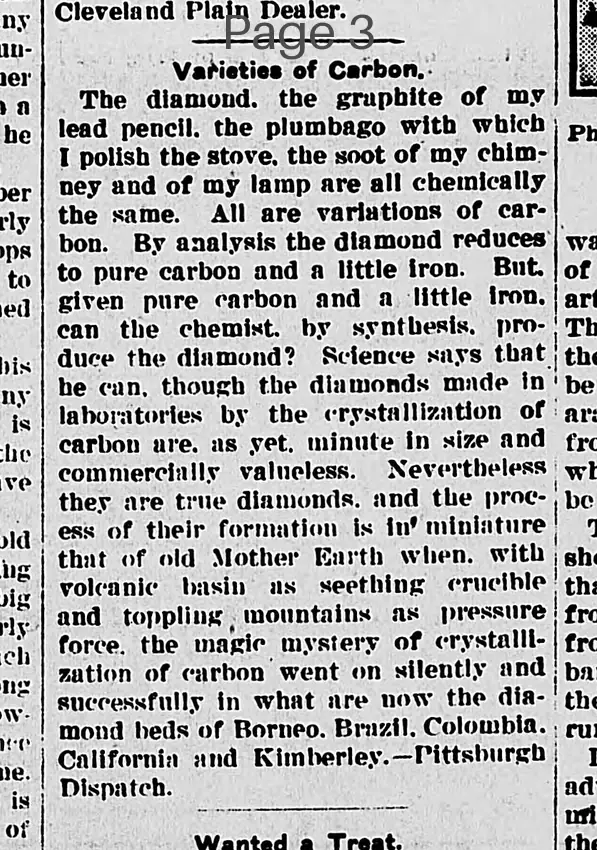
The diamond, the graphite of my lead pencil, the plumbago with which I polish the stove, the soot of my chimney and of my lamp are all chemically the same. All are variations of carbon. By analysis the diamond reduces to pure carbon and a little iron. But, given pure carbon and a little iron, can the chemist, by synthesis, produce the diamond? Science says that he can, though the diamonds made in laboratories by the crystallization of carbon are, as yet, minute in size and commercially valueless. Nevertheless they are true diamonds, and the process of their formation is in miniature that of old Mother Earth when, with volcanic basin as seething crucible and toppling mountains as pressure force, the magic mystery of crystallization of carbon went on silently and successfully in what are now the diamond beds of Borneo, Brazil, Colombia, California and Kimberley.—Pittsburgh Dispatch.
The diamond, the graphite of my lead pencil, the plumbago with which I polish the stove, the soot of my chimney and of my lamp are all chemically the same. All are variations of carbon. By analysis the diamond reduces to pure carbon and a little iron. But, given pure carbon and a little iron, can the chemist, by synthesis, produce the diamond? Science says that he can, though the diamonds made in laboratories by the crystallization of carbon are, as yet, minute in size and commercially valueless. Nevertheless they are true diamonds, and the process of their formation is in miniature that of old Mother Earth when, with volcanic basin as seething crucible and toppling mountains as pressure force, the magic mystery of crystallization of carbon went on silently and successfully in what are now the diamond beds of Borneo, Brazil, Colombia, California and Kimberley.—Pittsburgh Dispatch.
What sub-type of article is it?
Curiosity
What themes does it cover?
Nature
Triumph
What keywords are associated?
Carbon Varieties
Diamond Synthesis
Laboratory Diamonds
Volcanic Crystallization
Where did it happen?
Borneo, Brazil, Colombia, California, Kimberley
Story Details
Location
Borneo, Brazil, Colombia, California, Kimberley
Story Details
Diamonds, graphite, plumbago, and soot are all forms of carbon. Laboratory synthesis of tiny diamonds mimics Earth's volcanic crystallization process in diamond beds.