Thank you for visiting SNEWPapers!
Sign up free
The National Intelligencer And Washington Advertiser
Washington, District Of Columbia
What is this article about?
A letter to the National Intelligencer refuting claims from the New York Commercial Advertiser that South Carolina Republicans offered to support Gen. Pinckney over Jefferson in exchange for Federalists dropping Adams during the 1800 presidential elector selection. It analyzes vote counts to demonstrate Republican unity and Federalist delusions.
Merged-components note: The table illustrates the vote counts discussed in the letter to the editor, and their bounding boxes overlap spatially.
Clipping
OCR Quality
Full Text
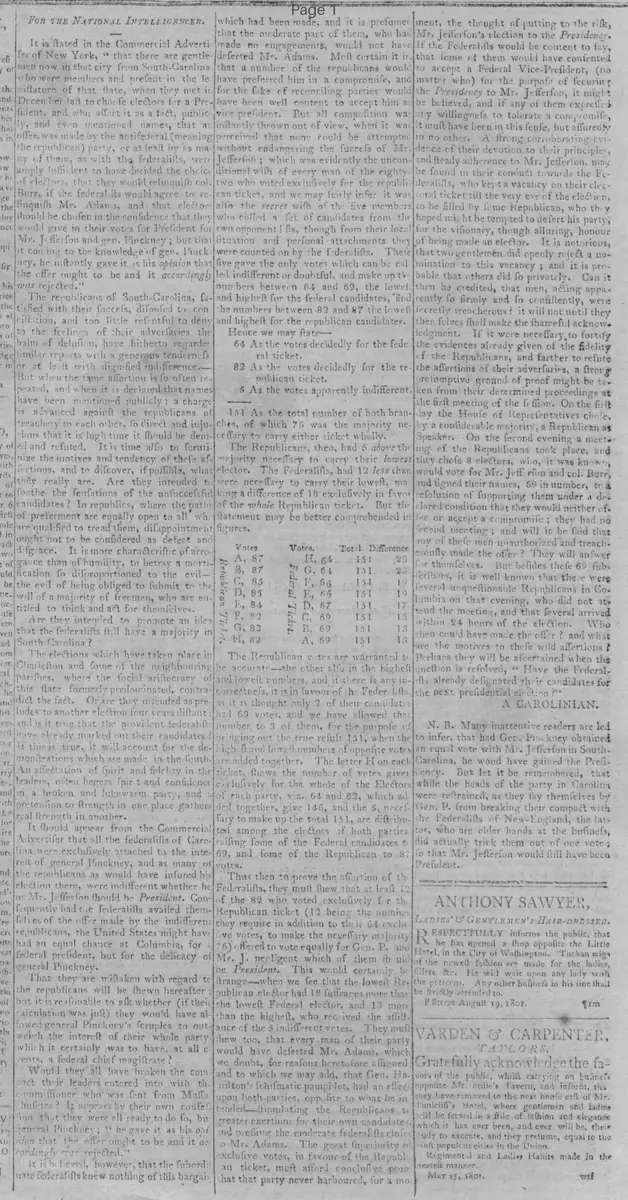
It is stated in the Commercial Advertiser of New York, "that there are gentlemen now in that city from South-Carolina who were members and present in the legislature of that state, when they met in December last to choose electors for a President, and who assert it as a fact, publicly, and even mentioned names, that an offer was made by the antifederal (meaning the republican) party, or at least by as many of them, as with the federalists, were amply sufficient to have decided the choice of electors, that they would relinquish col. Burr, if the federalists would agree to relinquish Mr. Adams, and that some other should be chosen in the confidence that they would give in their votes for President for Mr. Jefferson and gen. Pinckney; but that it coming to the knowledge of gen. Pinckney, he instantly gave it as his opinion that the offer ought to be and it accordingly was rejected."
The republicans of South-Carolina, satisfied with their success, disposed to conciliation, and too little resentful to deny to the feelings of their adversaries the balm of delusion, have hitherto regarded similar reports with a generous tenderness or at least with dignified indifference. But when the same assertion is so often repeated, and when it is declared that names have been mentioned publicly; a charge is advanced against the republicans of treachery to each other, so direct and injurious that it is high time it should be denied and refuted. It is time also to scrutinize the motives and tendency of these assertions, and to discover, if possible, what they really are. Are they intended to soothe the sensations of the unsuccessful candidates? In republics, where the paths of preferment are equally open to all who are qualified to tread them, disappointment ought not to be considered as defeat and disgrace. It is more characteristic of arrogance than of humility, to betray a mortification so disproportioned to the evil—the evil of being obliged to submit to the will of a majority of freemen, who are entitled to think and act for themselves.
Are they intended to promote an idea, that the federalists still have a majority in South-Carolina?
The elections which have taken place in Charleston and some of the neighbouring parishes, where the social aristocracy of this state formerly predominated, contradict the fact. Or are they intended as preludes to another election four years distant; and is it true that the provident federalists have already marked out their candidates? If this is true, it will account for the demonstrations which are made in the south. An affectation of spirit and fidelity in the leaders, often begets spirit and confidence in a broken and lukewarm party, and a pretension to strength in one place gathers real strength in another.
It should appear from the Commercial Advertiser that all the federalists of Carolina were exclusively attached to the interest of general Pinckney, and as many of the republicans as would have insured his election there, were indifferent whether he or Mr. Jefferson should be President. Consequently had the federalists availed themselves of the offer made by the indifferent republicans, the United States might have had an equal chance at Columbia, for a federal president, but for the delicacy of general Pinckney.
That they have mistaken with regard to the republicans will be shown hereafter; but it is reasonable to ask whether (if their calculation was just) they would have allowed general Pinckney's scruples to outweigh the interest of their whole party which it certainly was to have, at all events, a federal chief magistrate?
Would they all have broken the compact their leaders entered into with the commissioner who was sent from Massachusetts? It appears by their own confession that they were all ready to do so, but gen. Pinckney; "he gave it as his opinion that the offer ought to be and it accordingly was rejected."
It is believed, however, that the subordinate federalists knew nothing of this bargain which had been made, and it is presumed that the moderate part of them, who had made no engagements, would not have deserted Mr. Adams. Most certain it is that a number of the republicans would have preferred him in a compromise, and for the sake of reconciling parties would have been well content to accept him as vice president. But all compromise was instantly thrown out of view, when it was perceived that none could be attempted without endangering the success of Mr. Jefferson; which was evidently the unconditional wish of every man of the eighty two who voted exclusively for the republican ticket, and we may fairly infer it was also the secret wish of the five members who culled a set of candidates from the two opponent lists, though from their local situation and personal attachments they were counted on by the federalists. These five gave the only votes which can be called indifferent or doubtful, and make up the numbers between 64 and 69, the lowest and highest for the federal candidates, and the numbers between 82 and 87 the lowest and highest for the republican candidates.
Hence we may state—
64 As the votes decidedly for the federal ticket.
82 As the votes decidedly for the republican ticket,
5 As the votes apparently indifferent.
151 As the total number of both branches, of which 75 was the majority necessary to carry either ticket wholly.
The Republicans, then, had 6 above the majority necessary to carry their lowest elector. The Federalists, had 12 less than were necessary to carry their lowest, making a difference of 18 exclusively in favor of the whole Republican ticket. But this statement may be better comprehended in figures.
The Republican votes are warranted to be accurate—the other also in the highest and lowest numbers, and if there is any incorrectness, it is in favour of the Federalists as it is thought only 2 of their candidates had 69 votes, and we have allowed that number to 3 of them, for the purpose of bringing out the true result 151, when the highest and lowest numbers of opposite votes were added together. The letter H on each ticket, shows the number of votes given exclusively for the whole of the Electors of each party, viz. 64 and 82, which added together, give 146, and the 5, necessary to make up the total 151, are distributed among the electors of both parties, raising some of the Federal candidates to 69, and some of the Republican to 87 votes.
Thus then to prove the assertion of the Federalists, they must show that at least 17 of the 82 who voted exclusively for the Republican ticket (12 being the number they require in addition to their 64 exclusive votes, to make the necessary majority 76) offered to vote equally for Gen. P. and Mr. J. negligent which of them should be President. This would certainly be strange—when we see that the lowest Republican elector had 18 suffrages more than the lowest Federal elector, and 13 more than the highest, who received the assistance of the 5 indifferent votes. They must show too, that every man of their party would have deserted Mr. Adams, which we doubt, for reasons heretofore assigned and to which we may add, that Gen. Hamilton's schismatic pamphlet, had an effect upon both parties, opposite to what he intended—stimulating the Republicans to greater exertions for their own candidates, and pressing the moderate federalists closer to Mr. Adams. The great superiority of exclusive votes, in favour of the Republican ticket, must afford conclusive proof that that party never harboured, for a moment, the thought of putting to the risk, Mr. Jefferson's election to the Presidency.
If the Federalists would be content to say, that some of them would have consented to accept a Federal Vice-President, (no matter who) for the purpose of securing the Presidency to Mr. Jefferson, it might be believed, and if any of them expressed any willingness to tolerate a compromise, it must have been in this sense, but assuredly in no other. A strong corroborating evidence of their devotion to their principles and steady adherence to Mr. Jefferson, may be found in their conduct towards the Federalists, who kept a vacancy on their electoral ticket till the very eve of the election, to be filled by some Republican, who they hoped might be tempted to desert his party, for the visionary, though alluring, honour of being made an elector. It is notorious, that two gentlemen did openly reject a nomination to this vacancy; and it is probable that others did so privately. Can it then be credited, that men, acting apparently so firmly and so consistently, were secretly treacherous? it will not until they themselves shall make the shameful acknowledgment. If it were necessary, to fortify the evidences already given of the fidelity of the Republicans, and farther to refute the assertions of their adversaries, a strong presumptive ground of proof might be taken from their determined proceedings at the first meeting of the Union. On the first day the House of Representatives chose, by a considerable majority, a Republican as Speaker. On the second evening a meeting of the Republicans took place, and they chose 8 electors, who, it was known, would vote for Mr. Jefferson and col. Burr, and signed their names, 69 in number, to a resolution of supporting them under a declared condition that they would neither offer nor accept a compromise; they had no second meeting; and will it be said that any of these men unauthorized and treacherously made the offer? They will answer for themselves. But besides these 69 subscribers, it is well known that there were several unquestionable Republicans in Columbia on that evening, who did not attend the meeting, and that several arrived within 24 hours of the election. Who then could have made the offer? and what are the motives to these wild assertions? Perhaps they will be ascertained when the question is resolved, "Have the Federalists already designated their candidates for the next presidential election?"
A CAROLINIAN.
N. B. Many inattentive readers are led to infer, that had Gen. Pinckney obtained an equal vote with Mr. Jefferson in South-Carolina, he would have gained the Presidency. But let it be remembered, that while the heads of the party in Carolina were restrained, as they say themselves by Gen. P. from breaking their compact with the Federalists of New-England, the latter, who are older hands at the business, did actually trick them out of one vote; so that Mr. Jefferson would still have been President.
ANTHONY SAWYER.
| Votes | Votes. | Total. Difference | |||
| Republican | A, 87 | H, 64 | 151 | 23 | |
| B, 87 | G, 64 | 151 | 23 | ||
| C, 85 | F, 66 | 151 | 19 | ||
| D, 85 | E, 66 | 151 | 19 | ||
| E, 84 | D, 67 | 151 | 17 | ||
| F, 82 | C, 69 | 151 | 13 | ||
| G, 82 | B, 69 | 151 | 13 | ||
| H, 82 | A, 69 | 151 | 13 |
What sub-type of article is it?
What themes does it cover?
What keywords are associated?
What entities or persons were involved?
Letter to Editor Details
Author
A Carolinian
Recipient
National Intelligencer
Main Argument
the claims of republican treachery in offering to support pinckney over jefferson in south carolina's elector selection are false; vote analysis shows strong republican unity for jefferson and burr, with no evidence of such a compromise.
Notable Details