Thank you for visiting SNEWPapers!
Sign up free
Editorial
May 1, 1809
The National Intelligencer And Washington Advertiser
Washington, District Of Columbia
What is this article about?
Editorial argues US Embargo injures Britain's economy through high food prices, manufacturing disruptions, and raw material shortages, countering claims it benefits England; references parliamentary speeches on trade decline.
Clipping
OCR Quality
98%
Excellent
Full Text
WASHINGTON CITY.
MONDAY, MAY 1.
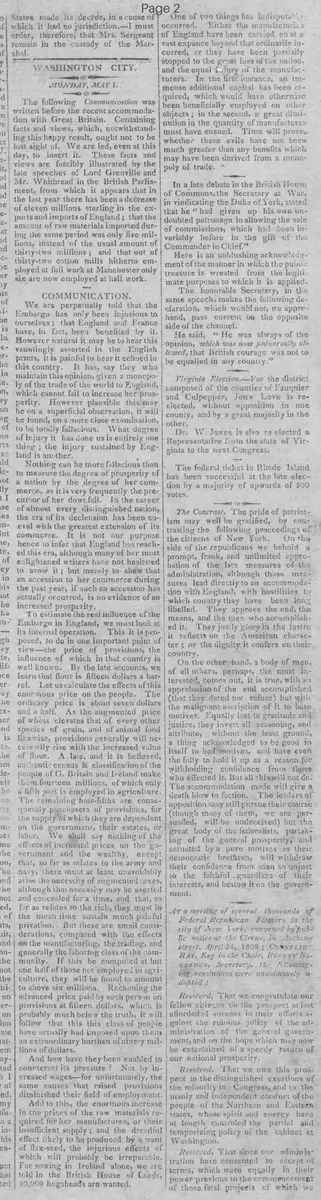
The following Communication was written before the recent accommodation with Great Britain. Containing facts and views, which, notwithstanding this happy result, ought not to be lost sight of. We are led, even at this day, to insert it. These facts and views are forcibly illustrated by the late speeches of Lord Grenville and Mr. Whitbread in the British Parliament, from which it appears that in the last year there has been a decrease of eleven millions sterling in the exports and imports of England; that the amount of raw materials imported during the same period was only five millions, instead of the usual amount of thirty-two millions; and that out of thirty-two cotton mills hitherto employed at full work at Manchester only six are now employed at half work.
COMMUNICATION.
We are perpetually told that the Embargo has only been injurious to ourselves; that England and France have, in fact, been benefited by it. However natural it may be to hear this vauntingly asserted in the English prints, it is painful to hear it echoed in this country. It has, say they who maintain this opinion, given a monopoly of the trade of the world to England, which cannot fail to increase her prosperity. However plausible this may be on a superficial observation, it will be found, on a more close examination, to be totally fallacious. What degree of injury it has done us is entirely one thing; the injury sustained by England is another.
Nothing can be more fallacious than to measure the degree of prosperity of a nation by the degree of her commerce, as it is very frequently the precursor of her downfall. In the career of almost every distinguished nation, the era of its declension has been co-eval with the greatest extension of its commerce. It is not our purpose hence to infer that England has reached this era, although many of her most enlightened writers have not hesitated to avow it; but merely to shew that an accession to her commerce during the past year, if such an accession has actually occurred, is no evidence of an increased prosperity.
To estimate the real influence of the Embargo in England, we must look at its internal operation. This it is proposed, to do in one important point of view-the price of provisions, the influence of which in that country is well known. By the late accounts, we learn that flour is fifteen dollars a barrel. Let us calculate the effects of this enormous price on the people. The ordinary price is about seven dollars and a half. As the augmented price of wheat elevates that of every other species of grain, and of animal food likewise, provisions generally will necessarily rise with the increased value of flour. A late, and it is believed, authentic census & classification of the people of G. Britain and Ireland make them fourteen millions, of which only a fifth part is employed in agriculture. The remaining four-fifths are consequently purchasers of provisions, for the supply of which they are dependent on the government, their estates, or labor. We shall say nothing of the effects of increased prices on the government and the wealthy. except that, so far as relates to the army and navy, there must at least unavoidably arise the necessity of augmented taxes, although that necessity may be averted and concealed for a time, and that, so far as relates to the rich, they must in the mean time sustain much painful privation. But these are small considerations, compared with the effects on the manufacturing, the trading, and generally the laboring class of the community. If this be computed at but one half of those not employed in agriculture, they will be found to amount to above six millions. Reckoning the advanced price paid by each person on provisions at fifteen dollars, which is probably much below the truth, it will follow that this class of people have actually had imposed upon them an extraordinary burthen of ninety millions of dollars.
And how have they been enabled to counteract its pressure? Not by increased wages-for unfortunately, the same causes that raised provisions diminished their field of employment. Add to this, the enormous increase in the prices of the raw materials required for her manufactures, or their insufficient supply; and the dreadful effect likely to be produced by a want of flax-seed, the injurious effects of which will probably be irreparable. For sowing in Ireland alone, we are told in the British House of Lords, 50,000 hogsheads are wanted.
One of two things has indisputably occurred. Either the manufactories of England have been carried on at a vast expence beyond that ordinarily incurred, or they have been partially stopped to the great loss of the nation, and the equal injury of the manufacturers. In the first instance, an immense additional capital has been required, which would have otherwise been beneficially employed on other objects; in the second, a great diminution in the quantity of manufactures must have ensued. Time will prove, whether these evils have not been much greater than any benefits which may have been derived from a monopoly of trade.
MONDAY, MAY 1.
The following Communication was written before the recent accommodation with Great Britain. Containing facts and views, which, notwithstanding this happy result, ought not to be lost sight of. We are led, even at this day, to insert it. These facts and views are forcibly illustrated by the late speeches of Lord Grenville and Mr. Whitbread in the British Parliament, from which it appears that in the last year there has been a decrease of eleven millions sterling in the exports and imports of England; that the amount of raw materials imported during the same period was only five millions, instead of the usual amount of thirty-two millions; and that out of thirty-two cotton mills hitherto employed at full work at Manchester only six are now employed at half work.
COMMUNICATION.
We are perpetually told that the Embargo has only been injurious to ourselves; that England and France have, in fact, been benefited by it. However natural it may be to hear this vauntingly asserted in the English prints, it is painful to hear it echoed in this country. It has, say they who maintain this opinion, given a monopoly of the trade of the world to England, which cannot fail to increase her prosperity. However plausible this may be on a superficial observation, it will be found, on a more close examination, to be totally fallacious. What degree of injury it has done us is entirely one thing; the injury sustained by England is another.
Nothing can be more fallacious than to measure the degree of prosperity of a nation by the degree of her commerce, as it is very frequently the precursor of her downfall. In the career of almost every distinguished nation, the era of its declension has been co-eval with the greatest extension of its commerce. It is not our purpose hence to infer that England has reached this era, although many of her most enlightened writers have not hesitated to avow it; but merely to shew that an accession to her commerce during the past year, if such an accession has actually occurred, is no evidence of an increased prosperity.
To estimate the real influence of the Embargo in England, we must look at its internal operation. This it is proposed, to do in one important point of view-the price of provisions, the influence of which in that country is well known. By the late accounts, we learn that flour is fifteen dollars a barrel. Let us calculate the effects of this enormous price on the people. The ordinary price is about seven dollars and a half. As the augmented price of wheat elevates that of every other species of grain, and of animal food likewise, provisions generally will necessarily rise with the increased value of flour. A late, and it is believed, authentic census & classification of the people of G. Britain and Ireland make them fourteen millions, of which only a fifth part is employed in agriculture. The remaining four-fifths are consequently purchasers of provisions, for the supply of which they are dependent on the government, their estates, or labor. We shall say nothing of the effects of increased prices on the government and the wealthy. except that, so far as relates to the army and navy, there must at least unavoidably arise the necessity of augmented taxes, although that necessity may be averted and concealed for a time, and that, so far as relates to the rich, they must in the mean time sustain much painful privation. But these are small considerations, compared with the effects on the manufacturing, the trading, and generally the laboring class of the community. If this be computed at but one half of those not employed in agriculture, they will be found to amount to above six millions. Reckoning the advanced price paid by each person on provisions at fifteen dollars, which is probably much below the truth, it will follow that this class of people have actually had imposed upon them an extraordinary burthen of ninety millions of dollars.
And how have they been enabled to counteract its pressure? Not by increased wages-for unfortunately, the same causes that raised provisions diminished their field of employment. Add to this, the enormous increase in the prices of the raw materials required for her manufactures, or their insufficient supply; and the dreadful effect likely to be produced by a want of flax-seed, the injurious effects of which will probably be irreparable. For sowing in Ireland alone, we are told in the British House of Lords, 50,000 hogsheads are wanted.
One of two things has indisputably occurred. Either the manufactories of England have been carried on at a vast expence beyond that ordinarily incurred, or they have been partially stopped to the great loss of the nation, and the equal injury of the manufacturers. In the first instance, an immense additional capital has been required, which would have otherwise been beneficially employed on other objects; in the second, a great diminution in the quantity of manufactures must have ensued. Time will prove, whether these evils have not been much greater than any benefits which may have been derived from a monopoly of trade.
What sub-type of article is it?
Economic Policy
Foreign Affairs
Trade Or Commerce
What keywords are associated?
Embargo Effects
British Economy
Provisions Prices
Manufacturing Decline
Trade Monopoly Fallacy
What entities or persons were involved?
England
Great Britain
Lord Grenville
Mr. Whitbread
Manchester Cotton Mills
Editorial Details
Primary Topic
Impact Of The Us Embargo On British Economy
Stance / Tone
Arguing Embargo Harms England Significantly Despite Claims Of Benefit
Key Figures
England
Great Britain
Lord Grenville
Mr. Whitbread
Manchester Cotton Mills
Key Arguments
Embargo Assertions Of Benefiting England Are Fallacious
Prosperity Not Measured Solely By Commerce Extent
High Provisions Prices Burden Non Agricultural Population
Manufactures Suffer From Raw Materials Shortages And Reduced Employment
Either Increased Costs Or Stopped Production In Factories