Thank you for visiting SNEWPapers!
Sign up free
The Ypsilanti Daily Press
Ypsilanti, Washtenaw County, Michigan
What is this article about?
In 1941, U.S. Christmas retail sales are projected to hit a record $5.5 billion, surpassing 1929 levels amid surplus consumer funds and fears of wartime shortages, with annual sales expected at $54 billion.
Clipping
OCR Quality
Full Text
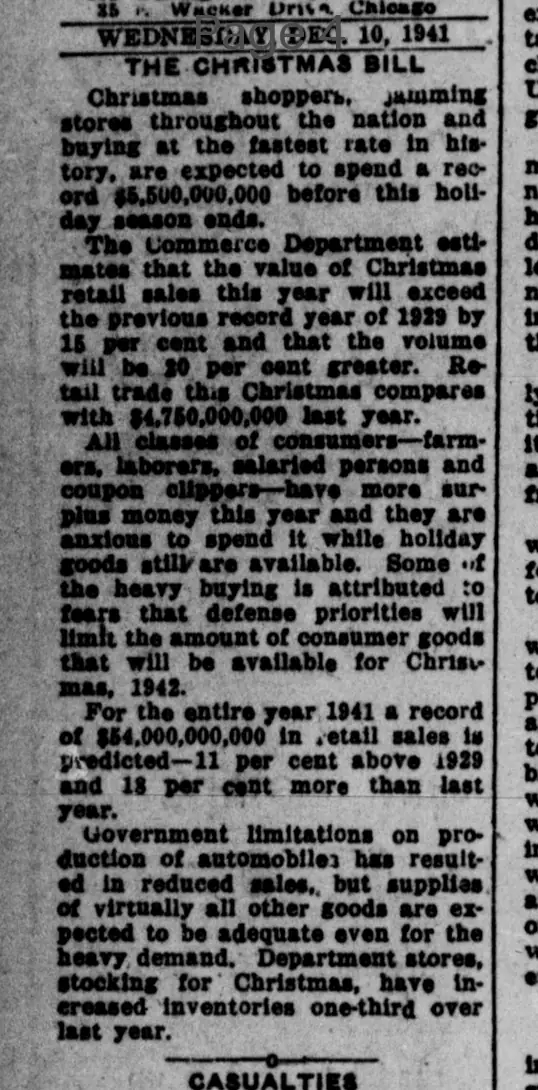
Christmas shoppers, jamming stores throughout the nation and buying at the fastest rate in history, are expected to spend a record $5,500,000,000 before this holiday season ends.
The Commerce Department estimates that the value of Christmas retail sales this year will exceed the previous record year of 1929 by 15 per cent and that the volume will be 10 per cent greater. Retail trade this Christmas compares with $4,750,000,000 last year.
All classes of consumers-farmers, laborers, salaried persons and coupon clippers-have more surplus money this year and they are anxious to spend it while holiday goods still are available. Some of the heavy buying is attributed to fears that defense priorities will limit the amount of consumer goods that will be available for Christmas, 1942.
For the entire year 1941 a record of $54,000,000,000 in retail sales is predicted-11 per cent above 1929 and 18 per cent more than last year.
Government limitations on production of automobiles has resulted in reduced sales, but supplies of virtually all other goods are expected to be adequate even for the heavy demand. Department stores, stocking for Christmas, have increased inventories one-third over last year.
What sub-type of article is it?
What keywords are associated?
Where did it happen?
Story Details
Location
Throughout The Nation
Event Date
1941
Story Details
Christmas shoppers are expected to spend a record $5,500,000,000, exceeding 1929 by 15% in value and 10% in volume compared to last year's $4,750,000,000. All classes have surplus money, with buying driven by fears of future shortages due to defense priorities. Annual retail sales predicted at $54,000,000,000, up 11% from 1929 and 18% from last year. Auto sales reduced by production limits, but other goods adequate; department stores increased inventories by one-third.