Thank you for visiting SNEWPapers!
Sign up free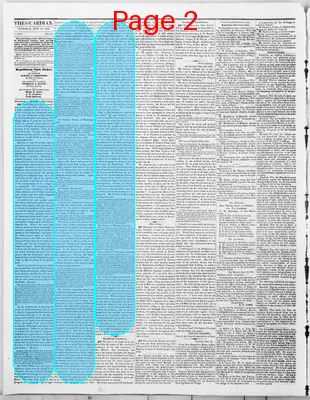
Editorial
June 30, 1859
The Buchanan County Guardian
Independence, Buchanan County, Iowa
What is this article about?
This editorial critiques Democratic positions on slavery, arguing that the Dred Scott Supreme Court decision conflicts with Popular Sovereignty by denying territorial legislatures the power to prohibit slavery, as territories are held in trust by Congress for all states. It defends Republican alignment with historical anti-slavery policy.
Clipping
OCR Quality
95%
Excellent
Full Text
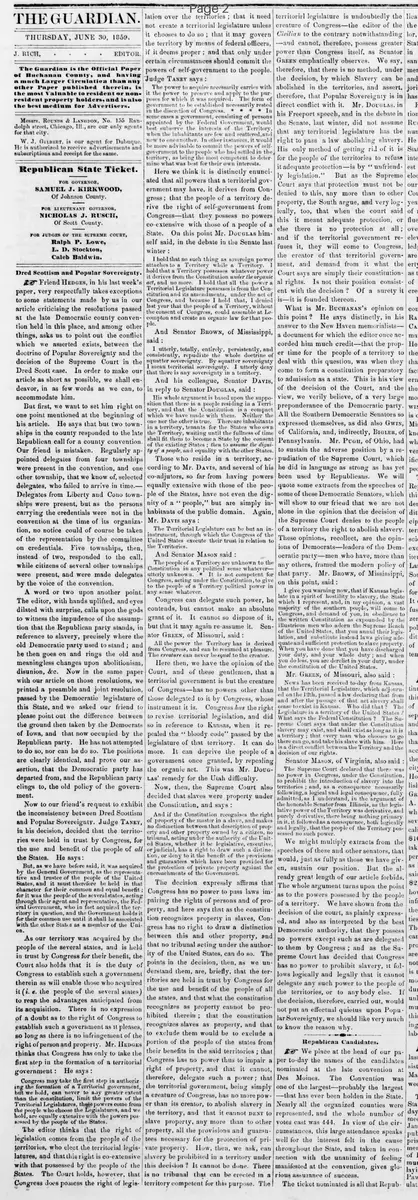
Dred Scottism and Popular Sovereignty.
Friend Hedges, in his last week's paper, very respectfully takes exceptions to some statements made by us in our article criticising the resolutions passed at the late Democratic county convention held in this place, and among other things, asks us to point out the conflict which we asserted exists, between the doctrine of Popular Sovereignty and the decision of the Supreme Court in the Dred Scott case. In order to make our article as short as possible, we shall endeavor, in as few words as we can, to accommodate him.
But first, we want to set him right on one point mentioned at the beginning of his article. He says that but two townships in the county responded to the late Republican call for a county convention. Our friend is mistaken. Regularly appointed delegates from four townships were present in the convention, and one other township, that we know of, selected delegates, who failed to arrive in time. Delegates from Liberty and Cono townships were present, but as the persons carrying the credentials were not in the convention at the time of its organization, no notice could of course be taken of the representation by the committee on credentials. Five townships, then, instead of two, responded to the call, while citizens of several other townships were present, and were made delegates by the voice of the convention.
A word or two upon another point. The editor, with hands uplifted, and eyes dilated with surprise, calls upon the gods to witness the impudence of the assumption that the Republican party stands, in reference to slavery, precisely where the old Democratic party used to stand; and he then goes on and rings the old and meaningless changes upon abolitionism, disunion, &c. Now in the same paper with our article on those resolutions, we printed a preamble and joint resolution passed by the Democratic legislature of this State, and we asked our friend to please point out the difference between the ground then taken by the Democrats of Iowa, and that now occupied by the Republican party. He has not attempted to do so, nor can he do so. The positions are clearly identical, and prove our assertion, that the Democratic party has departed from, and the Republican party clings to, the old policy of the government.
Now to our friend's request to exhibit the inconsistency between Dred Scottism and Popular Sovereignty. Judge Taney, in his decision, decided that the territories were held in trust by Congress, for the use and benefit of the people of all the States. He says:
"But, as we have before said, it was acquired by the General Government, as the representative and trustee of the people of the United States, and it must therefore be held in that character for their common and equal benefit; for it was the people of the several states, acting through their agent and representative, the Federal Government, who in fact acquired the territory in question, and the Government holds it for their common use until it shall be associated with the other States as a member of the Union."
As our territory was acquired by the people of the several states, and is held in trust by Congress for their benefit, the Court also holds that it is the duty of Congress to establish such a government therein as will enable those who acquired it (i. e. the people of the several states) to reap the advantages anticipated from its acquisition. There is no expression of a doubt as to the right of Congress to establish such a government as it pleases, so long as there is no infringement of the right of person and property. Mr. Hedges thinks that Congress has only to take the first step in the formation of a territorial government; He says:
"Congress may take the first step in authorizing the formation of a Territorial government, but we hold, can never to any greater extent than the constitution, limit the powers of the Territorial Legislatures, these powers come from the people who choose the Legislatures, and we hold, are equally extensive with the powers possessed by the people of the States."
The editor thinks that the right of legislation comes from the people of the territories, who elect the territorial legislatures, and that this right is co-extensive with that possessed by the people of the States. The Court holds, however, that Congress does possess the right of legislation over the territories; that it need not create a territorial legislature unless it chooses to do so; that it may govern the territory by means of federal officers, if it deems proper; and that only under certain circumstances should commit the powers of self-government to the people.
Judge Taney says:
"The power to acquire necessarily carries with it the power to preserve and apply to the purposes for which it was acquired." The form of government to be established necessarily rested in the discretion of Congress. * * * * In some cases a government, consisting of persons appointed by the Federal Government, would best subserve the interests of the Territory, when the inhabitants are few and scattered, and new to one another. In other instances, it would be more advisable to commit the powers of self-government to the people who had settled in the territory, as being the most competent to determine what was best for their own interests."
Here we think it is distinctly enunciated that all powers that a territorial government may have, it derives from Congress; that the people of a territory derive the right of self-government from Congress-that they possess no powers co-extensive with those of a people of a State. On this point Mr. Douglas himself said, in the debate in the Senate last winter:
"I hold that no such thing as sovereign power attaches to a Territory while a Territory. I hold that a Territory possesses whatever power it derives from the Constitution under the organic act, and no more. I hold that all the power a Territorial Legislature possesses is from the Constitution and its amendments, under the act of Congress, and because I hold that, I denied last year that the people of a Territory, without the consent of Congress, could assemble at Lecompton and create an organic law for that people."
And Senator Brown, of Mississippi, said:
"I utterly, totally, entirely, persistently, and consistently, repudiate the whole doctrine of squatter sovereignty. By squatter sovereignty I mean territorial sovereignty. I utterly deny that there is any sovereignty in a territory."
And his colleague, Senator Davis in reply to Senator Douglas, said:
"His whole argument is based upon the supposition that there is a people residing in a Territory, and that the Constitution is a compact which we have made with them. Neither the one nor the other is true. There are inhabitants in a territory, tenants for the States who own the Territory, waiting until the fullness of time shall fit them to become a State by the consent of the existing States; then to assume the dignity of a people, and equality with the other States."
Those who reside in a territory, according to Mr. Davis, and several of his co-adjutors, so far from having powers equally extensive with those of the people of the States, have not even the dignity of a "people," but are simply inhabitants of the public domain. Again Mr. Davis says:
"The Territorial Legislature can be but an instrument, through which the Congress of the United States execute their trust in relation to the Territories."
And Senator Mason said:
"The people of a Territory are unknown to the Constitution in any political sense whatever-utterly unknown. It is not competent for Congress, acting under the Constitution, to give to the people of a Territory political power in any sense whatever. Congress can delegate such power, he contends, but cannot make an absolute grant of it. It cannot so dispose of it, but that it may again re-assume it."
Senator Green, of Missouri, said:
"All the power the Territory has is derived from Congress, and can be resumed at pleasure. The creature can never be equal to the creator."
Here then, we have the opinion of the Court, and of these gentlemen, that a territorial government is but the creature of Congress-has no powers other than those delegated to it by Congress, whose instrument it is. Congress has the right to revise territorial legislation, and did so in reference to Kansas, when it repealed the "bloody code" passed by the legislature of that territory. It can do more. It can deprive the people of a government once granted, by repealing the organic act. This was Mr. Douglas' remedy for the Utah difficulty.
Now, then, the Supreme Court also decided that slaves were property under the Constitution, and says:
"And if the Constitution recognises the right of property of the master in a slave, and makes no distinction between that description of property and other property owned by a citizen, no tribunal, acting under the authority of the United States, whether it be legislative, executive, or judicial, has a right to draw such a distinction, or deny to it the benefit of the provisions and guarantees which have been provided for the protection of private property against the encroachments of the Government."
The decision expressly affirms that Congress has no power to pass laws impairing the rights of persons and of property, and here says that as the constitution recognizes property in slaves, Congress has no right to draw a distinction between this and other property, and that no tribunal acting under the authority of the United States, can do so. The points in the decision, then, as we understand them, are, briefly, that the territories are held in trust by Congress for the use and benefit of the people of all the states, and that what the constitution recognizes as property cannot be prohibited therein; that the constitution recognizes slaves as property, and that to exclude them would be to exclude a portion of the people of the states from their benefits in the said territories; that Congress has no power thus to impair a right of property, and that it cannot, therefore, delegate such a power; that the territorial government, being simply a creature of Congress, has no more power than its creator, to abolish slavery in the territory, and that it cannot deny to slave property, any more than to other property, all the provisions and guarantees necessary for the protection of private property. How, then, we ask, can slavery be prohibited in a territory under this decision? It cannot be done. There is no tribunal that can be erected in a territory competent for this purpose. The territorial legislature is undoubtedly the creature of Congress-the editor of the Civilian to the contrary notwithstanding-and cannot, therefore, possess greater power than Congress itself, as Senator Green emphatically observes. We say, therefore, that there is no method, under the decision, by which Slavery can be abolished in the territories, and assert, therefore, that Popular Sovereignty is in direct conflict with it. Mr. Douglas, in his Freeport speech, and in the debate in the Senate, last winter, did not assume that any territorial legislature has the right to pass a law abolishing slavery. His only method of getting rid of it is for the people of the territories to refuse it adequate protection-is by "unfriendly legislation." But as the Supreme Court says that protection must not be denied to this, any more than to other property, the South argue, and very logically, too, that when the court said this it meant adequate protection, or else there is no protection at all; and if the territorial government refuses it, they will come to Congress, the creator of that territorial government, and demand from it what the Court says are simply their constitutional rights. Is not their position consistent with the decision? Of a surety it is-it is founded thereon.
What is Mr. Buchanan's opinion on this point? He says distinctly, in his answer to the New Haven memorialists-a document for which the editor once accorded him much credit-that the proper time for the people of a territory to deal with this question, was when they come to form a constitution preparatory to admission as a state. This is his view of the decision of the Court, and the view, we verily believe, of a very large preponderance of the Democratic party. All the Southern Democratic Senators so expressed themselves, as did also Gwin, of California, and, indirectly, Bigler, of Pennsylvania. Mr. Pugh, of Ohio, had to sustain the adverse position by a repudiation of the Supreme Court, which he did in language as strong as has yet been used by Republicans. We will quote some extracts from the speeches of some of these Democratic Senators, which will show to our friend that we are not alone in the opinion that the decision of the Supreme Court denies to the people of a territory the right to abolish slavery. These opinions, recollect, are the opinions of Democrats-leaders of the Democratic party-men who have, more than any others, framed the modern policy of that party. Mr. Brown, of Mississippi, on this point, said:
"I give you warning now, that if Kansas legislate in a spirit of hostility to slavery, the State which I represent, and, in my opinion, a vast majority of the southern people, will come to Congress, and demand of you, in obedience to the written Constitution as expounded by the illustrious men who adorn the Supreme Bench of the United States, that you annul their legislation, and substitute instead laws giving adequate and sufficient protection to slave property. When you have done that you have discharged your duty, and your whole duty; and when you do less, you are derelict in your duty, under the constitution of the United States."
Mr. Green, of Missouri, also said:
"News has been received to-day from Kansas that the Territorial Legislature, which adjourned on the 12th, passed a law declaring that from and after the passage of that act slavery shall cease to exist in Kansas. Who did that? The Legislature in a territory of the United States? What says the Federal Constitution? The Supreme Court says that under the Constitution slavery may exist, and shall exist as long as it is a territory; that every man who chooses to go there can go, and take his slave with him. Here is a direct conflict between the Territory and the decision of our rights."
Senator Mason, of Virginia, also said:
"The Supreme Court declared that there was no power in Congress, under the Constitution, to prohibit the introduction of slavery into the territories: and, as a consequence necessarily following, a logical and legal consequence, fully admitted, as I understand, in the argument of the honorable Senator from Illinois, as the legislative power of the Territory was derivative, and purely derivative, there being nothing primary in it, it followed as a consequence, both logically and legally, that the people of the Territory possessed no such power."
We might multiply extracts from the speeches of these and other senators, that would, just as fully as those we have given, sustain our position. But the already great length of our article forbids. The whole argument turns upon the point as to the powers possessed by the people of a territory. We have shown from the decision of the court, as plainly expressed, and also as interpreted by the best Democratic authority, that they possess no powers except such as are delegated to them by Congress; and as the Supreme Court has decided that Congress has no power to prohibit slavery, it follows logically and legally that it cannot delegate any such power to the people of the territories, or to anybody else. If the decision, therefore, carried out, would not put an effectual quietus upon Popular Sovereignty, we should like very much to know the reason why.
Friend Hedges, in his last week's paper, very respectfully takes exceptions to some statements made by us in our article criticising the resolutions passed at the late Democratic county convention held in this place, and among other things, asks us to point out the conflict which we asserted exists, between the doctrine of Popular Sovereignty and the decision of the Supreme Court in the Dred Scott case. In order to make our article as short as possible, we shall endeavor, in as few words as we can, to accommodate him.
But first, we want to set him right on one point mentioned at the beginning of his article. He says that but two townships in the county responded to the late Republican call for a county convention. Our friend is mistaken. Regularly appointed delegates from four townships were present in the convention, and one other township, that we know of, selected delegates, who failed to arrive in time. Delegates from Liberty and Cono townships were present, but as the persons carrying the credentials were not in the convention at the time of its organization, no notice could of course be taken of the representation by the committee on credentials. Five townships, then, instead of two, responded to the call, while citizens of several other townships were present, and were made delegates by the voice of the convention.
A word or two upon another point. The editor, with hands uplifted, and eyes dilated with surprise, calls upon the gods to witness the impudence of the assumption that the Republican party stands, in reference to slavery, precisely where the old Democratic party used to stand; and he then goes on and rings the old and meaningless changes upon abolitionism, disunion, &c. Now in the same paper with our article on those resolutions, we printed a preamble and joint resolution passed by the Democratic legislature of this State, and we asked our friend to please point out the difference between the ground then taken by the Democrats of Iowa, and that now occupied by the Republican party. He has not attempted to do so, nor can he do so. The positions are clearly identical, and prove our assertion, that the Democratic party has departed from, and the Republican party clings to, the old policy of the government.
Now to our friend's request to exhibit the inconsistency between Dred Scottism and Popular Sovereignty. Judge Taney, in his decision, decided that the territories were held in trust by Congress, for the use and benefit of the people of all the States. He says:
"But, as we have before said, it was acquired by the General Government, as the representative and trustee of the people of the United States, and it must therefore be held in that character for their common and equal benefit; for it was the people of the several states, acting through their agent and representative, the Federal Government, who in fact acquired the territory in question, and the Government holds it for their common use until it shall be associated with the other States as a member of the Union."
As our territory was acquired by the people of the several states, and is held in trust by Congress for their benefit, the Court also holds that it is the duty of Congress to establish such a government therein as will enable those who acquired it (i. e. the people of the several states) to reap the advantages anticipated from its acquisition. There is no expression of a doubt as to the right of Congress to establish such a government as it pleases, so long as there is no infringement of the right of person and property. Mr. Hedges thinks that Congress has only to take the first step in the formation of a territorial government; He says:
"Congress may take the first step in authorizing the formation of a Territorial government, but we hold, can never to any greater extent than the constitution, limit the powers of the Territorial Legislatures, these powers come from the people who choose the Legislatures, and we hold, are equally extensive with the powers possessed by the people of the States."
The editor thinks that the right of legislation comes from the people of the territories, who elect the territorial legislatures, and that this right is co-extensive with that possessed by the people of the States. The Court holds, however, that Congress does possess the right of legislation over the territories; that it need not create a territorial legislature unless it chooses to do so; that it may govern the territory by means of federal officers, if it deems proper; and that only under certain circumstances should commit the powers of self-government to the people.
Judge Taney says:
"The power to acquire necessarily carries with it the power to preserve and apply to the purposes for which it was acquired." The form of government to be established necessarily rested in the discretion of Congress. * * * * In some cases a government, consisting of persons appointed by the Federal Government, would best subserve the interests of the Territory, when the inhabitants are few and scattered, and new to one another. In other instances, it would be more advisable to commit the powers of self-government to the people who had settled in the territory, as being the most competent to determine what was best for their own interests."
Here we think it is distinctly enunciated that all powers that a territorial government may have, it derives from Congress; that the people of a territory derive the right of self-government from Congress-that they possess no powers co-extensive with those of a people of a State. On this point Mr. Douglas himself said, in the debate in the Senate last winter:
"I hold that no such thing as sovereign power attaches to a Territory while a Territory. I hold that a Territory possesses whatever power it derives from the Constitution under the organic act, and no more. I hold that all the power a Territorial Legislature possesses is from the Constitution and its amendments, under the act of Congress, and because I hold that, I denied last year that the people of a Territory, without the consent of Congress, could assemble at Lecompton and create an organic law for that people."
And Senator Brown, of Mississippi, said:
"I utterly, totally, entirely, persistently, and consistently, repudiate the whole doctrine of squatter sovereignty. By squatter sovereignty I mean territorial sovereignty. I utterly deny that there is any sovereignty in a territory."
And his colleague, Senator Davis in reply to Senator Douglas, said:
"His whole argument is based upon the supposition that there is a people residing in a Territory, and that the Constitution is a compact which we have made with them. Neither the one nor the other is true. There are inhabitants in a territory, tenants for the States who own the Territory, waiting until the fullness of time shall fit them to become a State by the consent of the existing States; then to assume the dignity of a people, and equality with the other States."
Those who reside in a territory, according to Mr. Davis, and several of his co-adjutors, so far from having powers equally extensive with those of the people of the States, have not even the dignity of a "people," but are simply inhabitants of the public domain. Again Mr. Davis says:
"The Territorial Legislature can be but an instrument, through which the Congress of the United States execute their trust in relation to the Territories."
And Senator Mason said:
"The people of a Territory are unknown to the Constitution in any political sense whatever-utterly unknown. It is not competent for Congress, acting under the Constitution, to give to the people of a Territory political power in any sense whatever. Congress can delegate such power, he contends, but cannot make an absolute grant of it. It cannot so dispose of it, but that it may again re-assume it."
Senator Green, of Missouri, said:
"All the power the Territory has is derived from Congress, and can be resumed at pleasure. The creature can never be equal to the creator."
Here then, we have the opinion of the Court, and of these gentlemen, that a territorial government is but the creature of Congress-has no powers other than those delegated to it by Congress, whose instrument it is. Congress has the right to revise territorial legislation, and did so in reference to Kansas, when it repealed the "bloody code" passed by the legislature of that territory. It can do more. It can deprive the people of a government once granted, by repealing the organic act. This was Mr. Douglas' remedy for the Utah difficulty.
Now, then, the Supreme Court also decided that slaves were property under the Constitution, and says:
"And if the Constitution recognises the right of property of the master in a slave, and makes no distinction between that description of property and other property owned by a citizen, no tribunal, acting under the authority of the United States, whether it be legislative, executive, or judicial, has a right to draw such a distinction, or deny to it the benefit of the provisions and guarantees which have been provided for the protection of private property against the encroachments of the Government."
The decision expressly affirms that Congress has no power to pass laws impairing the rights of persons and of property, and here says that as the constitution recognizes property in slaves, Congress has no right to draw a distinction between this and other property, and that no tribunal acting under the authority of the United States, can do so. The points in the decision, then, as we understand them, are, briefly, that the territories are held in trust by Congress for the use and benefit of the people of all the states, and that what the constitution recognizes as property cannot be prohibited therein; that the constitution recognizes slaves as property, and that to exclude them would be to exclude a portion of the people of the states from their benefits in the said territories; that Congress has no power thus to impair a right of property, and that it cannot, therefore, delegate such a power; that the territorial government, being simply a creature of Congress, has no more power than its creator, to abolish slavery in the territory, and that it cannot deny to slave property, any more than to other property, all the provisions and guarantees necessary for the protection of private property. How, then, we ask, can slavery be prohibited in a territory under this decision? It cannot be done. There is no tribunal that can be erected in a territory competent for this purpose. The territorial legislature is undoubtedly the creature of Congress-the editor of the Civilian to the contrary notwithstanding-and cannot, therefore, possess greater power than Congress itself, as Senator Green emphatically observes. We say, therefore, that there is no method, under the decision, by which Slavery can be abolished in the territories, and assert, therefore, that Popular Sovereignty is in direct conflict with it. Mr. Douglas, in his Freeport speech, and in the debate in the Senate, last winter, did not assume that any territorial legislature has the right to pass a law abolishing slavery. His only method of getting rid of it is for the people of the territories to refuse it adequate protection-is by "unfriendly legislation." But as the Supreme Court says that protection must not be denied to this, any more than to other property, the South argue, and very logically, too, that when the court said this it meant adequate protection, or else there is no protection at all; and if the territorial government refuses it, they will come to Congress, the creator of that territorial government, and demand from it what the Court says are simply their constitutional rights. Is not their position consistent with the decision? Of a surety it is-it is founded thereon.
What is Mr. Buchanan's opinion on this point? He says distinctly, in his answer to the New Haven memorialists-a document for which the editor once accorded him much credit-that the proper time for the people of a territory to deal with this question, was when they come to form a constitution preparatory to admission as a state. This is his view of the decision of the Court, and the view, we verily believe, of a very large preponderance of the Democratic party. All the Southern Democratic Senators so expressed themselves, as did also Gwin, of California, and, indirectly, Bigler, of Pennsylvania. Mr. Pugh, of Ohio, had to sustain the adverse position by a repudiation of the Supreme Court, which he did in language as strong as has yet been used by Republicans. We will quote some extracts from the speeches of some of these Democratic Senators, which will show to our friend that we are not alone in the opinion that the decision of the Supreme Court denies to the people of a territory the right to abolish slavery. These opinions, recollect, are the opinions of Democrats-leaders of the Democratic party-men who have, more than any others, framed the modern policy of that party. Mr. Brown, of Mississippi, on this point, said:
"I give you warning now, that if Kansas legislate in a spirit of hostility to slavery, the State which I represent, and, in my opinion, a vast majority of the southern people, will come to Congress, and demand of you, in obedience to the written Constitution as expounded by the illustrious men who adorn the Supreme Bench of the United States, that you annul their legislation, and substitute instead laws giving adequate and sufficient protection to slave property. When you have done that you have discharged your duty, and your whole duty; and when you do less, you are derelict in your duty, under the constitution of the United States."
Mr. Green, of Missouri, also said:
"News has been received to-day from Kansas that the Territorial Legislature, which adjourned on the 12th, passed a law declaring that from and after the passage of that act slavery shall cease to exist in Kansas. Who did that? The Legislature in a territory of the United States? What says the Federal Constitution? The Supreme Court says that under the Constitution slavery may exist, and shall exist as long as it is a territory; that every man who chooses to go there can go, and take his slave with him. Here is a direct conflict between the Territory and the decision of our rights."
Senator Mason, of Virginia, also said:
"The Supreme Court declared that there was no power in Congress, under the Constitution, to prohibit the introduction of slavery into the territories: and, as a consequence necessarily following, a logical and legal consequence, fully admitted, as I understand, in the argument of the honorable Senator from Illinois, as the legislative power of the Territory was derivative, and purely derivative, there being nothing primary in it, it followed as a consequence, both logically and legally, that the people of the Territory possessed no such power."
We might multiply extracts from the speeches of these and other senators, that would, just as fully as those we have given, sustain our position. But the already great length of our article forbids. The whole argument turns upon the point as to the powers possessed by the people of a territory. We have shown from the decision of the court, as plainly expressed, and also as interpreted by the best Democratic authority, that they possess no powers except such as are delegated to them by Congress; and as the Supreme Court has decided that Congress has no power to prohibit slavery, it follows logically and legally that it cannot delegate any such power to the people of the territories, or to anybody else. If the decision, therefore, carried out, would not put an effectual quietus upon Popular Sovereignty, we should like very much to know the reason why.
What sub-type of article is it?
Constitutional
Slavery Abolition
Partisan Politics
What keywords are associated?
Dred Scott Decision
Popular Sovereignty
Slavery In Territories
Congressional Power
Territorial Legislatures
Republican Policy
Democratic Departure
What entities or persons were involved?
Judge Taney
Mr. Douglas
Mr. Buchanan
Senator Brown (Mississippi)
Senator Davis
Senator Mason
Senator Green (Missouri)
Democratic Party
Republican Party
Congress
Supreme Court
Editorial Details
Primary Topic
Conflict Between Dred Scott Decision And Popular Sovereignty
Stance / Tone
Republican Critique Of Democratic Slavery Policy, Arguing Dred Scott Undermines Territorial Anti Slavery Power
Key Figures
Judge Taney
Mr. Douglas
Mr. Buchanan
Senator Brown (Mississippi)
Senator Davis
Senator Mason
Senator Green (Missouri)
Democratic Party
Republican Party
Congress
Supreme Court
Key Arguments
Territories Held In Trust By Congress For All States' Benefit
Congress Has Full Legislative Power Over Territories, Delegating Limited Self Government
Slaves Recognized As Property Under Constitution, Cannot Be Prohibited In Territories
Territorial Legislatures Derive Power From Congress, Cannot Exceed It To Ban Slavery
Popular Sovereignty Conflicts With Dred Scott By Implying Territorial Sovereignty
Southern Democrats Argue Congress Must Protect Slave Property If Territories Refuse
Buchanan: Slavery Issue Decided Only At Statehood