Thank you for visiting SNEWPapers!
Sign up free
Letter to Editor
November 4, 1815
Richmond Enquirer
Richmond, Richmond County, Virginia
What is this article about?
An American gentleman in Bordeaux writes to a friend in New York, critiquing Napoleon's flight after Waterloo as a forfeiture of greatness, predicting the end of his career, Bourbon instability in France, resentment toward allied troops, and a potential French military resurgence.
Clipping
OCR Quality
95%
Excellent
Full Text
Extract of a letter from an American gentleman now in France to his friend in N. York, dated
Bordeaux, Sept. 10, 1815.
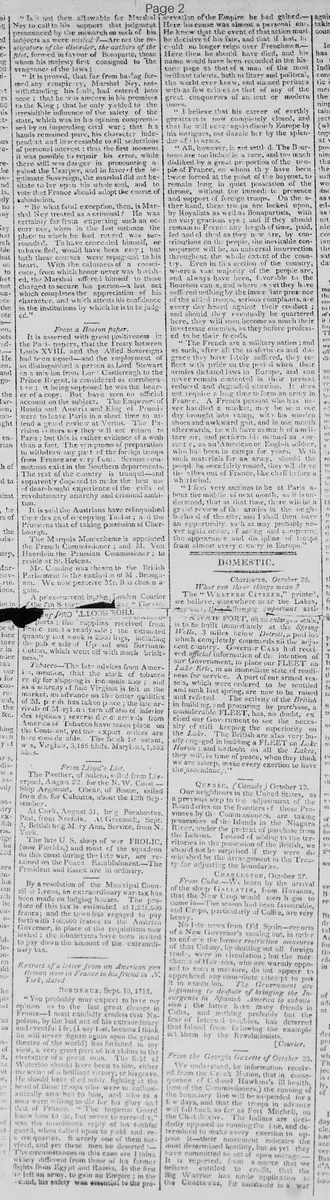
"You probably may expect to have my opinion as to the last great change in France—I must candidly confess that Napoleon, by the last act of his extraordinary and eventful life, (I say last, because I think he will never figure again upon the grand theatre of the world) has forfeited in my view, a very great part of his claims to the character of a great man. The field of Waterloo should have been to him, either the scene of a brilliant victory, or his grave. He should have died nobly fighting at the head of those troops who were so enthusiastically attached to him, and who to a man were willing to die for his glory and that of France. 'The Imperial Guard know how to die, but never to surrender.' was the unanimous reply of his faithful guard, when called upon to yield and receive quarter. Scarcely one of them survived, and yet these men he deserted—
The circumstances in this case are I think widely different from those of his former flights from Egypt and Russia. In the first—left an army. to gain an Empire; in the second, his safety was essential to the preservation of the Empire he had gained.—Here his cause was almost a personal one. He knew that the event of that action must be decisive of his fate, and that if lost, he could no longer reign over Frenchmen.—Here then he should have died, and his name would have been recorded in the historic page as that of a man of the most brilliant talents, both military and political, the world ever knew, and stained perhaps with as few crimes as that of any of the great conquerors of ancient or modern times.
I believe that his career of earthly greatness is now completely closed, and that he will never again disturb Europe by his intrigues, nor dazzle her by the splendor of his arms.
All, however, is not settled. The Bourbons are too imbecile a race, and too much disliked by a great proportion of the people of France, on whom they have been twice forced at the point of the bayonet, to remain long in quiet possession of the throne, without the immediate presence and support of foreign troops. On the other hand, these troops are looked upon, by Royalists as well as Bonapartists, with no very gracious eye; and if they should remain in France any length of time, paid, fed and clothed as they now are, by contributions on the people, the inevitable consequence will be, an universal insurrection throughout the whole extent of the country. Even in this section of the country, where a vast majority of the people are, and always have been, favorable to the Bourbon cause, and where as yet they have suffered nothing by the immediate presence of the allied troops, serious complaints, are every day heard against their conduct; and should they eventually be quartered here, they will soon become as much their inveterate enemies, as they before professed to be their friends.
The French are a military nation: and as such, after all the misfortunes and disgrace they have lately suffered, they reflect with pride on the period when their armies dictated laws to Europe, and can never remain contented in their present reduced and degraded situation. It does not require a long time to form an army in France. A French peasant who has never handled a musket, may be seen one day brought into camp, with his wooden shoes and awkward gait, and in one month afterwards, he will have as much of a military air, and perform his manual as great a ty, as an American or English soldier, who has been in camps for years. With such materials for an army, should the people be once fairly roused, they will drive the allies out of France, like chaff before a whirlwind.
I feel very anxious to be at Paris about the middle of next month. as it is understood, that at that time, there will be a grand review of the armies in the neighborhood of the city, and I shall then have an opportunity, such as may probably never again occur, of seeing and comparing the appearance and discipline of troops from almost every country in Europe."
Bordeaux, Sept. 10, 1815.
"You probably may expect to have my opinion as to the last great change in France—I must candidly confess that Napoleon, by the last act of his extraordinary and eventful life, (I say last, because I think he will never figure again upon the grand theatre of the world) has forfeited in my view, a very great part of his claims to the character of a great man. The field of Waterloo should have been to him, either the scene of a brilliant victory, or his grave. He should have died nobly fighting at the head of those troops who were so enthusiastically attached to him, and who to a man were willing to die for his glory and that of France. 'The Imperial Guard know how to die, but never to surrender.' was the unanimous reply of his faithful guard, when called upon to yield and receive quarter. Scarcely one of them survived, and yet these men he deserted—
The circumstances in this case are I think widely different from those of his former flights from Egypt and Russia. In the first—left an army. to gain an Empire; in the second, his safety was essential to the preservation of the Empire he had gained.—Here his cause was almost a personal one. He knew that the event of that action must be decisive of his fate, and that if lost, he could no longer reign over Frenchmen.—Here then he should have died, and his name would have been recorded in the historic page as that of a man of the most brilliant talents, both military and political, the world ever knew, and stained perhaps with as few crimes as that of any of the great conquerors of ancient or modern times.
I believe that his career of earthly greatness is now completely closed, and that he will never again disturb Europe by his intrigues, nor dazzle her by the splendor of his arms.
All, however, is not settled. The Bourbons are too imbecile a race, and too much disliked by a great proportion of the people of France, on whom they have been twice forced at the point of the bayonet, to remain long in quiet possession of the throne, without the immediate presence and support of foreign troops. On the other hand, these troops are looked upon, by Royalists as well as Bonapartists, with no very gracious eye; and if they should remain in France any length of time, paid, fed and clothed as they now are, by contributions on the people, the inevitable consequence will be, an universal insurrection throughout the whole extent of the country. Even in this section of the country, where a vast majority of the people are, and always have been, favorable to the Bourbon cause, and where as yet they have suffered nothing by the immediate presence of the allied troops, serious complaints, are every day heard against their conduct; and should they eventually be quartered here, they will soon become as much their inveterate enemies, as they before professed to be their friends.
The French are a military nation: and as such, after all the misfortunes and disgrace they have lately suffered, they reflect with pride on the period when their armies dictated laws to Europe, and can never remain contented in their present reduced and degraded situation. It does not require a long time to form an army in France. A French peasant who has never handled a musket, may be seen one day brought into camp, with his wooden shoes and awkward gait, and in one month afterwards, he will have as much of a military air, and perform his manual as great a ty, as an American or English soldier, who has been in camps for years. With such materials for an army, should the people be once fairly roused, they will drive the allies out of France, like chaff before a whirlwind.
I feel very anxious to be at Paris about the middle of next month. as it is understood, that at that time, there will be a grand review of the armies in the neighborhood of the city, and I shall then have an opportunity, such as may probably never again occur, of seeing and comparing the appearance and discipline of troops from almost every country in Europe."
What sub-type of article is it?
Historical
Reflective
Political
What themes does it cover?
Military War
Politics
What keywords are associated?
Napoleon
Waterloo
Bourbons
France
Allied Troops
Insurrection
Military Nation
What entities or persons were involved?
American Gentleman
His Friend In N. York
Letter to Editor Details
Author
American Gentleman
Recipient
His Friend In N. York
Main Argument
napoleon forfeited his greatness by fleeing waterloo instead of dying honorably; his career is over, bourbons are unstable and disliked, leading to potential insurrection against allied troops, with france's military spirit poised for resurgence.
Notable Details
'The Imperial Guard Know How To Die, But Never To Surrender.'
Compares Flights From Egypt And Russia To Waterloo