Thank you for visiting SNEWPapers!
Sign up free
The Virginia Gazette
Richmond, Williamsburg, Richmond County, Virginia
What is this article about?
John Camm writes to the Virginia Gazette printers on April 7, 1768, from York, to publish his account of a dispute with Dr. Arthur Lee over Lee's letter accusing Camm of a destructive 'coalition' harming the College and colony. Camm includes his unanswered letter to Lee demanding specifics and criticizes Lee's return of it as cowardly.
Clipping
OCR Quality
Full Text
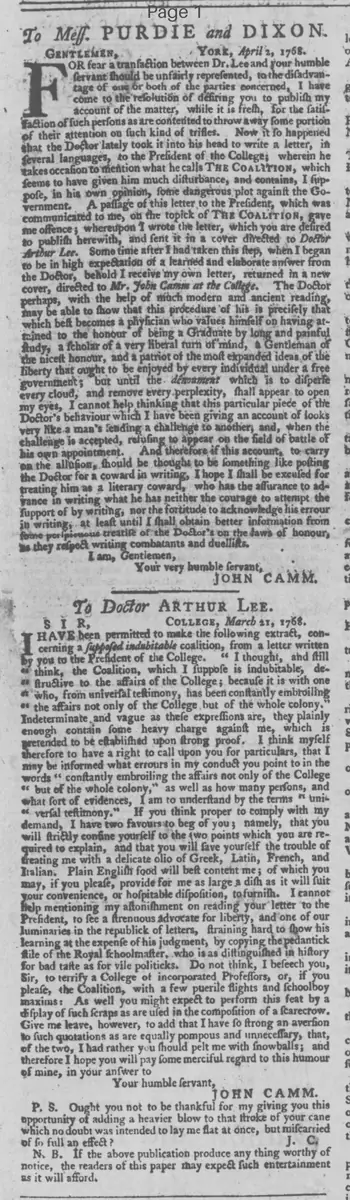
GENTLEMEN:
York, April 7, 1768.
On hearing a conversation between delegates, John D—— and your humble Servant should be unfairly represented, to the disadvantage of one or both of the parties concerned, I have come to the resolution of desiring you to publish my account of the matter, while it is fresh, for the satisfaction of such persons as are contented to throw away some portion of their attention on such kind of trifles. Now it so happened that the Doctor lately took it into his head to write a letter, in several languages, to the President of the College; wherein he takes occasion to mention what he calls THE COALITION, which seems to have given him much disturbance, and contains, I suppose, in his own opinion, some dangerous plot against the Government. A passage of this letter to the President, which was communicated to me, on the topic of The Coalition, gave me offence; whereupon I wrote the letter, which you are desired to publish herewith, and sent it in a cover directed to Doctor Arthur Lee. Some time after I had taken this step, when I began to be in high expectation of a learned and elaborate answer from the Doctor, behold I receive my own letter, returned in a new cover, directed to Mr. John Camm at the College. The Doctor perhaps, with the help of much modern and ancient reading, may be able to show that this procedure of his is precisely that which best becomes a physician who values himself on having attained to the honour of being a Graduate by long and painful study, a scholar of a very liberal turn of mind, a Gentleman of the nicest honour, and a patriot of the most expanded ideas of that liberty that ought to be enjoyed by every individual under a free government; but until the denouement which is to disperse every cloud, and remove every perplexity, shall appear to open my eyes, I cannot help thinking that this particular piece of the Doctor's behaviour which I have been giving an account of looks very like a man's sending a challenge to another, and, when the challenge is accepted, refusing to appear on the field of battle of his own appointment. And therefore if this account, to carry on the allusion, should be thought to be something like posting the Doctor for a coward in writing, I hope I shall be excused for treating him as a literary coward, who has the assurance to advance in writing what he has neither the courage to attempt the support of by writing, nor the fortitude to acknowledge his error in writing, at least until I shall obtain better information from some perspicuous treatise of the Doctor's on the laws of honour, as they respect writing combatants and duelists.
I am, Gentlemen,
Your very humble servant,
JOHN CAMM.
To Doctor Arthur Lee.
SIR,
COLLEGE, March 21, 1768.
I have been permitted to make the following extract, concerning a supposed indubitable coalition, from a letter written by you to the President of the College.
"I thought, and still think, the Coalition, which I suppose is indubitable, destructive to the affairs of the College; because it is with one who, from universal testimony, has been constantly embroiling the affairs not only of the College, but of the whole colony."
Indeterminate and vague as these expressions are, they plainly enough contain some heavy charge against me, which is pretended to be established upon strong proof. I think myself therefore to have a right to call upon you for particulars, that I may be informed what errors in my conduct you point to in the words "constantly embroiling the affairs not only of the College but of the whole colony," as well as how many persons, and what sort of evidences, I am to understand by the terms "universal testimony." If you think proper to comply with my demand, I have two favours to beg of you; namely, that you will strictly confine yourself to the two points which you are required to explain, and that you will save yourself the trouble of treating me with a delicate olio of Greek, Latin, French, and Italian. Plain English food will best content me; of which you may, if you please, provide for me as large a dish as it will suit your convenience, or hospitable disposition, to furnish. I cannot help mentioning my astonishment on reading your letter to the President, to see a strenuous advocate for liberty, and one of our luminaries in the republic of letters, straining hard to show his learning at the expense of his judgment, by copying the pedantick style of the Royal schoolmaster, who is as distinguished in history for bad taste as for vile politics. Do not think, I beseech you, Sir, to terrify a College of incorporated Professors, or, if you please, the Coalition, with a few puerile flights and schoolboy maxims: As well you might expect to perform this feat by a display of such scraps as are used in the composition of a scarecrow. Give me leave, however, to add that I have so strong an aversion to such quotations as are equally pompous and unnecessary, that, of the two, I had rather you should pelt me with snowballs; and therefore I hope you will pay some merciful regard to this humour of mine, in your answer to
Your humble servant,
JOHN CAMM.
P. S. Ought you not to be thankful for my giving you this opportunity of adding a heavier blow to that stroke of your cane which no doubt was intended to lay me flat at once, but miscarried of so full an effect?
J. C.
N.B. If the above publication produce any thing worthy of notice, the readers of this paper may expect such entertainment as it will afford.
What sub-type of article is it?
What themes does it cover?
What keywords are associated?
What entities or persons were involved?
Letter to Editor Details
Author
John Camm
Recipient
To The Purdie And Dixon
Main Argument
john camm defends himself against dr. arthur lee's accusation of involvement in a destructive 'coalition' harming the college and colony, demands specifics from lee, and criticizes lee's return of camm's letter as evasive and cowardly conduct unbecoming a gentleman and patriot.
Notable Details
- reference to lee's multilingual letter to the college president
- allusion to dueling honor in literary dispute
- criticism of lee's pedantic style and quotations in multiple languages
- mention of 'universal testimony' and 'constant embroiling' of affairs