Thank you for visiting SNEWPapers!
Sign up free
Morning Herald
New York, New York County, New York
What is this article about?
In New York City's Court of Sessions, tailor Robert Melville appeals commitment as a 'disorderly person' for not providing for his wife and 10 children per revised statutes. Witnesses testify to his industriousness and adequate support, while wife alleges neglect. Court affirms decision, mandating security or prison.
Clipping
OCR Quality
Full Text
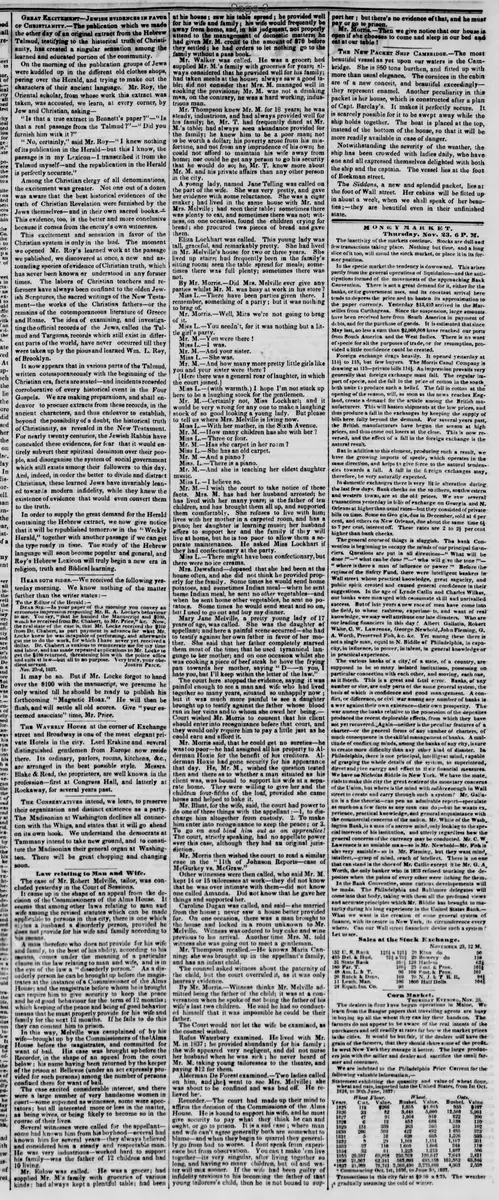
The case of Mr. Robert Melville, tailor, was concluded yesterday in the Court of Sessions.
It came up in the shape of an appeal from the decision of the Commissioners of the Alms House. It seems that among other laws relating to man and wife among the revised statutes which can be made applicable to persons in this city, there is one which cites a husband a disorderly person, provided he does not provide for his wife and family according to his means.
A man therefore who does not provide for his wife and family, to the best of his ability, according to his means, comes under the meaning of a particular clause in the law relating to man and wife, and is in the eye of the law a "disorderly person." As a disorderly person he can be brought up before the magistrates at the instance of a Commissioner of the Alms House; and the magistrate before whom he is brought can require him to give security to keep the peace and be of good behaviour for the term of 12 months; which keeping of the peace and being of good behavior means that he must properly provide for his wife and family for the next 12 months. If he fails to do this they can commit him to prison.
In this way, Melville was complained of by his wife—brought up by the Commissioners of the Alms House before the magistrates, and committed for want of bail. His case was brought up before the Recorder, in the shape of an appeal from the court below : his name having been returned by the keeper of the prison at Bellevue (under an act expressly provided for such persons) among the number of persons confined there for want of bail.
The case excited considerable interest, and there were a large number of very handsome women in court—some subpoenaed as witnesses, some were spectators: but all interested more or less in the matter, as being wives, or being likely to become so in the course of their lives.
Several witnesses were called for the appellant—some had known him from his boyhood—several had known him for several years—they always believed and considered him a steady and respectable man. He was very industrious—worked hard to support his family—was the father of 12 children and had 10 living.
Mr. Eulow was called. He was a grocer; had supplied Mr. M's family with groceries of various kinds; had always kept a plentiful table: had been at his house; saw his table spread; he provided well for his wife and family; his wife would frequently be away from home, and, in his judgment, not properly attend to the management of domestic matters; he had given Mr. M. credit to the amount of $70 before they settled; he had orders to let nothing go to the family without a pass book.
Mr. Walker was called. He was a grocer; had supplied Mr. M.'s family with groceries for years; always considered that he provided well for his family; had taken meals at the house; always saw a good table; did not consider that Mrs. M. managed well in cooking the provisions; Mr. M. was not a drinking man, on the contrary, he was a hard working, industrious man.
Mr. Thompson knew Mr. M. for 18 years; he was steady, industrious, and had always provided well for his family; he, Mr. T. had frequently dined at Mr. M.'s table; had always seen abundance provided for the family; he knew him to be a poor man; not to be worth a dollar; his poverty arose from his misfortune, and not from any imprudence of his own; he could not afford to maintain his wife away from home; nor could he get any person to go his security that he would do so: he, Mr. T. knew more about Mr. M. and his private affairs than any other person in the city.
A young lady, named Jane Telling was called on the part of the wife. She was very pretty, and gave her evidence with some reluctance. She was a cigar maker: had lived in the same house with Mr. and Mrs. Melville; had seen their table; sometimes there was plenty to eat, and sometimes there was not; witness, on one occasion, found the children crying for bread; she procured two pieces of bread and gave them.
Eliza Lockhart was called. This young lady was tall, graceful, and remarkably pretty. She had lived in Mr. Melville's house for two or three years. She lived up stairs; had frequently been in the family's sitting room; seen the table spread for meals; some times there was full plenty; sometimes there was not.
By Mr. Morris.—Did Mrs. Melville ever give any parties whilst Mr. M. was busy at work in his store?
Miss L.—There have been parties given there. I remember, something of a party ; but it was nothing to brag of.
Mr. Morris.—Well, Miss we're not going to brag of it.
Miss L.—You needn't, for it was nothing but a little girl's party.
Mr. M.—You were there !
Miss L.—I was.
Mr. M.—And your sister.
Miss L.—She was.
Mr. M.—And how many more pretty little girls like you and your sister were there?
[Here there was a general roar of laughter, in which the court joined.]
Miss L.—(with warmth.) I hope I'm not stuck up here to be a laughing stock for the gentlemen.
Mr. M.—Certainly not, Miss Lockhart; and it would be very wrong for any one to make a laughing stock of so good looking a young lady. But please to tell us where Mrs. Melville is living now.
Miss L.—With her mother, in the Sixth Avenue.
Mr. M.—How many children has she with her ?
Miss L.—Three or four
Mr. M.—Has she carpet in her room ?
Miss L.—She has an old carpet.
Mr. M.—And a piano ?
Miss. L.—There is a piano.
Mr. M.—And she is teaching her eldest daughter music.
Miss L.—I believe so.
Mr. M.—I wish the court to take notice of these facts. Mrs. M. has had her husband arrested; he has lived with her many years; is the father of ten children, and has brought them all up, and supported them comfortably. She refuses to live with him: lives with her mother in a carpeted room, and has piano; her daughter is learning music; her husband offers to support her and the family if they will live at home, but he is too poor to allow them a separate maintenance. He asked Miss Lockhart if they had confectionary at the party.
Miss L.—There might have been confectionary, but there were no ice creams.
Mrs. Dews and—deposed that she had been at the house often, and she did not think he provided properly for the family. Some times he would send home potatoes, and sometimes Indian meal—when he sent home Indian meal, he sent no other vegetables—and when he sent home other vegetables, he sent no potatoes. Some times he would send meat and so on, but I used to go out and buy my dinner.
Mary Jane Melville, a pretty young lady of 17 years of age, was called. She was the daughter of appellant; and here a painful scene occurred—she had to testify against her own father in favor of her mother. She said that her father completely starved them most of the time; that he used tyrannical language to her mother; and on one occasion whilst she was cooking a piece of beef steak he hove the frying pan towards her mother, saying "D—n you, hate you, but I'll keep within the letter of the law."
The court here stopped the evidence, saying it was painful enough to see a man and wife who had lived together so many years, situated so unhappily now ; but it was much more painful to see a daughter brought up to testify against the father whose blood ran in her veins and to whom she owed her being.
Court wished Mr. Morris to consent that his client should enter into recognizance before that court, and they would only require him to pay a little just as he could earn and afford it.
Mr. Morris said, that he could get no sureties—he was too poor—he had assigned all his property to Alderman Hoxie for the benefit of his creditors. Alderman Hoxie had gone security for his appearance that day. He, Mr. M., wished the question tested then and there as to whether a man situated as his client was, was bound to support his wife at a separate home. They were willing to give her and the children four-fifths of the loaf, provided she came home and helped to bake it.
Mr. Blunt, for the wife, said, the court had power to do one of three things with the appellant :-1, to discharge him altogether from custody. 2. To make him enter into recognizance to keep the peace; or 3. To go on and bind him out as an apprentice!
The court, strictly speaking, had no appellate power over this case, although they had an original jurisdiction.
Mr. Morris then wished the court to read a similar case in the "11th of Johnson Reports—case of McGurkey vs. McGraw."
Other witnesses were then called, who said Mr. M. kept 14 or 15 tailoresses at work—they did not know that he was over intimate with them—did not know one called Amanda. Did not know that he gave her things and supported her.
Caroline Dugan was called, and said—she married from the house ; never saw a house better provided for. On one occasion, there was a man brought to the house and locked in a room unknown to Mr. Melville. Witness was ordered to buy cake and wine previous to his arrival. Another time Mrs. M. told witness she was going out to meet a gentleman.
Mr. Thompson recalled.—He knows Maria Canning; she was brought up in the appellant's family. and has an infant child.
The counsel asked witness about the paternity of the child. but the court overruled it, as it was only hearsay evidence.
By Mr. Morris.—Witness thinks Mr. Melville admitted being the father of the child; it was at a conversation when he spoke of not being the father of his wife's last two children. He said he had so conducted himself that it was impossible he could be their father.
The Court would not let the wife be examined, as the counsel wished.
Rufus Waterbury examined. He lived with Mr M. in 1837; he provided abundantly for his family; the wife appeared very negligent, and did not nurse her husband when he was sick : he never heard of Mr. M. taking young tailoresses to the theatre, and paying $12 for them.
Alderman De Forest examined.—Two ladies called on him, and they went to see Mrs. Melville: she was about to be confined and was bad off. He relieved her.
Recorder.—The court had made up their mind to affirm the decision of the Commissions of the Alms House. He is bound to support his wife, and he must give security to pay what they think he can and ought, or go to prison. It is a sad case ; where man and wife can't agree generally both are somewhat to blame—and when they begin to quarrel they generally go from bad to worse. I don't speak from experience but from observation. You can't make 'em live together—its very singular, after living together so long, and having so many children, but oil and water will mix sooner. If the wife had been guilty of infidelity previous to his becoming the father of that young tailoress's child, then he is not bound to support her ; but there's no evidence of that, and he must pay or go to prison.
Mr. Morris.—Then we give notice that our house is open if she chooses to come and sleep in our bed and eat at our table!
What sub-type of article is it?
What themes does it cover?
What keywords are associated?
What entities or persons were involved?
Where did it happen?
Story Details
Key Persons
Location
New York City, Court Of Sessions
Event Date
Concluded Yesterday
Story Details
Tailor Robert Melville appeals commitment as disorderly person for failing to support wife and 10 children. Defense witnesses affirm his provision and her mismanagement; prosecution claims neglect and parties. Court upholds, requires security for support or prison, noting mutual blame in marital discord.