Thank you for visiting SNEWPapers!
Sign up free
The National Intelligencer And Washington Advertiser
Washington, District Of Columbia
What is this article about?
March 1803 London news reports imminent war between England and France over Malta evacuation and Egyptian troops. King's message to Parliament notes French preparations; Britain issues press warrants, impresses over 2000 seamen, readies ships and army. Diplomatic confrontation between Bonaparte and Lord Whitworth in Paris. Yorkshire conspiracy trial linked to potential invasion.
Merged-components note: Sequential components forming a single extended foreign news article on tensions between England and France, including reports from London and Paris; merged across pages.
Clippings
1 of 2
OCR Quality
Full Text
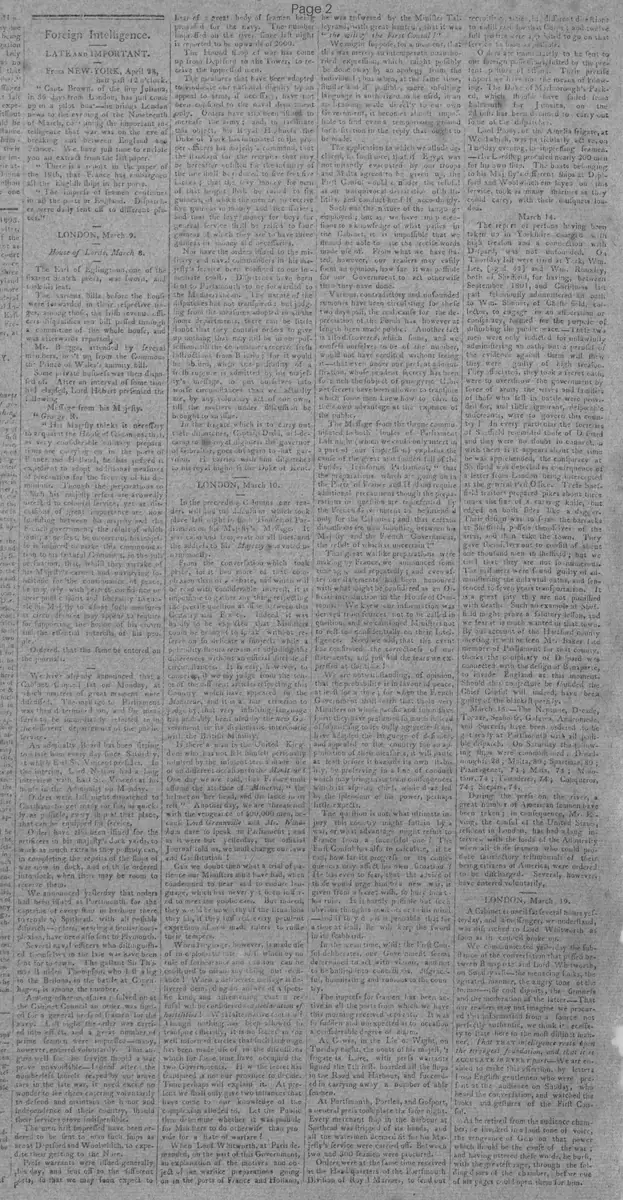
There is a report in the paper of the 19th, that France has embargoed all the English ships in her ports.
The impress of seamen continues in all the ports of England. Dispatches were daily sent to different places.
LONDON, March 9.
House of Lords, March 8.
The Earl of Eglintoun, one of the sixteen Scotch peers, was sworn, and took his seat.
The various bills before the house were forwarded in their respective stages, among them, the Irish revenue collectors disqualification bill passed through a committee of the whole house, and was afterwards reported.
Mr. Bagge, attended by several members, brought up from the Commons the Prince of Wales's annuity bill.
Some private business was then disposed of. After an interval of some time had elapsed, Lord Hobart presented the following message from his Majesty.
George R.
His Majesty thinks it necessary to acquaint the House of Commons, that, as very considerable military preparations are carrying on in the ports of France and Holland, he has judged it expedient to adopt additional measures of precaution for the security of his dominions. Though the preparations to which his majesty refers are avowedly directed to colonial service, yet as discussions of great importance are now taking place between his majesty and the French government, the result of which must, at present, be uncertain, his majesty is induced to make this communication to his faithful Commons, in the just belief, that, while they unite with his Majesty in the earnest and unavailing solicitude for the continuance of peace, they will, with equal confidence in their public spirit and liberality, enable his Majesty to adopt such measures as circumstances may appear to require for supporting the honor of his crown and the essential interests of his people.
Ordered, that the same be entered on the journals.
We have already announced that a Cabinet Council sat on Monday, at which matters of great moment were discussed. The intelligence to Parliament was then determined on, and the measures to be immediately resorted to in the different departments of the public service.
An Admiralty Board has been sitting to a late hour every day since Saturday, at which Earl St. Vincent presides. In the interim, Lord Nelson had a long interview with Earl St. Vincent at his house in the Admiralty on Monday.
Orders were last night dispatched to Chatham to get ready for sea, as quick as possible, every ship at that place, that can be equipped for service.
Orders have also been issued for the artificers in his majesty's dock yards, to work as much extra as they possibly can, in completing the repairs of the ships of war now in dock, and of those ordered into dock, when there may be room to receive them.
We announced yesterday that orders had been issued at Portsmouth for the captains of every ship in harbour there to repair to Spithead, with all possible dispatch—similar orders, wearing a similar complexion, have been also sent to Plymouth.
Several naval officers who distinguished themselves in the late war have been sent for to town. The gallant Sir Thomas Boulden Thompson, who lost a leg in the Bellona, in the battle at Copenhagen, is among the number.
Among other measures resolved on at the Cabinet Council an order was signed for a general press warrant for the navy. Last night the order was carried into effect, and a great number of prime seamen were impressed—many, however, entered voluntarily. This augurs well for the service should a war prove unavoidable—Indeed after the numberless laurels reaped by our brave tars in the late war, it need excite no wonder to see them entering voluntarily to defend and maintain the honor and independence of their country, should their services prove indispensable.
The men first impressed have been ordered to be sent to man such ships as are at Deptford and Woolwich, to expedite their getting to the Nore.
Press warrants were issued generally this day, and sent out to the different ports, so that we may soon expect to hear of a great body of seamen being provided for the navy.
The number impressed on the river since last night is reported to be upwards of 2000.
The Hound sloop of war has come up from Deptford to the Tower, to receive the impressed men.
The measures that have been adopted to vindicate our national dignity by an appeal to arms, if necessary, have not been confined to the naval department only. Orders have also been issued to increase the army; and, to facilitate this object, his Royal Highness the Duke of York has intimated to the provosts his majesty's command, that the standard for the recruits that may hereafter be collected for the infantry of the line shall be reduced to five feet five inches; that the levy money for men of that height shall be raised to six guineas, of which the men are to receive five guineas in money and necessaries; and that the levy money for boys for general service shall be raised to four guineas. All who enter are to have three guineas in money and necessaries.
Nor have the orders issued to the military and civil commanders in his majesty's service been confined to our immediate coast. Dispatches have been sent to Portsmouth to be forwarded to the Mediterranean. The nature of the dispatches has not transpired: but judging from the measures adopted in all the home departments, there can be little doubt that they contain orders to give up nothing that may still be in our possession, till the commanders receive fresh instructions from Britain; for it would be absurd, when the possibility of a fresh rupture is admitted by his majesty's message, to put ourselves into worse circumstances than we actually are, by any voluntary act of our own, till the matters under discussion be brought to an issue.
In the frigate which is to carry out these dispatches, Captain Dodd, aide-de-camp to his royal highness the governor of Gibraltar, goes out again to that garrison. He carries with him dispatches to his royal highness the Duke of Kent.
LONDON, March 10.
In the preceding columns our readers will find the account which took place last night in both Houses of Parliament, on his Majesty's Message. It was calm and temperate on all sides, and the address to his Majesty was voted unanimously.
From the conversation which took place, for it bore more of the tint of conversation than of debate, and which will be read with considerable interest, it is impossible to gather anything respecting the precise quarrel at issue between this country and France. Indeed it was hardly to be expected that Ministers could be brought to speak with reserve on so delicate a subject, while a possibility should remain of dissolving the differences without an official disclosure of circumstances. It is easy, however, to conceive, if we may judge from the tenor of the great articles respecting this country which have appeared in the Moniteur, and it is a safe criterion to judge by, that very insulting language has probably been held by the new Government in its diplomatic intercourse with the British Ministry.
Is there a man in the United Kingdom who has not felt himself personally insulted by the insolent terms made use of on different occasions in the Moniteur? One day we are told, that France must assume the attitude of Minerva, 'the helmet on her head, and the lance in her rest.' Another day, we are threatened with the vengeance of 500,000 men, because Lord Grenville and M. Windham had dared to speak in Parliament; and as it were but yesterday, the official Journal told us, we must change our laws and Constitution!
Can we doubt then what a trial of patience our Ministers must have had, when condemned to hear and to endure language, which has never yet been linked to meet the public ear. But mindful, they would be unworthy of the situations they hold, if they turned every peculiar expression of new mad rulers to rume their tempers.
When language, however, is made use of in diplomatic intercourse, which by no rule of forbearance and caution can be construed to mean anything but defiance! When a deliberate message is delivered demanding an answer of a specific kind, and threatening that a refusal will be considered as a declaration of hostilities! What alternative remains?
Although nothing has been allowed to transpire officially, it is no secret in well informed circles that such language has been made use of in the discussions which for some time have occupied the two Governments. How the secret has transpired is not our province to decide. Time perhaps will explain it. At present we shall only give two instances that have come to our knowledge of the complexion alluded to. Let the Public then determine whether it was possible for Ministers to do otherwise than provide for a state of warfare?
When Lord Whitworth, at Paris demanded, on the part of this Government, an explanation of the motives and object of the warlike preparations going on in the ports of France and Holland, he was answered by the Minister Talleyrand, with great haughtiness, that it was the will of the First Consul! …
We might suppose, for a moment, that this was merely an intemperate unadvised expression, which might probably be done away by an apology from the individual; but when, at the same time, similar if not possibly, more insulting language is authorized to be used, in an application made directly to our own Government, it becomes almost impossible to find even a temporizing ground for hesitation in the reply that ought to be made.
The application to which we allude declared, in cool blood, that if Egypt was not instantly evacuated by our troops and Malta agreed to be given up, the First Consul would consider the refusal as an unequivocal declaration of hostilities, and conduct himself accordingly.
Such was the nature of the language employed; but as we have no pretensions to a knowledge of what passes in the Cabinet, it is impossible that we should be able to state the precise words made use of. From what we have stated, however, our readers may easily form an opinion, how far it was possible for our Government to act otherwise than they have done.
Various, contradictory and unfounded rumours have been circulating for these two days past, the real cause for the depreciation of the Funds has however at length been made public. Another fact is also discovered, which some, and we confess ourselves to be of this number, would not have credited without seeing it—that even under our present administration, whose prudent secrecy has been so much the subject of panegyric, Cabinet secrets have been allowed to transpire which some men knew how to turn to their own advantage at the expense of the public.
The Message from the throne communicated to both houses of Parliament last night (which we could only insert in a part of our impress) explains the cause of the great and sudden fall of the Funds. It informs Parliament, 'that the preparations which are going on in the Ports of France and Holland require additional precautions though the preparations in question are represented by the French government to be intended only for the Colonies; and that certain discussions are now subsisting between his Majesty and the French Government, the result of which is uncertain!'
That great warlike preparations were making by France, we announced some time ago and repeatedly; and even after our statements had been honoured with what might be considered as an official introduction in the House of Commons, We knew our information was derived from sources not to be called in question, and we cautioned Ministers not to rest too confidentially on their intelligence. Need we add, that the event has confirmed the correctness of our statements, and justified the fears we expressed at the time!
We are notwithstanding, of opinion, that the probability is in favour of peace. at least. for a time; for when the English Government shall learn that those very Ministers on whose pacific and submissive dispositions they have presumed so much instead of submitting to its bullying pretensions, have adopted the language of defiance, and appealed to the country for approbation of their measures, it will pause at least before it hazards its own stability, by persevering in a line of conduct which may bring on its train consequences which its spring chief, while dazzled by the splendour of his power, perhaps little expects.
The question is not, what ultimate injury this country might sustain by a war, or what advantages might result to France from a successful one? The First Consul has also to calculate, if he can, how far its progress or its consequences may affect his own situation?
He has even to fear, that the advice of those would urge him to a new war, is given from a secret wish, to hurry him to his ruin. It is hardly possible but such obvious thoughts must occur to his mind and if they do it is probable that for a time at least, he will keep the sword in its scabbard.
In the mean time, while the First Consul deliberates, our Government seems determined to act with vigour, and not to be bullied into concessions, disgraceful, humiliating and ruinous to the country.
The impress for seamen has been active in all the ports from which we have this morning received accounts. It was so sudden and unexpected as to occasion a considerable degree of alarm.
At Cowes, in the Isle of Wight, on Tuesday night, the boats of his majesty's frigate La Loire, with press warrants signed the 7th inst. boarded all the ships in the Road and Harbour, and succeeded in carrying away a number of able seamen.
At Portsmouth, Portsea, and Gosport, a general press took place the same night. Every merchant ship in the harbour at Spithead was stripped of its hands, and all the watermen deemed fit for his Majesty's service were carried off. Between two and 300 seamen were procured.
Orders were at the same time received at the Head quarters of the Portsmouth Division of Royal Marines, to send out recruiting parties in different directions to enlist men for that corps; and twelve full parties were appointed to go on that service as soon as possible.
Orders are immediately to be sent to our foreign possessions, suited to the present posture of affairs. Their precise import we have no the means of knowing. The Duke of Marlborough's Packet, which should have sailed from Falmouth for Jamaica, on the 2d inst. has been detained to carry out some of the dispatches.
Lord P.oby, of the Amelia frigate, at Woolwich, was particularly active, on Tuesday evening, in impressing seamen. His Lordship procured nearly 200 men for his own ship. The boats belonging to his Majesty's different ships at Deptford and Woolwich employed on this service, took as many marines as they could carry, with their muskets loaded.
March 14.
The report of persons having been taken up in Yorkshire charged with high treason and a connection with Despard, was not unfounded. On Thursday last were tried at York, Wm. Lee, aged 42, and Wm. Rowley, both of Sheffield, for having, between September 1801, and Christmas last past feloniously administered an oath to Wm. Simnet, of Chesterfield, collector, to engage in an association or conspiracy, formed for the purpose of disturbing the public peace.—These two men were only indicted for unlawfully administering an oath, but a perusal of the evidence against them will show they were guilty of high treason.
They associated, they took a secret oath, were to overthrow the government by force of arms, the wives and families of those who fell in battle were provided for, and these ignorant, despicable miscreants, were to govern this country! In every particular the societies of Sheffield resembled those of Ireland and they were no doubt in connection with them as it appears about the time he was apprehended, the conspiracy at Sheffield was detected in consequence of a letter from London being intercepted at the general Post Office. These Sheffield traitors prepared pikes about three times the size of a carving knife, but edged on both sides like a dagger.
Their design was to seize the barracks at Sheffield, possess themselves of the arms, and then take the town. They gave themselves out to consist of about one thousand men in Sheffield; but we trust that they are not so numerous.
The prisoners were found guilty of administering the unlawful oaths, and sentenced to seven years transportation. It is a great pity they are not punished with death. Such an example at Sheffield might prove a salutary lesson, and we fear it is much wanted in that town.
By our account of the Hartford county meeting it will be seen Mr. Baker the member of Parliament for that county, thinks the conspiracy of Despard was connected with the design of Bonaparte, to invade England at this moment.
Should this conjecture be founded the Chief Consul will indeed, have been guilty of the blackest perfidy.
March 15. The Neptune, Decade, Toraze, Seahorse, Galatea, Andromeda, and Success, have been ordered to be got ready at Portsmouth with all possible dispatch. On Saturday the following ships were commissioned. Dreadnought, 98; Malta, 80; Spartan, 80; Plantagenet, 74; Mars, 74; Minotaur, 74; Thunderer, 74; Conqueror, 74; Sceptre, 74.
During the press on the river, a great number of American seamen have been taken; in consequence, Mr. Erving, the Consul of the United States, resident in London, has had a long interview with the lords of the Admiralty when all those seamen who could produce satisfactory testimonials of their being citizens of America, were ordered to be discharged. Several, however, have entered voluntarily.
LONDON, March 19.
A Cabinet council sat several hours yesterday, and a messenger, we understand, was dispatched to Lord Whitworth as soon as the council broke up.
We communicated yesterday the substance of the conversation that passed between Bonaparte and Lord Whitworth, on Sunday last—the menacing looks, the agitated manner, the angry tone of the former—the cool dignity, the firmness and the moderation of the latter—That our readers may not imagine we procured this information from a source not perfectly authentic, we think it necessary to state here in the most distinct manner, that THAT intelligence rests upon the strongest foundation, and that it is ACCURATE in EVERY particular. We are enabled to make this assertion, by letters from English gentlemen who were present at the audience on Sunday, who heard the conversation, and watched the looks and gestures of the First Consul.
As he retired from the audience chamber, he invoked in a loud tone of voice, the vengeance of God on that power which should be the cause of the war; and having uttered these words, he burst, with the greatest rage, through the folding doors of the chamber, before one of his pages could open them for him.
It appears on all the accounts we have already received from Paris, that Bonaparte was by no means prepared to expect such vigorous preparations on our part. As soon as the message arrived, a council of State was called, which sat from this morning till it at night. Couriers were immediately dispatched to Vienna, Berlin, Petersburg and Italy.
We have already said, that we suspect Bonaparte will do every thing in his power to procrastinate. Our ministers, however, we are right to have, are determined not to permit a lingering negotiation. The null will observations in a paper connected with theirs, coincide with those which we expressed in our paper on Thursday. "There is one event with respect to which his Majesty's ministers, we have no doubt, will provide as far as such an occurrence can be provided against, by stipulation and agreement--they will not suffer the present crisis to pass without coming to some precise and specific settlement, upon all the objects under discussion--and they are fully aware that nothing would be so disadvantageous to the nation as to permit the present negotiation to be spun out, and the objects of it be patched up for the present. If any such attempt should be made, we are informed they are fully determined to resist it having armed, they will not disarm, without placing every point under discussion in a satisfactory state."
"We heartily wish that we could trust as implicitly to the disposition of the First Consul, as we are sure we may to that of his Majesty's Ministers. That without recurring to causes of discontent and inquietude, which may have taken place since the treaty of Amiens, without having recourse to mutual reproaches, circumstances may admit of conciliation, and that we may be permitted to look with confidence for the future--but if inordinate ambition induces the Chief Consul of France to annex continually new territories to the Republic, to extend his views to projects repugnant to British interests, treaties may be signed but jealousies will exist incompatible with the true spirit of peace."
Government, we have been informed this morning, is to receive a definitive answer from Bonaparte to night. Their admiral was dispatched on Tuesday last, and as we understand, an immediate reply was demanded; they are in expectation of dispatches to night or to-morrow morning that will decide the question of Peace or War.
Should war be declared, government of course will not let a French ship come out of any of the French ports.
The shipwrights and caulkers employed in the merchants' yards in the river, have made an offer to the admiralty of their services to be employed in any yard their lordships may direct, to assist in equipping the fleet. This offer is not accepted, the artificers in the yards being equal to all the duty.
Lord Keith arrived at Plymouth on Thursday morning, and immediately hoisted his flag on board the Culloden of 74 guns.
An English vessel arrived on Wednesday night from La Hogue. She sailed from thence last Sunday evening in consequence of the bustle and confusion that was going on at La Hogue and Cherbourg. She was about to load oysters for London, and was heaving out ballast for that purpose: but from the warlike appearance of affairs in that neighbourhood, the captain thought it most prudent to leave it as early as possible. Tickets were leaving at the houses of all those connected with the army, and the utmost confusion seemed to prevail.
The rumours of changes in the Administration, are, we understand, unfounded:--Earl St. Vincent, we rejoice to hear, remains in office.
March evening 19.
We have been favoured with a copy of very interesting letters, for the authenticity of which we can vouch relative to the evacuation of the Cape of Good Hope. It will be seen, that if the orders for keeping possession of it had arrived five hours later, it would now have been in the hands of the Dutch troops. The whole of the business relating to the orders and counter orders of Ministers on this subject, is at present involved in complete mystery. It is plain, however that upwards of six months ago Ministers thought measures of precaution necessary.
PARIS, March 14.
There was yesterday, as usual, a grand circle at the Thuilleries. The ambassadors of the different powers were in the saloon, with a numerous assemblage of strangers and ladies of distinction, generals, senators, tribunes, legislators, &c. &c.
Bonaparte entered with an unusual alertness of manner, and, after saluting the company, he addressed himself to Lord Whitworth, in a tone sufficiently loud to be heard by all who were present--"You know, my lord, that a terrible storm has arisen between England and France."
Lord Whitworth, "Yes, General Consul; but it is to be hoped that this storm will be dissipated without any serious consequences."
Bonaparte--"It will be dissipated when England shall have evacuated Malta. If not, the cloud will burst, and the hail must fall. The king of England has promised by treaty to evacuate that place, and who is to violate the faith of treaties?"
Lord Whitworth replied on finding himself questioned in this manner, and before so many persons. "But you know, General Consul, the circumstances which have hitherto delayed the evacuation of Malta. The intention of my government is to fulfill the treaty of Amiens; and you know all--"
Bonaparte--"You know (with impatience) that the French have carried on the war for ten years, and you cannot doubt but that they are in a condition to wage it again. Inform your court, that if on the receipt of your dispatches, orders are not issued for the immediate surrender of Malta, then war is declared I declare it from this moment."
Lord Whitworth--"My only resolution is to see the treaty carried into effect, and leave it to the Ambassadors of the several powers, who are present, to say who is in the wrong. You flattered yourselves that France would not dare to show her resentment whilst her squadrons were at St. Domingo. I am happy thus publicly to undeceive you on that head."
Lord Whitworth--"But, General, the negotiation is not yet broken, and there is even reason to believe--"
Bonaparte--"Of what negotiation does your lordship speak? Is it necessary to negotiate what is conceded by treaty--to negotiate the fulfillment of engagements and the duties of good faith?"
Lord Whitworth was about to reply, Bonaparte made a sign with his hand, and continued in a less elevated tone.
"My lord, your lady is indisposed. She may, probably breathe her native air rather sooner than you or I expected. I wish most ardently for peace, but if my just demands be not instantly complied with, then war must follow, and God will decide. If treaties are not sufficient to bind to peace, then the vanquished must not be left in a condition to offer injury."
Here this unexpected conversation terminated, if that term be allowed, where the discourse was almost wholly on one side.
Bonaparte afterwards walked up and down the hall, and discoursed with several persons with an assumed air of gaiety. To the English, however, who met his eye, his regards were limited to a cold salute.
This scene is of so important in its nature and consequences, and at the same time so new in diplomatic history, that I have taken much pains to get at its details. The auditors were numerous and attentive: but one article arose from the quickness of the allusions, as the reply did not always very graciously await the answer. Some traits of extreme vivacity on the part of the First Consul, I do not choose to hazard. In other respects the text, I believe is faithful, and I leave it to you to make the comment.
What sub-type of article is it?
What keywords are associated?
What entities or persons were involved?
Where did it happen?
Foreign News Details
Primary Location
London And Paris
Event Date
March 1803
Key Persons
Outcome
impressment of upwards of 2000 seamen; commissioning of multiple warships; guilty verdicts for wm. lee and wm. rowley with seven years transportation; british preparations for potential war including fleet readiness and army expansion; french embargo on english ships; heightened tensions over malta and egypt with threats of war.
Event Details
Ship Juliana arrives with London news to March 19 indicating war imminent between England and France. France reportedly embargoes English ships. Britain responds with King's message to Parliament on French and Dutch preparations, leading to unanimous address. Cabinet and Admiralty meetings result in press warrants, impressment of seamen in ports like Thames, Portsmouth, Cowes; orders to ready ships at Chatham, Portsmouth, Plymouth; army recruitment lowered standards and increased bounties. Dispatches sent to Mediterranean and Gibraltar to hold possessions. Diplomatic insults from French Moniteur and Talleyrand; demands for Egypt evacuation and Malta surrender, with threats of hostilities. Detailed account of heated public exchange between Bonaparte and Lord Whitworth at Tuileries on March 14 over Malta, where Bonaparte declares war if not evacuated. Yorkshire trial of conspirators linked to Despard and possible Bonaparte invasion plot. American seamen discharged after consular intervention. Cabinet dispatches messenger to Whitworth; expectation of definitive response deciding peace or war.