Thank you for visiting SNEWPapers!
Sign up free
Editorial
September 14, 1904
The Lamar Register
Lamar, Prowers County, Colorado
What is this article about?
A Republican editorial criticizes Democratic candidate Alton B. Parker's acceptance speech for endorsing the St. Louis platform, which opposes protective tariffs, weakens military, and abandons Philippines. It warns of free trade risks and urges voting Republican to maintain progress.
Clipping
OCR Quality
92%
Excellent
Full Text
PARKER'S ATTITUDE
THE DEMOCRATIC CANDIDATE'S ACCEPTANCE SPEECH.
He Would Strike Down Protection, Cripple the Navy, Decimate the Army and Undo All That Has Been Accomplished by the Republican Party.
In his speech of acceptance Judge Parker accepts the Democratic platform as "admirable."
He approves of it in detail and as a whole. If elected he will carry it out.
Of course, he will; he must. He will be the servant, not the master, of his party.
And rightly so. Presidents are elected to carry out party doctrine, not to antagonize it. Grover Cleveland tried to boss things in 1894, and he came to grief. He refused to attach his signature to the Democratic tariff law of 1894, but he lacked the nerve to veto it. He simply held his nose during the interval necessary to enable the bill to become a law without his concurrence.
Judge Parker is not another Cleveland. He will not attempt to boss or to fight his party, as Cleveland did. He is not built that way.
He will be with his party in all things.
The St. Louis platform, which would strike down protection, would cripple the navy, would decimate the army, would cut adrift seven millions of Filipinos totally incapable of self-government, and would in a general way undertake to turn back the wheels of progress and undo all that the Republican party has done toward making our country the greatest on earth-all this the Democratic candidate accepts as "admirable."
Regarding the chief issue of the campaign he says:
The present tariff law is unjust in its operation, excessive in many of its rates and so framed in particular instances as to exact inordinate profits from the people.
So well understood has this view become that many prominent members of the Republican party, and at least two of its State conventions, have dared to voice the general sentiment on that subject.
That party seems, however, to be collectively able to harmonize only upon a plank that admits that revision may present, and still less to strip the tariff of its protective features. Therefore, the task of tariff making should be taken out of the hands of the Republican party and intrusted to the Democratic party.
If intrusted with the responsibility of tariff making the Democratic party promises to be reasonable. It will not rip up everything all at once. It will go about it gradually, so that the producing interests may have ample time to discharge their workpeople and reduce the volume of production to correspond with the increased inflow of competitive products from abroad. In this way it is hoped to avoid the immediate advent of panic, paralysis, stagnation and ruin. These, it is calculated, will come less swiftly than they did in 1893.
But, in any event, says the Esopus trimmer, not much mischief could be done by a Democratic President and House of Representatives until the present Republican majority in the Senate shall have disappeared.
This would take two years at the least; it might take three or four years to bring about.
In the meantime, says the candidate, the country would be safe.
Astonishing admission!
Certainty and safety lie only in the Republican control of the Senate.
"We would like to do a whole lot of mischief, and we will do it as soon as we can, but we can't do it for two or three years.
Therefore, elect a Democratic president this year."
That, in substance, is the attitude of Parker on the tariff question.
We are invited to sow the seed of free trade in November of 1904, on the assurance that a full free trade crop cannot be harvested much before 1906 or 1907.
It may be, however, that we should not have to wait so long as that for the free trade crop. Events of the past year or two distinctly suggest the possibility that with a Democratic House and a Democratic President having patronage to distribute, a tariff reduction bill and a "genuine reciprocity" bill could be passed by the aid of votes in the Senate that are now classed as Republican.
Things no stranger than this have happened, and may happen again.
Summed up in the light of all the facts and all the evidence, the acceptance speech of Judge Parker contains not one solitary reason why any Republican should take the risk of voting the Democratic ticket this year. On the contrary, all the facts, all the evidence, all the common sense of the situation, should impel every Republican to vote the Republican ticket, and many Democrats besides.
There never was a time when the country was in greater danger of a lapse backward to free trade than in the campaign of 1904.
That is the actual truth.
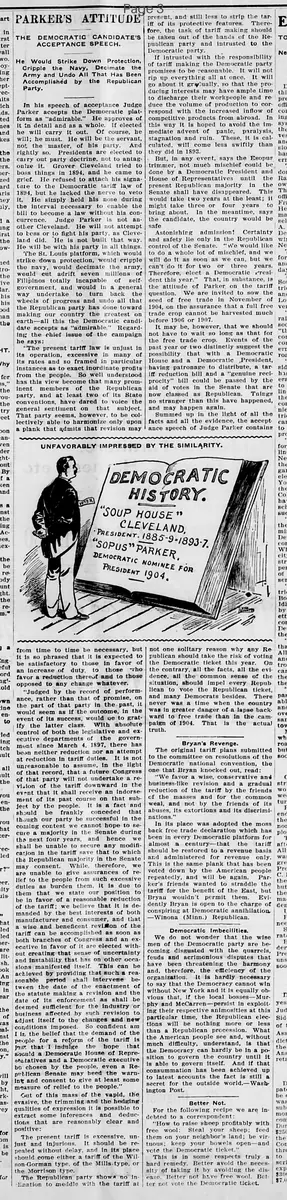
UNFAVORABLY IMPRESSED BY THE SIMILARITY.
from time to time be necessary, but it is so phrased that it is expected to be satisfactory to those in favor of an increase of duty to those who favor a reduction thereof and to those opposed to any change whatever.
"Judged by the record of performance, rather than that of promise, on the part of that party in the past, it would seem as if the outcome, in the event of its success, would be to gratify the latter class. With absolute control of both the legislative and executive departments of the government since March 4, 1897, there has been neither reduction nor an attempt at reduction in tariff duties. It is not unreasonable to assume, in the light of that record, that a future Congress of that party will not undertake a revision of the tariff downward in the event that it shall receive an indorsement of its past course on that subject by the people.
It is a fact and should be frankly conceded that though our party be successful in the coming contest we cannot hope to secure a majority in the Senate during the next four years, and hence we shall be unable to secure any modification in the tariff save that to which the Republican majority in the Senate may consent.
While, therefore, we are unable to give assurances of relief to the people from such excessive duties as burden them, it is due to them that we state our position to be in favor of a reasonable reduction of the tariff; we believe that it is demanded by the best interests of both manufacturer and consumer, and that a wise and beneficent revision of the tariff can be accomplished as soon as both branches of Congress and an executive in favor of it are elected without creating that sense of uncertainty and instability that has on other occasions manifested itself.
This can be achieved by providing that such a reasonable period shall intervene between the date of the enactment of the statute making a revision and the date of its enforcement as shall be deemed sufficient for the industry or business affected by such revision to adjust itself to the changes and new conditions imposed.
So confident am I in the belief that the demand of the people for a reform of the tariff is just that I indulge the hope that should a Democratic House of Representatives and a Democratic executive be chosen by the people, even a Republican Senate may heed the warning and consent to give at least some measure of relief to the people."
Out of this mass of the vapid, the evasive, the trimming and the hedging qualities of expression it is possible to extract some inferences and deductions that are reasonably clear and positive:
The present tariff is excessive, unjust and injurious.
It should be repealed without delay, and in its place should come either a tariff of the Wilson-Gorman type, of the Mills type, or the Morrison type.
The Republican party shows no inclination to meddle with the tariff at all, not one solitary reason why any Republican should take the risk of voting the Democratic ticket this year. On the contrary, all the facts, all the evidence, all the common sense of the situation, should impel every Republican to vote the Republican ticket, and many Democrats besides.
There never was a time when the country was in greater danger of a lapse backward to free trade than in the campaign of 1904.
That is the actual truth.
THE DEMOCRATIC CANDIDATE'S ACCEPTANCE SPEECH.
He Would Strike Down Protection, Cripple the Navy, Decimate the Army and Undo All That Has Been Accomplished by the Republican Party.
In his speech of acceptance Judge Parker accepts the Democratic platform as "admirable."
He approves of it in detail and as a whole. If elected he will carry it out.
Of course, he will; he must. He will be the servant, not the master, of his party.
And rightly so. Presidents are elected to carry out party doctrine, not to antagonize it. Grover Cleveland tried to boss things in 1894, and he came to grief. He refused to attach his signature to the Democratic tariff law of 1894, but he lacked the nerve to veto it. He simply held his nose during the interval necessary to enable the bill to become a law without his concurrence.
Judge Parker is not another Cleveland. He will not attempt to boss or to fight his party, as Cleveland did. He is not built that way.
He will be with his party in all things.
The St. Louis platform, which would strike down protection, would cripple the navy, would decimate the army, would cut adrift seven millions of Filipinos totally incapable of self-government, and would in a general way undertake to turn back the wheels of progress and undo all that the Republican party has done toward making our country the greatest on earth-all this the Democratic candidate accepts as "admirable."
Regarding the chief issue of the campaign he says:
The present tariff law is unjust in its operation, excessive in many of its rates and so framed in particular instances as to exact inordinate profits from the people.
So well understood has this view become that many prominent members of the Republican party, and at least two of its State conventions, have dared to voice the general sentiment on that subject.
That party seems, however, to be collectively able to harmonize only upon a plank that admits that revision may present, and still less to strip the tariff of its protective features. Therefore, the task of tariff making should be taken out of the hands of the Republican party and intrusted to the Democratic party.
If intrusted with the responsibility of tariff making the Democratic party promises to be reasonable. It will not rip up everything all at once. It will go about it gradually, so that the producing interests may have ample time to discharge their workpeople and reduce the volume of production to correspond with the increased inflow of competitive products from abroad. In this way it is hoped to avoid the immediate advent of panic, paralysis, stagnation and ruin. These, it is calculated, will come less swiftly than they did in 1893.
But, in any event, says the Esopus trimmer, not much mischief could be done by a Democratic President and House of Representatives until the present Republican majority in the Senate shall have disappeared.
This would take two years at the least; it might take three or four years to bring about.
In the meantime, says the candidate, the country would be safe.
Astonishing admission!
Certainty and safety lie only in the Republican control of the Senate.
"We would like to do a whole lot of mischief, and we will do it as soon as we can, but we can't do it for two or three years.
Therefore, elect a Democratic president this year."
That, in substance, is the attitude of Parker on the tariff question.
We are invited to sow the seed of free trade in November of 1904, on the assurance that a full free trade crop cannot be harvested much before 1906 or 1907.
It may be, however, that we should not have to wait so long as that for the free trade crop. Events of the past year or two distinctly suggest the possibility that with a Democratic House and a Democratic President having patronage to distribute, a tariff reduction bill and a "genuine reciprocity" bill could be passed by the aid of votes in the Senate that are now classed as Republican.
Things no stranger than this have happened, and may happen again.
Summed up in the light of all the facts and all the evidence, the acceptance speech of Judge Parker contains not one solitary reason why any Republican should take the risk of voting the Democratic ticket this year. On the contrary, all the facts, all the evidence, all the common sense of the situation, should impel every Republican to vote the Republican ticket, and many Democrats besides.
There never was a time when the country was in greater danger of a lapse backward to free trade than in the campaign of 1904.
That is the actual truth.
UNFAVORABLY IMPRESSED BY THE SIMILARITY.
from time to time be necessary, but it is so phrased that it is expected to be satisfactory to those in favor of an increase of duty to those who favor a reduction thereof and to those opposed to any change whatever.
"Judged by the record of performance, rather than that of promise, on the part of that party in the past, it would seem as if the outcome, in the event of its success, would be to gratify the latter class. With absolute control of both the legislative and executive departments of the government since March 4, 1897, there has been neither reduction nor an attempt at reduction in tariff duties. It is not unreasonable to assume, in the light of that record, that a future Congress of that party will not undertake a revision of the tariff downward in the event that it shall receive an indorsement of its past course on that subject by the people.
It is a fact and should be frankly conceded that though our party be successful in the coming contest we cannot hope to secure a majority in the Senate during the next four years, and hence we shall be unable to secure any modification in the tariff save that to which the Republican majority in the Senate may consent.
While, therefore, we are unable to give assurances of relief to the people from such excessive duties as burden them, it is due to them that we state our position to be in favor of a reasonable reduction of the tariff; we believe that it is demanded by the best interests of both manufacturer and consumer, and that a wise and beneficent revision of the tariff can be accomplished as soon as both branches of Congress and an executive in favor of it are elected without creating that sense of uncertainty and instability that has on other occasions manifested itself.
This can be achieved by providing that such a reasonable period shall intervene between the date of the enactment of the statute making a revision and the date of its enforcement as shall be deemed sufficient for the industry or business affected by such revision to adjust itself to the changes and new conditions imposed.
So confident am I in the belief that the demand of the people for a reform of the tariff is just that I indulge the hope that should a Democratic House of Representatives and a Democratic executive be chosen by the people, even a Republican Senate may heed the warning and consent to give at least some measure of relief to the people."
Out of this mass of the vapid, the evasive, the trimming and the hedging qualities of expression it is possible to extract some inferences and deductions that are reasonably clear and positive:
The present tariff is excessive, unjust and injurious.
It should be repealed without delay, and in its place should come either a tariff of the Wilson-Gorman type, of the Mills type, or the Morrison type.
The Republican party shows no inclination to meddle with the tariff at all, not one solitary reason why any Republican should take the risk of voting the Democratic ticket this year. On the contrary, all the facts, all the evidence, all the common sense of the situation, should impel every Republican to vote the Republican ticket, and many Democrats besides.
There never was a time when the country was in greater danger of a lapse backward to free trade than in the campaign of 1904.
That is the actual truth.
What sub-type of article is it?
Partisan Politics
Economic Policy
Military Affairs
What keywords are associated?
Parker Speech
Democratic Platform
Tariff Revision
Protectionism
Free Trade
Republican Party
St Louis Convention
Navy Army
Philippines Policy
What entities or persons were involved?
Judge Parker
Grover Cleveland
Democratic Party
Republican Party
St. Louis Platform
Filipinos
Editorial Details
Primary Topic
Critique Of Alton B. Parker's Acceptance Speech And Democratic Platform
Stance / Tone
Strongly Pro Republican, Anti Democratic, Warning Against Tariff Reduction And Free Trade
Key Figures
Judge Parker
Grover Cleveland
Democratic Party
Republican Party
St. Louis Platform
Filipinos
Key Arguments
Parker Accepts The Democratic Platform As Admirable And Will Carry It Out
Platform Would Strike Down Protection, Cripple Navy, Decimate Army, Abandon Philippines
Current Tariff Is Unjust And Excessive; Should Be Revised By Democrats Gradually
Republican Control Of Senate Prevents Immediate Democratic Mischief
Voting Democratic Risks Sowing Seeds Of Free Trade, Leading To Panic And Ruin
No Reason For Republicans To Vote Democratic; Vote Republican To Maintain Progress