Thank you for visiting SNEWPapers!
Sign up free
Daily National Intelligencer
Washington, District Of Columbia
What is this article about?
On July 9, 1817, the British House of Commons unanimously passed a resolution addressing the Prince Regent, urging continued international efforts for the universal abolition of the African Slave Trade, highlighting progress, regrets over ongoing practices, and calls for stronger diplomatic measures.
Clipping
OCR Quality
Full Text
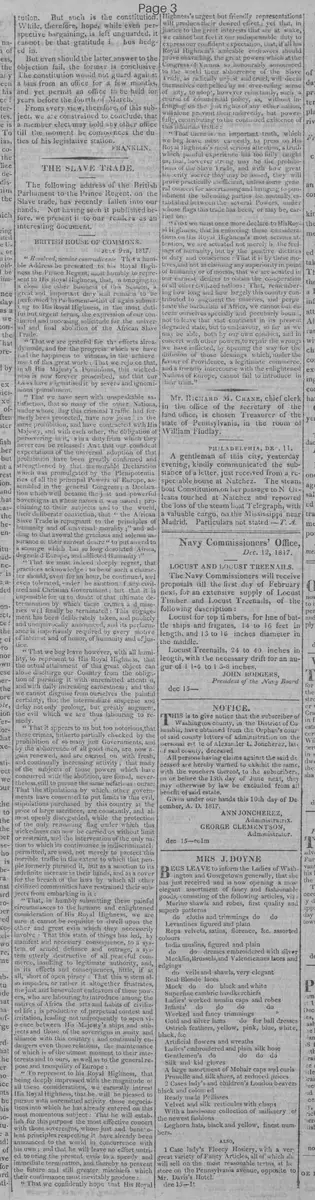
The following address of the British Parliament to the Prince Regent, on the Slave trade, has recently fallen into our hands. Not having seen it published before, we present it to our readers as an interesting document.
BRITISH HOUSE OF COMMONS.
JULY 9TH, 1817.
"Resolved, nemine contradicente, That a humble Address be presented to his Royal Highness the Prince Regent, most humbly to represent to His Royal Highness, that, in bringing to a close the other business of this Session, a great and important duty still remains to be performed by Parliament—that of again submitting to His Royal Highness, in the most dutiful but urgent terms, the expression of our continued and unceasing solicitude for the universal and final abolition of the African Slave Trade.
"That we are grateful for the efforts already made, and for the progress which we have had the happiness to witness, in the achievement of this great work: That we rejoice that, in all His Majesty's Dominions, this wickedness is now forever proscribed, and that our Laws have stigmatised it by severe and ignominious punishment.
"That we have seen with unspeakable satisfaction, that so many of the other Nations, under whose flag this criminal Traffic had formerly been protected, have now joined in the same prohibition, and have contracted with His Majesty, and with each other, the obligation of persevering in it, as in a duty from which they never can be released: And that our confident expectations of the universal adoption of that prohibition have been greatly confirmed and strengthened by that memorable Declaration which was promulgated by the Plenipotentiaries of all the principal Powers of Europe, assembled in the general Congress; a Declaration which well became the just and powerful Sovereigns in whose names it was issued; proclaiming to their subjects and to the world, their deliberate conviction, that "the African Slave Trade is repugnant to the principles of humanity and of universal morality;" and adding to that avowal the gracious and solemn assurance of their earnest desire "to put an end to a scourge which has so long desolated Africa, degraded Europe, and afflicted Humanity?"
"That we must indeed deeply regret, that practices acknowledged to be of such a character should, even for an hour, be continued, and even tolerated, under the sanction of any civilized and Christian Government; but that it is impossible for us to doubt of that ultimate determination by which these crimes and miseries will finally be terminated: This engagement has been deliberately taken, and publicly and unequivocally announced, and its performance is imperiously required by every motive of interest and of honor, of humanity and of justice.
"That we beg leave however, with all humility, to represent to His Royal Highness, that the actual attainment of this great object can alone discharge our Country from the obligation of pursuing it with unremitted attention, and with daily increasing earnestness; and that we cannot disguise from ourselves the painful certainty, that the intermediate suspense and delay not only prolong, but greatly augment, the evil which we are thus labouring to remedy.
"That it appears to us but too notorious, that these crimes, hitherto partially checked by the prohibition of so many just Governments, and by the abhorrence of all good men, are now again renewed, and are carried on with fresh, and continually increasing activity; that many of the subjects of those powers which have concurred with the abolition, are found, nevertheless, still to pursue the same nefarious course: That the stipulations by which other governments have consented to put limits to this evil, stipulations purchased by this country at the price of large sacrifices, are constantly, and almost openly disregarded, while the protection of the only remaining flag under which this wickedness can now be carried on without limit or restraint, and the intervention of the only nation to which its continuance is indiscriminately permitted, are used, not merely to protect this horrible traffic in the extent to which that people formerly pursued it, but as a sanction to its indefinite increase in their hands, and as a cover for the breach of the laws by which all other civilized communities have restrained their subjects from embarking in it:
"That, in humbly submitting these painful circumstances to the humane and enlightened consideration of His Royal Highness, we are sure it cannot be requisite to dwell upon the other and great evils which they necessarily involve: That this state of things has led, by manifest and necessary consequence, to a system of armed defiance and outrage, a system utterly destructive of all peaceful commerce, insulting to legitimate authority, and, in its effects and consequences, little, if at all, short of open piracy: That this system also impedes, or rather it altogether frustrates, the just and benevolent endeavors of those powers, who are labouring to introduce among the natives of Africa the arts and habits of civilized life; is productive of perpetual contest and irritation, leading not unfrequently to open violence between His Majesty's ships and subjects and those of the sovereigns in amity and alliance with this country; and continually endangers even those relations, the maintenance of which is of the utmost moment to their interests and to ours, as well as to the general repose and tranquility of Europe:
"To represent to his Royal Highness, that being deeply impressed with the magnitude of all these considerations, we earnestly intreat His Royal Highness, that he will be pleased to pursue with unremitted activity those negotiations into which he has already entered on this most momentous subject: That he will establish for this purpose the most effective concert with those sovereigns, whose just and benevolent principles respecting it have already been announced to the world in concurrence with his own; and that he will leave no effort untried to bring the present evils to a speedy and immediate termination, and thereby to prevent the future and still greater mischiefs which their continuance must inevitably produce:
"That we confidently hope that His Royal Highness's urgent but friendly representations will produce their desired effect; yet that, in justice to the great interests that are at stake, we cannot but feel it our indispensable duty to express our confident expectation, that, if all his Royal Highness's amicable endeavors should prove unavailing, the great powers which at the Congress of Vienna so honourably announced to the world their abhorrence of the Slave Trade, as radically unjust and cruel, will deem themselves compelled by an over-ruling sense of duty, to adopt, however reluctantly, such a course of commercial policy, as, without infringing on the just rights of any other nation, will alone prevent their indirectly, but powerfully, contributing to the continued existence of this inhuman traffic:
"That there is no important truth, which we beg leave most earnestly to press on His Royal Highness's most serious attention, a truth which painful experience has too fully taught us, that, however strong may be the prohibitions of the slave trade, and with how great sincerity soever they may be issued, they will prove practically inefficient, unless some general concert for ascertaining and bringing to punishment the offending parties be mutually established between the several Powers, under whose flags this trade has been, or may be, carried on:
"That we must once more declare to His Royal Highness, that in enforcing these considerations on His Royal Highness's most serious attention, we are actuated not merely by the feelings of humanity, but by the positive dictates of duty and conscience: That it is by these motives, and not as claiming any superiority in point of humanity or of morals, that we are actuated in our earnest desires to obtain the co-operation of all other civilized nations: That, remembering how long and how largely this country contributed to augment the miseries, and perpetuate the barbarism of Africa, we cannot but esteem ourselves specially and peculiarly bound, not to leave that vast continent in its present degraded state, but to endeavour, so far as we may be able, both by our own conduct, and in concert with other powers, to repair the wrongs we have inflicted, by opening the way for the diffusion of those blessings which, under the favour of Providence, a legitimate commerce, and a friendly intercourse with the enlightened Nations of Europe, cannot fail to introduce in their train."
What sub-type of article is it?
What keywords are associated?
What entities or persons were involved?
Where did it happen?
Foreign News Details
Primary Location
Africa
Event Date
1817 07 09
Key Persons
Outcome
unanimously passed resolution (nemine contradicente) urging international abolition efforts; no specific casualties reported.
Event Details
The British House of Commons resolved to present an address to the Prince Regent expressing urgent solicitude for the universal abolition of the African Slave Trade, gratitude for progress in His Majesty's Dominions and other nations, regret over continued practices under some flags, calls for unremitted diplomatic negotiations, establishment of international concert for enforcement, and emphasis on Britain's duty to repair past wrongs.