Thank you for visiting SNEWPapers!
Sign up free
Letter to Editor
June 14, 1849
The Minnesota Pioneer
Saint Paul, Ramsey County, Minnesota
What is this article about?
The New York Day Book publishes a March 31, 1845, letter from John Quincy Adams to D. Francis Bacon, declining to address New York Whigs due to the party's role in advancing slavery through Texas annexation, emphasizing the North-South political divide.
Clipping
OCR Quality
95%
Excellent
Full Text
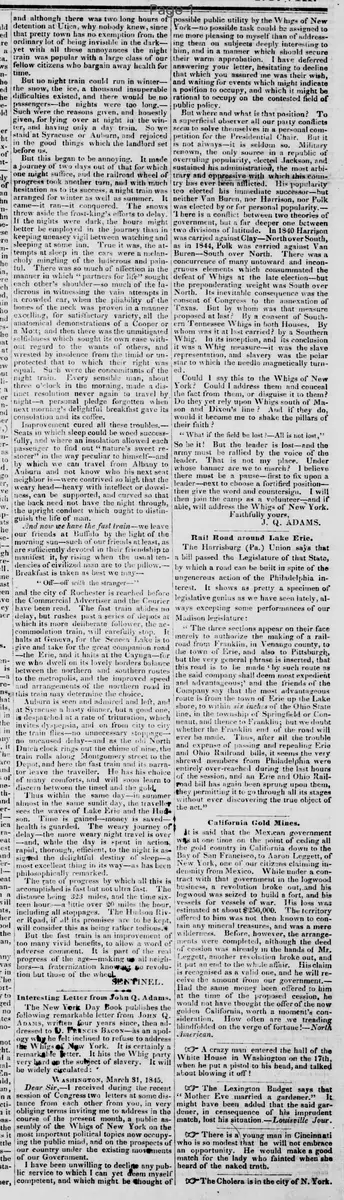
Interesting Letter from John Q. Adams.
The New York Day Book publishes the following remarkable letter from John Q. Adams, written four years since, then addressed to D. Francis Bacon--as an apology why he felt inclined to refuse to address the Whigs of New York. It is certainly a remarkable letter. It hits the Whig party very hard on the subject of slavery. It will be widely circulated:
WASHINGTON, March 31, 1845.
Dear Sir,--I received during the recent session of Congress two letters at some distance from each other from you, in very obliging terms inviting me to address in the course of the present month, a public assembly of the Whigs of New York on the most important political topics now occupying the public mind, and on the prospects of our country under the existing movements of our Government.
I have been unwilling to decline any public service to which I can yet deem myself competent, and which might be thought of possible public utility by the Whigs of New York--no possible task could be assigned to me more pleasing to myself than of addressing them on subjects deeply interesting to him, and in a manner which should secure their warm approbation. I have deferred answering your letter, hesitating to decline that which you assured me was their wish, and waiting for events which might indicate a position to occupy, and which it might be rational to occupy on the contested field of public policy.
But where and what is that position? To a superficial observer all our party conflicts seem to solve themselves in a personal competition for the Presidential Chair. But it is not always--it is seldom so. Military renown, the only source in a republic of overruling popularity, elected Jackson, and sustained his administration, the most arbitrary and oppressive with which this country has ever been afflicted. His popularity too elected his immediate successor--but neither Van Buren, nor Harrison, nor Polk was elected by or for personal popularity.--
There is a conflict between two theories of government, but a far deeper one between two divisions of latitude. In 1840 Harrison was carried against Clay--North over South, as in 1844, Polk was carried against Van Buren--South over North. There was a concurrence of many untoward and incongruous elements which consummated the defeat of Whigs at the late election--but the preponderating weight was South over North. Its inevitable consequence was the consent of Congress to the annexation of Texas. But by whom was that measure proposed at last? By a consent of Southern Tennessee Whigs in both Houses. By whom was it at last carried? by a Southern Whig. In its inception, and its conclusion it was a Whig measure--it was the slave representation, and slavery was the polar star to which the needle magnetically turned.
Could I say this to the Whigs of New York? Could I address them and conceal the fact from them, or disguise it to them? Do they yet rely upon Whigs south of Mason and "Dixon's line? And if they do, would it become me to shake the pillars of their faith?
" What if the field be lost ?--All is not lost,"
So be it! But the leader is lost--and the army must be rallied by the voice of the leader. That is not my place. Under whose banner are we to march? I believe there must be a pause--first to fix upon a leader--next to choose a fortified position-- then give the word and countersign, I will then join the camp as a volunteer--and if able, will address the Whigs of New York.
Faithfully yours,
J. Q. ADAMS.
The New York Day Book publishes the following remarkable letter from John Q. Adams, written four years since, then addressed to D. Francis Bacon--as an apology why he felt inclined to refuse to address the Whigs of New York. It is certainly a remarkable letter. It hits the Whig party very hard on the subject of slavery. It will be widely circulated:
WASHINGTON, March 31, 1845.
Dear Sir,--I received during the recent session of Congress two letters at some distance from each other from you, in very obliging terms inviting me to address in the course of the present month, a public assembly of the Whigs of New York on the most important political topics now occupying the public mind, and on the prospects of our country under the existing movements of our Government.
I have been unwilling to decline any public service to which I can yet deem myself competent, and which might be thought of possible public utility by the Whigs of New York--no possible task could be assigned to me more pleasing to myself than of addressing them on subjects deeply interesting to him, and in a manner which should secure their warm approbation. I have deferred answering your letter, hesitating to decline that which you assured me was their wish, and waiting for events which might indicate a position to occupy, and which it might be rational to occupy on the contested field of public policy.
But where and what is that position? To a superficial observer all our party conflicts seem to solve themselves in a personal competition for the Presidential Chair. But it is not always--it is seldom so. Military renown, the only source in a republic of overruling popularity, elected Jackson, and sustained his administration, the most arbitrary and oppressive with which this country has ever been afflicted. His popularity too elected his immediate successor--but neither Van Buren, nor Harrison, nor Polk was elected by or for personal popularity.--
There is a conflict between two theories of government, but a far deeper one between two divisions of latitude. In 1840 Harrison was carried against Clay--North over South, as in 1844, Polk was carried against Van Buren--South over North. There was a concurrence of many untoward and incongruous elements which consummated the defeat of Whigs at the late election--but the preponderating weight was South over North. Its inevitable consequence was the consent of Congress to the annexation of Texas. But by whom was that measure proposed at last? By a consent of Southern Tennessee Whigs in both Houses. By whom was it at last carried? by a Southern Whig. In its inception, and its conclusion it was a Whig measure--it was the slave representation, and slavery was the polar star to which the needle magnetically turned.
Could I say this to the Whigs of New York? Could I address them and conceal the fact from them, or disguise it to them? Do they yet rely upon Whigs south of Mason and "Dixon's line? And if they do, would it become me to shake the pillars of their faith?
" What if the field be lost ?--All is not lost,"
So be it! But the leader is lost--and the army must be rallied by the voice of the leader. That is not my place. Under whose banner are we to march? I believe there must be a pause--first to fix upon a leader--next to choose a fortified position-- then give the word and countersign, I will then join the camp as a volunteer--and if able, will address the Whigs of New York.
Faithfully yours,
J. Q. ADAMS.
What sub-type of article is it?
Political
Persuasive
Reflective
What themes does it cover?
Politics
Slavery Abolition
What keywords are associated?
Whig Party
Slavery
Texas Annexation
North South Divide
John Quincy Adams
Political Leadership
What entities or persons were involved?
J. Q. Adams
D. Francis Bacon
Letter to Editor Details
Author
J. Q. Adams
Recipient
D. Francis Bacon
Main Argument
john quincy adams declines to address the whigs of new york, citing the party's complicity in advancing slavery through the annexation of texas as a southern triumph over the north, and calls for a pause to select a new leader and position.
Notable Details
References Elections Of Jackson, Van Buren, Harrison, Clay, Polk
Criticizes Whig Support For Texas Annexation
Quotes Milton: 'What If The Field Be Lost? All Is Not Lost'