Thank you for visiting SNEWPapers!
Sign up free
Editorial
June 1, 1803
The Recorder
Richmond, Virginia
What is this article about?
Preface from 1798 volume critiquing the rapid shifts in American public opinion on foreign policy and neutrality from 1793-1798, covering Washington's proclamation, Genet's arrival, Jay's treaty, western insurrection, and XYZ affair.
Clipping
OCR Quality
98%
Excellent
Full Text
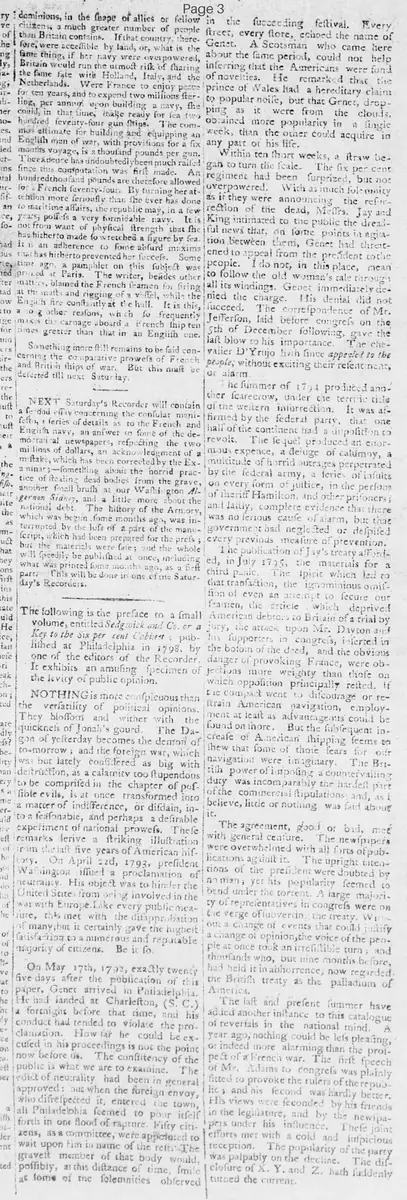
The following is the preface to a small volume, entitled Sedgwick and Co. or a Key to the Six per cent Cabinet; published at Philadelphia in 1798, by one of the editors of the Recorder. It exhibits an amusing specimen of the levity of public opinion.
NOTHING is more conspicuous than the versatility of political opinions. They blossom and wither with the quickness of Jonah's gourd. The dragon of yesterday becomes the demon of to-morrow; and the foreign war, which was but lately considered as big with destruction, as a calamity too stupendous to be comprised in the chapter of possible evils, is at once transformed into a matter of indifference, or disdain, into a reasonable, and perhaps a desirable experiment of national prowess. These remarks derive a striking illustration from the last five years of American history. On April 22d, 1793, president Washington issued a proclamation of neutrality. His object was to hinder the United States from being involved in the war with Europe. Like every public measure, this met with the disapprobation of many; but it certainly gave the highest satisfaction to a numerous and reputable majority of citizens. Be it so.
On May 17th, 1793, exactly twenty-five days after the publication of this paper, Genet arrived in Philadelphia. He had landed at Charleston, (S. C.) a fortnight before that time, and his conduct had tended to violate the proclamation. How far he could be excused in his proceedings is not the point now before us. The consistency of the public is what we are to examine. The edict of neutrality had been in general approved: but when the foreign envoy, who disrespected it, entered the town, all Philadelphia seemed to pour itself forth in one flood of rapture. Fifty citizens, as a committee, were appointed to wait upon him in name of the rest. The gravest member of that body would, possibly, at this distance of time, smile at some of the solemnities observed in the succeeding festival. Every street, every store, echoed the name of Genet. A Scotsman who came here about the same period, could not help inferring that the Americans were fond of novelties. He remarked that the prince of Wales had a hereditary claim to popular noise, but that Genet, dropping as it were from the clouds, obtained more popularity in a single week, than the other could acquire in any part of his life.
Within ten short weeks, a straw began to turn the scale. The six per cent regiment had been surprised, but not overpowered. With as much solemnity as if they were announcing the resurrection of the dead, Messrs. Jay and King intimated to the public the dreadful news that, on some points in negotiation between them, Genet had threatened to appeal from the president to the people. I do not, in this place, mean to follow the old woman's tale through all its windings. Genet immediately denied the charge. His denial did not succeed. The correspondence of Mr. Jefferson, laid before congress on the 5th of December following, gave the last blow to his importance. The chevalier D'Yrujo has since appealed to the people; without exciting their resentment, or alarm.
The summer of 1794 produced another scarecrow, under the terrific title of the western insurrection. It was affirmed by the federal party, that one half of the continent had a disposition to revolt. The sequel produced an enormous expense, a deluge of calumny, a multitude of horrid outrages perpetrated by the federal army, a series of assaults on every form of justice, in the persons of sheriff Hamilton, and other prisoners; and lastly, complete evidence that there was no serious cause of alarm, but that government had neglected or despised every previous measure of prevention.
The publication of Jay's treaty afforded, in July 1795, the materials for a third panic. The spirit which led to that transaction, the ignominious omission of even an attempt to secure our seamen, the article which deprived American debtors to Britain of a trial by jury, the attack upon Mr. Dayton and his supporters in congress, inserted in the bosom of the deed, and the obvious danger of provoking France, were objections more weighty than those on which opposition principally rested. If the compact went to discourage or restrain American navigation, employment at least as advantageous could be found on shore. But the subsequent increase of American shipping seems to show that some of those fears for our navigation were imaginary. The British power of imposing a countervailing duty was incomparably the hardest part of the commercial stipulations and, as I believe, little or nothing was said about it.
The agreement, good or bad, met with general censure. The newspapers were overwhelmed with all sorts of publications against it. The upright intentions of the president were doubted by no man; yet his popularity seemed to bend under the torrent. A large majority of representatives in congress were on the verge of overruling the treaty. Without a change of events that could justify a change of opinion, the voice of the people at once took an irresistible turn; and thousands who, but nine months before, had held it in abhorrence, now regarded the British treaty as the palladium of America.
The last and present summer have added another instance to this catalogue of reversals in the national mind. A year ago, nothing could be less pleasing, or indeed more alarming than the prospect of a French war. The first speech of Mr. Adams to congress was plainly fitted to provoke the rulers of the republic; and his second was hardly better. His views were seconded by his friends in the legislature, and by the newspapers under his influence. These joint efforts met with a cold and suspicious reception. The popularity of the party was palpably on the decline. The disclosure of X. Y. Z. hath suddenly turned the current.
NOTHING is more conspicuous than the versatility of political opinions. They blossom and wither with the quickness of Jonah's gourd. The dragon of yesterday becomes the demon of to-morrow; and the foreign war, which was but lately considered as big with destruction, as a calamity too stupendous to be comprised in the chapter of possible evils, is at once transformed into a matter of indifference, or disdain, into a reasonable, and perhaps a desirable experiment of national prowess. These remarks derive a striking illustration from the last five years of American history. On April 22d, 1793, president Washington issued a proclamation of neutrality. His object was to hinder the United States from being involved in the war with Europe. Like every public measure, this met with the disapprobation of many; but it certainly gave the highest satisfaction to a numerous and reputable majority of citizens. Be it so.
On May 17th, 1793, exactly twenty-five days after the publication of this paper, Genet arrived in Philadelphia. He had landed at Charleston, (S. C.) a fortnight before that time, and his conduct had tended to violate the proclamation. How far he could be excused in his proceedings is not the point now before us. The consistency of the public is what we are to examine. The edict of neutrality had been in general approved: but when the foreign envoy, who disrespected it, entered the town, all Philadelphia seemed to pour itself forth in one flood of rapture. Fifty citizens, as a committee, were appointed to wait upon him in name of the rest. The gravest member of that body would, possibly, at this distance of time, smile at some of the solemnities observed in the succeeding festival. Every street, every store, echoed the name of Genet. A Scotsman who came here about the same period, could not help inferring that the Americans were fond of novelties. He remarked that the prince of Wales had a hereditary claim to popular noise, but that Genet, dropping as it were from the clouds, obtained more popularity in a single week, than the other could acquire in any part of his life.
Within ten short weeks, a straw began to turn the scale. The six per cent regiment had been surprised, but not overpowered. With as much solemnity as if they were announcing the resurrection of the dead, Messrs. Jay and King intimated to the public the dreadful news that, on some points in negotiation between them, Genet had threatened to appeal from the president to the people. I do not, in this place, mean to follow the old woman's tale through all its windings. Genet immediately denied the charge. His denial did not succeed. The correspondence of Mr. Jefferson, laid before congress on the 5th of December following, gave the last blow to his importance. The chevalier D'Yrujo has since appealed to the people; without exciting their resentment, or alarm.
The summer of 1794 produced another scarecrow, under the terrific title of the western insurrection. It was affirmed by the federal party, that one half of the continent had a disposition to revolt. The sequel produced an enormous expense, a deluge of calumny, a multitude of horrid outrages perpetrated by the federal army, a series of assaults on every form of justice, in the persons of sheriff Hamilton, and other prisoners; and lastly, complete evidence that there was no serious cause of alarm, but that government had neglected or despised every previous measure of prevention.
The publication of Jay's treaty afforded, in July 1795, the materials for a third panic. The spirit which led to that transaction, the ignominious omission of even an attempt to secure our seamen, the article which deprived American debtors to Britain of a trial by jury, the attack upon Mr. Dayton and his supporters in congress, inserted in the bosom of the deed, and the obvious danger of provoking France, were objections more weighty than those on which opposition principally rested. If the compact went to discourage or restrain American navigation, employment at least as advantageous could be found on shore. But the subsequent increase of American shipping seems to show that some of those fears for our navigation were imaginary. The British power of imposing a countervailing duty was incomparably the hardest part of the commercial stipulations and, as I believe, little or nothing was said about it.
The agreement, good or bad, met with general censure. The newspapers were overwhelmed with all sorts of publications against it. The upright intentions of the president were doubted by no man; yet his popularity seemed to bend under the torrent. A large majority of representatives in congress were on the verge of overruling the treaty. Without a change of events that could justify a change of opinion, the voice of the people at once took an irresistible turn; and thousands who, but nine months before, had held it in abhorrence, now regarded the British treaty as the palladium of America.
The last and present summer have added another instance to this catalogue of reversals in the national mind. A year ago, nothing could be less pleasing, or indeed more alarming than the prospect of a French war. The first speech of Mr. Adams to congress was plainly fitted to provoke the rulers of the republic; and his second was hardly better. His views were seconded by his friends in the legislature, and by the newspapers under his influence. These joint efforts met with a cold and suspicious reception. The popularity of the party was palpably on the decline. The disclosure of X. Y. Z. hath suddenly turned the current.
What sub-type of article is it?
Foreign Affairs
Partisan Politics
War Or Peace
What keywords are associated?
Political Opinions
Neutrality Proclamation
Genet Arrival
Jay's Treaty
Western Insurrection
Xyz Affair
Public Opinion Shifts
What entities or persons were involved?
Washington
Genet
Jay
King
Jefferson
Adams
Federal Party
Editorial Details
Primary Topic
Versatility Of American Public Opinion On Foreign Policy And Neutrality 1793 1798
Stance / Tone
Amusing Critique Of Political Fickleness
Key Figures
Washington
Genet
Jay
King
Jefferson
Adams
Federal Party
Key Arguments
Political Opinions Change Rapidly Like Jonah's Gourd
Neutrality Proclamation Initially Popular But Genet's Arrival Sparked Enthusiasm
Genet's Popularity Waned After Threats To Appeal To The People
Western Insurrection Overhyped By Federal Party With No Real Alarm
Jay's Treaty Initially Censured But Later Embraced As Vital
Prospect Of French War Alarming But Xyz Disclosure Reversed Opinions