Thank you for visiting SNEWPapers!
Sign up free
The Virginia Gazette
Richmond, Williamsburg, Richmond County, Virginia
What is this article about?
In a letter to John Wright, signed Juvenis, the writer denounces Wright's published letters as malicious attacks on a woman's character, portraying them as hypocritical defenses masking personal vengeance rather than moral concern, and mocks Wright's pretensions while refusing further engagement. (248 characters)
Merged-components note: Continuation of the same letter to Mr. John Wright across columns on page 3.
Clipping
OCR Quality
Full Text
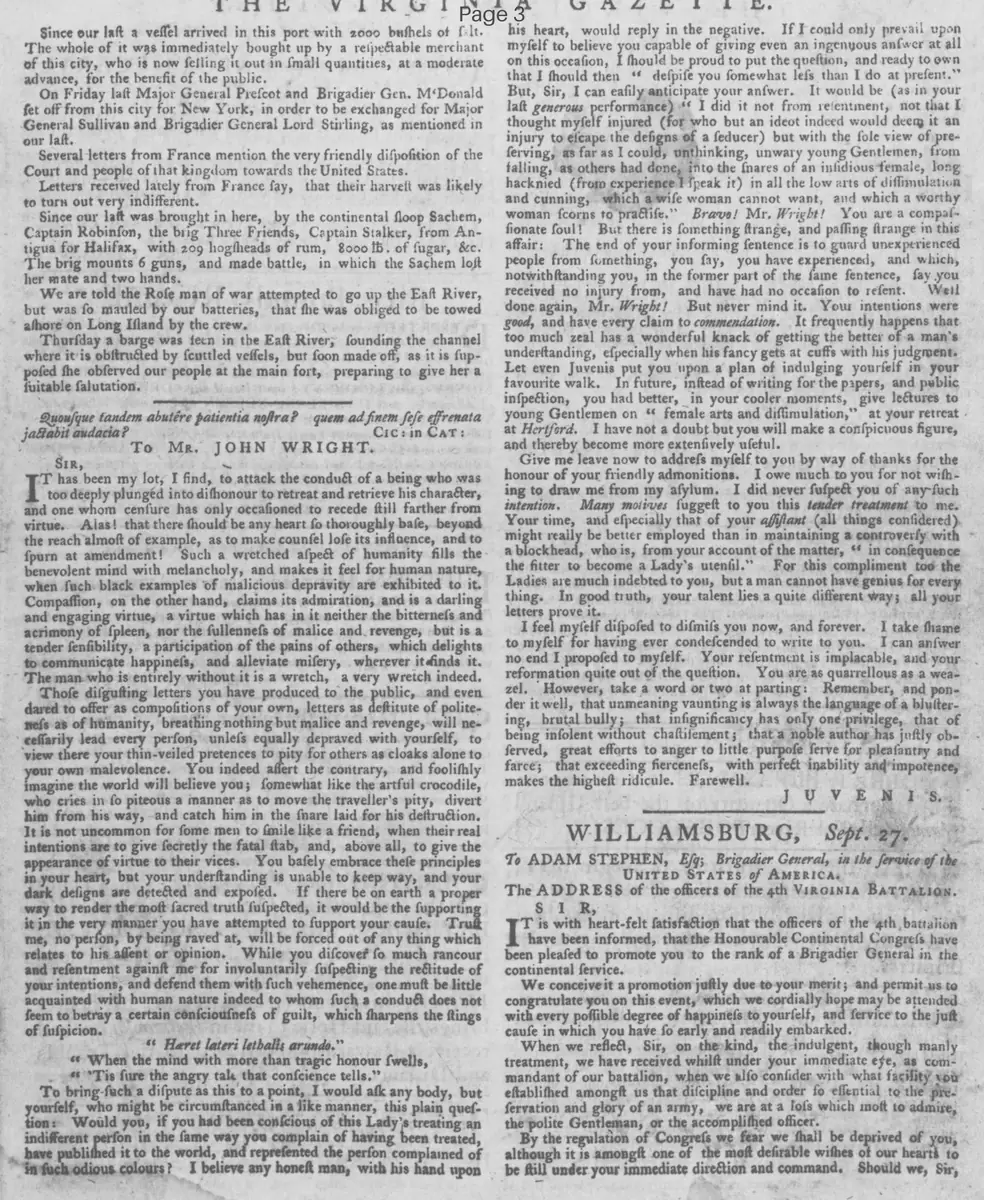
SIR,
It has been my lot, I find, to attack the conduct of a being who was too deeply plunged into dishonour to retreat and retrieve his character, and one whom censure has only occasioned to recede still farther from virtue. Alas! that there should be any heart so thoroughly base, beyond the reach almost of example, as to make counsel lose its influence, and to spurn at amendment! Such a wretched aspect of humanity fills the benevolent mind with melancholy, and makes it feel for human nature, when such black examples of malicious depravity are exhibited to it.
Compassion, on the other hand, claims its admiration, and is a darling and engaging virtue, a virtue which has in it neither the bitterness and acrimony of spleen, nor the dullness of malice and revenge, but is a tender sensibility, a participation of the pains of others, which delights to communicate happiness, and alleviate misery, wherever it finds it.
The man who is entirely without it is a wretch, a very wretch indeed.
Those disgusting letters you have produced to the public, and even dared to offer as compositions of your own, letters as destitute of politeness as of humanity, breathing nothing but malice and revenge, will necessarily lead every person, unless equally depraved with yourself, to view there your thin-veiled pretences to pity for others as cloaks alone to your own malevolence. You indeed assert the contrary, and foolishly imagine the world will believe you; somewhat like the artful crocodile, who cries in so piteous a manner as to move the traveller's pity, divert him from his way, and catch him in the snare laid for his destruction.
It is not uncommon for some men to smile like a friend, when their real intentions are to give secretly the fatal stab, and, above all, to give the appearance of virtue to their vices. You basely embrace these principles in your heart, but your understanding is unable to keep pace, and your dark designs are detected and exposed. If there be on earth a proper way to render the most sacred truth suspected, it would be the supporting it in the very manner you have attempted to support your cause. Trust me, no person, by being railed at, will be forced out of any thing which relates to his settled opinion. While you discover so much rancour and resentment against me for involuntarily suspecting the rectitude of your intentions, and defend them with such vehemence, one must be little acquainted with human nature indeed to whom such a conduct does not seem to betray a certain consciousness of guilt, which sharpens the stings of suspicion.
"Hæret lateri lethalis arundo."
"When the mind with more than tragic honour swells,
'Tis sure the angry tale that conscience tells."
To bring such a dispute as this to a point, I would ask any body, but yourself, who might be circumstanced in a like manner, this plain question: Would you, if you had been conscious of this Lady's treating an indifferent person in the same way you complain of having been treated, have published it to the world, and represented the person complained of in such odious colours? I believe any honest man, with his hand upon
his heart, would reply in the negative. If I could only prevail upon myself to believe you capable of giving even an ingenious answer at all on this occasion, I should be proud to put the question, and ready to own that I should then "despise you somewhat less than I do at present."
But, Sir, I can easily anticipate your answer. It would be (as in your last generous performance) "I did it not from resentment, not that I thought myself injured (for who but an idiot indeed would deem it an injury to escape the designs of a seducer) but with the sole view of preserving, as far as I could, unthinking, unwary young Gentlemen from falling, as others had done, into the snares of an insidious female, long hackneyed (from experience I speak it) in all the low arts of dissimulation and cunning, which a wise woman cannot want, and which a worthy woman scorns to practise." Bravo! Mr. Wright! You are a compassionate soul! But there is something strange, and passing strange in this affair: The end of your informing sentence is to guard unexperienced people from something, you say, you have experienced, and which, notwithstanding you, in the former part of the same sentence, say you received no injury from, and have had no occasion to resent, Well done again, Mr. Wright! But never mind it. Your intentions were good, and have every claim to commendation. It frequently happens that too much zeal has a wonderful knack of getting the better of a man's understanding, especially when his fancy gets at odds with his judgment.
Let even Juvenis put you upon a plan of indulging yourself in your favourite walk. In future, instead of writing for the papers, and public inspection, you had better, in your cooler moments, give lectures to young Gentlemen on "female arts and dissimulation," at your retreat at Hertford. I have not a doubt but you will make a conspicuous figure, and thereby become more extensively useful.
Give me leave now to address myself to you by way of thanks for the honour of your friendly admonitions. I owe much to you for not wishing to draw me from my asylum. I did never suspect you of any such intention. Many motives suggest to you this tender treatment to me.
Your time, and especially that of your assistant (all things considered) might really be better employed than in maintaining a controversy with a blockhead, who is, from your account of the matter, "in consequence the fitter to become a Lady's utensil." For this compliment too the Ladies are much indebted to you, but a man cannot have genius for every thing. In good truth, your talent lies in a quite different way; all your letters prove it.
I feel myself disposed to dismiss you now, and forever. I take shame to myself for having ever condescended to write to you. I can answer no end I proposed to myself. Your resentment is implacable, and your reformation quite out of the question. You are as quarrelsome as a weasel. However, take a word or two at parting: Remember, and ponder it well, that unmeaning vaunting is always the language of a blustering, brutal bully; that insignificancy has only one privilege, that of being insolent without chastisement; that a noble author has justly observed, great efforts to anger do little purpose, serve for pleasantry and farce; that exceeding fierceness, with perfect inability and impotence, makes the highest ridicule. Farewell.
JUVENIS.
What sub-type of article is it?
What themes does it cover?
What keywords are associated?
What entities or persons were involved?
Letter to Editor Details
Author
Juvenis
Recipient
Mr. John Wright
Main Argument
the writer accuses john wright of malice, hypocrisy, and lacking compassion in his public letters criticizing a lady's conduct as seductive and deceitful, arguing that wright's motives are personal resentment rather than protective concern, and questions wright's integrity while dismissing further debate.
Notable Details