Thank you for visiting SNEWPapers!
Sign up free
The Enquirer
Richmond, Henrico County, Virginia
What is this article about?
The US Circuit Court in Raleigh, NC, adjourned on Jan. 7 after arguments in an ejectment suit by Earl Granville's devisees against Collins and Allen over land rights. Key issues: Revolution's effect, state laws, alienage, limitations. Decision reserved; impacts two-thirds of state soil.
Merged-components note: Continuation across pages of the North Carolina circuit court case on Granville land claims.
Clippings
1 of 2
OCR Quality
Full Text
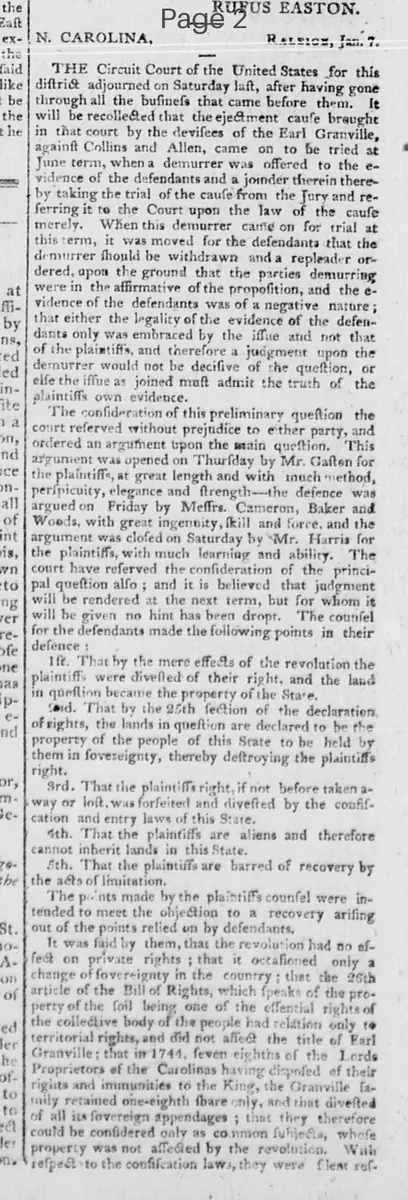
THE Circuit Court of the United States for this district adjourned on Saturday last, after having gone through all the business that came before them. It will be recollected that the ejectment cause brought in that court by the devisees of the Earl Granville, against Collins and Allen, came on to be tried at June term, when a demurrer was offered to the evidence of the defendants and a rejoinder therein thereby taking the trial of the cause from the Jury and referring it to the Court upon the law of the cause merely. When this demurrer came on for trial at this term, it was moved for the defendants that the demurrer should be withdrawn and a repleader ordered, upon the ground that the parties demurring were in the affirmative of the proposition, and the evidence of the defendants was of a negative nature; that either the legality of the evidence of the defendants only was embraced by the issue and not that of the plaintiffs, and therefore a judgment upon the demurrer would not be decisive of the question, or else the issue as joined must admit the truth of the plaintiffs own evidence.
The consideration of this preliminary question the court reserved without prejudice to either party, and ordered an argument upon the main question. This argument was opened on Thursday by Mr. Gaston for the plaintiffs, at great length and with much method, perspicuity, elegance and strength—the defence was argued on Friday by Messrs. Cameron, Baker and Woods, with great ingenuity, skill and force, and the argument was closed on Saturday by Mr. Harris for the plaintiffs, with much learning and ability. The court have reserved the consideration of the principal question also; and it is believed that judgment will be rendered at the next term, but for whom it will be given no hint has been dropt. The counsel for the defendants made the following points in their defence:
1st. That by the mere effects of the revolution the plaintiffs were divested of their right, and the land in question became the property of the State.
2d. That by the 25th section of the declaration of rights, the lands in question are declared to be the property of the people of this State to be held by them in sovereignty, thereby destroying the plaintiffs right.
3rd. That the plaintiffs right, if not before taken away or lost, was forfeited and divested by the confiscation and entry laws of this State.
4th. That the plaintiffs are aliens and therefore cannot inherit lands in this State.
5th. That the plaintiffs are barred of recovery by the acts of limitation.
The points made by the plaintiffs counsel were intended to meet the objection to a recovery arising out of the points relied on by defendants.
It was said by them, that the revolution had no effect on private rights; that it occasioned only a change of sovereignty in the country; that the 26th article of the Bill of Rights, which speaks of the property of the soil being one of the essential rights of the collective body of the people had relation only to territorial rights, and did not affect the title of Earl Granville: that in 1729, seven eighths of the Lords Proprietors of the Carolinas having ceded their rights and immunities to the King, the Granville family retained one-eighth share only, and that divested of all its sovereign appendages; that they therefore could be considered only as common subjects, whose property was not affected by the revolution. With respect to the confiscation laws, they were silent as to proprietary rights.
Expecting this property; the estates of others had been confiscated by name, but this had not been touched: That the law providing for the entry of lands had, it was acknowledged, been considered as making this land liable to entry; but though this had been the general opinion, it was no proof it was a correct one. They contended it was not, as the land had been already granted, and all granted lands are expressly excepted by this law. But, supposing this property had been forfeited either by the revolution, or the confiscation laws, the State had never become seized of it by any office found, and therefore could not legally grant it.
With respect to Alienage, it was insisted that as Lord Carteret (the present plaintiff) was born a subject of Great-Britain, he could not become an Alien to his fellow subjects by the Revolution; and as they considered the grant of the lands in question as had, having been already granted by the King to the plaintiff the Act of Limitation could not operate in its favour.
Col. A. Martin spoke at some length, as an Amicus curiae, in favour of the defendants.
The suit brought by the same plaintiffs against Gen. Davie and Gen. Jones was continued.
As the decision of this cause is all important to the People of this State (two-thirds of all the soil being involved in it) the Editor proposes publishing the arguments of the Counsel on both sides at length, the gentlemen concerned having promised to favor him with them.
Register.
What sub-type of article is it?
What keywords are associated?
What entities or persons were involved?
Where did it happen?
Domestic News Details
Primary Location
Raleigh, N. Carolina
Event Date
Jan. 7
Key Persons
Outcome
court reserved decision on demurrer and main question; judgment expected next term. suit against davie and jones continued. impacts two-thirds of state soil.
Event Details
The US Circuit Court adjourned after arguments in ejectment case by Granville's devisees vs. Collins and Allen. Demurrer to evidence debated; points raised on Revolution's effect, state rights declaration, confiscation/entry laws, alienage, and limitations. Plaintiffs argued private rights unaffected. Amicus curiae support for defendants.