Thank you for visiting SNEWPapers!
Sign up free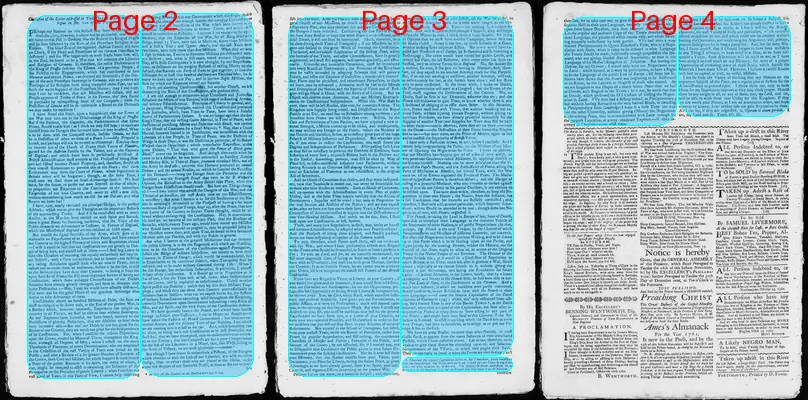
The New Hampshire Gazette
Portsmouth, Rockingham County, New Hampshire
What is this article about?
Conclusion of a letter to two British ministers (likely Pitt and Newcastle) urging favorable peace terms supporting the King of Prussia, recovering Flanders towns from France, and implementing post-war reforms to safeguard the British constitution from debt, standing armies, and crown influence amid the Seven Years' War.
Merged-components note: Merged across pages as the conclusion of a single letter addressed to two great men on political matters, including the related footnote. Relabeled from editorial to letter_to_editor to better reflect its form as a reader-style letter with opinions and debates.
Clippings
1 of 3
OCR Quality
Full Text
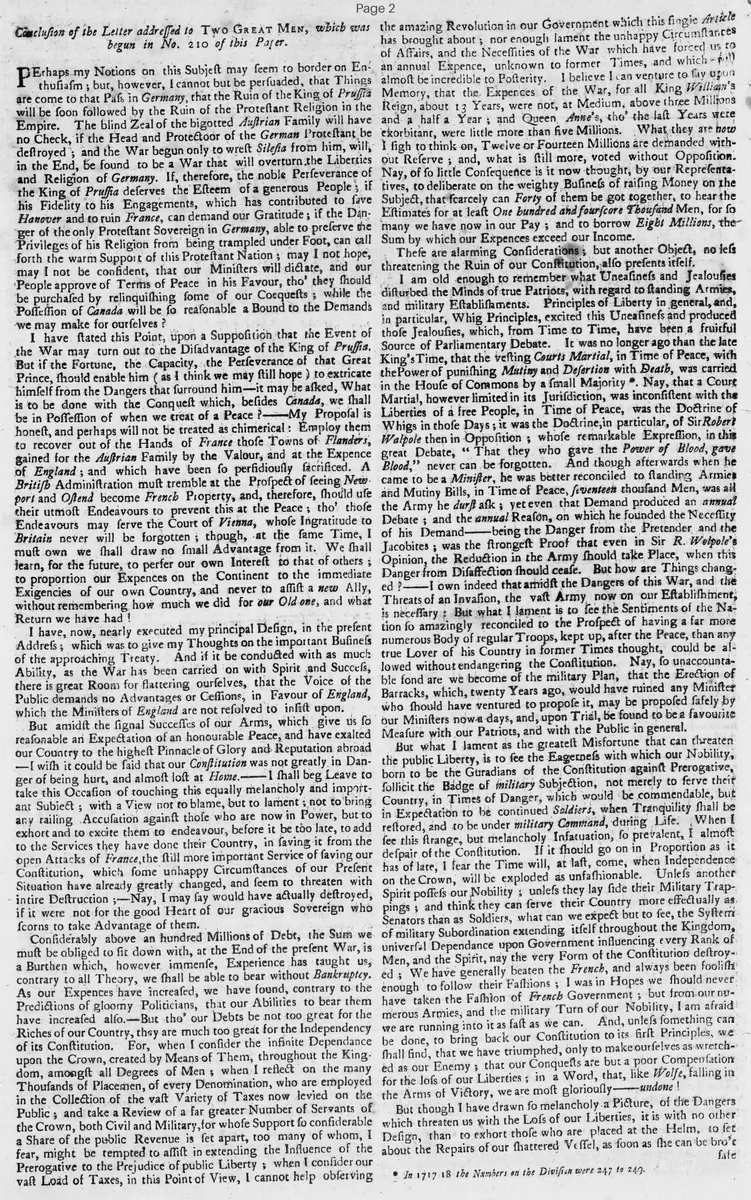
Perhaps my Notions on this Subject may seem to border on Enthusiasm; but, however, I cannot but be persuaded, that Things are come to that Pass in Germany, that the Ruin of the King of Prussia will be soon followed by the Ruin of the Protestant Religion in the Empire. The blind Zeal of the bigotted Austrian Family will have no Check, if the Head and Protector of the German Protestant be destroyed; and the War begun only to wrest Silesia from him, will, in the End, be found to be a War that will overturn the Liberties and Religion of Germany. If, therefore, the noble Perseverance of the King of Prussia deserves the Esteem of a generous People; if his Fidelity to his Engagements, which has contributed to save Hanover and to ruin France, can demand our Gratitude; if the Danger of the only Protestant Sovereign in Germany, able to preserve the Privileges of his Religion from being trampled under Foot, can call forth the warm Support of this Protestant Nation; may I not hope, may I not be confident, that our Ministers will dictate, and our People approve of Terms of Peace in his Favour, tho' they should be purchased by relinquishing some of our Conquests; while the Possession of Canada will be so reasonable a Bound to the Demands we may make for ourselves?
I have stated this Point, upon a Supposition that the Event of the War may turn out to the Disadvantage of the King of Prussia. But if the Fortune, the Capacity, the Perseverance of that Great Prince, should enable him (as I think we may still hope) to extricate himself from the Dangers that surround him--it may be asked, What is to be done with the Conquest which, besides Canada, we shall be in Possession of when we treat of a Peace?--My Proposal is honest, and perhaps will not be treated as chimerical: Employ them to recover out of the Hands of France those Towns of Flanders, gained for the Austrian Family by the Valour, and at the Expence of England: and which have been so perfidiously sacrificed. A British Administration must tremble at the Prospect of seeing Newport and Ostend become French Property, and, therefore, should use their utmost Endeavours to prevent this at the Peace; tho' those Endeavours may serve the Court of Vienna, whose Ingratitude to Britain never will be forgotten; though, at the same Time, I must own we shall draw no small Advantage from it. We shall learn, for the future, to prefer our own Interest to that of others; to proportion our Expences on the Continent to the immediate Exigencies of our own Country, and never to assist a new Ally, without remembering how much we did for our Old-one, and what Return we have had!
I have, now, nearly executed my principal Design, in the present Address: which was to give my Thoughts on the important Business of the approaching Treaty. And if it be conducted with as much Ability, as the War has been carried on with Spirit and Success, there is great Room for flattering ourselves, that the Voice of the Public demands no Advantages or Cessions, in Favour of England, which the Ministers of England are not resolved to insist upon.
But amidst the signal Successes of our Arms, which give us so reasonable an Expectation of an honourable Peace, and have exalted our Country to the highest Pinnacle of Glory and Reputation abroad -- I wish it could be said that our Constitution was not greatly in Danger of being hurt, and almost lost at Home. -- I shall beg Leave to take this Occasion of touching this equally melancholy and important Subject; with a View not to blame, but to lament; not to bring any railing Accusation against those who are now in Power, but to exhort and to excite them to endeavour, before it be too late, to add to the Services they have done their Country, in saving it from the open Attacks of France, the still more important Service of saving our Constitution, which some unhappy Circumstances of our Present Situation have already greatly changed, and seem to threaten with intire Destruction; -- Nay, I may say would have actually destroyed, if it were not for the good Heart of our gracious Sovereign who scorns to take Advantage of them.
Considerably above an hundred Millions of Debt, the Sum we must be obliged to sit down with, at the End of the present War, is a Burthen which, however immense, Experience has taught us, contrary to all Theory, we shall be able to bear without Bankruptcy. As our Expences have increased, we have found, contrary to the Predictions of gloomy Politicians, that our Abilities to bear them have increased also. -- But tho' our Debts be not too great for the Riches of our Country, they are much too great for the Independency of its Constitution. For, when I consider the infinite Dependance upon the Crown, created by Means of Them, throughout the Kingdom, amongst all Degrees of Men; when I reflect on the many Thousands of Placemen, of every Denomination, who are employed in the Collection of the vast Variety of Taxes now levied on the Public; and take a Review of a far greater Number of Servants of the Crown, both Civil and Military, for whose Support so considerable a Share of the public Revenue is set apart, too many of whom, I fear, might be tempted to assist in extending the Influence of the Prerogative to the Prejudice of public Liberty; when I consider our vast Load of Taxes, in this Point of View, I cannot help observing has brought about; nor enough lament the unhappy Circumstances the amazing Revolution in our Government which this single Article has brought about; nor enough lament the unhappy Circumstances of Affairs, and the Necessities of the War which have forced us to an annual Expence, unknown to former Times, and which [will] almost be incredible to Posterity. I believe I can venture to say upon Memory, that the Expences of the War, for all King William's Reign, about 13 Years, were not, at Medium, above three Millions and a half a Year; and Queen Anne's, tho' the last Years were exorbitant, were little more than five Millions. What they are now I sigh to think on, Twelve or Fourteen Millions are demanded without Reserve; and, what is still more, voted without Opposition. Nay, of so little Consequence is it now thought, by our Representatives, to deliberate on the weighty Business of raising Money on the Subject, that scarcely can Forty of them be got together, to hear the Estimates for at least One hundred and fourscore Thousand Men, for so many we have now in our Pay; and to borrow Eight Millions, the Sum by which our Expences exceed our Income.
These are alarming Considerations; but another Object, no less threatening the Ruin of our Constitution, also presents itself.
I am old enough to remember what Uneasinesses and Jealousies disturbed the Minds of true Patriots, with regard to standing Armies and military Establishments. Principles of Liberty in general, and in particular, Whig Principles, excited this Uneasiness and produced those Jealousies, which, from Time to Time, have been a fruitful Source of Parliamentary Debate. It was no longer ago than the late King's Time, that the vesting Courts Martial, in Time of Peace, with the Power of punishing Mutiny and Desertion with Death, was carried in the House of Commons by a small Majority*. Nay, that a Court Martial, however limited in its Jurisdiction, was inconsistent with the Liberties of a free People, in Time of Peace, was the Doctrine of Whigs in those Days; it was the Doctrine, in particular, of Sir Robert Walpole then in Opposition; whose remarkable Expression, in this great Debate, "That they who gave the Power of Blood, gave Blood," never can be forgotten. And though afterwards when he came to be a Minister, he was better reconciled to standing Armies and Mutiny Bills, in Time of Peace, seventeen thousand Men, was all the Army he durst ask; yet even that Demand produced an annual Debate; and the annual Reason, on which he founded the Necessity of his Demand -- being the Danger from the Pretender and the Jacobites; was the strongest Proof that even in Sir R. Walpole's Opinion, the Reduction in the Army should take Place, when this Danger from Disaffection should cease. But how are Things changed? -- I own indeed that amidst the Dangers of this War, and the Threats of an Invasion, the vast Army now on our Establishment, is necessary: But what I lament is to see the Sentiments of the Nation so amazingly reconciled to the Prospect of having a far more numerous Body of regular Troops, kept up, after the Peace, than any true Lover of his Country in former Times thought could be allowed without endangering the Constitution. Nay, so unaccountable fond are we become of the military Plan, that the Erection of Barracks, which, twenty Years ago, would have ruined any Minister who should have ventured to propose it, may be proposed safely by our Ministers now a days, and, upon Trial, be found to be a favourite Measure with our Patriots, and with the Public in general.
But what I lament as the greatest Misfortune that can threaten the public Liberty, is to see the Eagerness with which our Nobility, born to be the Guardians of the Constitution against Prerogative, solicit the Badge of military Subjection, not merely to serve their Country in Times of Danger, which would be commendable, but in Expectation to be continued Soldiers, when Tranquility shall be restored, and to be under military Command during Life. When I see this strange, but melancholy Infatuation, so prevalent, I almost despair of the Constitution. If it should go on in Proportion as it has of late, I fear the Time will, at last, come, when Independence on the Crown, will be exploded as unfashionable. Unless another Spirit possesses our Nobility: unless they lay aside their Military Trappings; and think they can serve their Country more effectually as Senators than as Soldiers, what can we expect but to see, the System of military Subordination extending itself throughout the Kingdom, universal Dependance upon Government influencing every Rank of Men, and the Spirit, nay the very Form of the Constitution destroyed -- We have generally beaten the French, and always been foolish enough to follow their Fashions; I was in Hopes we should never have taken the Fashion of French Government; but from our numerous Armies, and the military Turn of our Nobility, I am afraid we are running into it as fast as we can. And, unless something can be done, to bring back our Constitution to its first Principles, we shall find, that we have triumphed, only to make ourselves as wretched as our Enemy; that our Conquests are but a poor Compensation for the loss of our Liberties; in a Word, that, like Wolfe, falling in the Arms of Victory, we are most gloriously -- undone!
But though I have drawn so melancholy a Picture, of the Dangers which threaten us with the Loss of our Liberties, it is with no other Design, than to exhort those who are placed at the Helm, to set about the Repairs of our shattered Vessel, as soon as she can be bro't safe
* In 1717-18 the Numbers on the Division were 247 to 249.
safe into Harbour. After the Peace is once settled. it ought to be the
great Object of our Ministers, to devise every Expedient, and to
adopt every Plan, that may extricate this unhappy Constitution from
the Dangers I have described. Considering the low Ebb of France,
we have some Reason to hope that when Peace is once restored,upon
solid Terms, it will not soon be interrupted. Much, therefore, may
be done during those Years of Tranquility ; if our Ministers be
diligent and faithful in this great Work of reviving the Constitution.
The sacred, and inviolable Application of the Sinking Fund, which
the Increase-of our Trade, and other Circumstances, have so greatly
augmented, and must still augment, will operate gradually, and
effectually. Universal and invariable Oeconomy, must be introduced
into every Branch of Government ; the Revenues of the Kingdom
may be vastly increased by adopting Schemes that will prevent
Frauds, and lessen the Expence of Collection ; innumerable
unnecessary Places may be abolished, and exhorbitant Perquisites, in those
we leave, may be restrained ; Attention must be had to the Morals
and Principles of the Nation, and the Revival of Virtue and of Religion
will go Hand in Hand, with the Revival of Liberty. But no
Object will deserve more Attention, than our Military Encroach-
ments on Constitutional Independence. When this War shall be
over, there will be less Reason, than ever, for numerous Armies. The
Kingdom now happily being united, and Disaffection to the Royal
Family at an End, we need fear no Rebellions among ourselves ; and
Invasions from France are less likely than ever. Besides, by the
Care and Perseverance of some Patriots. we have acquired a new in-
ternal Strength, a Militia trained up to be useful, and consequently.
we may without any Danger to the Public, reduce the Number of
our Guards and Garrisons, so low, as to destroy great part of the huge
Fabrick of Military Influence and Dependence. But whatever you
do, if you mean to restore the Constitution, you must secure the
Dignity and Independence of Parliament. After passing such Laws
as may still be necessary to preserve the Freedom of Elections, from
Influence of every Sort ; to punish Bribery both in the Electors and
in the Elected; something, perhaps, may still be done by Way of
Place-bill, to lessen ministerial Influence over Parliaments, without
having Recourse to an Oliverian Self-denying Ordinance ; or to so
total an Exclusion of Placemen as was established, in the original
Act of Settlement.
And an House of Commons thus chosen, and thus made independ-
ent, now that Jacobitism is rooted out, can never be formidable but
to those who have Reason to tremble. Such an House of Commons.
will co-operate with the Administration in every Plan of public
Utility, and at the Same Time inquire carefully into the Abuses of
Government ; Supplies will be voted ; but only in Proportion to
the real Income and Abilities of the Nation ; and we may expect
to see, what we have not seen above these forty Years, a Parliamentary
Commission of Accounts erected to inquire into the Disbursement of
near Two Hundred Millions. And unless we see this, soon, I shall
look upon our Constitution, as lost, forever.
These, and many such Regulations. as these, may, under an honest
and virtuous Administration, be adopted when once Peace is restored :
And the Prospect of seeing them adopted, and steadily pursued,
keeps me from despairing altogether of the Commonwealth.
To you, therefore, whose Power most likely, will not terminate
with the War: and whom I have presumed to address with Regard
to the Terms what should be demanded, to secure us from a perfidious
Foe ; To you, my Lord, and Sir, let me earnestly recommend, the
still more important Care, of saving us from ourselves ; and as you
have with an Unanimity, that doth you both great Honour, directed
our Councils. so as to humble France, let me intreat you to preserve
your Union, till it re invigorate the almost lost Powers of the British
Constitution.
If you have any Regard to Virtue. to Liberty, to your Country ; if
you would live great,and die lamented ; if you would shine in History,
with our Clarendons and Southamptons : let not this Opportunity; per
haps,this last Opportunity of saving British Liberty,& Independence,
be thrown away. You, my Lord, whose Rank, whose extensive Influ-
ence, and personal Authority, have given you the Pre-eminence, in
public Affairs, as it were by Prescription ; much will depend upon
you, in the carrying on this important Work. But when I direct my
Address to you, Sir, you must be conscious that besides the general
Expectations we have from you, as a Lover of your Country, we
have your own repeated Promises, and Declarations to make us flat-
ter ourselves that you will not stop short, in your Schemes of national
Reformation. Not tutored in the School of Corruption, but lifted,
from your earliest Years, under the Banner of Patriotism, called into
Power, by popular Approbation, and still uniting, the uncommon
Characters of Minister and Patriot ; Favourite of the Public, and
Servant of the Crown ; be not offended, Sir, if I remind you, not
to Disappoint that Confidence the Public places in your future En-
deavours to prop the sinking Constitution. Nor let it ever fall from
your Memory, that the Nation expects from your Virtue, your
Oeconomy, your Plans for Liberty, during the future Peace, as great
Advantages as we have already gained, from your Spirit, your bold
Councils, and vigorous Efforts in carrying on the present War.
Perhaps I grow too warm, on a favourite Subject ; and, therefore,
from Schemes which cannot take Effect, till the War be closed, let
me turn your Attention again, for a little while longer. to the Ob-
ject immediately before our Eyes-- the ensuing Conferences for
Peace. And. with Regard to these.though I suppose, they will begin
before the Winter be over, I think there is some Reason, for being
of Opinion that we must have another Campaign, before they can
be finally closed. France is too low, to think seriously of a Peace,
without making some desperate Effort. She never would have ex-
posed her Weakness to all Europe, by so shameful and so humbling a
Bankruptcy ; She never would have ruined her public Credit, and
melted her Plate, the last Resource, when every other has been ex-
hausted, only to receive Terms from England. No, she knows She
is undone, for ever, if she gets no footing in Hanover; and, there-
fore, we may expect to see another Attempt made for that Purpose.
But, if we are not wanting to ourselves, another Attempt, will end,
as unfortunately for her, as the former have done ; and her Ruin
only be more confirmed. In the mean while, I make no Doubt,
the Plenipotentiaries will meet at a Congress ; but the Events of the
Field, must regulate the Deliberations of the Cabinet. We, no
Doubt, shall be firm in our Demands, whatever they are ; and the
French will endeavour to gain Time, to know whether there is any
Likelihood of obliging us to offer them better. In this Situation,
then, France must hear with Terror, that without breaking our na-
tional Faith, without injuring private Property, without giving ex-
horbitant Premiums, we have already provided immensely for the
Supplies of another Year (and Supplies for Years may still be had)
to meet them--not in America ; there they are no more ;-not
on the Ocean--the Destruction of their Fleets leaves that Empire
free to us--but once more, on the Plains of Minden, again to feel
and to confess the Superiority of British Valour.
I have only a Particular or two, to add, before I conclude. And I
cannot help congratulating the Public, on the Wisdom of our Man-
ner of Opening the Negociation for Peace. I mean to observe,
that our Ministers have happily got rid of a Set of very useless, or
very pernicious Gentlemen called Mediators, by applying directly to
the Enemy himself. Nothing can be more ridiculous than the Fi-
gure of the Pope's Nuncio, and the Ambassador of Venice, acting the
Farce of Mediation at Munster. for several Years, while the War
went on, till its Events regulated the Terms of Peace. The Media-
tion of insignificant Powers is therefore absurd ; and the Danger of
calling in a powerful Mediator, who may threaten to declare against
you, if you do not submit to his partial Decisions, is too obvious to
be insisted upon. You have done wisely, therefore, to keep the Ne-
gotiation in your own Hands ; the Nation, from this Instance, has
a full Confidence that her Interests are skilfully conducted ; and.
therefore. I shall only add, another particular, which however subor-
dinate, will no Doubt be attended to by you ; though some late Ne-
gociators of ours, with France, neglected it.
The French, in taking the Lead in Europe of late, have of Course,
been able to introduce their Language as the common Vehicle of
the Sentiments of other Nations,in all public Negociations ; so that.
perhaps, the French is the only Tongue, by the Channel of which
Plenipotentiaries and Ministers of different Countries, can converse.
But when the Negociation is to be put into Writing, and to be drawn
up in that Form which is to be binding upon all the Parties, and
signed jointly by the treating Powers, neither the Honour, nor the
Interest of the State, ought to allow us, to accept of the Original
Treaty in the Native Tongue of our Enemies. The Honour of the
Nation forbids this : as it would be a Confession of Superiority to
which Britain, at no Time, much less after so glorious a War, should
submit ; especially as we cannot submit to it, without giving the
Enemy a real Advantage, and laying the Foundation for future
Cavils. ---Cardinal Mazarine, in his Letters, boasts, that by a latent
Ambiguity and Nicety in the French Stile, he had been able to out-
wit Don Louis de Haro, in the Conferences at the Pyrenees. And a
much later Instance, in which we ourselves were partly concerned,
should confirm us, in our Refusal to treat with the French in their
own Language.--I mean the famous Capitulation of the Dutch
Garrison of Tournay in 1745 ; which, tho' only restrained from act-
ing, for a limited Time in any of the Barrier Towns t, as the Dutch
believed, when they accepted of the Capitulation, was soon after in-
terpreted by France, as tying them up from acting in any part of
the World ; and might have been fatal to this Country, if the Re-
bellion in Scotland, to assist in quelling which the Dutch lent us those
very Troops, had been so successful, as to oblige us to put our Fo-
reign Allies to the Test.
We have no great Reason, no more than other Nations, to trust
Gallic Faith, as appears from the many Instances of their unpalliated
Perfidy, which I have collected above. Let us not, therefore, be so
weak as to give them Room for obtruding upon us, any fallacious
Interpretations of the Words. in which they plight their Faith.
They are too ready to break it when the Terms are ever so clear ; and
+ I have not the original Capitulation before me, but I remember. pretty exactly on
what the Cavil turned The Troops were not to act, I think for two Years, in any of the
Places les plus reculées de la Barriere. I he Dutch, no Doubt, understood, de la
Barriere to be the Genitive Case, but the French said they meant it in the Ablative.
therefore, let us take care not to give them that Advantage which superior Skill in their own Language, naturally confers, and which upon some future Occasion, they may improve to our Detriment.
Let the original and authentic Copy of the Treaty therefore be in a dead Language, the phrases of which cannot vary, and whose Meaning is equally understood by both parties. We had once a very learned Plenipotentiary in Queen Elizabeth's Time, who in a Negotiation with Spain, when it came to be debated in what Language the Treaty should be made, ludicrously enough proposed to the Spaniard, who was giving himself Airs of Superiority, to treat in the Language of his Master's Kingdom of Jerusalem. But leaving the Hebrew, for our Divines ; I would only have our Negociators treat in Latin : which seemed, as it were by prescription, to have a Right to be the Language of the public Law of Europe ; till some late Instances have shewn that the French was beginning to be substituted in its Room, by the Laziness or Neglect of those who treated. As we are sanguine in our Hopes of a much better Peace than we had at Utrecht, with Regard to the Terms ; let it not, be worse than that at Utrecht, which preserved the Old Custom of settling the Negotiation in Latin. We then had a Bishop indeed, as Plenipotentiary ; but without having Recourse to the very learned Bench, or choosing a Plenipotentiary from Cambridge (I hope in a little Time one may join the other University, without giving Offence) the Negociators at the ensuing Peace, may be accommodated with Latin enough for the purpose I mention, at a very moderate Expence.--If their Secretary or Chaplain cannot assist them.
But when I begin to be ludicrous on so serious a Subject, it is Time to have done : And my Address has already swelled to such a Size as surprizes myself, as much, as I fear it will tire the Reader. However, the vast Variety of Facts and particulars, which naturally offered themselves to me, and which could not be omitted without hurting the Connexion, and weakening my Argument, will, perhaps, procure Indulgence for so long a pamphlet : And, for the same Reason, I flatter myself, that if I should happen to have been mistaken in any Thing I advance, to have erred in a Date, or to have mis-quoted a Treaty, some Allowances will be made to me, as I have been oblig'd to trust much to my Memory. for want of a proper Opportunity of consulting many of those Books, which furnish the Materials I have made Use of. However. I believe a candid Reader will find no capital, at least, no wilful, Mistake.
I am far from the Vanity of thinking that my Notions on the important Subject of the Peace, are a regular plan or System for the Administration to proceed upon. I throw them out, only as loose Hints for my Superiors to improve as they may think proper. Should there be any weight in all, or any of them, you, my Lord, and Sir. will be able to work them into Utility for this Kingdom. If they are not worth your Notice, as I am an anonymous writer, and hope never to be known, I can neither lose nor gain Reputation by them. All I can say, if they are neglected, is, Operam et oleam perdidi. I am, my Lord and Sir, Yours, &c. &c.
What sub-type of article is it?
What themes does it cover?
What keywords are associated?
What entities or persons were involved?
Letter to Editor Details
Recipient
Two Great Men
Main Argument
urges british ministers to secure peace terms favoring prussia and recovering flanders from france, while implementing reforms to protect the constitution from war-induced debt, standing armies, and crown influence, emphasizing the need to restore parliamentary independence and reduce military dependence post-war.
Notable Details